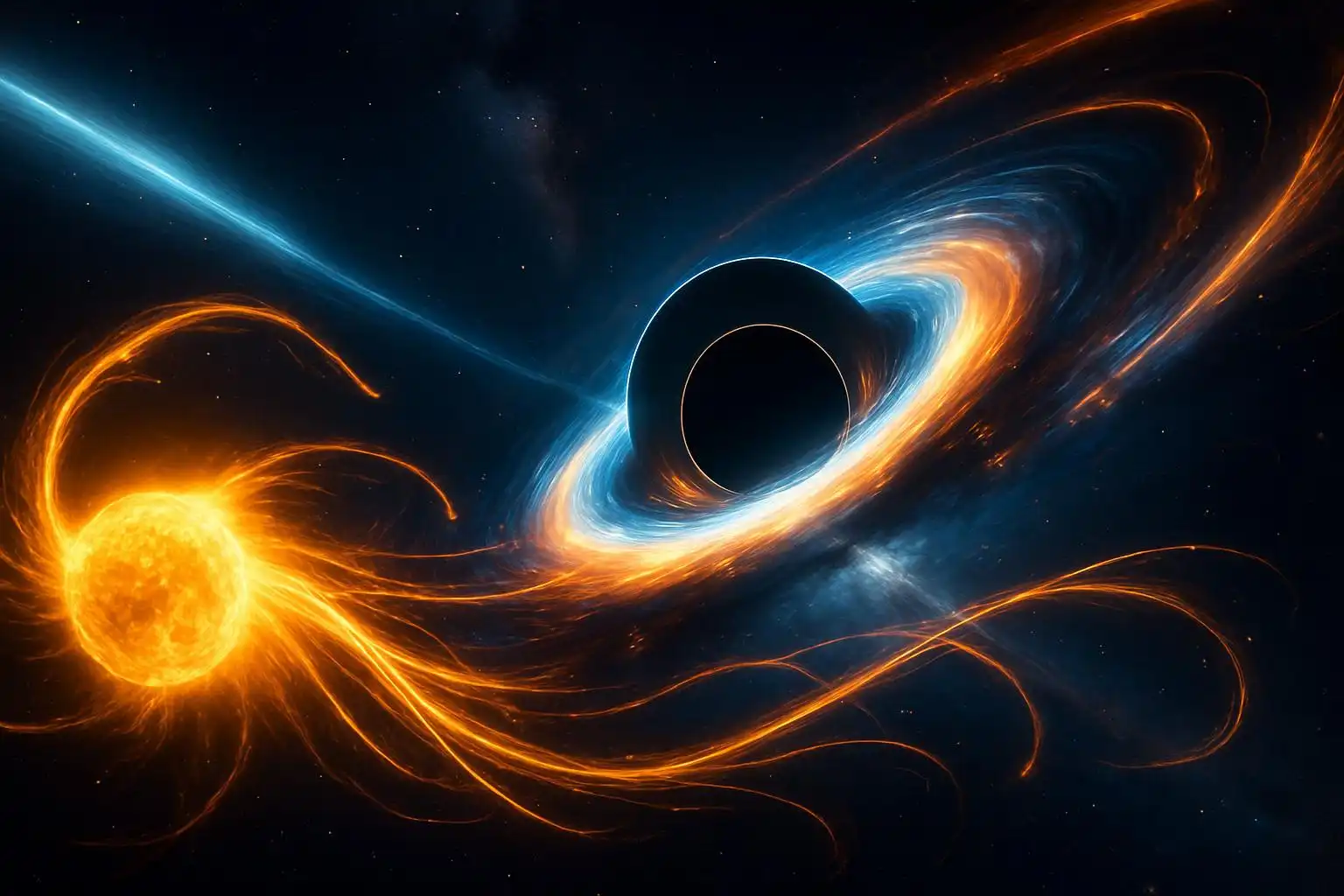

Let’s set the scene. It’s the fourth quarter. The crowd is on its feet. And a star — a perfectly ordinary, hydrogen-burning, billions-of-years-old star — just made the catastrophic mistake of wandering too close to a supermassive black hole. What happens next makes every highlight reel you’ve ever seen on SportsCenter look like a slow Tuesday afternoon at the DMV.
This is a tidal disruption event, or TDE. And if you’ve never heard of one, buckle up, because the universe just one-upped every action movie you’ve ever loved.
The Setup: A Star Takes a Wrong Turn
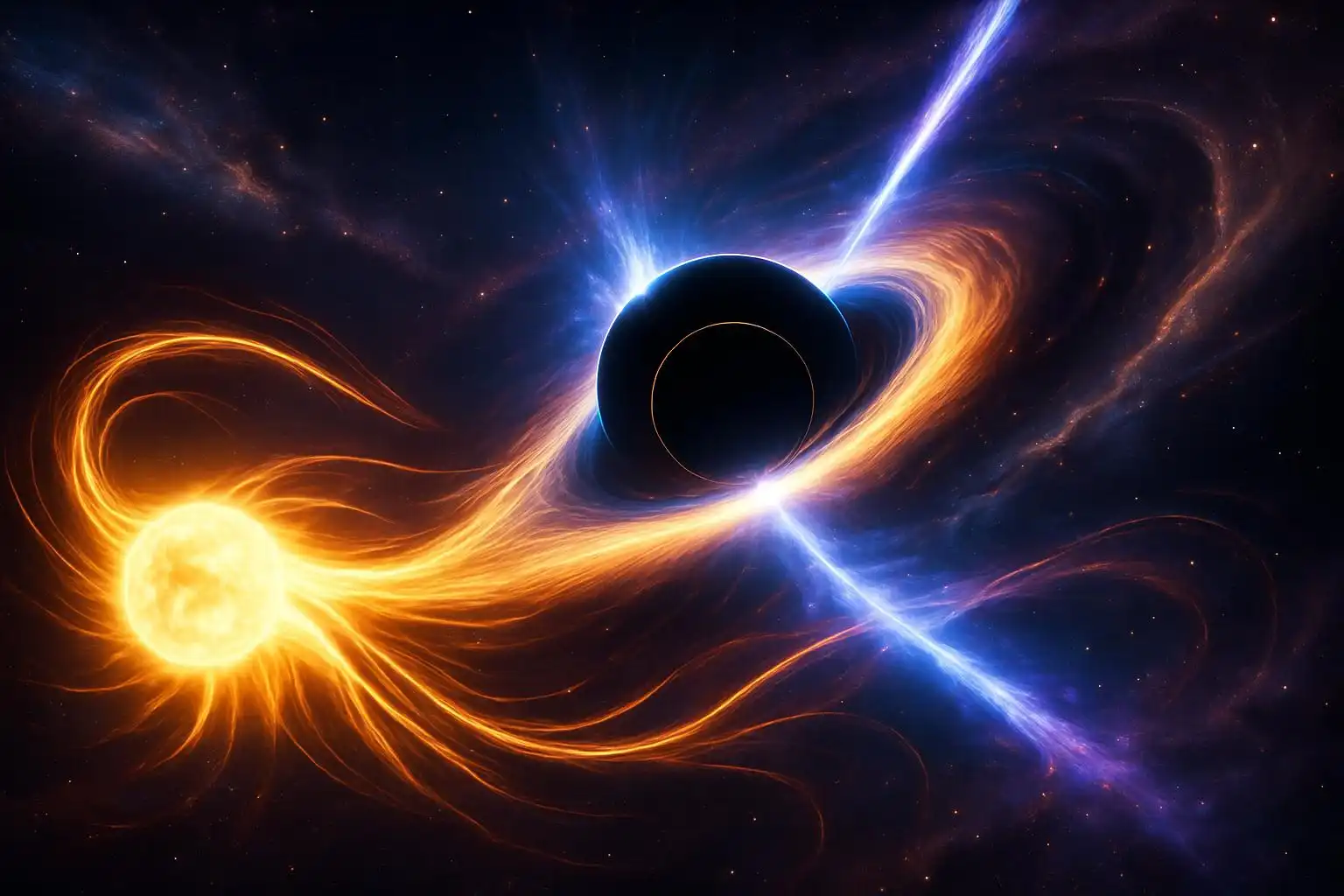
Picture a star about the size of our Sun — roughly 1.4 million kilometers across, glowing at about 5,500 degrees Celsius on its surface, minding its own business in the outskirts of a galaxy. Now picture a supermassive black hole sitting at the galaxy’s center, weighing in at, say, a few million solar masses. That black hole has a gravitational reach that would make a defensive lineman jealous.
Due to gravitational perturbations — basically, the cosmic equivalent of getting nudged into traffic — the star drifts onto a trajectory that brings it too close to the black hole. We’re talking within the tidal radius, the point at which the black hole’s gravitational pull on the near side of the star is so much stronger than the pull on the far side that the star simply cannot hold itself together.
The technical term for what happens next is spaghettification. Yes, that is the real scientific term. Astronomers named it that on purpose, and I respect every one of them for it.
The Hit: Spaghettification and the Flare
The star gets stretched — radially, along the direction toward the black hole — and compressed laterally, like cosmic pasta. In a matter of hours to days (depending on the mass of the black hole and the star’s orbital trajectory), roughly half the stellar material gets flung outward into space, and the other half spirals inward toward the black hole in a long, thin stream.
That infalling stream of stellar gas wraps around the black hole, collides with itself, shocks, heats up to tens of millions of degrees, and produces a luminous flare that can briefly outshine the entire host galaxy. We’re talking about a single event — one star getting destroyed — producing more light than 100 billion suns combined. For weeks. Sometimes months.
This is the cosmic highlight reel moment. If you want a movie comparison: remember the gravity wave sequence in Interstellar, where the planet Miller orbits Gargantua so closely that one hour equals seven years on Earth? That’s tidal gravity doing slow, time-dilating work. A TDE is tidal gravity doing fast, catastrophic, star-shredding work. Same physics. Completely different vibe.
The Stats: These Numbers Are Absurd
Let me give you some numbers, because the numbers are genuinely unhinged.
The black hole at the center of our own Milky Way — Sagittarius A*, the one the Event Horizon Telescope imaged in 2022 — has a mass of about 4 million solar masses. Its tidal radius for a Sun-like star is roughly 100 million kilometers. That sounds like a lot, but it’s only about two-thirds the distance from Earth to the Sun. In galactic terms, that’s nothing. That’s a rounding error.
Now here’s the kicker: astronomers estimate that in a galaxy like ours, a TDE occurs roughly once every 10,000 to 100,000 years. That sounds rare. But there are hundreds of billions of galaxies in the observable universe, which means right now, as you are reading this sentence, a tidal disruption event is probably happening somewhere in the cosmos. A star is being spaghettified. Somewhere. Right now.
You’re welcome for that image.
The Plays We’ve Actually Seen
We’ve been cataloguing TDEs in earnest since the late 1990s, and the roster is growing fast. Some fan favorites:
AT2019qiz — Discovered in 2019, this TDE was caught early enough that astronomers could watch the flare build in real time, like watching a star get tackled in slow motion. It became one of the best-characterized TDEs ever observed and provided strong evidence that the flare comes from the stellar debris stream shocking itself, lending support to the stream-stream collision model over a pre-existing accretion disk. Science, in action.
ASASSN-15lh — For a while, this 2015 event was classified as the most luminous supernova ever detected. Then people looked closer. It may be a TDE, though its true nature has remained genuinely contested, with both TDE and superluminous-supernova interpretations argued in the literature. Nothing unites and divides astrophysicists like an event that refuses to be categorized neatly. (We love it and we hate it.)
AT2022cmc — This one produced a relativistic jet — a beam of plasma fired from the black hole’s poles at close to the speed of light, pointed almost directly at Earth. We detected it in gamma rays, in X-rays, in radio waves. It was like the black hole looked straight at us after the meal and said, you saw that. We did. We absolutely did.
The Physics Under the Hood
Here’s where it gets even wilder, if you can believe it.
The exact mechanism by which the infalling debris produces that spectacular flare is still being debated. There are two main camps:
-
Stream-stream collisions: The debris stream wraps around the black hole, and the leading edge collides with the trailing material. The collision shocks the gas, heats it up, and produces radiation. This is the model AT2019qiz strongly supports.
-
Disk reprocessing: The debris quickly circularizes into an accretion disk, and the disk’s radiation gets reprocessed by an outer envelope of gas, shifting it to the optical and UV wavelengths we observe. Think of it like the black hole wearing a lampshade — the inner brightness gets softened and redistributed.
The truth is probably some combination of both, varying by event. The universe, as always, refuses to be simple.
What we do know is that the jets — when they form — are thought to arise from the black hole’s spin interacting with the magnetic fields in the accreting material via the Blandford-Znajek mechanism, currently the leading theoretical model. The black hole’s rotation essentially winds up the magnetic field lines like a cosmic drill bit and launches plasma at relativistic speeds. The physics is elegant. The result is a beam of energy that would sterilize anything in its path across thousands of light-years.
Good thing AT2022cmc’s jet was pointed at us from about 8.5 billion light-years away. Distance: the universe’s best safety feature.
Why This Matters Beyond the Spectacle
TDEs aren’t just the universe’s greatest highlight reel. They’re also one of our best tools for studying black holes that would otherwise be completely invisible to us.
Most supermassive black holes — including Sagittarius A* — are quiescent. They’re not actively feeding. They’re just sitting there, doing black hole things, warping spacetime, not giving us much to look at. A TDE is like a spotlight suddenly switching on. For weeks or months, we get to study the black hole’s mass, spin, and environment in detail we’d never otherwise have access to.
It’s also one of the key ways we think intermediate-mass black holes — the missing link between stellar-mass black holes (a few to a few dozen solar masses) and supermassive ones (millions to billions) — might eventually be confirmed. If we catch a TDE in a globular cluster or a dwarf galaxy with no known central black hole, that’s our smoking gun.
And then there’s the gravitational wave angle. Future space-based detectors like LISA (the Laser Interferometer Space Antenna, currently planned for the 2030s) may be able to detect the gravitational wave signal from extreme mass-ratio inspirals — essentially, a compact object spiraling into a supermassive black hole in a slow-motion TDE-adjacent process. We’re building the instruments to hear the universe do this in real time.
The Scoreboard
So let’s recap the final stats of a tidal disruption event:
- One star: destroyed in hours to days
- Energy released: can rival or exceed the total energy our Sun will emit over its entire 10-billion-year lifetime
- Peak luminosity: up to 100 billion times the Sun, briefly outshining the host galaxy
- Jet velocity (when present): up to 99.5% the speed of light
- Frequency: roughly once per 10,000–100,000 years per galaxy
- Cool factor: immeasurable
Somewhere out there, a star just had the worst day in its multi-billion-year life. A black hole had lunch. And for a few glorious weeks, that galaxy lit up like a stadium at the Super Bowl — except the stadium is a trillion kilometers wide and the halftime show is a relativistic jet pointed at your face.
Next time you look up at a galaxy in the night sky — even just the smudge of the Andromeda Galaxy, visible to the naked eye on a clear night — know that somewhere in there, the physics is cooking. Stars are wandering. Black holes are waiting. And the universe is always, always, working on its next highlight.
Tell someone about it.



Leave a Reply