
At the center of the Milky Way, roughly 26,000 light-years away in the direction of Sagittarius, there is a black hole with a mass of about four million suns. We know this not from theory alone, but from watching stars move. Specifically, from watching a star called S2 sweep around an invisible point at speeds exceeding 7,000 kilometers per second, tracing an ellipse so tight that its closest approach — periapsis — brings it within 120 AU of the event horizon’s gravitational dominion. That measurement, and the extraordinary instrument behind it, is what this article is about.
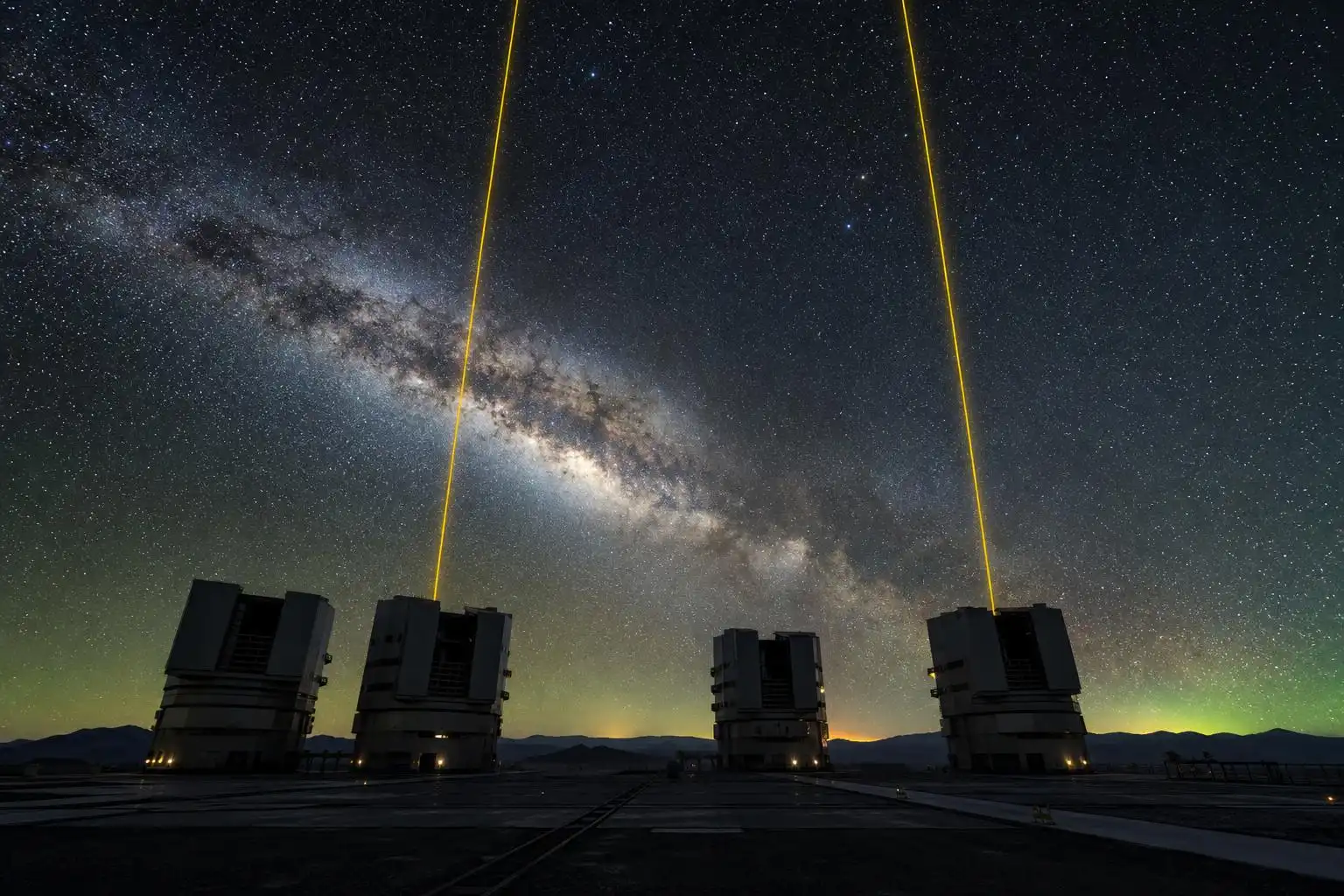
The instrument is GRAVITY, a second-generation beam combiner at ESO’s Very Large Telescope Interferometer (VLTI) on Cerro Paranal, Chile. It operates in the K band, roughly 2.0–2.4 microns, and it does something that would have seemed implausible two decades ago: it combines the light from all four Unit Telescopes — each 8.2 meters in diameter, separated by baselines up to 130 meters — into a single coherent interference pattern, then uses that pattern to measure positions on the sky to an astrometric precision of around 10 microarcseconds. To put that number in human terms: 10 microarcseconds is the angle subtended by a human hair viewed from about 10,000 kilometers away. It is the angle a star at the Galactic Center moves in roughly two weeks of orbital motion.
Why Interferometry, and Why K Band?
The angular resolution of a single telescope is set by the ratio of wavelength to aperture: θ ≈ λ/D. For an 8.2-meter telescope at K band (λ ≈ 2.2 μm), that works out to about 55 milliarcseconds — good, but nowhere near sufficient to resolve the orbital motion of S2 in fine detail, let alone to detect the relativistic precession of its orbit. Interferometry replaces D with the baseline between telescopes, stretching the effective aperture to 130 meters and pushing the fringe spacing down to about 3.5 milliarcseconds. But GRAVITY’s astrometric precision goes far beyond even that, because it doesn’t just measure fringes — it measures the phase of those fringes with extraordinary stability by simultaneously observing a reference source (in this case a nearby bright infrared star such as IRS 16C) and the science target on the same detector, in the same optical train, at the same moment.
K band is the right choice for the Galactic Center for a simple reason: dust. The line of sight to Sgr A* passes through roughly 30 magnitudes of visual extinction — so much that the center is completely invisible at optical wavelengths. At 2.2 microns, extinction drops to about 2.5 magnitudes, making the region observable. The stars in the S-cluster, the dense group orbiting within a few arcseconds of Sgr A*, have K-band magnitudes ranging from about 14 to 17, faint but within reach of the combined collecting area of four 8.2-meter telescopes feeding a sensitive detector.
The Optical Architecture: Four Telescopes, One Coherence
Getting fringes from four telescopes simultaneously is not a matter of pointing them at the same object and hoping for the best. Light from each telescope must arrive at the beam combiner with path-length differences controlled to within a fraction of the coherence length — for K band with a bandwidth of roughly 0.3 microns, that coherence length is about 15 microns. Over a 130-meter baseline, atmospheric turbulence introduces path-length fluctuations that can be orders of magnitude larger than this, on timescales of milliseconds.
GRAVITY addresses this with two interleaved systems. First, each Unit Telescope is equipped with an adaptive optics system — MACAO (Multi-Application Curvature Adaptive Optics), with 60 actuators — that corrects wavefront errors within each telescope aperture, delivering a Strehl ratio of around 40–50% in K band under median Paranal seeing. This step is necessary but not sufficient: it sharpens each telescope’s image, but it doesn’t lock the relative phase between telescopes.
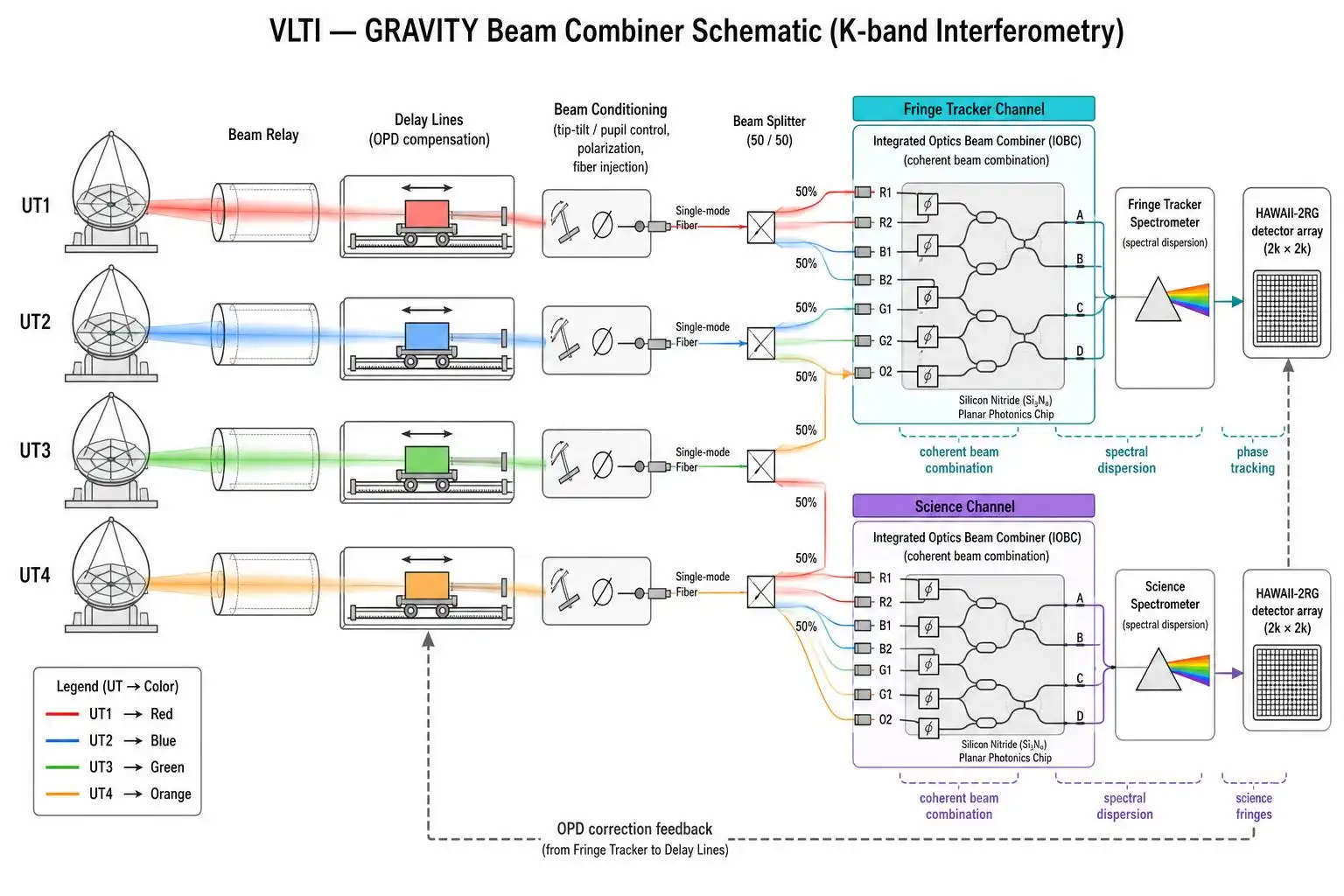
The second system is a fringe tracker called GRAVITY FT, which operates on a bright reference source (typically a star within a few arcseconds of the science target) at high speed — up to 1 kHz — and sends real-time corrections to piezo-driven delay lines that adjust the optical path lengths to keep the fringes stable. The science channel then integrates on the fainter target for up to 300 seconds, accumulating photons while the fringe tracker holds the interference pattern frozen. This division of labor — fast fringe tracking on a bright reference, slow integration on the science target — is what makes 10-microarcsecond astrometry possible.
The beam combiner itself is an integrated optics chip, a technology borrowed from telecommunications. Rather than routing beams through bulk optics and beam splitters, GRAVITY etches waveguides directly into a silica-on-silicon substrate, a few centimeters across. The four input beams enter the chip, are combined pairwise in a network of directional couplers, and the resulting six baseline outputs (from the six pairs among four telescopes) are dispersed by a spectrograph across a HAWAII-2RG detector — a 2048×2048 HgCdTe array with read noise below 10 electrons per read in its science channel. The spectral resolution is selectable: R ≈ 22 in low-resolution mode, or R ≈ 500 and R ≈ 4000 in medium and high resolution, the latter enabling detection of velocity shifts via the Doppler effect within individual spectral channels.
S2 and the Relativistic Payoff
S2 has an orbital period of about 16 years. GRAVITY began observing the S-cluster in 2016, and S2’s periapsis passage in 2018 became one of the most closely watched events in modern astrophysics. The collaboration published results that year confirming the detection of gravitational redshift in S2’s spectrum — the photons climbing out of Sgr A*’s gravitational well lose energy, shifting their wavelengths toward the red. Near periapsis, the combined relativistic signal (gravitational redshift plus transverse Doppler effect) amounts to about 200 km/s in equivalent radial velocity, superimposed on S2’s orbital Doppler shift of over 2,700 km/s. Disentangling the two required the spectral precision of GRAVITY’s high-resolution mode combined with independent radial velocity measurements from SINFONI, a VLT integral-field spectrograph.
More dramatically, in 2020 the GRAVITY Collaboration published the detection of Schwarzschild precession in S2’s orbit. In Newtonian gravity, a two-body orbit is a closed ellipse — periapsis always points in the same direction. In general relativity, the orbit precesses: the periapsis direction rotates by a small angle each orbit, the same effect that explains the anomalous precession of Mercury’s perihelion, scaled up enormously by the much stronger gravitational field. For S2, the precession amounts to about 12 arcminutes per orbit — tiny in absolute terms, but measurable with GRAVITY’s astrometric precision. The measured value agreed with the GR prediction to within the measurement uncertainties, ruling out alternative gravity theories that predict different precession rates and setting constraints on any extended mass distribution — dark matter, stellar remnants — within S2’s orbit at the level of a few thousand solar masses.
The Flares: Plasma Orbiting at the Last Stable Orbit
Sgr A* is not a static target. It flares in the near-infrared on timescales of hours, brightening by factors of a few to more than ten as clumps of plasma near the innermost stable circular orbit (ISCO) are heated and radiate. The ISCO radius for a non-spinning black hole is 3 Schwarzschild radii, or about 6 GM/c² — for Sgr A*’s mass, that corresponds to roughly 30 microarcseconds projected on the sky at 8 kpc distance. Plasma orbiting at the ISCO completes one revolution in about 30 minutes.
In 2018, GRAVITY detected the orbital motion of three infrared flares from Sgr A*, tracing loops on the sky with radii of about 150 microarcseconds and periods consistent with orbital motion near the ISCO. This was the first direct astrometric detection of matter moving in the immediate vicinity of a supermassive black hole — not inferred from spectral variability or light curves, but geometrically, as a position moving on the sky. The implied orbital radius places the emitting plasma close to, but outside, the ISCO for a Schwarzschild black hole, with the data mildly preferring a prograde orbit around a spinning (Kerr) black hole.
What GRAVITY+ Will Do
The current GRAVITY instrument is limited in part by the brightness of the fringe-tracking reference: it needs a source of K ≈ 10 or brighter within the isoplanatic patch (roughly 2 arcseconds in K band at Paranal) to lock the fringes. This restricts the accessible sky to fields with a conveniently bright nearby star. The upgrade program, GRAVITY+, addresses this by replacing MACAO with a new wide-field adaptive optics system on each Unit Telescope — 40×40 actuator deformable mirrors with laser guide stars, similar in concept to Keck’s LGS AO system but adapted for the VLTI’s four-telescope architecture. The new AO systems will push K-band Strehl ratios above 60% under median seeing and extend fringe tracking to references as faint as K ≈ 19, opening up extragalactic targets: active galactic nuclei, quasar broad-line regions, and binary black hole candidates at cosmological distances.
Among the early science enabled by GRAVITY, measurements of the broad-line region of the quasar 3C 273 — the first quasar ever identified, at redshift z = 0.158 — resolved the spatial extent of the gas moving around its central black hole, measuring a size of a few tens of microarcseconds and a black hole mass consistent with reverberation mapping estimates. This is interferometric astrometry applied not to our own Galactic Center but to a source 750 megaparsecs away.
The Engineering Discipline Behind the Result
It is worth pausing on what it takes to make any of this work. The delay lines that equalize the optical path lengths from each telescope to the beam combiner must hold their positions to nanometer precision over integration times of hundreds of seconds, while the telescopes themselves track across the sky and the atmosphere above them churns. The integrated optics chip must maintain stable coupling efficiency across the K band despite temperature fluctuations in the instrument. The HAWAII-2RG detector must be cooled to 77 K and read out fast enough for fringe tracking while accumulating science photons in a parallel channel. The data reduction pipeline must extract visibilities and closure phases from raw detector frames, calibrate them against reference sources observed minutes apart, and propagate uncertainties through to astrometric positions without introducing systematic errors larger than the 10-microarcsecond goal.
None of this is glamorous in the way that a first-light image is glamorous. But the 12-arcminute precession of S2’s orbit, the orbital loops of plasma near Sgr A*’s event horizon, the resolved broad-line region of a quasar at z = 0.158 — these results exist because engineers held optical path lengths to nanometers and physicists trusted the interference fringes they produced. That trust, earned through years of calibration and validation, is what turns four telescopes on a Chilean mountaintop into the most precise astrometric instrument humanity has ever pointed at the sky.



Leave a Reply