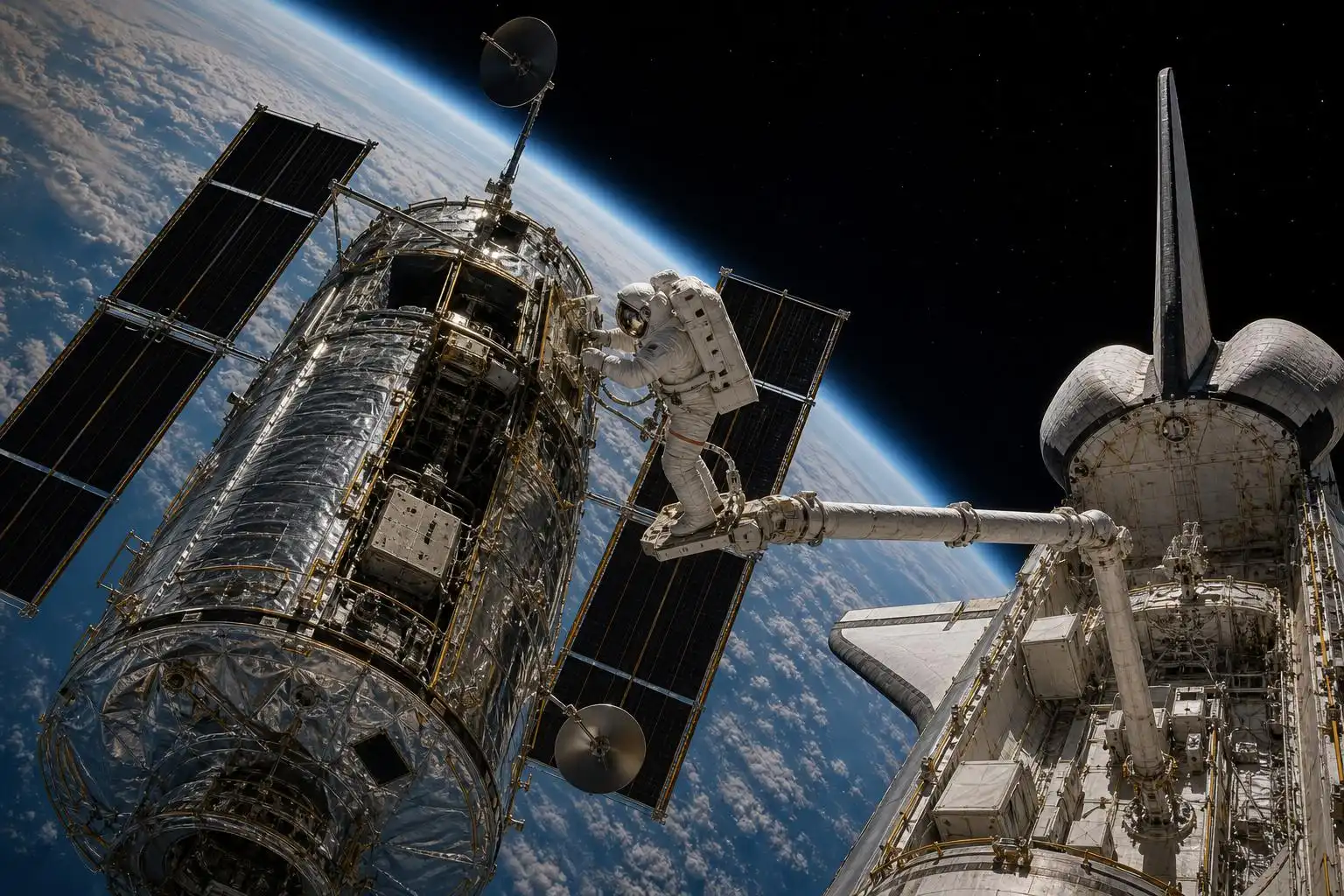

When the first images came back from the Hubble Space Telescope in June 1990, the mood at NASA’s Goddard Space Flight Center was not triumphant — it was quietly catastrophic. Stars that should have been pinpoints were surrounded by halos. The 2.4-meter primary mirror, ground to a precision of better than 10 nanometers RMS, was wrong. Not contaminated, not misaligned in a fixable way — wrong in its fundamental shape. A spherical aberration of just 2.2 micrometers, a flaw smaller than one-fiftieth the width of a human hair, had been polished in with exquisite accuracy. The null corrector used to test the mirror during fabrication had been assembled with one lens 1.3 millimeters out of position. The result was a $1.5 billion observatory that couldn’t focus.
What followed is one of the most dramatic engineering recoveries in the history of science — and it happened not once, but five times, across servicing missions that collectively redefined what humans could accomplish in low Earth orbit.
The Geometry of the Problem
To understand why Hubble was fixable at all, you have to understand why it was designed the way it was. From the beginning — from Lyman Spitzer’s 1946 paper proposing a large space telescope — the concept assumed human access. The Space Shuttle was the delivery mechanism, and Hubble was engineered with that in mind: handrails at regular intervals, modular instrument bays with standardized latches, components sized to fit through the payload bay doors. The telescope was, in a very real sense, designed to be serviced.
That design philosophy paid off in December 1993, when STS-61 carried seven astronauts to Hubble aboard the shuttle Endeavour. The fix for the spherical aberration was elegant in its indirection: rather than replace the mirror — an impossibility on orbit — engineers designed COSTAR (Corrective Optics Space Telescope Axial Replacement), a phone-booth-sized instrument containing small mirrors figured to introduce the exact opposite aberration. COSTAR’s mirrors were accurate to 5 nanometers. Simultaneously, the Wide Field and Planetary Camera 2 (WFPC2) was installed with corrective optics built directly into its relay mirrors.
The crew performed five spacewalks over eleven days. Across the mission, astronauts replaced the solar arrays, gyroscopes, and magnetometers, in addition to installing COSTAR. The work was meticulous — some bolts had seized in the thermal cycling of orbit, and the crew had to improvise. When the first corrected images came back in January 1994, the improvement was staggering: point-spread functions collapsed from arcsecond halos to the diffraction-limited 0.05-arcsecond resolution Hubble had always promised. The telescope had been reborn.
SM2: The Quiet Mission
Servicing Mission 2 in February 1997 is often overshadowed by the drama of SM1, but it was operationally significant. The crew of STS-82 installed the Space Telescope Imaging Spectrograph (STIS) and the Near Infrared Camera and Multi-Object Spectrometer (NICMOS). STIS covered a wavelength range from 115 to 1,000 nanometers and provided long-slit and spatially resolved spectroscopy — a massive gain in efficiency over its predecessor, the Faint Object Spectrograph.
NICMOS operated at near-infrared wavelengths (0.8–2.5 microns) using a solid nitrogen cryogen block to cool its detectors to around 58 Kelvin. The cryogen was expected to last roughly 4.5 years, but a thermal short — contact between the dewar and its surrounding structure — accelerated the boil-off. NICMOS went dark in January 1999, nearly two years early. It was a reminder that thermal management in space is never truly solved, only managed.
SM3A and 3B: Keeping the Lights On
By 1999, three of Hubble’s six gyroscopes had failed, putting the telescope into safe mode and suspending science operations entirely. SM3A, flown in December 1999, was a rescue mission: all six gyros replaced, a new computer installed, new voltage/temperature improvement kits added to the batteries. It was unglamorous work, the kind of mission that doesn’t generate press releases but keeps a $2 billion asset from becoming an orbiting paperweight.
SM3B in March 2002 brought the Advanced Camera for Surveys (ACS), which increased Hubble’s discovery efficiency by a factor of ten over WFPC2. ACS covered 202×202 arcseconds with its Wide Field Channel, using a mosaic of two 2048×4096 CCDs. It also brought a new cryocooler for NICMOS, replacing the depleted solid nitrogen with a closed-cycle mechanical cooler — a first for a space observatory instrument. The cryocooler dropped NICMOS detector temperatures to 77.1 Kelvin, close enough to restore most of its sensitivity.
The STIS Failure and the Near-Death of SM4
In August 2004, STIS suffered a power supply failure that took it completely offline. The timing was brutal: NASA had already announced, in the wake of the Columbia disaster, that SM4 was cancelled on safety grounds. Without shuttle flights to the International Space Station as a safe-haven option, Administrator Sean O’Keefe determined that a Hubble servicing flight was too risky. For two years, Hubble limped forward with ACS as its primary workhorse — until ACS itself suffered a short circuit in January 2007 that disabled its Wide Field Channel.
The political and scientific pressure to reverse the SM4 decision was immense. The astronomical community mobilized. A National Academy of Sciences report in 2004 argued for the mission’s restoration. O’Keefe’s successor, Michael Griffin, reversed the cancellation in 2006. SM4 — now carrying more hardware than any previous servicing mission — launched in May 2009 aboard Atlantis.
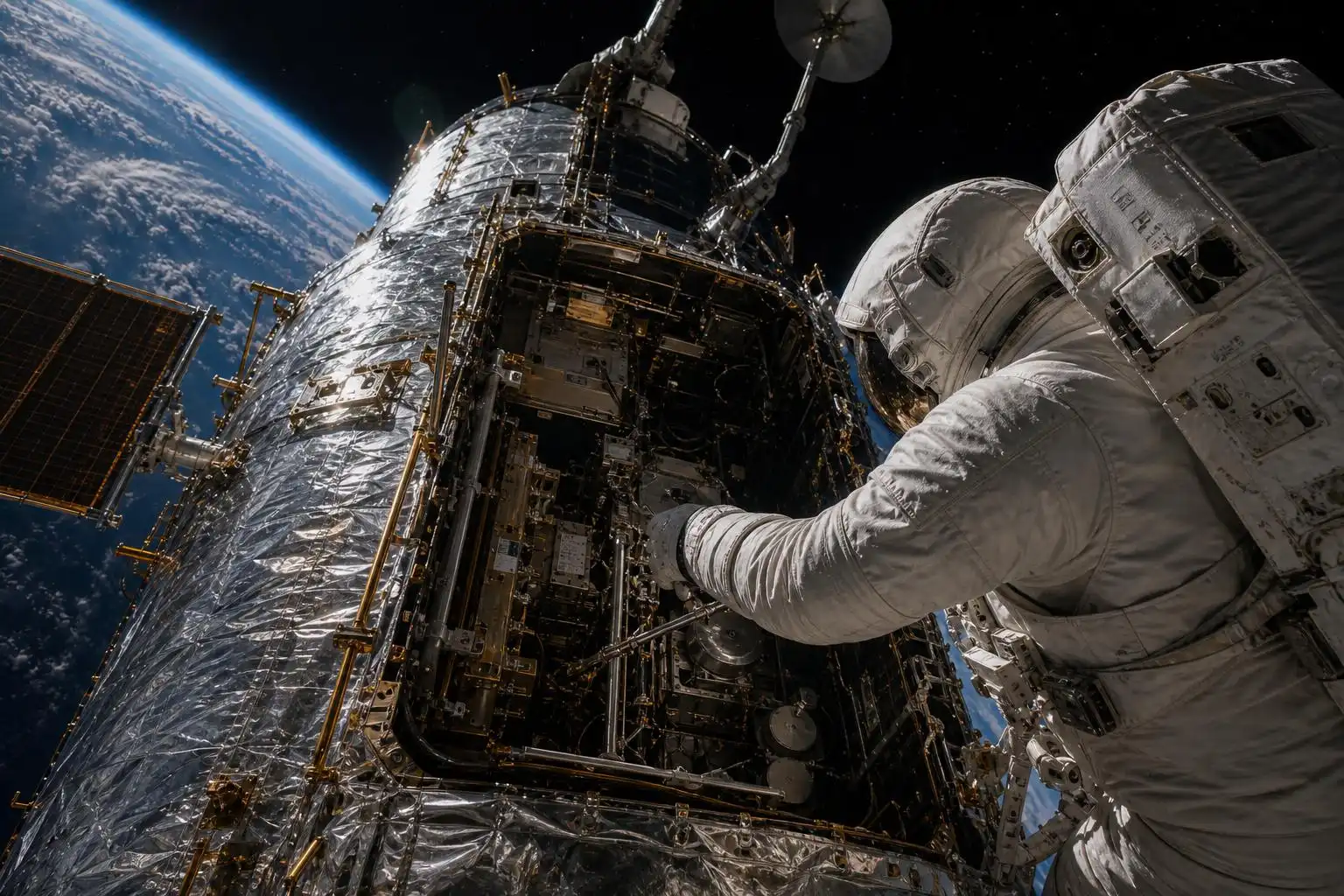
The crew repaired both failed instruments. STIS was repaired in orbit — a task never attempted before, requiring astronauts to remove 111 tiny screws from an access panel using a specially designed mini-power tool, then replace a circuit board inside a live instrument. The repair worked. ACS was also repaired in orbit. Wide Field Camera 3 (WFC3) replaced WFPC2, covering ultraviolet through near-infrared (200–1,700 nm) with a sensitivity roughly 35 times greater than its predecessor, and the Cosmic Origins Spectrograph (COS) replaced COSTAR. New gyros, new batteries, a soft-capture mechanism for eventual de-orbit, and a refurbished fine guidance sensor rounded out the manifest.
SM4 was the last. The shuttle fleet retired in 2011. There will be no SM5.
What Servicing Actually Costs
The five servicing missions cost, in aggregate, somewhere between $2.5 and $4 billion depending on how you allocate shuttle operations overhead. That sounds like a staggering sum until you consider what it bought: an observatory that launched in 1990 and is still returning science in the 2020s, with instruments that bear no resemblance to those it carried at first light. Hubble has been, in a meaningful sense, a different telescope on five separate occasions.
The engineering lesson is uncomfortable for those who prefer clean programmatic lines: serviceability costs money up front — in mass margins, in standardized interfaces, in handrail placements and bolt-torque specifications — but it can pay back that investment many times over. JWST, by contrast, was deliberately placed at L2 partly because its complexity made a servicing architecture impractical. Roman Space Telescope is not being designed for Hubble-style human servicing.
Pointing, Stability, and the Fine Guidance Sensors
One aspect of Hubble’s engineering that rarely gets the attention it deserves is its pointing system. The telescope must maintain pointing stability of 0.007 arcseconds RMS over a 24-hour period — roughly equivalent to holding a laser dot steady on a dime from 200 miles away. This is accomplished through a combination of reaction wheels, magnetic torquer bars, and the Fine Guidance Sensors (FGS), which lock onto guide stars with interferometric precision.
The FGS are not merely pointing tools. They are science instruments in their own right, capable of measuring stellar positions to better than 1 millisecond of arc and detecting the wobble induced by orbiting companions — effectively doing astrometry that rivals ground-based interferometry. When one FGS was replaced during SM4, the replacement unit was actually a refurbished sensor from an earlier mission — a piece of hardware that had already been to space, returned, refurbished, and flown again. That kind of logistics chain doesn’t exist for any other space observatory.
The Thermal Cycling Reality
Every 97 minutes, Hubble crosses the terminator between Earth’s sunlit and dark hemispheres. The temperature swings from roughly +100°C to -100°C on external surfaces. Over 35 years, that’s more than 180,000 thermal cycles. The solar arrays — replaced twice — were the most visibly affected components, developing a characteristic “jitter” as they thermally flexed during each transition, briefly disturbing the pointing. The replacement arrays installed during SM3B used a different blanket material that reduced the jitter significantly.
The outer shell, the light baffle, the handrails — all of it has been cycling through 200-degree temperature swings for three and a half decades. Materials fatigue. Lubricants migrate. Coatings degrade. The fact that Hubble continues to function is partly a tribute to its original design margins and partly a tribute to the crews who replaced components before they failed catastrophically.
What Comes After
Hubble’s gyroscopes are failing again. In 2024, the telescope entered a reduced-science mode using only one gyro, limiting its sky coverage and scheduling flexibility. There will be no mission to replace them. The plan is to operate in single-gyro mode for as long as possible — potentially into the 2030s — before a controlled de-orbit, likely assisted by a commercial spacecraft using the soft-capture mechanism installed during SM4.
It is a quiet ending for a telescope that has never had a quiet moment. From the spherical aberration crisis to the STIS power failure to the ACS short circuit, Hubble has been a continuous exercise in engineering problem-solving under the constraint that your workshop is 340 miles above the ground, traveling at 17,500 miles per hour, and you get maybe eleven days to work before the shuttle has to come home.
The images — the Pillars of Creation, the Hubble Deep Field, the expansion rate of the universe encoded in Cepheid distances — are the science. But the engineering is the story of what it actually takes to do science in space: not just building the instrument, but keeping it alive, fixing it when it breaks, and knowing when to let it go.


Leave a Reply