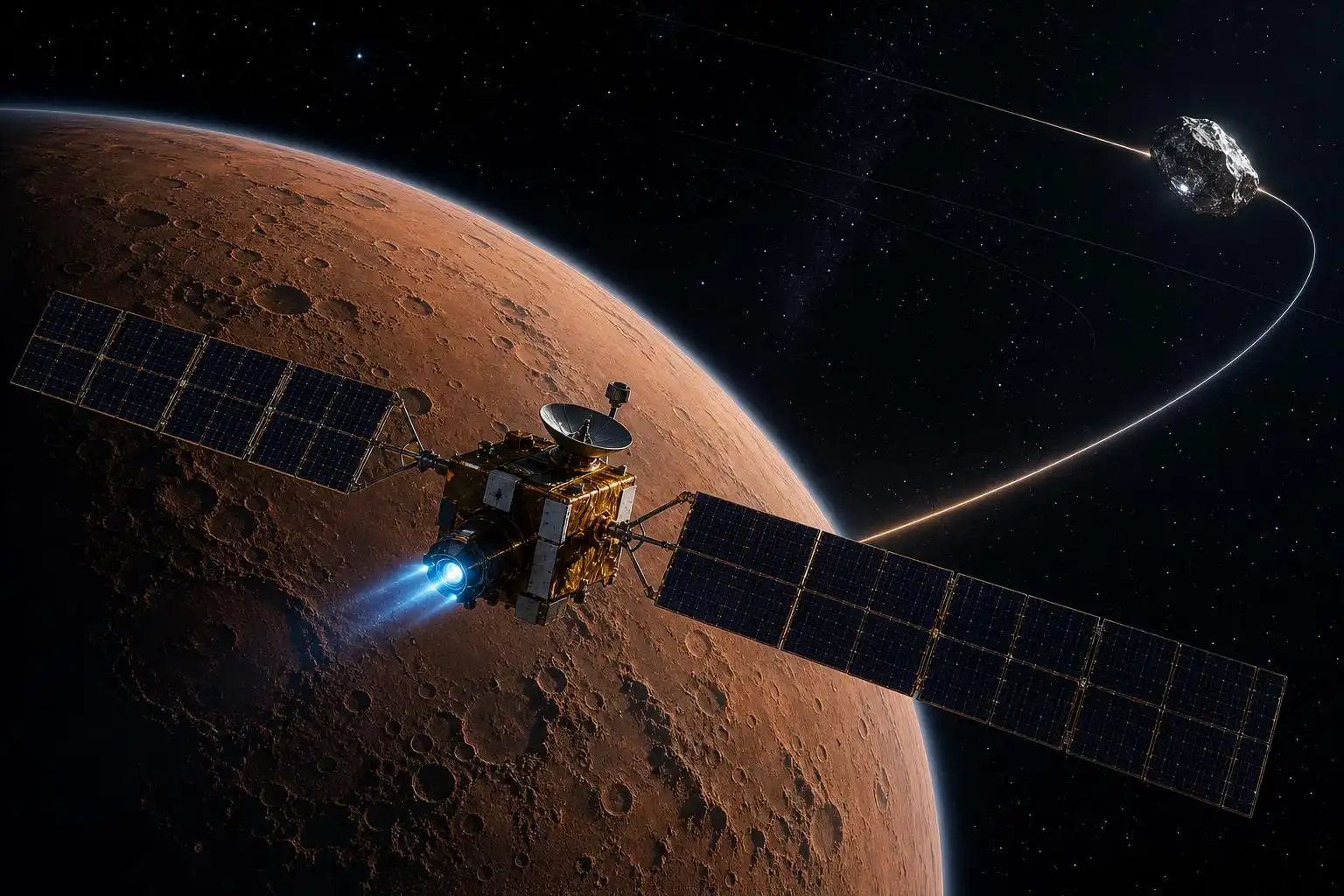

On May 15, 2026, NASA’s Psyche spacecraft swept within 4,609 kilometers of Mars — close enough that the planet’s gravity bent its trajectory without burning a drop of propellant [6]. The multispectral imager caught a crisp portrait of the double-ring crater Huygens and the ancient, battered southern highlands below. It was a beautiful postcard, but the real point of the encounter was mechanical: Mars handed Psyche a velocity boost and a plane change that no onboard thruster could have managed as efficiently, redirecting the spacecraft toward a rendezvous with asteroid (16) Psyche in August 2029. That arrival, three years away as of this writing, could rewrite what we know about the iron hearts of rocky planets — including our own.
A Gravity Slingshot Across the Inner Solar System
Gravity assists are one of the oldest tricks in the interplanetary playbook. Mariner 10 used Venus in 1974 to reach Mercury; Cassini looped past Venus twice and Earth once before arriving at Saturn in 2004. The principle is the same each time: a spacecraft flies close enough to a massive body that it steals a tiny fraction of that body’s orbital momentum. The planet barely notices; the spacecraft accelerates dramatically.
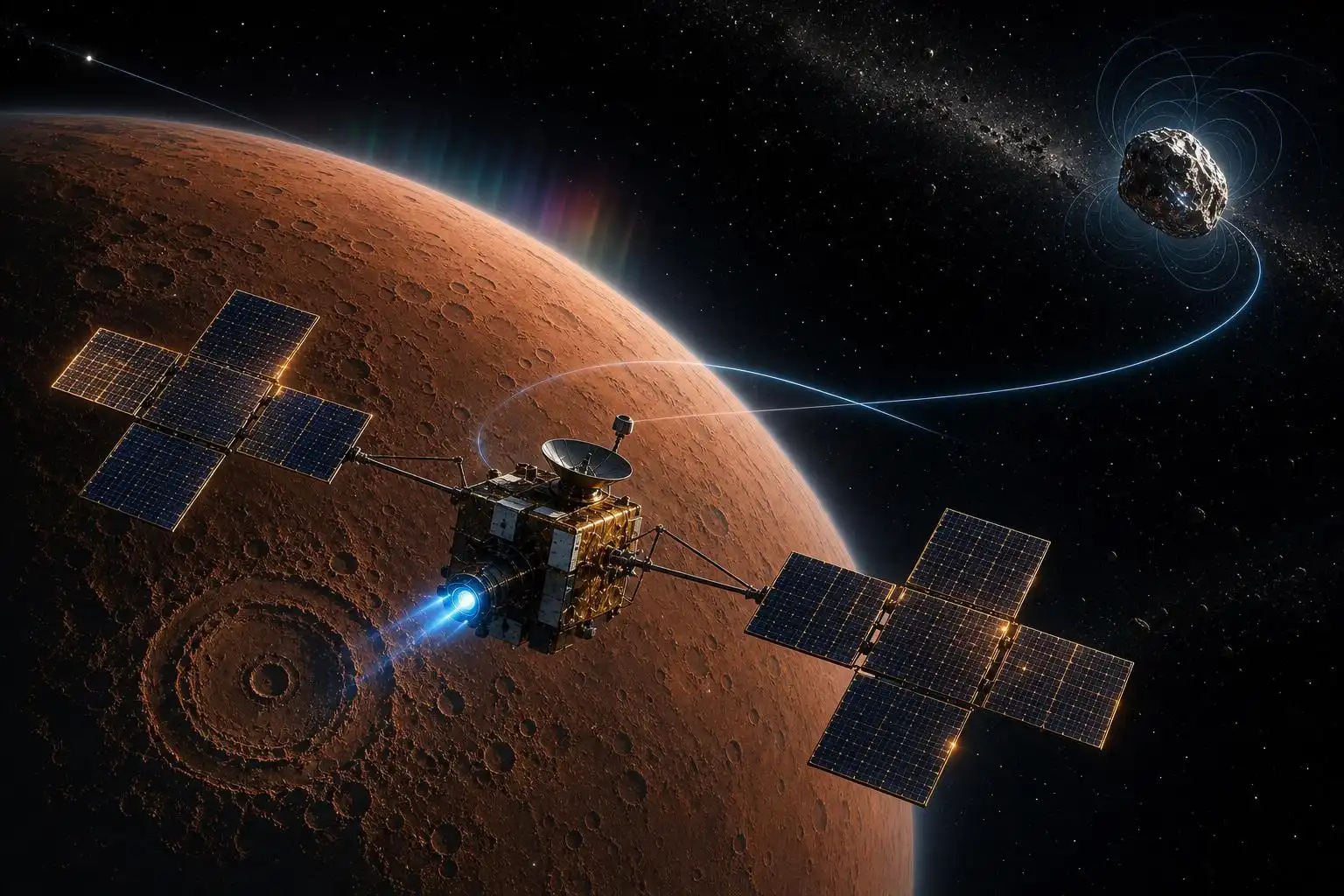
For Psyche, the Mars flyby served a dual purpose. The boost in speed is the obvious one — the spacecraft needed more velocity to climb out toward the asteroid belt, which orbits between roughly 2.2 and 3.2 astronomical units from the Sun. But the orbital plane adjustment was arguably just as important. Earth orbits the Sun in a plane called the ecliptic; asteroid Psyche orbits at a slight tilt relative to it. Getting a spacecraft from one plane to the other by firing engines is expensive in terms of propellant. Letting Mars do the work for free is elegant engineering.
The image returned from the flyby isn’t just a public relations moment, either. Psyche’s multispectral imager — the same instrument that will map the asteroid’s surface in multiple wavelengths — got a real-target calibration opportunity. Mars is a well-characterized world. Scientists know its surface colors, mineral signatures, and albedo in extraordinary detail from decades of orbiters. Running the imager over Martian terrain while the data can be cross-checked against known values is the kind of in-flight validation that gives instrument teams confidence before they arrive somewhere genuinely unknown.
What Is Asteroid Psyche, Really?
The target of all this effort is one of the most unusual objects in the solar system. Asteroid (16) Psyche, roughly 280 kilometers across at its widest, has a density and radar reflectivity that suggest it is extraordinarily rich in metal — possibly iron and nickel, the same materials that make up Earth’s core. One leading hypothesis holds that Psyche is the exposed metallic core of a planetesimal, a small proto-planet that formed in the early solar system and was then stripped of its rocky mantle by one or more violent collisions [6].
If that hypothesis is correct, Psyche would be the only place in the solar system where we can look directly at what the inside of a rocky planet looks like — no drilling required, no kilometers of mantle and crust to penetrate. Earth’s core lies nearly 6,400 kilometers beneath our feet, forever inaccessible to direct sampling. Psyche might be a core that the solar system has already excavated for us.
The alternative hypotheses are nearly as interesting. Some models suggest Psyche is not a stripped core at all, but rather a primitive body that accreted metal-rich material in the early solar system without ever differentiating in the conventional sense. Or it could be something in between — partially differentiated, with patches of silicate rock mixed into a predominantly metallic structure. The spacecraft’s instrument suite is designed to distinguish between these possibilities, and the distinction matters enormously for understanding how planets are built.
The Instrument Suite That Will Settle the Question
When Psyche arrives at the asteroid in August 2029, it will carry four core science instruments, each targeting a different aspect of the mystery.
The multispectral imager, already tested at Mars, will map the surface in multiple wavelength bands from visible light through near-infrared. Different minerals absorb and reflect light at characteristic wavelengths, so the imager will build a mineralogical map of the surface — telling scientists where metal concentrates, where silicate patches might appear, and whether the surface composition is as uniform as a stripped core would suggest or as patchy as a partially differentiated body might be.
The gamma-ray and neutron spectrometer, called GRNS, will do something the imager cannot: it will probe the bulk elemental composition of the top meter or so of the asteroid’s surface. High-energy cosmic rays constantly bombard the asteroid, and when they strike the surface material they trigger nuclear reactions that release characteristic gamma rays and neutrons. Different elements — iron, silicon, magnesium, hydrogen — produce distinct signatures. GRNS essentially reads those signatures the way a chemist reads a spectrum, building up an elemental inventory of the asteroid’s outer layer. If Psyche really is an iron-nickel core, GRNS should see iron dominating the signal with very little silicon or magnesium. A more mixed composition would tell a different story.
The magnetometer is perhaps the most philosophically interesting instrument on board. Planetary cores generate magnetic fields through a dynamo process — convecting liquid metal driven by heat and rotation. If Psyche was once the core of a differentiated planetesimal, it may have had its own dynamo, and the rocks at its surface might preserve a frozen record of that ancient magnetic field, the way magnetized minerals in Earth’s ocean crust record the history of our planet’s field reversals. The magnetometer will measure the asteroid’s current magnetic field to see whether any remnant magnetism survives. A strong, organized remnant field would be powerful evidence for the stripped-core hypothesis; a weak or chaotic one would complicate the picture.
Finally, the radio science investigation will use the spacecraft’s communication system itself as a science instrument. By tracking tiny Doppler shifts in the radio signal between Psyche and Earth’s Deep Space Network antennas, scientists can reconstruct the asteroid’s gravity field in fine detail. The gravity field reveals how mass is distributed inside the body — whether the interior is uniform, layered, or lumpy. Combined with the surface maps from the imager and the elemental data from GRNS, the gravity map will let scientists build a three-dimensional model of Psyche’s interior structure.
August 2029: A Crowded Calendar for Asteroid Science
Here is a striking coincidence worth pausing on: Psyche arrives at its metal asteroid in August 2029, just four months after another major asteroid encounter that will dominate the news cycle that spring.
On April 13, 2029 — a Friday, as it happens — the roughly 375-meter asteroid Apophis will sweep past Earth at a distance of just 32,000 kilometers, closer than the satellites in geosynchronous orbit [1]. ESA’s Ramses mission, launching in 2028 and built by prime contractor OHB Italia with JAXA contributing lightweight solar arrays, an infrared imager, and launch aboard an H3 rocket, will accompany Apophis through that close approach, watching Earth’s gravity reshape the asteroid’s surface and alter its rotation state in real time. (I wrote about Ramses in detail last month, so I won’t retread all of that ground here — but the timing is worth noting.)
The point is that 2029 will be, by any measure, a landmark year for asteroid science. Apophis will show us what tidal forces do to a rubble-pile asteroid during a close planetary encounter. Psyche will show us what the remnant core of a long-dead proto-planet looks like up close. These are completely different questions, but together they bracket the range of what asteroids can be: loosely bound collections of rock and dust at one end, and dense metallic survivors of planetary catastrophe at the other.
Why It Matters for Planetary Defense and Planet Formation
There is a tendency to treat asteroid missions as exotic curiosities — interesting, certainly, but disconnected from anything that affects daily life. The planetary defense argument pushes back on that. To deflect an asteroid that actually threatens Earth, you need to know what it is made of and how it is held together. A solid iron body behaves completely differently under a kinetic impactor than a rubble pile does. The DART mission demonstrated kinetic impactor deflection on the rubble-pile asteroid Dimorphos in 2022, and Hera is currently en route to characterize the aftermath. Psyche will add the metallic end-member to that growing library of asteroid types.
The planet formation argument is perhaps more profound. Every rocky planet in the inner solar system — Mercury, Venus, Earth, Mars — has a metallic core that we cannot directly sample. We infer their properties from seismology, from moment-of-inertia measurements, from the behavior of magnetic fields. Psyche, if it really is an exposed core, is the closest thing to a ground-truth check that the solar system offers. The GRNS data, the magnetometer readings, and the gravity maps will feed directly into models of how Earth’s own core formed and evolved. That is not a small thing.
The Mars flyby on May 15 was a single image and a trajectory adjustment. But it marks the moment Psyche stopped being an Earth-departure mission and became an asteroid-approach mission. The clock to August 2029 has started.



Leave a Reply