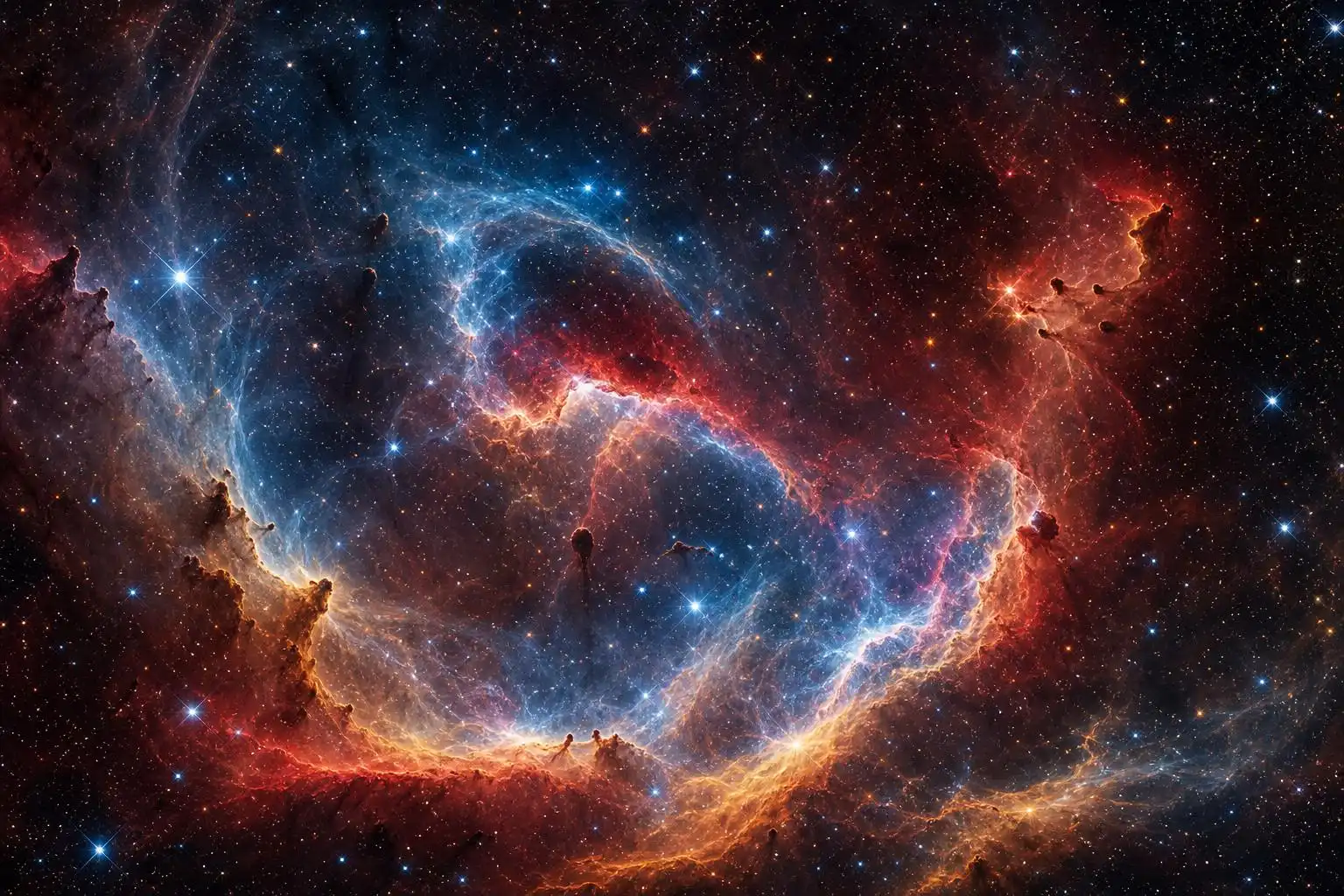

There is a fact that scientists have known for decades, one that gets repeated so often it has nearly lost its power to astonish: almost every atom heavier than hydrogen in your body was forged inside a star that died before our Sun was born.
Read that again. Not inspired by stars. Not connected to stars in some poetic, metaphorical sense. The calcium in your bones. The iron threading through your blood. The oxygen filling your lungs right now as you read this sentence. All of it was cooked in the nuclear furnace of a star, scattered into space when that star died, drifted through the cold dark for millions of years, and eventually — improbably, magnificently — ended up as you.
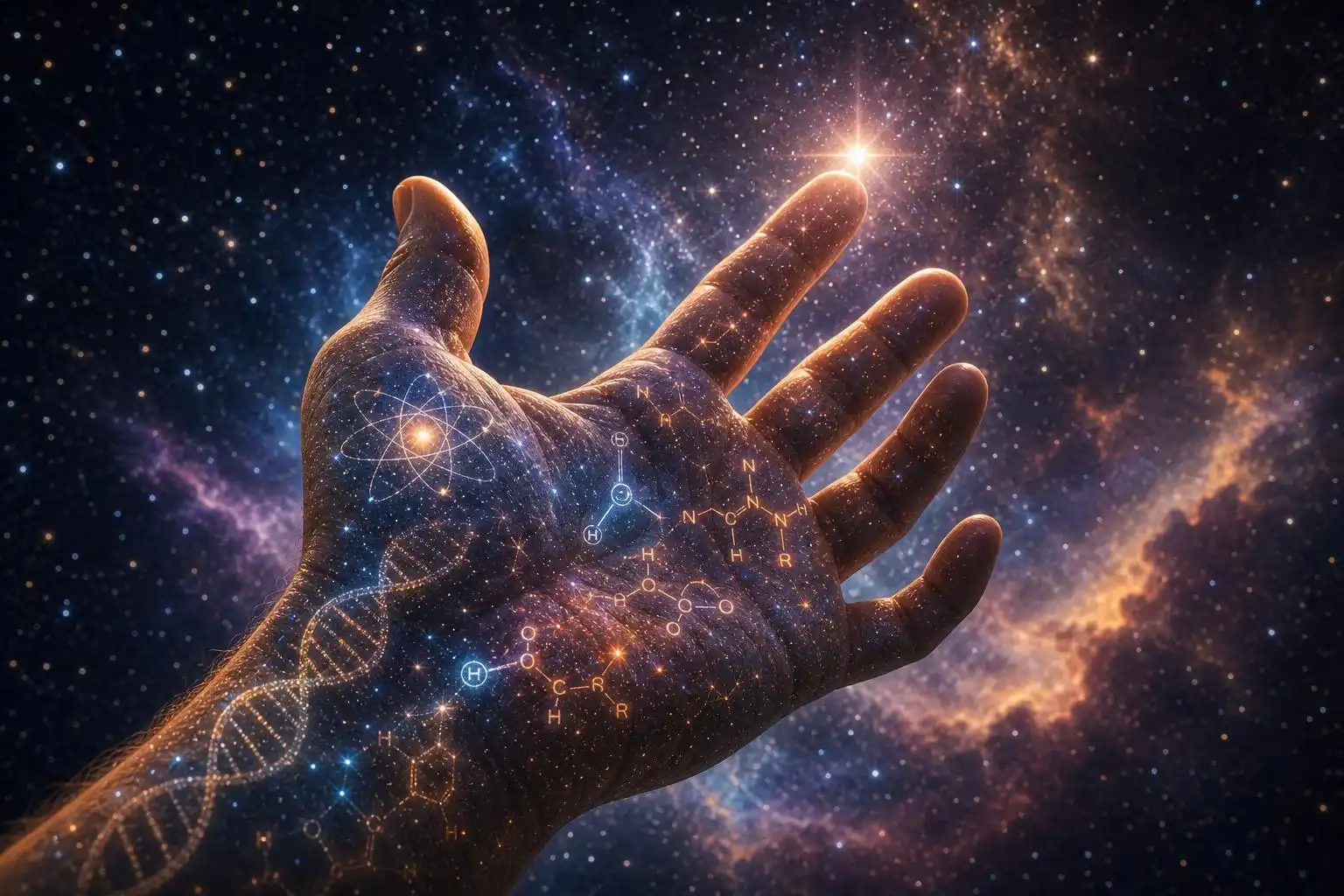
This is not a metaphor. This is chemistry. And I think most of us have never really let it land.
The Universe Starts With Almost Nothing Useful
To appreciate what stars did for you, you have to understand what the universe looked like before them.
In the first few minutes after the Big Bang, the cosmos was a seething plasma of unimaginable heat. As it cooled, protons and neutrons snapped together to form the simplest atomic nuclei: hydrogen (one proton), helium (two protons), and a tiny smattering of lithium (three protons). That’s it. That is the entire periodic table that the early universe managed to produce.
Hydrogen and helium are wonderful things, but you cannot build a nervous system out of them. You cannot make bone, or muscle, or the enzymes that let your cells convert food into motion. For life as we understand it, you need carbon, nitrogen, oxygen, phosphorus, sulfur, iron — elements that sit much further along the periodic table. Elements the Big Bang never made.
The universe was, in its infancy, chemically impoverished. A vast ocean of gas with almost nothing interesting in it.
Stars changed that.
What Stars Actually Do (In Human Terms)
A star is, at its core, a pressure cooker — one so extreme that it forces atomic nuclei to fuse together into heavier elements. Our Sun, right now, is converting about 600 million tons of hydrogen into helium every single second. That reaction releases the energy that warms your face on a summer afternoon.
But our Sun is a modest, middle-aged star. It will never get hot enough in its core to fuse anything heavier than carbon and oxygen. The really interesting elements — the ones that end up in your hemoglobin and your DNA — require stars far more massive than ours. Stars ten, twenty, fifty times the Sun’s mass.
In those giants, gravity squeezes the core so hard that the nuclear reactions don’t stop at helium. Carbon fuses into neon. Neon fuses into oxygen. Oxygen fuses into silicon. And silicon, in a final frantic burst lasting just a few days, fuses into iron.
Iron is the end of the road. Fusing iron costs energy rather than releasing it, so the star’s core suddenly has nothing left to push back against gravity. In less than a second — a fraction of a second, actually — a core the size of Earth collapses to a ball roughly 20 kilometers across. The resulting shockwave tears the star apart in a supernova explosion so bright it can briefly outshine an entire galaxy of 200 billion stars.
And in that explosion, all those elements — carbon, oxygen, nitrogen, iron, and dozens of others — are flung into space.
The Long Journey to Becoming You
Here is where the story gets almost unbearably patient.
Those atoms don’t rush to become you. They drift. They wander through interstellar space for millions, sometimes hundreds of millions, of years. They get caught up in clouds of gas and dust. They clump together. Eventually, enough material accumulates in one place that gravity takes over and a new star — our Sun — ignites at the center of a swirling disk of debris.
That disk is where planets form. And on one particular planet, at just the right distance from just the right star, some of those ancient stellar atoms find themselves in liquid water. Then in organic molecules. Then in the first self-replicating strands of chemistry we’d eventually call life.
Four billion years later, those atoms are reading an article on the internet.
The iron in your blood was almost certainly forged in a star that exploded more than five billion years ago — before our solar system existed. The calcium in your teeth may have come from multiple different stellar explosions, each contributing a share of their wreckage to the cloud that eventually became the Sun and Earth and you.
You are not just connected to the cosmos. You are assembled from its history.
Why This Should Matter to Someone Who Isn’t an Astronomer
I get asked this question a lot, in various forms: Why does any of this matter to me?
Fair question. You have groceries to buy and emails to answer. The fact that your iron came from a supernova doesn’t help you do your taxes.
But here’s what I think it does do.
It reframes the question of where you belong. Most of us feel, on some level, like small and somewhat accidental creatures on a medium-sized planet orbiting an unremarkable star in a galaxy that contains 200 billion other stars, in a universe that contains hundreds of billions of other galaxies. That framing — the one that makes you feel like a cosmic afterthought — is technically accurate but deeply incomplete.
The complete picture is this: you are what the universe has been building toward for 13.8 billion years. Not in a mystical sense, but in a literal, physical, chemical sense. The universe spent its first few hundred million years making stars. Those stars spent millions of years making elements. Those elements spent billions of years assembling into increasingly complex structures. And here, on this particular rock, that process of assembly reached the point where the assembled matter could look up and wonder where it came from.
That is not nothing. That is extraordinary.
The Atoms Are Just Visiting
There’s one more layer to this that I find quietly staggering.
The atoms in your body are not permanently yours. They cycle through you. The atoms in your lungs right now will be in the atmosphere in a few years. The atoms in your bones will eventually return to soil. In some meaningful sense, you are a temporary pattern — a whirlpool of borrowed star-stuff that holds itself together for a few decades before dispersing back into the world.
Astronomer Harlow Shapley once estimated that in every breath you take, there are roughly a septillion atoms — that’s a one followed by 24 zeros. And because atoms are so numerous and so old, it’s statistically near-certain that some of the atoms in your next breath were once inside Julius Caesar, or a Tyrannosaurus rex, or a tree that fell in a forest 50 million years ago.
We are not separate from nature, looking at it through a window. We are nature, briefly organized into a shape that can ask questions.
Coming Home to the Cosmos
The philosopher Alan Watts once said that we do not come into the world — we come out of it, the way a wave comes out of the ocean. I think astrophysics has quietly confirmed this, in the most literal possible terms.
You didn’t arrive here from somewhere else. You are the universe, in one of its more complicated configurations. The carbon in your cells is the same carbon that once drifted in a stellar nursery. The oxygen you breathe is the same oxygen that was scattered by an ancient explosion. The iron in your blood has been in this galaxy longer than Earth has existed.
Next time you look up at the night sky and feel small, try this instead: recognize that the sky is made of the same stuff you are. Those distant lights and you share a common origin, a common chemistry, a common story.
The stars didn’t just make you. In a very real sense, the stars are you — just in a different arrangement, a different chapter of the same long story the universe has been telling since the beginning.
And that, I think, is worth pausing your day for.



Leave a Reply