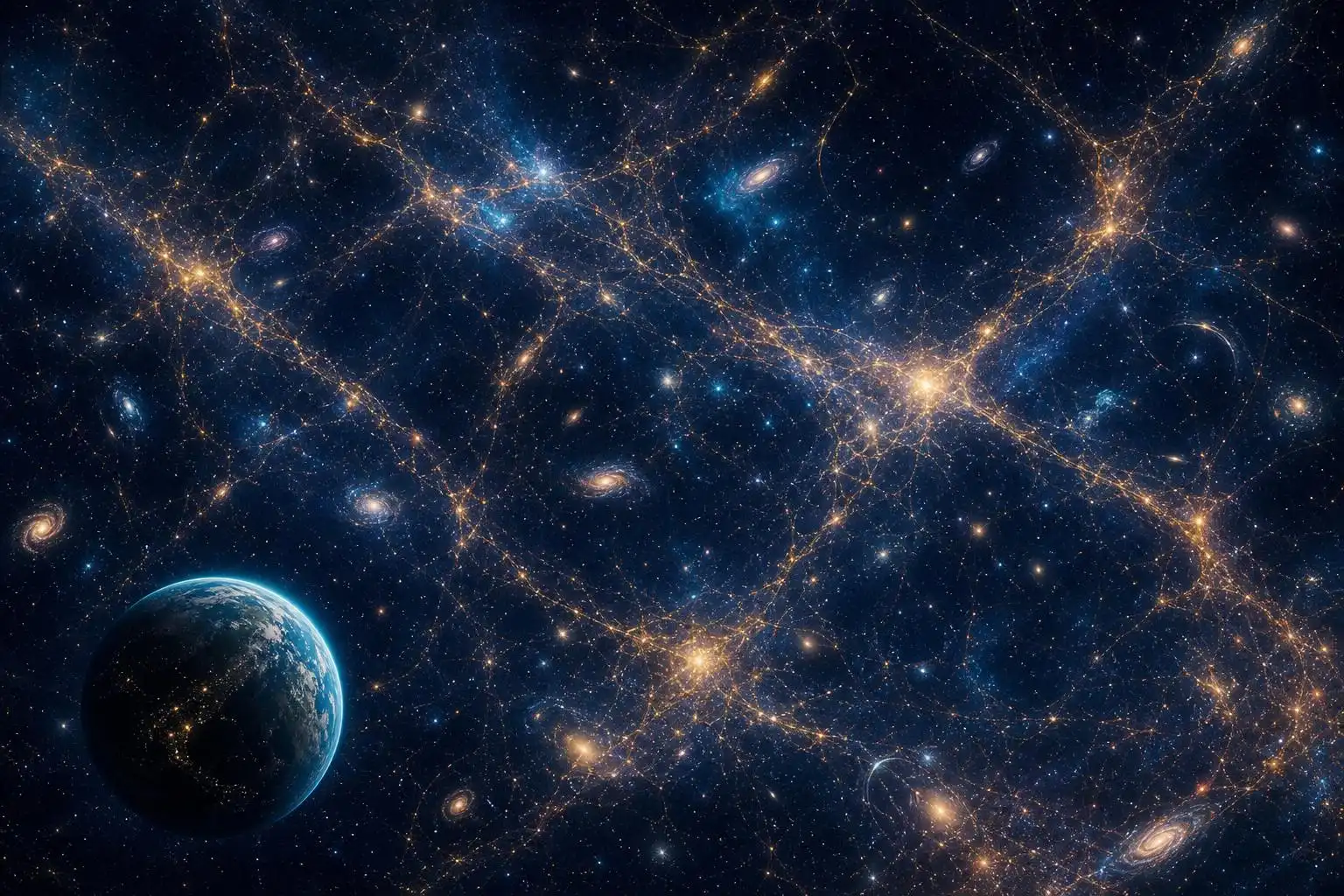

There is a question so strange that physicists argue about whether it even counts as science, and yet it may be the most personal question the cosmos has ever asked: Why is the universe so perfectly suited for us?
Not “suited” in a vague, poetic sense. Suited in a deeply, almost suspiciously precise way — as if someone had been fiddling with knobs.
The Knobs That Make Everything Possible
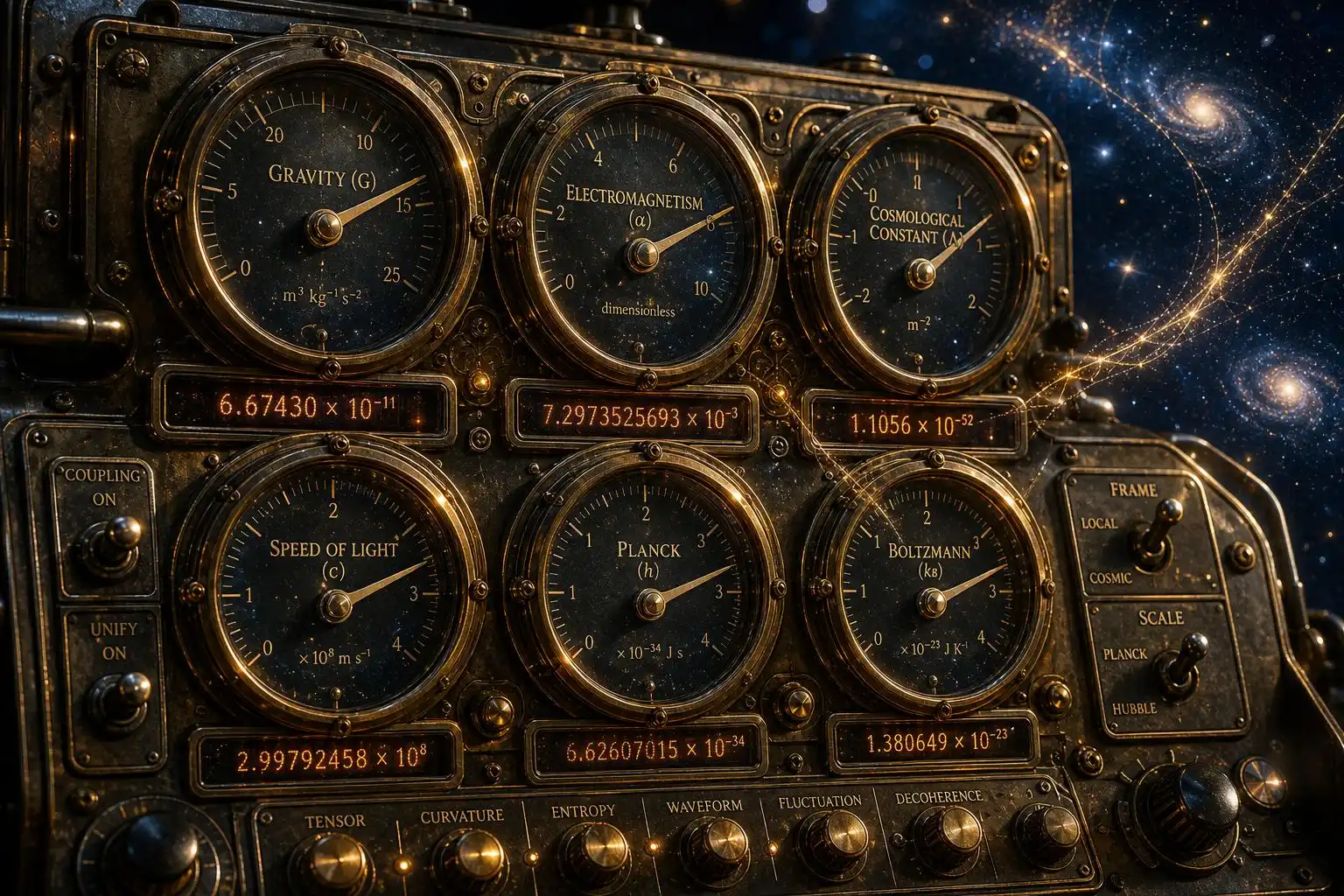
Imagine the universe comes with a control panel. On it are dials labeled things like “strength of gravity,” “charge of the electron,” “rate of expansion after the Big Bang,” and “ratio of matter to antimatter.” Each dial has a number on it. Those numbers are what physicists call the fundamental constants of nature.
Here’s the unsettling part: if you nudge almost any one of those dials by even a tiny amount, the universe stops working — at least for us.
Turn up the strength of gravity just slightly, and stars burn through their fuel in thousands of years instead of billions. Life on Earth needed about 3.5 billion years just to get from single-celled organisms to something that could ask this question. A shorter-burning sun would have snuffed that story before chapter one.
Turn down the strength of the electromagnetic force significantly, and the chemistry that underlies life as we know it breaks down. The atomic structures that make complex molecules possible depend on electromagnetism being tuned within a workable range.
Adjust the cosmological constant — the energy density of empty space — by even a tiny fraction of the enormous discrepancy between its observed value and what quantum field theory predicts, and the universe either collapses back on itself almost immediately or expands so fast that matter never clumps into galaxies, stars, or planets. Either way: nothing.
This is not cherry-picking. Physicists have catalogued dozens of these “fine-tuning” coincidences, though the strength of each case depends on which parameters are varied and by how much. The universe’s recipe calls for extraordinarily specific ingredients, measured to extraordinary precision, and somehow we got exactly that recipe.
So: why?
Enter the Anthropic Principle
In 1973, the physicist Brandon Carter was sitting in Kraków at a conference marking the 500th anniversary of Copernicus’s birth. There was a certain irony in the timing: Copernicus had famously dethroned humanity from the center of the cosmos, arguing that Earth was not special. Carter was about to push back — gently, carefully, and philosophically.
He introduced what he called the Anthropic Principle: the observation that the universe we find ourselves in must be compatible with the existence of observers like us, because if it weren’t, we wouldn’t be here to observe it.
On the surface, this sounds like a tautology. Of course we only see a universe that allows us to exist. What else could we see?
But sit with it for a moment. It’s actually doing something subtle and important. It’s saying that our very existence is a selection effect. We are not a random sample of all possible universes. We are, by definition, a sample drawn only from universes where observers can arise. And that sample is extraordinarily narrow.
Think of it this way: imagine you are a fish. You look around and notice that everything in your world is wet. You might conclude that the universe is fundamentally watery. But you’d be wrong — you’re just only ever going to find yourself in the wet parts. Your existence selected for wetness.
We are the fish. And we are trying to figure out whether the ocean is all there is.
The Weak and the Strong
Carter actually drew a distinction that matters here. The Weak Anthropic Principle (WAP) says simply: we can only observe conditions that are compatible with our existence. This is almost uncontroversially true. It’s a logical constraint on observation, not a claim about the universe itself.
The Strong Anthropic Principle (SAP) goes much further: the universe must have properties that allow observers to arise at some point. This version implies something almost teleological — that the universe was in some sense aimed at producing life.
The Weak version is a methodological reminder. The Strong version is a philosophical claim that makes many scientists deeply uncomfortable, because it sounds like it’s sneaking purpose into physics through the back door.
Most working physicists accept the Weak version as a useful corrective — a reminder to check your assumptions when you notice something suspiciously convenient. The Strong version remains contested, fascinating, and unresolved.
Three Ways to Explain the Knobs
If the universe really is fine-tuned for life, there are essentially three families of explanation on the table.
1. It’s a coincidence.
The constants are what they are. They didn’t have to be anything. We just got lucky. This is philosophically unsatisfying but not logically forbidden. Unlikely things happen. You are, after all, the product of a specific sperm meeting a specific egg out of trillions of possibilities, preceded by centuries of ancestors who each survived long enough to reproduce. Your existence is astronomically improbable. And yet here you are.
2. It was designed.
Some kind of intelligence or intention set the dials. This is the theological answer, and it has been around far longer than modern physics. The fine-tuning argument is one of the oldest arguments for the existence of God, updated with 21st-century numbers. Physics cannot rule this out, but it also cannot test it. A designer who leaves no fingerprints beyond the laws of physics is, by definition, outside the reach of science.
3. There are many universes.
This is the multiverse hypothesis, and it is the explanation that lets physicists sleep at night without invoking design. If there are an enormous — perhaps infinite — number of universes, each with different values for the fundamental constants, then it becomes unsurprising that at least one of them has the right values for life. We live in that one because it’s the only one we could live in. The Anthropic Principle, in this framing, is the explanation: we selected ourselves into this universe by existing.
The multiverse is a remarkable idea. It also, currently, has no direct observational support. Some versions of string theory predict a “landscape” of perhaps 10⁵⁰⁰ possible universes. Certain models of eternal inflation naturally produce a “bubble multiverse” of regions with different properties, though this does not follow from inflationary cosmology in general. But a universe we cannot observe is, by definition, very hard to test. Critics argue that invoking the multiverse is trading one mystery for an even larger one.
What This Feels Like From the Inside
Here’s the thing that gets me every time I think about this: the anthropic principle isn’t just an abstract puzzle for physicists. It’s a question about what it means to be here at all.
You are a collection of atoms that the universe arranged, over 13.8 billion years, into something capable of wondering why it exists. The carbon in your body was forged in the cores of stars that lived and died before our sun was born. The water in your cells contains hydrogen that has been around since three minutes after the Big Bang. You are, in a very literal sense, the universe looking at itself.
And the question the universe seems to be asking, through you, is: Was any of this inevitable?
The honest answer is that we don’t know. We don’t know if the constants of nature could have been otherwise, or if they are fixed by some deeper theory we haven’t found yet. We don’t know if the multiverse is real. We don’t know if the fine-tuning is genuinely improbable or if we’re just bad at calculating cosmic probability.
But here’s what we do know: the fact that you are here, reading this, asking this question, is itself a data point. Your existence is evidence. Not proof of design, not proof of a multiverse, but evidence that the universe has at least one configuration in which matter becomes curious about its own origins.
The Copernican Reflex and Its Limits
There is a deeply ingrained instinct in modern science — call it the Copernican Reflex — to assume that we are not special. Earth is not the center of the solar system. The solar system is not the center of the galaxy. The galaxy is not the center of the universe. Wherever you look, the lesson seems to be: you are not the point.
The Anthropic Principle doesn’t reverse this. It doesn’t say we are cosmically central or specially chosen. What it says is something more subtle: the act of observation is not neutral. When you look at the universe, you are not looking from nowhere. You are looking from a very particular vantage point — one that required 13.8 billion years of cosmic history, a specific set of physical constants, a star in the right place, a planet with liquid water, and an unbroken chain of life stretching back to the first self-replicating molecule.
That vantage point shapes what you can see. And being aware of that — really aware of it, bone-deep — changes the way the universe feels.
It doesn’t feel like a cold, indifferent void. It feels like a place that, whether by luck or design or sheer multiplicity, managed to produce something that could be astonished by it.
That, I think, is worth sitting with. Even if you never resolve the question. Maybe especially then.


Leave a Reply