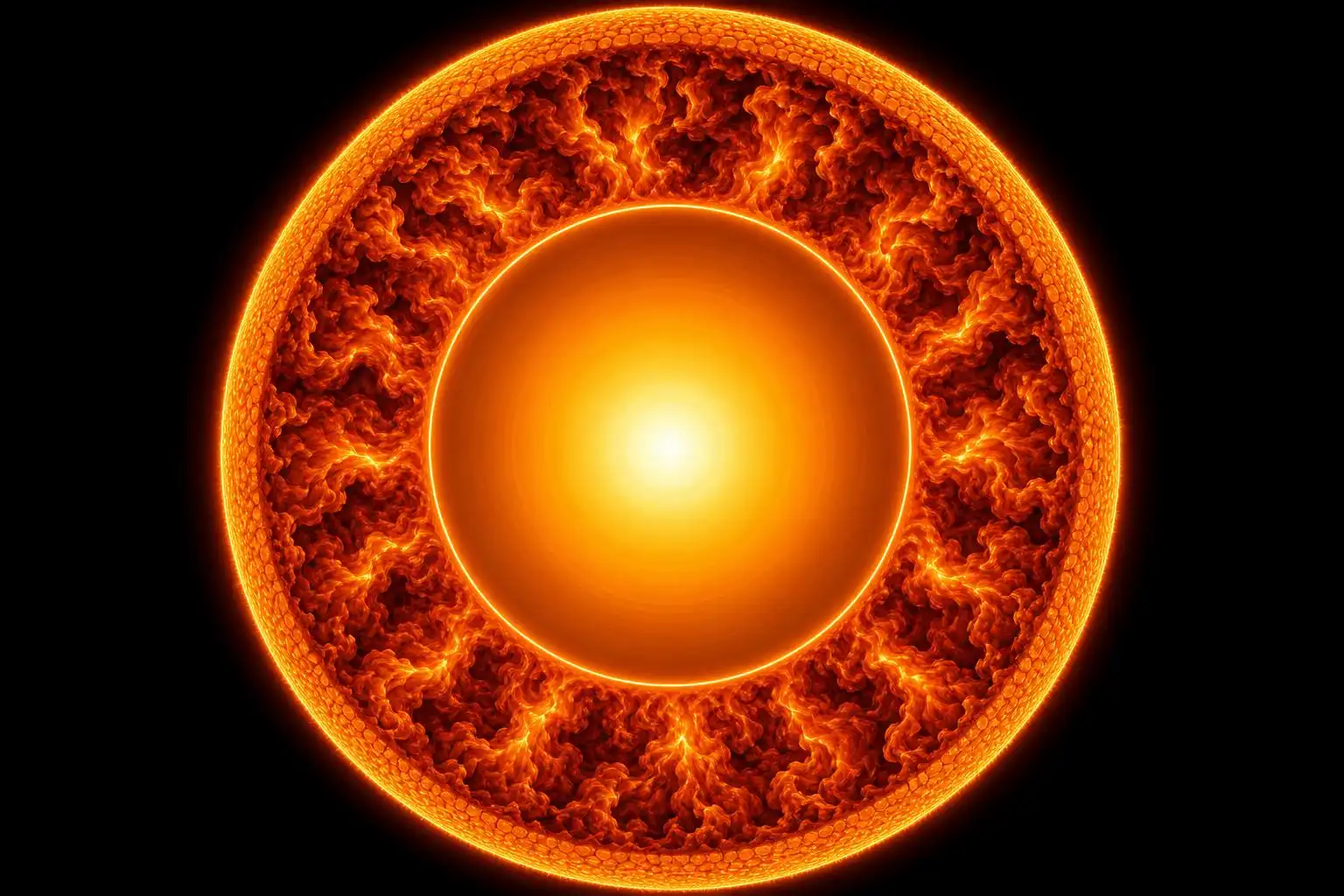

Crack open any stellar interior and you find two fundamentally different regimes of energy transport: radiation and convection. In a radiative zone, photons carry energy outward through a sea of plasma, scattering millions of times before advancing even a centimeter. In a convective zone, buoyant blobs of hot gas rise, cool, and sink in a continuous, churning overturn. The boundary between these two regimes — the tachocline in the Sun, or the edge of a convective core in a more massive star — is not merely a bookkeeping line on a diagram. It is a physical surface that controls chemical mixing, angular momentum transport, and ultimately how long a star lives. The question of exactly where that boundary sits, and why, is one of the most consequential open problems in stellar physics.
The Schwarzschild Criterion: When Does Convection Switch On?
The decision between radiative and convective transport comes down to a single inequality, the Schwarzschild criterion:
∇rad > ∇ad
Here, ∇rad is the temperature gradient the star would need to carry its luminosity purely by radiation, and ∇ad is the adiabatic temperature gradient — the rate at which a rising blob cools as it expands. If the required radiative gradient is steeper than the adiabatic one, a displaced blob stays buoyant and convection ignites. If not, the blob is damped back and radiation handles the job.
∇rad depends on opacity and luminosity: specifically, it scales as κL/m, where κ is the local opacity, L is the enclosed luminosity, and m is the enclosed mass. High opacity traps radiation, forcing the temperature gradient to steepen until convection takes over. High local luminosity has the same effect. This is why the cores of massive stars — where nuclear energy generation is intensely concentrated — are convective, and why the outer envelopes of cool stars — where hydrogen and helium recombination dramatically raises opacity — are also convective.
The Sun as a Worked Example
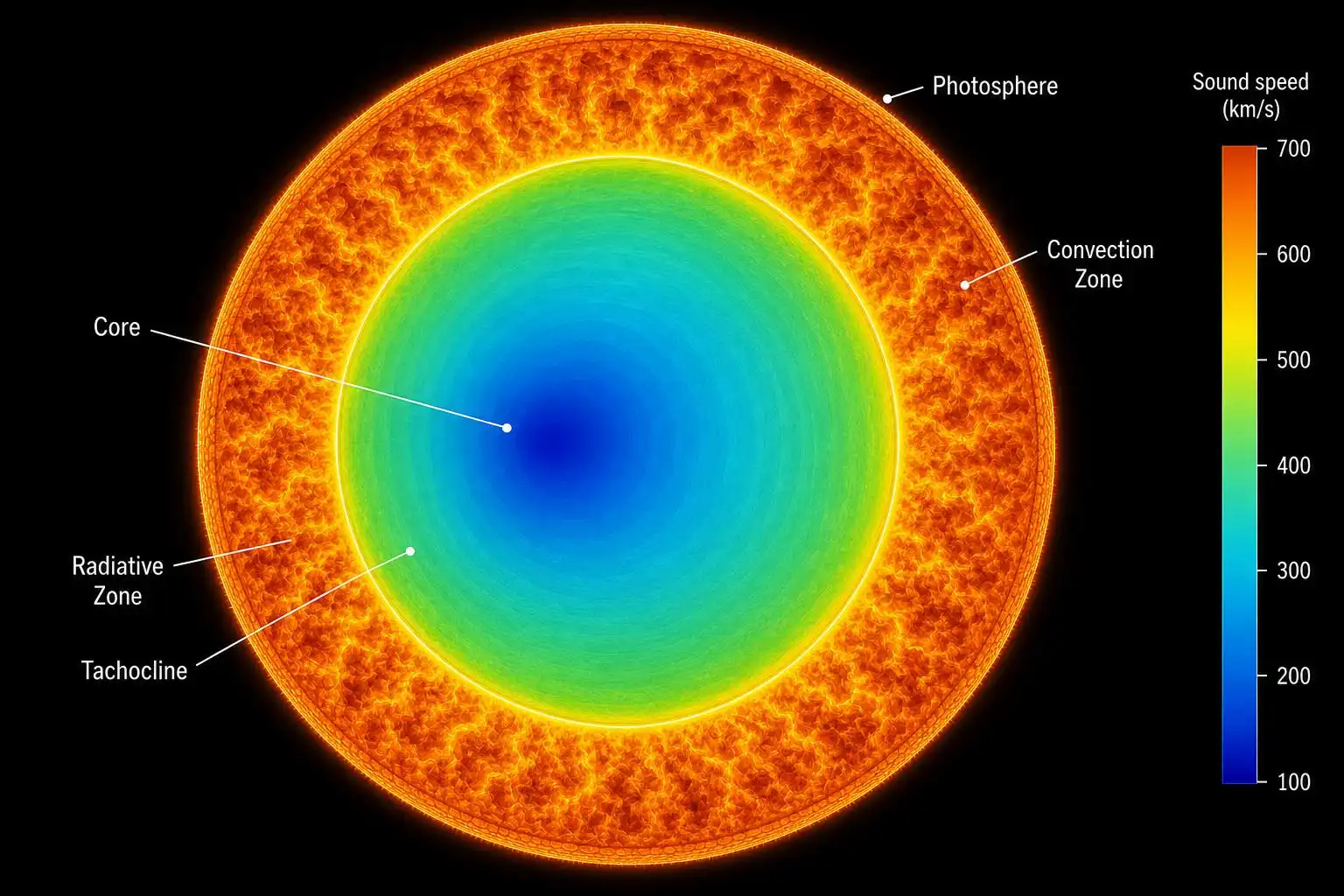
The Sun (spectral type G2 V, 1 M☉, 1 L☉) offers the cleanest case study. Its interior divides into three layers: a convective core that existed only in its early pre-main-sequence life and has since vanished, a radiative interior extending from the center out to about 0.71 R☉, and a convective envelope from there to the photosphere.
In the solar radiative zone, ∇rad ≈ 0.25, comfortably below ∇ad ≈ 0.40 for an ideal monatomic gas. The plasma is hot enough (10–15 million K near the center) that hydrogen is fully ionized, and the dominant opacity source is electron scattering, which is relatively modest. The p-p chain generates energy at a rate proportional to ρT⁴, producing a gentle luminosity gradient that radiation can handle without breaking into convection.
At 0.71 R☉, the temperature drops to roughly 2 million K. Here, the opacity rises sharply, driven primarily by partially ionized heavier elements (metals) that are far more effective photon absorbers than the fully stripped nuclei deeper in the interior. The Rosseland mean opacity κ jumps from ~1 cm² g⁻¹ in the deep interior to ~10 cm² g⁻¹ near the base of the convection zone. The required radiative gradient surges past the adiabatic threshold, and convection erupts. This is the base of the solar convection zone, located at 0.713 R☉, a value pinned with remarkable precision by helioseismology. The tachocline is the thin shear layer situated at this boundary.
Helioseismology and the Sharp Boundary Problem
Helioseismology — the study of the Sun’s acoustic oscillation modes — has given us a three-dimensional sound-speed profile of the solar interior accurate to better than 0.1%. The sound speed cs ∝ √(T/μ) depends on temperature and mean molecular weight μ, so any discontinuity in composition or temperature gradient leaves a detectable imprint on the oscillation frequencies.
At the tachocline, helioseismology reveals a thin shear layer roughly 0.04 R☉ thick where the Sun transitions from the approximately uniform rotation of the radiative interior to the latitude-dependent differential rotation of the convective zone above. This shear is dynamically important: it is widely believed to be the seat of the solar dynamo, where differential rotation stretches poloidal magnetic field lines into toroidal ones, ultimately generating sunspot cycles.
But helioseismology also exposed a puzzle: the solar abundance problem. Models using the older Grevesse & Noels (1993) solar abundances matched the helioseismically inferred sound-speed profile to within 0.1% throughout the interior. When Asplund and collaborators revised the solar photospheric abundances downward in 2005 and 2009 — reducing oxygen, carbon, and neon by 25–35% using 3D non-LTE atmospheric models — the agreement collapsed. The revised models place the base of the convection zone at ~0.726 R☉, disagreeing significantly with the helioseismic value of 0.713 R☉. This mismatch, now nearly two decades old, remains unresolved. The proposed fixes — extra opacity from neon, additional diffusion, accretion of low-metallicity material early in the Sun’s history — each resolve part of the discrepancy but introduce new tensions elsewhere.
Convective Cores in Massive Stars: The Opposite Problem
Move up the main sequence to a star of 5–10 M☉ and the architecture inverts. The CNO cycle, which dominates above ~1.3 M☉, concentrates energy generation so intensely in the central few percent of the mass that ∇rad vastly exceeds ∇ad there. The core is vigorously convective. A 10 M☉ star has a convective core containing roughly 20% of its mass; a 30 M☉ star’s convective core may encompass 50% or more.
The outer envelope of these stars, by contrast, is hot enough that hydrogen remains ionized throughout, keeping opacity low and allowing radiation to carry the energy flux without triggering convection. The structure is essentially the mirror image of the Sun: convective inside, radiative outside.
This has profound evolutionary consequences. A convective core is chemically homogeneous — vigorous mixing continually replenishes the burning region with fresh hydrogen from just beyond the core boundary. The star therefore burns a larger fraction of its total hydrogen before exhausting its core supply, living longer and evolving differently than a purely radiative star would. The exact size of the convective core is therefore not a detail but a first-order input to stellar evolution tracks and isochrone fitting.
Convective Overshooting: The Boundary Is Not a Wall
Here is where the physics becomes genuinely uncertain. The Schwarzschild criterion tells you where convection starts, but it says nothing about where convective motions stop. A rising blob that crosses into the formally stable (∇rad < ∇ad) zone does not instantly decelerate — it has momentum. It overshoots into the stable region, decelerating over some distance before turning back. This convective overshooting extends the effective mixing region beyond the Schwarzschild boundary.
Overshooting is parameterized in stellar models as αov × Hp, where Hp = −dr/d(ln P) is the local pressure scale height and αov is a dimensionless efficiency factor typically calibrated to 0.1–0.3. This sounds modest, but at the edge of a convective core in a 10 M☉ star, Hp is comparable to the core radius itself. An overshooting of 0.2 Hp can increase the hydrogen-burning lifetime by 15–25% and shift the main-sequence turnoff point on an HR diagram by a measurable amount.
Calibrating αov empirically requires systems where stellar ages are independently known. Binary stars are ideal: both components formed simultaneously, so the more evolved star’s position on the HR diagram constrains the overshooting needed to place it at the right age. Studies of well-characterized eclipsing binaries — systems like V578 Mon and TZ Men — suggest αov ≈ 0.15–0.20, but the scatter is large enough that a mass dependence cannot be ruled out. Asteroseismology of solar-like oscillators with Kepler data has independently suggested αov ≈ 0.1–0.2 for stars near 1–2 M☉, broadly consistent.
The deeper problem is that overshooting is not really a single number. Real convective boundaries are not sharp surfaces but dynamic, fluctuating interfaces where gravity waves are excited, where chemical gradients can suppress or enhance mixing, and where semiconvection (a slow diffusive mixing in regions that are Schwarzschild-unstable but Ledoux-stable) can operate. Three-dimensional hydrodynamic simulations of convective boundaries — from groups including Meakin & Arnett and more recently the MUSIC code collaborations — show that the boundary morphology is time-dependent and turbulent, with plumes penetrating to varying depths. Reducing this complexity to a single αov is a known oversimplification that the field has not yet superseded at the level of full stellar evolution codes.
The Ledoux Criterion and Semiconvection
A subtlety the Schwarzschild criterion ignores is composition gradients. In a region where helium has been deposited by nuclear burning within a convective core, the mean molecular weight μ is higher inside the core than in the surrounding envelope — it decreases outward across the core boundary. A rising blob carrying the composition of the core therefore has higher μ than its surroundings, making it heavier and providing a stabilizing restoring force that opposes convection. The Ledoux criterion accounts for this:
∇rad > ∇ad + ∇µ
where ∇μ = d(ln μ)/d(ln P) is the composition gradient term. A layer that is Schwarzschild-unstable (∇rad > ∇ad) but Ledoux-stable (∇rad < ∇ad + ∇μ) is in the semiconvective regime. It does not undergo vigorous convection, but it is not purely radiative either. Slow, diffusive mixing occurs on a timescale intermediate between convective turnover and the nuclear burning timescale.
Semiconvection is particularly important in massive stars during and after the main sequence. It affects the size of the helium core left behind after hydrogen exhaustion, which in turn controls whether a star becomes a red supergiant or a blue supergiant, and — at the end — whether it produces a neutron star or a black hole. The blue-to-red supergiant ratio in the Large Magellanic Cloud, which differs from predictions of standard models, is one of the observational fingerprints of this unresolved mixing physics. SN 1987A, which exploded from a blue supergiant (Sanduleak −69° 202, a B3 Ia star) rather than the expected red supergiant, is consistent with — and has helped motivate study of — the role of interior mixing processes, including semiconvection, in determining a massive star’s pre-supernova structure.
What We Still Don’t Know
The radiative-convective boundary is not a solved problem dressed up in clean mathematics. The Schwarzschild criterion gives a clean local condition, but the actual boundary location depends on:
- Opacity tables, which must be computed from atomic physics and are uncertain at the 5–15% level in the temperature range 10⁵–10⁶ K most relevant to the solar tachocline.
- Overshooting and penetration, which are intrinsically 3D, time-dependent, and not reducible to a single free parameter without loss of physical content.
- Rotation, which drives meridional circulation and shear mixing that can carry material across nominally stable boundaries on secular timescales.
- Magnetic fields, which can suppress or enhance convective motions depending on orientation and field strength.
The next decade offers real leverage. The PLATO mission (ESA, targeted launch 2026) will deliver asteroseismic data for tens of thousands of main-sequence and subgiant stars, with the precision to constrain convective core sizes as a function of mass across the HR diagram. Ground-based spectroscopic campaigns on eclipsing binaries continue to refine αov empirically. And 3D stellar convection simulations are beginning to reach the parameter regimes — low Mach number, low Prandtl number — that are actually relevant to stellar interiors rather than just computationally convenient.
The radiative-convective boundary is where a star’s internal bookkeeping gets complicated. It is where the smooth, analytic picture of stellar structure meets the turbulent, magnetized, compositionally stratified reality of a living star. Getting it right is not a refinement — it is a prerequisite for trusting everything we infer from stellar evolution models, from the age of the universe derived from globular cluster turnoffs to the mass distribution of compact remnants. The boundary is thin. The physics it encodes is not.



Leave a Reply