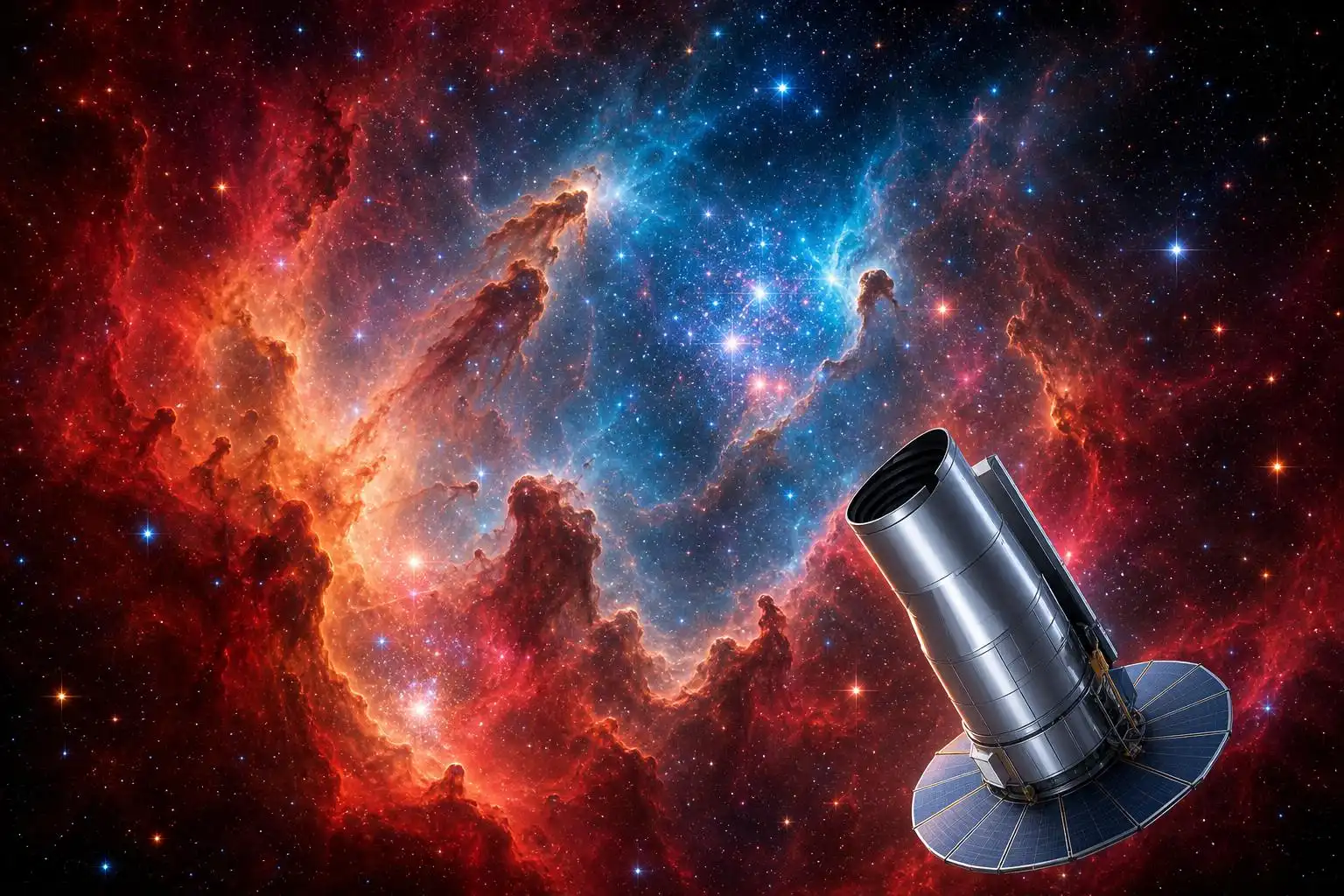

There is a moment in every cryogenic space mission where the engineers stop pretending they are in control. It happens when the last valve closes, the last ground support umbilical drops away, and the telescope is committed — sealed inside its own cold, dark world with a finite supply of the substance keeping it alive. For the Spitzer Space Telescope, that substance was liquid helium. 360 liters of it, loaded into a toroidal tank wrapped around the inner shell of the cryostat, chilled to 1.2 Kelvin, and launched on August 25, 2003, aboard a Delta II rocket from Cape Canaveral. The plan was to keep Spitzer’s detectors cold enough to see the universe in infrared for roughly 2.5 years. The helium lasted nearly five and a half.
That overrun — roughly 3 years of bonus science bought by careful thermal management and a genuinely clever orbit — is one of the great engineering success stories in NASA’s Great Observatories program. But the story of Spitzer is really about the fundamental problem of doing infrared astronomy from space: you are trying to detect heat, with an instrument that is itself warm, orbiting a star, inside a solar system full of dust that glows in exactly the wavelengths you are trying to study. Every design decision on Spitzer was a negotiation with thermodynamics, and the cryogen was the currency.
Why Infrared Astronomy Needs to Be Cold
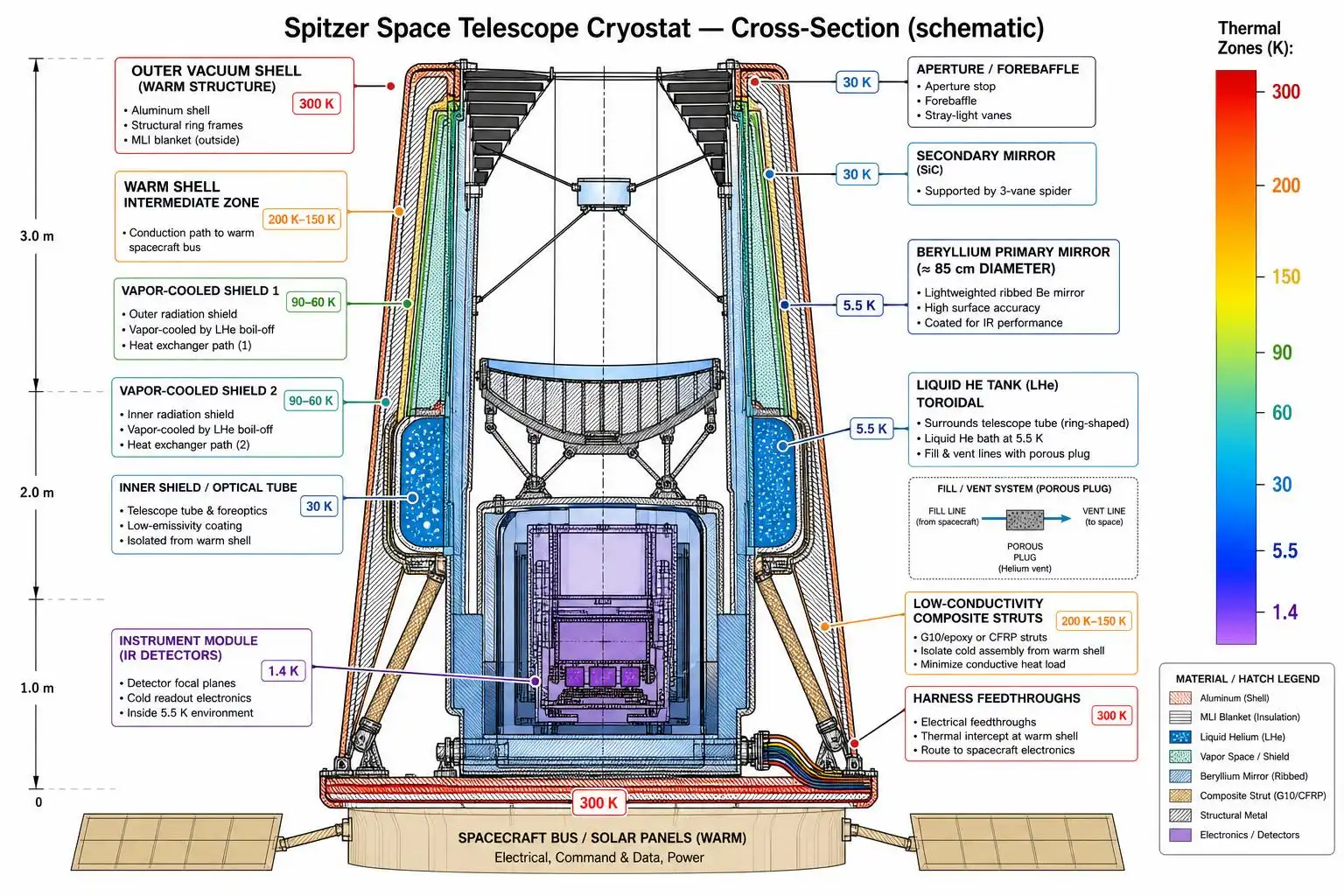
Infrared radiation is thermal radiation. Everything above absolute zero emits it, including your telescope. A mirror at room temperature (~300 K) radiates so intensely in the mid-infrared that it would completely swamp the faint signals from distant galaxies, protostellar disks, or the chemical fingerprints of organic molecules in interstellar clouds. To detect those signals, you need your optics and detectors cold — very cold. Spitzer’s primary mirror, an 85-centimeter beryllium reflective surface, had to be held near 5.5 Kelvin during cryogenic operations. Its detectors, three instrument modules covering 3.6 to 160 microns, needed to sit at temperatures ranging from 1.4 K (for the longest-wavelength photometric arrays) to around 15 K for the shorter-wavelength channels.
Achieving those temperatures in space requires either passive radiative cooling, stored cryogen, or some combination of the two. Spitzer used both in a layered architecture. The outer shell of the spacecraft was a vacuum dewar — a giant thermos bottle. Inside it sat the telescope and instruments, surrounded by the helium tank. The helium boiled off slowly, and that boil-off gas was vented through a series of heat exchangers, intercepting heat conducted inward from the warmer outer shell before it could reach the optics. The system was elegant in its simplicity: the cryogen was not just a coolant, it was an active thermal shield.
The Warm-Launch Architecture: A Radical Bet
Earlier infrared space telescopes — IRAS in 1983, ISO in 1995 — launched their entire cryostat pre-cooled. The telescope and all its optics were already at cryogenic temperatures when they left the ground. This required enormous amounts of cryogen just to survive the launch environment, and it meant the instruments were exposed to the thermal shock of ascent while already brittle-cold.
Spitzer’s engineers at Ball Aerospace and JPL made a different bet. They would launch the telescope warm — near room temperature — and cool it down on orbit using the cryogen and passive radiation to space. The primary mirror and structure were designed from the outset to be cooled slowly in orbit, which meant they could be built lighter. The beryllium primary, at just 85 cm in diameter, weighed only about 8.5 kilograms. The entire spacecraft came in at 950 kilograms at launch — remarkably light for an observatory of its capability. That low mass was a direct consequence of the warm-launch philosophy, which in turn allowed a smaller, cheaper launch vehicle.
The trade-off was a cooling-down period of about 40 days after launch before science operations could begin. Engineers watched the mirror temperature drop through telemetry, checking for any signs of thermal stress or unexpected heat loads. It worked. The telescope cooled cleanly, the instruments powered up, and first light observations began in December 2003.
The Earth-Trailing Orbit: Thermodynamics as Mission Design
The single most important thermal decision on Spitzer was not about insulation or cryogen purity. It was about where to put the telescope. Spitzer does not orbit the Earth. It orbits the Sun, in an Earth-trailing heliocentric orbit, drifting away from our planet at roughly 0.1 AU per year. By the end of its cryogenic mission in May 2009, it was about 0.5 AU behind Earth.
This orbit solved several problems simultaneously. First, it kept the spacecraft away from Earth’s infrared emission and the thermal cycling of low-Earth orbit. Second, it allowed the solar panels and the warm electronics to face the Sun, while the telescope pointed away — into the cold of deep space — and radiated heat passively. The cold side of Spitzer, the aperture end of the cryostat, had an unobstructed view of the 2.7 K cosmic microwave background. Passive radiation alone could cool the outer shell to around 34 K. That meant the helium only had to do the last leg of cooling, from ~34 K down to the 1.4–5.5 K range the detectors needed. The cryogen load was dramatically reduced compared to a low-Earth orbit architecture.
The downside of this orbit is that it is one-way. There is no servicing. Unlike Hubble, which sits in a 547-kilometer low-Earth orbit where astronauts can reach it, Spitzer was always going to run until the helium ran out and then transition or die. That constraint focused the mission design with a clarity that serviced observatories never quite achieve.
360 Liters and the Art of Boil-Off Management
The helium tank held 360 liters at launch, pressurized to keep the liquid stable. The boil-off rate was carefully controlled — too fast and you waste cryogen cooling things you don’t need to cool; too slow and you risk the detectors warming above their operating thresholds. The average boil-off rate over the cryogenic mission was on the order of a few tenths of a liter per day, though the team worked continuously to reduce parasitic heat loads.
One of the quiet heroes of the mission was the pointing constraint system. Spitzer had a solar avoidance angle — the telescope could not point within about 82.5 degrees of the Sun, and it had to keep its solar panels illuminated. Within those constraints, the operations team scheduled observations to minimize the time spent slewing (which warms the spacecraft slightly through gyroscopic dissipation) and to maximize time on cold, thermally stable targets. Every degree of unnecessary slew was a fraction of a liter of helium.
The team also tracked the helium level using a gauge system, but liquid helium in microgravity is notoriously difficult to measure. The fluid sloshes freely, doesn’t settle under gravity, and can form bubbles that confuse capacitance-based sensors. Engineers cross-checked the gauge readings against thermal models, boil-off flow rates, and the observed temperature stability of the detectors to triangulate the actual remaining supply. It was as much art as engineering.
The Science the Cold Made Possible
What did those 360 liters of helium actually buy? The answer is a catalog of discoveries that reshaped our understanding of the infrared universe.
Spitzer’s Infrared Array Camera (IRAC), operating at 3.6, 4.5, 5.8, and 8.0 microns, imaged the structure of our own galaxy — dust lanes, star-forming regions, the central bar of the Milky Way — with a clarity that optical telescopes could never achieve through the obscuring dust. The Multiband Imaging Photometer for Spitzer (MIPS), covering 24, 70, and 160 microns, detected the thermal emission from dust in debris disks around nearby stars, giving us the first statistical census of planetary system formation. The Infrared Spectrograph (IRS), spanning 5.3 to 40 microns, identified polycyclic aromatic hydrocarbons, silicate features, and water ice in the spectra of galaxies, protostars, and solar system objects.
Perhaps most memorably, Spitzer detected the first light curves of exoplanet atmospheres. In 2005, the telescope measured the thermal emission from the hot Jupiters HD 209458b and TrES-1 as they passed behind their host stars — the first direct detection of light from planets outside our solar system. The technique exploited Spitzer’s extraordinary photometric stability, which was itself a product of the thermal stability that the cryogenic architecture provided. A warm, thermally noisy detector could never have achieved the 0.1% photometric precision those observations required.
Warm Mission: Death Deferred, Science Transformed
On May 15, 2009, the last of the liquid helium boiled away. The longer-wavelength channels of IRAC and MIPS went dark as their detectors warmed above operating temperature. But the two shortest-wavelength IRAC channels — 3.6 and 4.5 microns — were close enough to the telescope’s passive equilibrium temperature (~28 K) that they remained functional. NASA declared a “warm mission” and kept Spitzer operating in this reduced mode.
The warm mission lasted another decade. Spitzer spent it doing things its designers had never anticipated: mapping the three-dimensional structure of the Milky Way’s stellar disk through the GLIMPSE360 survey, characterizing the atmospheres of the TRAPPIST-1 system’s seven Earth-sized planets (a dataset that will directly inform JWST follow-up), and supporting the K2 and TESS exoplanet missions with ground-truth photometry. The telescope finally retired on January 30, 2020 — 16 years and 5 months after launch, more than six times its original design life.
The warm mission was only possible because of decisions made at the beginning: the choice of beryllium for the mirror (which remains dimensionally stable across a huge temperature range), the Earth-trailing orbit (which gave the telescope a naturally cold thermal environment), and the IRAC detector architecture (which used indium antimonide arrays that happen to remain quantum-efficient at the warmer post-helium temperatures).
What Spitzer Taught Us About Building Cold Telescopes
JWST is the direct intellectual heir of Spitzer. The decision to put JWST at the Sun-Earth L2 point — cold, stable, away from Earth’s thermal emission — echoes Spitzer’s Earth-trailing orbit philosophy. JWST’s passive cooling architecture, which uses its sunshield to drive the telescope to ~40 K before the active cooler takes the MIRI instrument down to 6.7 K, is a scaled-up version of the same layered approach. Even the use of gold-coated beryllium for JWST’s mirror segments reflects lessons learned from Spitzer’s mirror performance.
The Roman Space Telescope, currently targeting a launch around 2027, will use a 2.4-meter primary mirror and will operate in the near-infrared without a cryostat — its detectors are cold enough with passive cooling from its L2 orbit. That is only possible because the community learned, through Spitzer and JWST, exactly how cold you can get for free if you pick the right orbit and design the thermal architecture carefully from day one.
Spitzer’s cryogen was not just a consumable. It was a design philosophy made liquid — a commitment to the idea that the universe’s faint, cold signals are worth the extraordinary engineering effort required to listen for them. When the last helium atom vented into space in May 2009, it did not mark the end of that philosophy. It marked the moment the telescope proved it had internalized the lesson well enough to survive without it.



Leave a Reply