
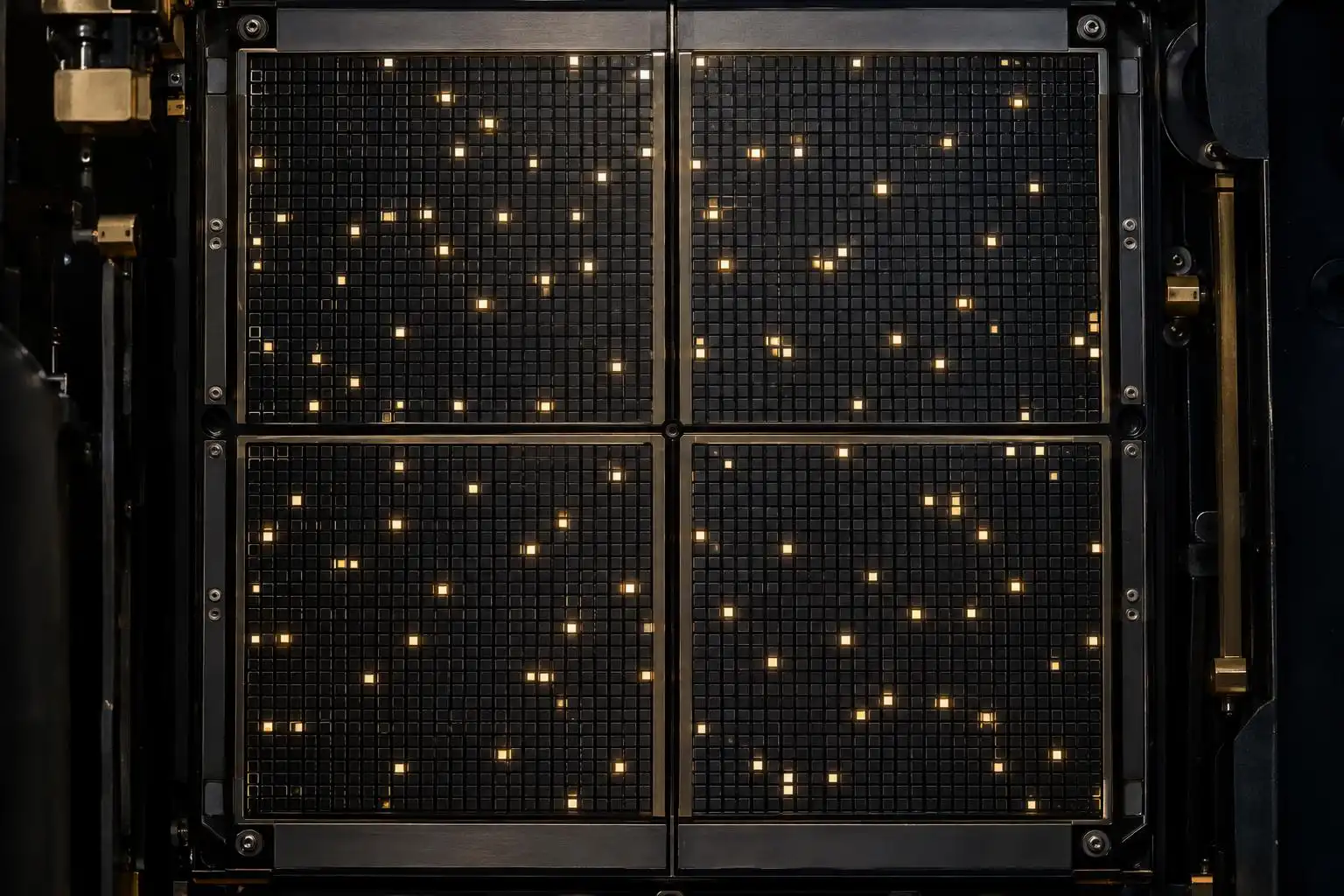

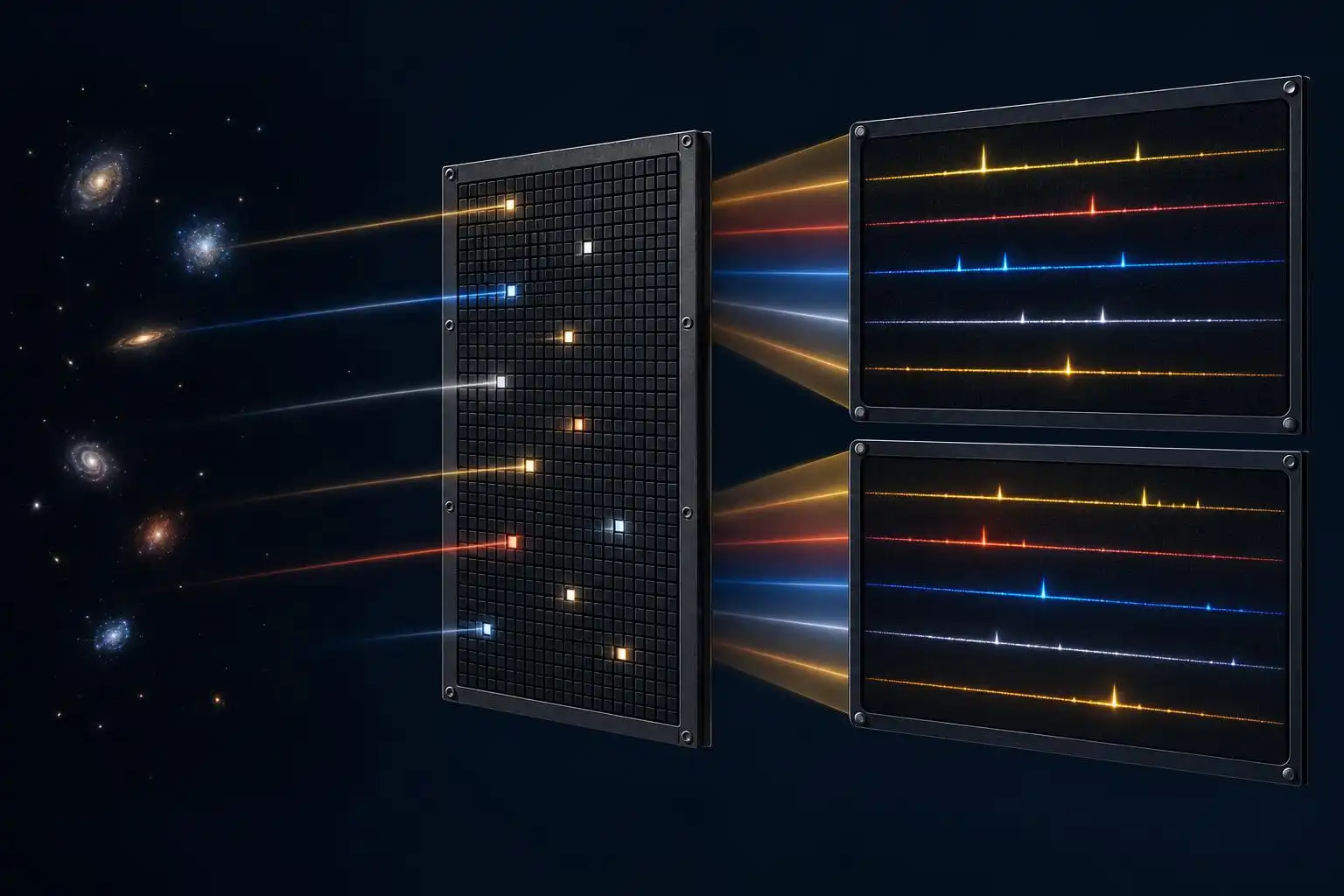
A distant galaxy can be a few pixels wide in a James Webb Space Telescope image. Its spectrum is harder to obtain. Spread its light by wavelength, and that faint signal must compete with background light and with spectra from other objects in the field. NIRSpec’s multi-object mode solves part of the problem with a device that looks less like a conventional slit and more like a wall of tiny, individually selectable doors.
Those doors are the microshutter assembly. It lets observers admit light from many chosen targets while blocking much of the unwanted sky. The result can be hundreds of spectra in one observation—but only after a careful exercise in geometry, pointing, and detector planning.
A slit for every selected target
A traditional spectrograph often accepts light through one long slit. NIRSpec instead has four microshutter quadrants, each containing 365 columns and 171 rows. That is 249,660 shutters in total. An open shutter presents an aperture roughly 0.20 by 0.46 arcseconds on the sky: small enough to isolate a compact galaxy, though not necessarily large enough to contain all of its light.
Opening a shutter is a physical operation, not a software mask applied to an image afterward. A magnet sweeps across the array to open the shutters; electrostatic forces hold selected ones open while the others close. Starlight and galaxy light then pass through the chosen openings to NIRSpec’s dispersing optics and two infrared detector arrays.
A closed shutter helps keep unwanted light out of the spectrograph. An open one does not guarantee a useful spectrum. The target must land inside it, and its dispersed light must have room on the detector without interfering with another target’s spectrum. Multiplexing is therefore not simply a matter of counting how many shutters can open.
Why the target list is a geometry problem
Imagine a deep image containing a thousand candidate galaxies. Observers assign priorities, then use planning software to test which candidates can be observed together. Each proposed shutter position maps to a particular location on the detector, where its light will stretch into a spectrum. Two galaxies that are well separated in the image can still produce overlapping spectra. Some attractive targets cannot share the same exposure.
The assignment also depends on the telescope’s orientation. Rotating the field changes where galaxies fall on the shutter grid and how their spectra project onto the detectors. A different orientation may make a high-priority target accessible—or cause another target’s spectrum to collide with its neighbor’s. The nominal shutter count is enormous; the useful number of simultaneous targets is set by the arrangement of objects and the chosen observing setup.
Reliability enters the plan too. Some shutters cannot be used as intended, and a shutter that remains open when it should be closed can admit contaminating light. Observers work from maps of these imperfections rather than assuming an ideal array. That is ordinary instrument calibration with unusually visible consequences: a tiny mechanical defect can change which galaxy makes the final observing list.
The pointing has to match the mask
Once a shutter configuration is designed, Webb must place the sky onto it accurately. NIRSpec uses a target-acquisition procedure to establish where the field lies relative to the microshutter array before the science exposure. A small placement error matters when the useful aperture is only about 0.20 arcseconds wide in its narrow dimension.
Centering is not just a yes-or-no question. If a galaxy sits near a shutter edge, some of its light misses the spectrograph. The loss varies with wavelength because the telescope’s diffraction pattern grows broader toward longer infrared wavelengths. A point source that fits comparatively comfortably at short wavelengths can lose a larger fraction of its light through the same opening near the long-wavelength end of NIRSpec’s range.
That makes extracting a spectrum different from measuring a galaxy’s total brightness. The detector records the light that passed through the aperture, not everything the galaxy emitted toward Webb. Corrections for slit losses depend on the source’s position and shape; an extended or irregular galaxy is more complicated than a centered point source. Apparent changes in spectral brightness deserve scrutiny before they become claims about a galaxy’s physics.
Moving the target to measure the background
NIRSpec observers commonly use several neighboring shutters for a target and move the telescope slightly between exposures. This is called nodding. At each position, the galaxy occupies a different place within the opened shutter pattern, while the other positions help measure background and detector effects. Subtracting those measurements makes a faint spectrum easier to isolate.
The nod is small, but it has to be planned with the shutters. A galaxy must remain inside the intended open apertures as Webb moves. Nearby sources can spoil what looked like a clean background position in the original image. Exposure design therefore includes not only where the galaxy begins, but where it will appear at every planned pointing.
This procedure is especially valuable for deep observations. More integration time collects more photons from the target, but it also records background and detector signatures. Repeated positions provide a way to distinguish some of those unwanted signals from light that follows the galaxy. They do not erase every uncertainty; they give the reduction a better measurement to work with.
What the shutters make possible—and what they do not
Behind the microshutter assembly, observers can select a prism that covers roughly 0.6 to 5.3 micrometers at relatively low spectral resolution, or gratings that separate wavelengths more finely. The prism is powerful for finding broad spectral features and measuring redshifts from faint objects. Higher-resolution settings can better distinguish nearby features, but spread a target’s limited light over more detector pixels.
The shutters make these choices efficient by allowing many galaxies to be observed at once. They do not make a faint source bright, prevent all spectral overlap, or recover light that missed an aperture. A good NIRSpec multi-object program balances target priorities, orientation, shutter availability, wavelength coverage, exposure time, and a credible background measurement.
That balance is the achievement behind a crowded field of clean spectra. The striking result may be a redshift for a remote galaxy, but it rests on doors smaller than a fraction of an arcsecond, a telescope placed accurately against their grid, and an observing plan that anticipates where every streak of light will land. The picture is beautiful because the engineering was disciplined.



Leave a Reply
You must be logged in to post a comment.