
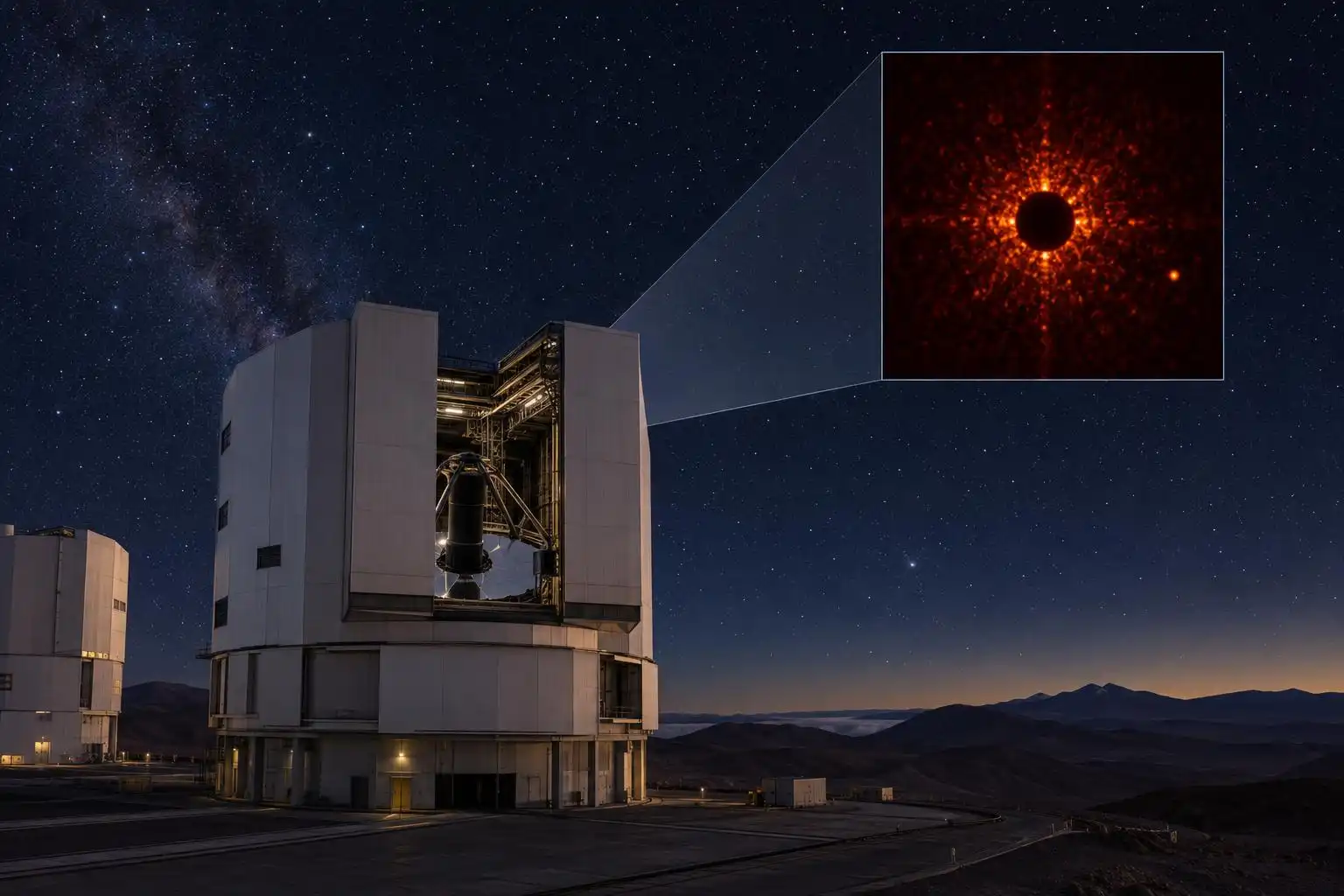

A planet ten astronomical units from a star 20 parsecs away appears just half an arcsecond from it. At that separation, an eight-meter telescope can resolve the two in infrared light. Resolution, though, is not the same as detection. The star’s light spills into a halo that can be thousands of times brighter than the planet.
On the Very Large Telescope’s UT3 at Paranal, the SPHERE instrument tackles that glare. One of its cameras, IRDIS—the InfraRed Dual-band Imager and Spectrograph—takes two images of the same star at nearly the same time, through slightly different filters. Its job is not simply to make a sharp picture. It is to help distinguish a faint companion from the imperfectly suppressed starlight surrounding it.
Why a Sharp Image Still Has a Halo
At a wavelength of 1.6 micrometers, the diffraction scale of an eight-meter telescope is roughly 0.04 arcseconds. A planet half an arcsecond from its star is therefore separated by more than ten such resolution elements. In principle, there is room to see it. In practice, atmospheric turbulence moves and distorts the incoming wavefront, scattering stellar light across that space.
SPHERE’s adaptive-optics system, SAXO, measures those distortions and drives a deformable mirror at roughly a kilohertz. Under favorable conditions it concentrates much of the star’s infrared light into a compact core. A coronagraph then blocks that core and reduces its diffracted light. Neither step is perfect: uncorrected turbulence and small optical aberrations leave bright, structured patches called speckles. Some look enough like planets to fool an observer inspecting a single frame.
That distinction governs the observation. The measurement is not just whether a point of light appears near the star. It is whether that point behaves like light from the sky while the instrument’s speckles behave like light from the instrument.
Two Filters, One Exposure
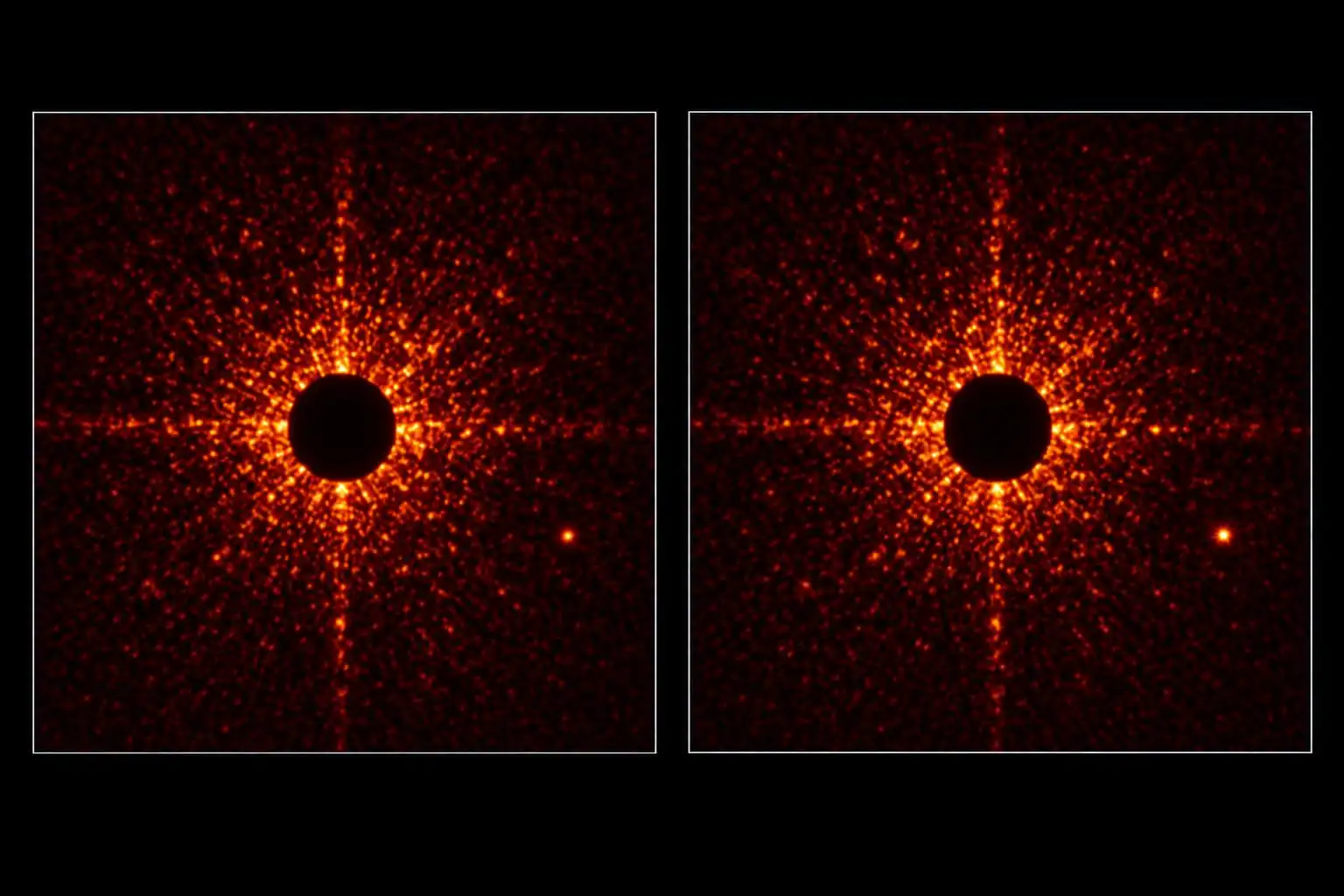
In its dual-band imaging mode, IRDIS records the same field simultaneously in two nearby wavelength bands. A commonly used pair is H2, centered near 1.593 micrometers, and H3, near 1.667 micrometers. The images fall on separate regions of the detector. Recording them together matters: both channels see essentially the same atmospheric conditions rather than two different moments of turbulence.
Speckles are wavelength-dependent. Their positions scale approximately with wavelength, so a speckle farther from the star in H3 than in H2 may line up after one image is rescaled. Starlight also tends to have a relatively smooth spectrum across these nearby bands. Subtracting appropriately aligned images can therefore remove some of the stellar pattern while retaining a companion whose brightness differs between the filters.
Methane provides one reason a companion’s brightness might differ. Cool atmospheres can absorb strongly in parts of the H band, making an object conspicuous in one filter and faint in the other. But methane is not a universal planet marker: warmer young planets may lack strong methane absorption. Dual-band subtraction is a way to test spectral differences, not a machine that turns every planet into an unmistakable dot.
The arithmetic has costs. Rescaling the images to align speckles also shifts the apparent location of a real companion. Imperfectly matched optics leave residuals, and a companion with similar brightness in both filters can partly subtract away. Observers must carry those losses into any claim about what the data could have detected.
Letting the Sky Rotate
IRDIS observations often use a second separation trick: angular differential imaging. In pupil-tracking mode, the telescope keeps the orientation of its optics approximately fixed relative to the detector while the sky rotates during the sequence. Instrumental speckles remain near the same detector positions; a real companion traces an arc around the hidden star.
Software can build a model of the relatively stationary stellar pattern from many exposures and subtract it from each frame. The cleaned frames are then rotated to put the sky in a common orientation and combined. A signal that moved with the sky adds up; much of the stationary pattern does not.
Field rotation is valuable only when there is enough of it. Close to the star, a companion must rotate through a larger angle to move by even one resolution element on the detector. With too little rotation, the software may include the companion in its speckle model and erase part of the very signal it is meant to find. Observing time, target position, and separation all affect that risk.
Measuring What the Processing Removes
The final image is not a direct photograph in the ordinary sense. It is the result of calibrations, image alignment, speckle modeling, subtraction, and combination. Bright and dark lobes around a candidate can be artifacts of that processing. A plausible point source needs a measured position and brightness, together with an honest account of how much companion light the reductions removed.
One practical test is to insert artificial companions into the raw data at known separations and brightnesses, then run the full reduction again. The recovered signals reveal the pipeline’s throughput: how much light survives its subtraction. Repeating the test at different positions also helps establish a detection limit, although noise close to a star cannot always be treated as though every image pixel were an independent measurement.
IRDIS’s image scale is about 12.25 milliarcseconds per pixel. That sampling lets observers locate a candidate precisely, but precision in a processed frame does not by itself prove that the object orbits the star. Follow-up observations can check whether it shares the star’s motion across the sky rather than behaving like a distant background source. Spectral measurements and orbital motion may provide further evidence.
The Result Is Earned Before It Is Seen
A finished SPHERE image can make a planet look comfortably separated from its star. The hard part was never drawing two distinct points. It was controlling a changing wavefront, suppressing stellar light without pretending it had vanished, and measuring how each subtraction altered the faint signal left behind.
IRDIS makes that work possible by giving observers two simultaneous spectral views and a stable sequence in which sky rotation can expose instrumental impostors. The compelling point of light at the end is also a record of engineering discipline: optics kept steady, exposures planned for rotation, and sensitivity tested against artificial planets before the real one is trusted.


Leave a Reply
You must be logged in to post a comment.