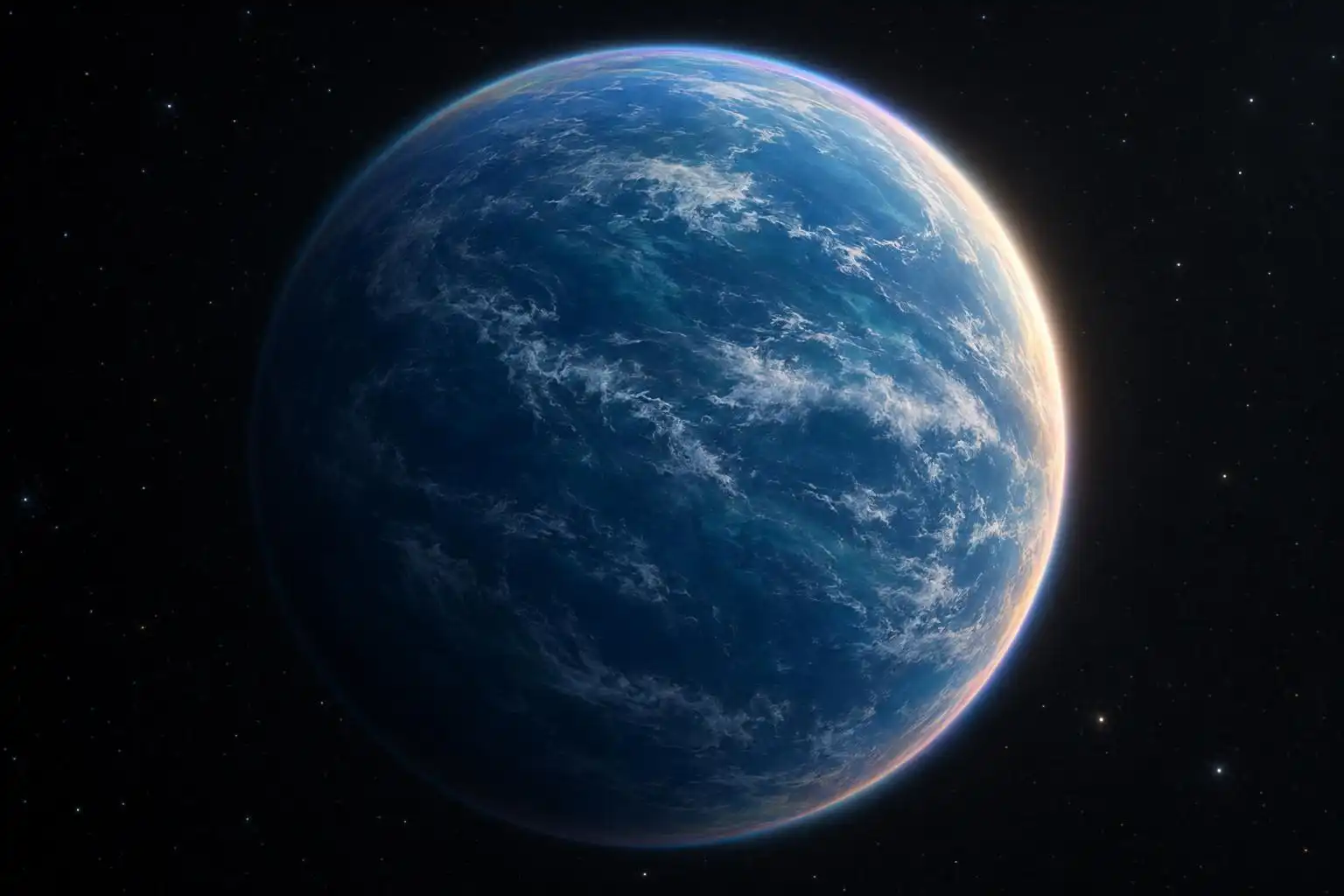

Imagine finding a planet with oceans, clouds, and something in its atmosphere that keeps getting replenished. Would you call it alive? On Earth, living things change the air around them. But a distant planet can also produce surprising chemistry without a single organism. The hard part of searching for life isn’t just reaching another world. It’s deciding what would count as an answer.
We Have a Sample Size of One
Every living thing we know shares a remarkable amount of chemistry. Bacteria, oak trees, and people all use DNA to store instructions and cells to carry out the work of living. That common ground helps us study life on Earth. It also leaves us with a problem: Earth life is the only example we have.
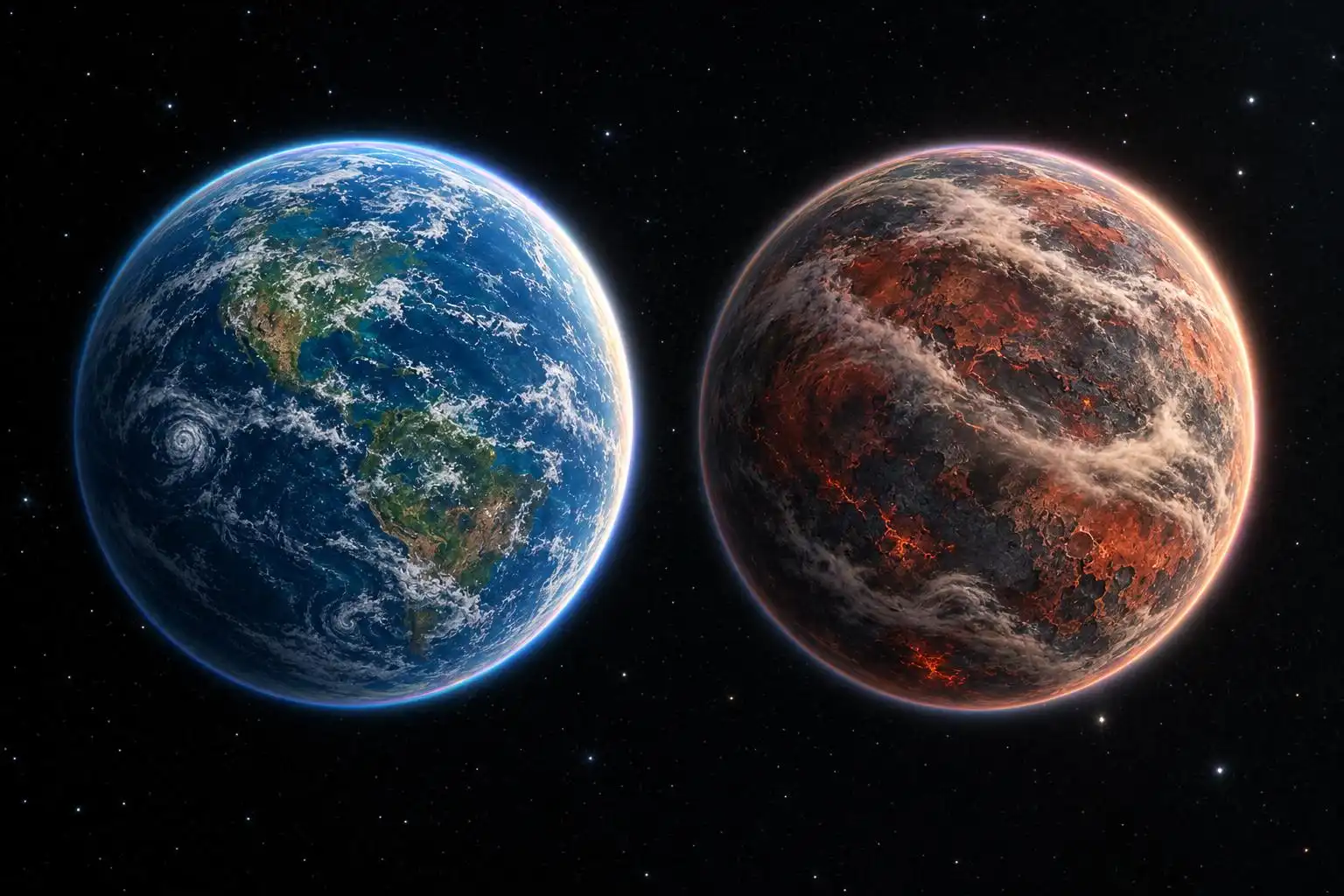
If you had seen only one kind of house, you might mistake its roof for a requirement of shelter. Scientists face a similar risk when they look for life elsewhere. Liquid water and familiar carbon chemistry are sensible places to start because they work here. They are not proof that every possible living system must look like ours.
What Are We Actually Looking For?
A useful way to think about life is not as a particular shape, but as an ongoing process. Living things take in materials or energy, maintain themselves, and pass on information that can change over generations. Even this description has fuzzy edges. A flame consumes fuel and grows, but we don’t usually call it alive. A virus evolves, but it needs a host cell to reproduce.
Those awkward cases matter. They remind us that “alive” may not be a switch we can flip after one measurement. If we encounter unfamiliar chemistry, we might first be able to say something narrower and more honest: this system appears to organize itself, use energy, or change in a way that deserves investigation.
A Planet Can Give Clues Without Giving Answers
From far away, we cannot examine an organism under a microscope. We can, however, study light that has interacted with a planet’s atmosphere. Different gases leave different patterns in that light. On Earth, life helps maintain atmospheric oxygen, while organisms and geological processes both produce methane.
Finding oxygen and methane together on another planet would be intriguing because the gases react with each other. If both persist, something must keep supplying them. But “something” is not automatically biology. Some oxygen can form without life, and methane can come from geological activity. The planet’s star, water, rocks, and history all affect how we interpret a possible signal.
Think of it as noticing warm light in a house across the street. Someone might be inside. Or a lamp might be on a timer. The light gives you a reason to look closer, not a license to invent a resident. A promising sign of life would need to survive careful attempts to explain it without life.
The Most Interesting Discovery Might Be Confusing
We often picture the announcement as a clean moment: scientists find a signal, check it, and declare that we are not alone. Reality may be slower. One observation could suggest an unusual atmospheric gas. Later measurements might strengthen the case, reveal an ordinary explanation, or leave us uncertain for years.
That uncertainty is not a failure of the search. It is what responsible curiosity looks like when the stakes are enormous. A genuine discovery would change our understanding of biology and our place in the universe. A false alarm would teach us something, too: that planets can be more chemically inventive than we expected.
Why This Question Is About Earth, Too
Trying to recognize unfamiliar life forces us to notice how much of our own planet we take for granted. Earth’s air is not merely a backdrop for living things. Over immense spans of time, life has helped shape it. The world outside your window is part of a long exchange between organisms and their surroundings.
Perhaps we will someday find a distant world whose clues are unmistakable. Perhaps our first serious candidate will resist a simple verdict. Either way, the search asks us to practice a rare kind of humility: to look for company without insisting, before we meet it, that it must resemble us.



Leave a Reply
You must be logged in to post a comment.