
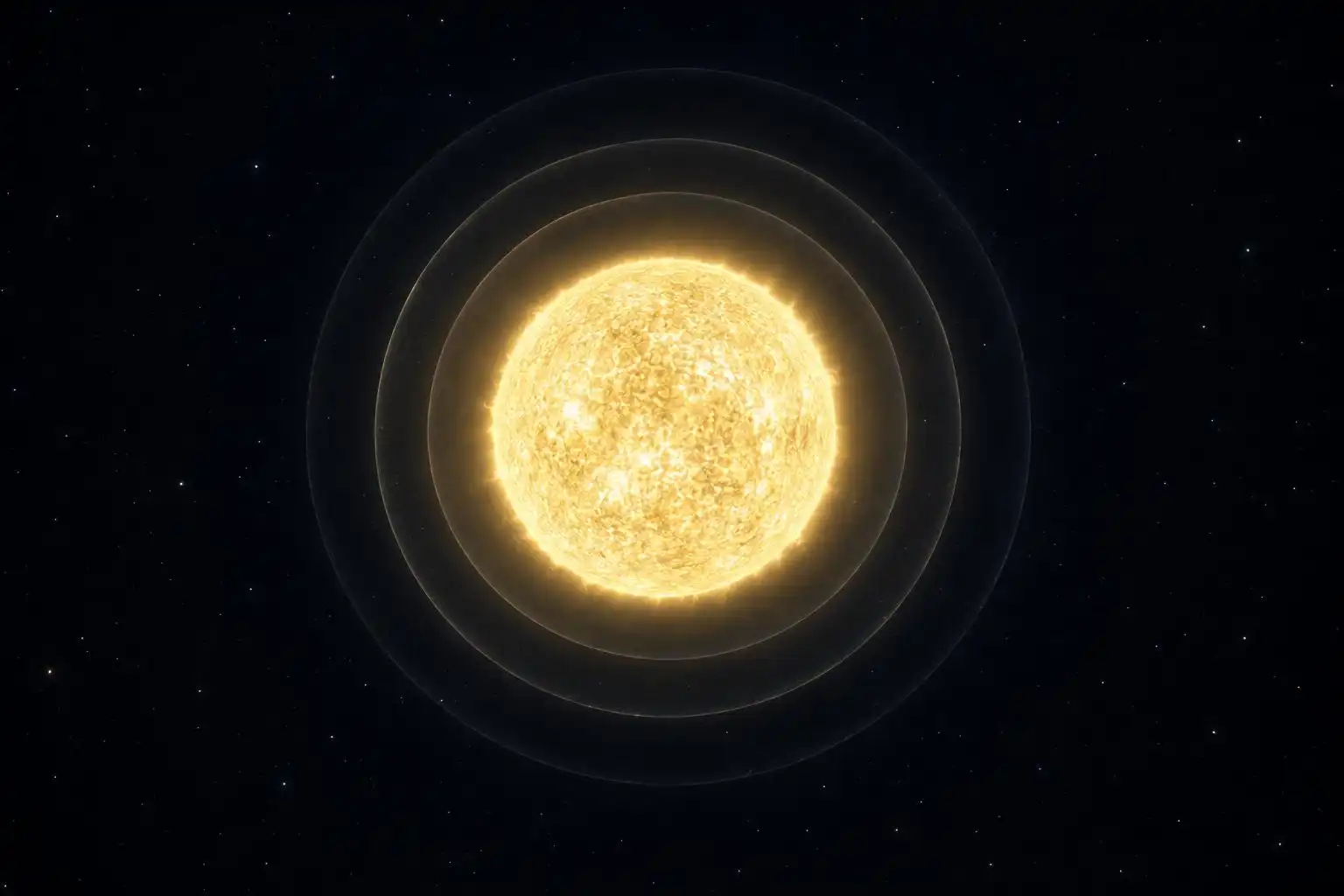

A star that expands should cool; a cooler star should contract. That sounds like a recipe for settling into equilibrium, not for repeating the same motion every few days. Yet Delta Cephei brightens and fades on a period of about 5.37 days. Its atmosphere moves outward and inward, while its temperature and luminosity change with the cycle. What keeps feeding energy into the motion?
The answer is a thin layer of helium beneath the visible surface. It behaves less like a spring than a heat valve: at the right point in the cycle, it briefly holds back energy flowing outward from the star. That delay is enough to turn a small disturbance into a sustained pulsation.
A giant with a five-day clock
Delta Cephei is an evolved star of roughly 4–5 solar masses, with a mean radius near 40–45 solar radii and a luminosity around 2,000 times the Sun’s. Its spectral type changes approximately from F near maximum light to G near minimum light. On a Hertzsprung–Russell diagram, it lies above the main sequence in the instability strip, where some stars pulsate rather than remain steady.
Its period reflects the time it takes the star to respond to gravity. To first approximation, a pulsation period scales as √(R³/GM), where R is radius and M is mass. A large, diffuse star therefore has a slower clock than a compact one. That scaling explains why a giant can pulse over days, but it does not explain why the motion survives. Without a source of driving, the oscillation would lose energy.
Helium makes an unusual heat valve
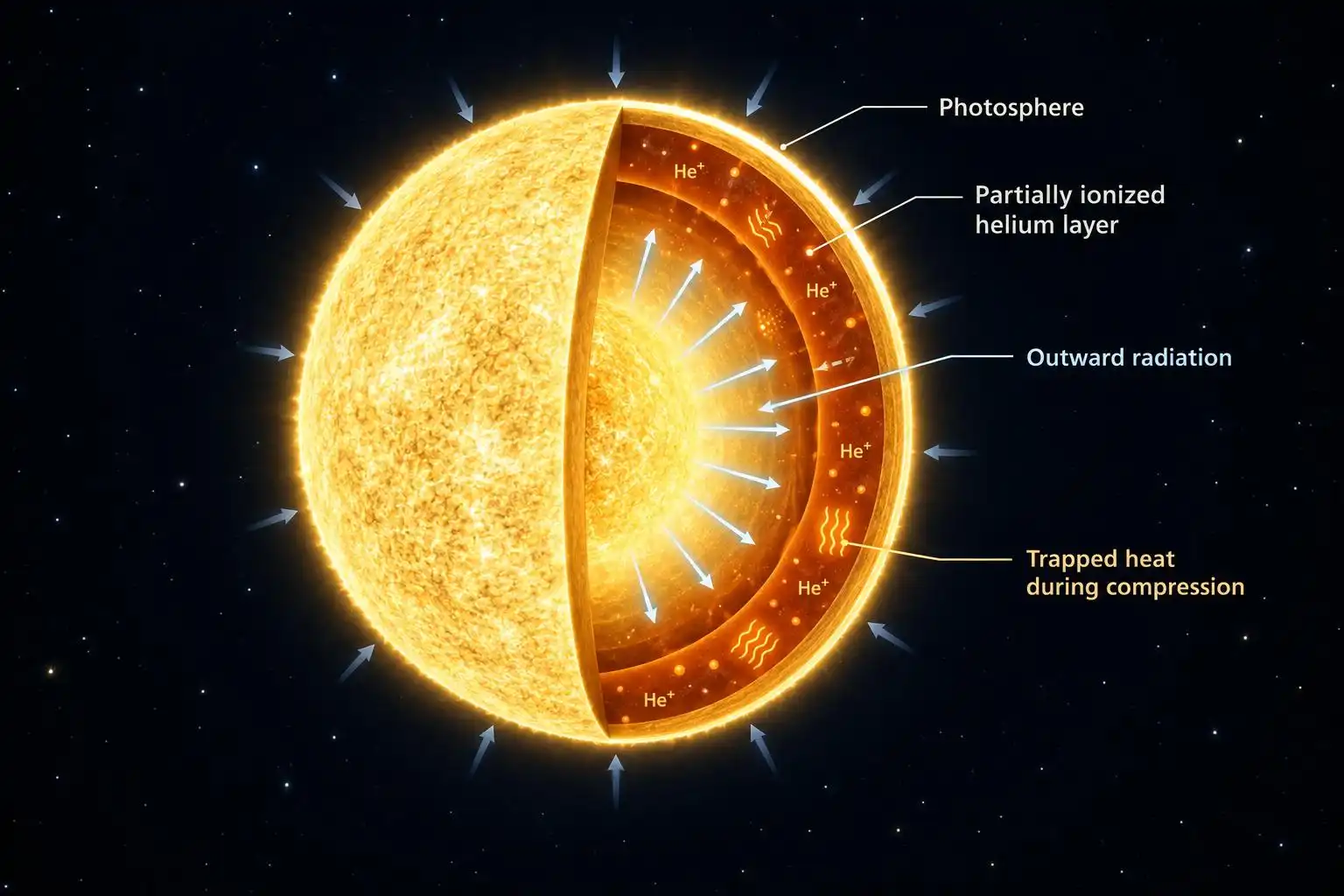
A short distance below Delta Cephei’s photosphere, temperatures reach several tens of thousands of kelvin. Here, helium is partly ionized: some atoms have lost one electron, while others have lost both. Compression supplies energy that can strip away that second electron instead of simply raising the gas temperature. This partial-ionization zone has an unusual response to heating and squeezing.
Crucially, its opacity—the difficulty radiation has in passing through it—rises during the appropriate part of compression. Energy continues arriving from deeper inside the star, but less gets out. Heat accumulates in the layer. As the star begins to expand, that stored energy helps push outward, doing mechanical work on the oscillation. The process is called the κ mechanism, using the conventional symbol κ for opacity.
Timing matters. If the layer released its heat immediately, it could not give the expanding gas much of a push. If it held the heat for far longer than a cycle, the energy would arrive too late. In a Cepheid, the thermal response of the helium-ionization zone is sufficiently close to the pulsation period for the heat flow to reinforce the motion.
Why not every giant pulses
A star must place that heat valve at a useful depth. On the hot side of the instability strip, the relevant ionization zone sits too close to the surface: its thermal response is too fast to drive the pulsation effectively. Toward the cool side, deepening convection transports energy and tends to damp the oscillation. The strip is therefore a range of stellar structures, not a special temperature at which helium suddenly appears.
Evolution brings suitable stars through that range. Many classical Cepheids cross it during a blue loop, when an intermediate-mass star burning helium in its core moves temporarily toward higher surface temperatures on the Hertzsprung–Russell diagram. The core supplies the long-term luminosity; the helium-ionization layer in the outer envelope regulates the short-term pulsation. These are distinct jobs in distinct parts of the star.
What the period tells us
Cepheids’ periods are useful because their clocks encode their sizes. At similar surface temperatures, a more luminous Cepheid generally has a larger radius, and a larger radius means a longer pulsation period. Stellar evolution supplies the accompanying relationship between mass and luminosity. Together, those facts underpin the observed period–luminosity relation used to estimate astronomical distances.
There is a subtle observational warning here: maximum light does not simply mean maximum radius. Temperature changes strongly affect the emerging light, particularly in visible bands, so brightness and size need not peak together. Delta Cephei’s cycle is not a star alternately switching its nuclear furnace on and off. It is an envelope repeatedly storing and releasing a small fraction of the energy already flowing through it—and giving itself a push at just the right time.


Leave a Reply
You must be logged in to post a comment.