
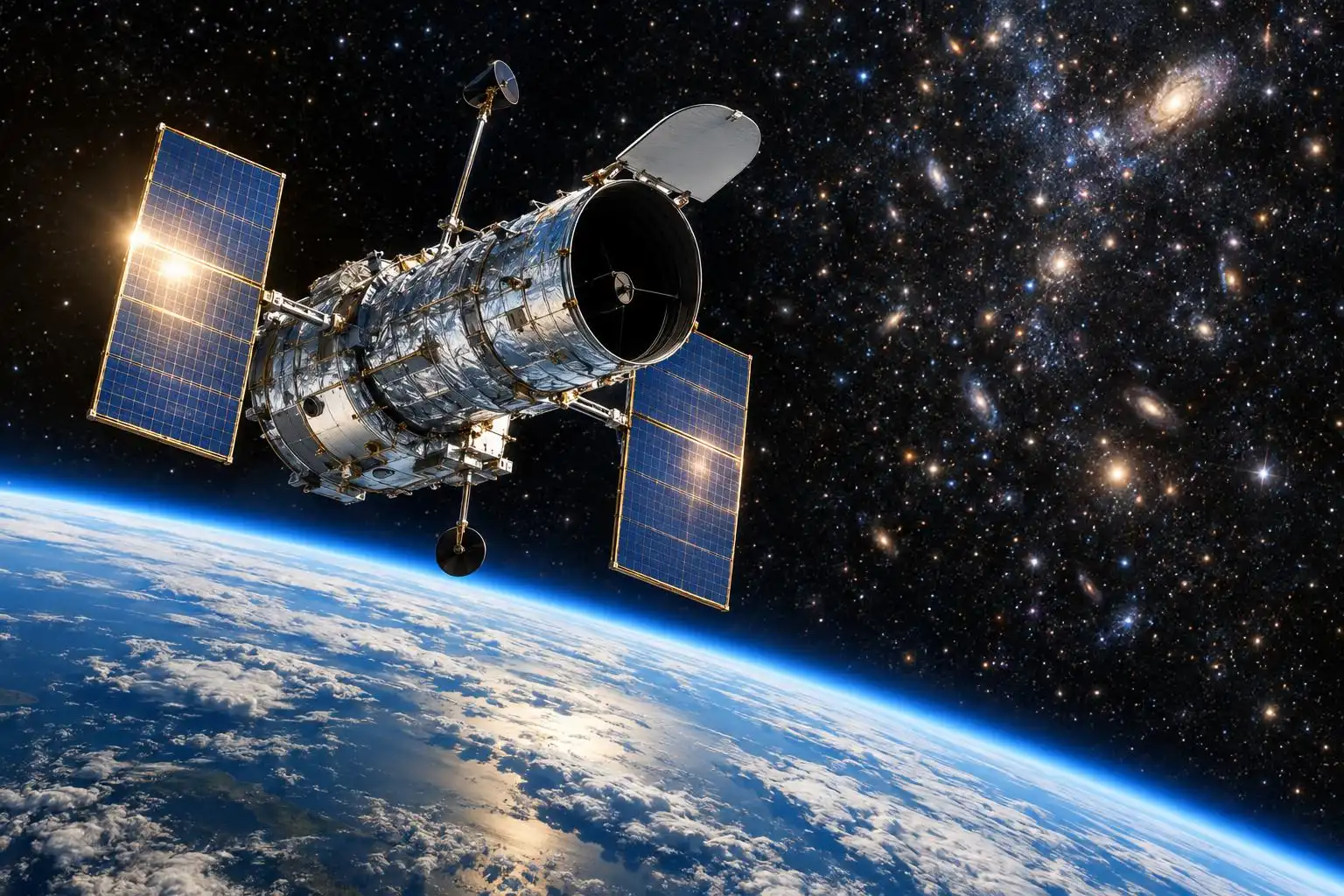

A faint galaxy cannot be photographed sharply if the camera wanders while its shutter is open. For the Hubble Space Telescope, holding still is not a matter of bolting a tripod to the ground. The observatory circles Earth roughly every 95 minutes, slews between targets, and must keep its instruments aimed while its own equipment generates tiny disturbances. The difference between a crisp exposure and a smeared one can be a fraction of an arcsecond.
Hubble solves this with two systems that do different jobs. Gyroscopes tell the spacecraft how its orientation is changing. Fine Guidance Sensors watch stars and provide a precise reference for where it is pointing. In 2024, a troublesome gyro forced NASA to rely on a mode that uses just one. The telescope could still do science, but the change exposed how much work lies between finding a target and staying on it.
Gyroscopes Tell Hubble When It Moves
Hubble launched in 1990 with six gyroscopes. They measure rotation about the telescope’s axes; they do not take pictures of the sky, and they do not turn the spacecraft themselves. Their readings help the control system estimate how far and how quickly Hubble has moved. Four reaction wheels supply the torque for slews and small pointing corrections, while magnetic torquers help manage accumulated wheel momentum.
The distinction matters during a slew. Before Hubble can lock onto guide stars near a new target, it needs to know approximately where it is and how it is turning. Gyros provide continuous motion measurements that help bridge that interval. Other attitude sensors, including star trackers and Sun sensors, provide additional references, but they cannot simply replace a gyro’s continuous rate measurement in every part of an observing sequence.
A gyro is also a wear item in a machine built to work for decades. Astronauts replaced all six of Hubble’s gyroscopes during the final shuttle servicing mission in 2009. That visit bought years of observing time, not immunity from failure. By 2024, one remaining operational gyro was intermittently reporting faulty high rotation rates. The telescope was not actually spinning at the rates it claimed, but a control system must treat suspect attitude data seriously.
Guide Stars Provide the Fine Reference
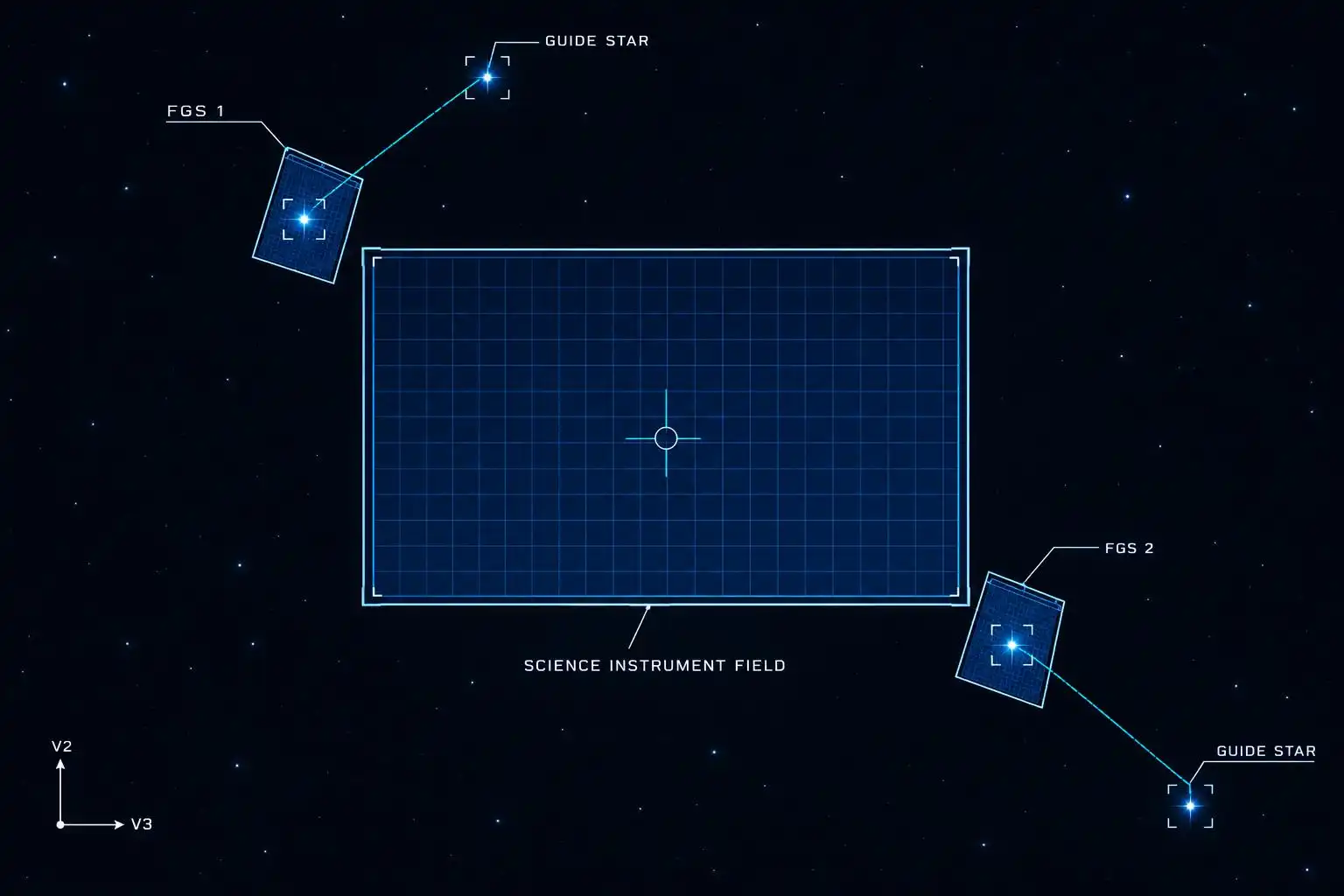
Once Hubble reaches a target, its Fine Guidance Sensors take on the most delicate part of the job. Three sensors share the focal plane around the telescope’s 2.4-meter primary mirror. Typically, two lock onto guide stars while the science instruments observe; the third can be used for astrometry. The sensors detect tiny changes in the apparent positions of their stars, giving the pointing system feedback that a gyro alone cannot provide.
This is why choosing a patch of sky to observe involves more than checking whether a galaxy is visible. Mission planners must also find suitable guide stars in the appropriate sensor fields. A guide star that is too faint, unsuitable for reliable tracking, or unavailable at the required orientation can complicate an observation before the science camera ever begins an exposure.
Under normal fine-guidance operation, Hubble can hold its pointing to about 0.007 arcseconds. That figure is easier to appreciate beside the mirror: engineers built a 2.4-meter light collector, launched it above the atmosphere, then gave it a control system capable of keeping a distant star nearly fixed on a detector. The mirror gathers the photons; the guidance system stops them from being spread across the image.
Why One Working Gyro Changes the Schedule
In June 2024, NASA announced that Hubble would operate in one-gyro mode and keep another functional gyro in reserve. This was not an improvised response to a single bad reading. Engineers had developed reduced-gyro operating modes long before they were needed, including a two-gyro mode used prior to the 2009 servicing mission.
With only one gyro in use, Hubble depends more heavily on its other sensors to establish its attitude before the Fine Guidance Sensors acquire guide stars. Acquisitions and slews can take longer. Some observations become harder to schedule, and some targets—particularly moving objects—face tighter restrictions. Less of each day can go toward collecting science data.
One-gyro mode does not mean that every exposure becomes blurry. Once the guide stars are acquired and the telescope is tracking, the Fine Guidance Sensors can still deliver precise pointing. The main penalty lies in getting into that state, maintaining the required safety margins, and fitting observations into an orbit already interrupted by Earth blocking the view.
That distinction is easy to miss when looking at a finished image. A single Hubble picture may depend on multiple exposures taken across several orbits, each requiring the telescope to recover the target and reacquire guidance. A slower setup costs observing time even if the exposures that follow are excellent.
A Serviced Telescope Meets Its Limits
Hubble’s pointing system is a record of an unusual bargain. Its hardware was built with redundancy, and the shuttle made replacement possible. Astronauts could swap out failed components instead of accepting that one aging part would end the mission. The 2009 gyro replacement was part of that bargain; so was the painstaking work of planning for fewer gyros when redundancy inevitably thinned.
There is no shuttle servicing flight waiting in the wings now. Conserving a working gyro as a spare is therefore more than a scheduling choice. It is a way of preserving another option if the gyro in use fails, at the cost of some observing efficiency today.
For the astronomer receiving the data, a successful guide-star lock may appear as little more than a clean, sharp exposure. For the people operating Hubble, it is the satisfying end of a chain: sensors establish attitude, wheels turn a massive observatory, guide stars come into view, and the pointing settles. Only then can the telescope do the quiet thing it was built to do—hold still while the light arrives.


Leave a Reply
You must be logged in to post a comment.