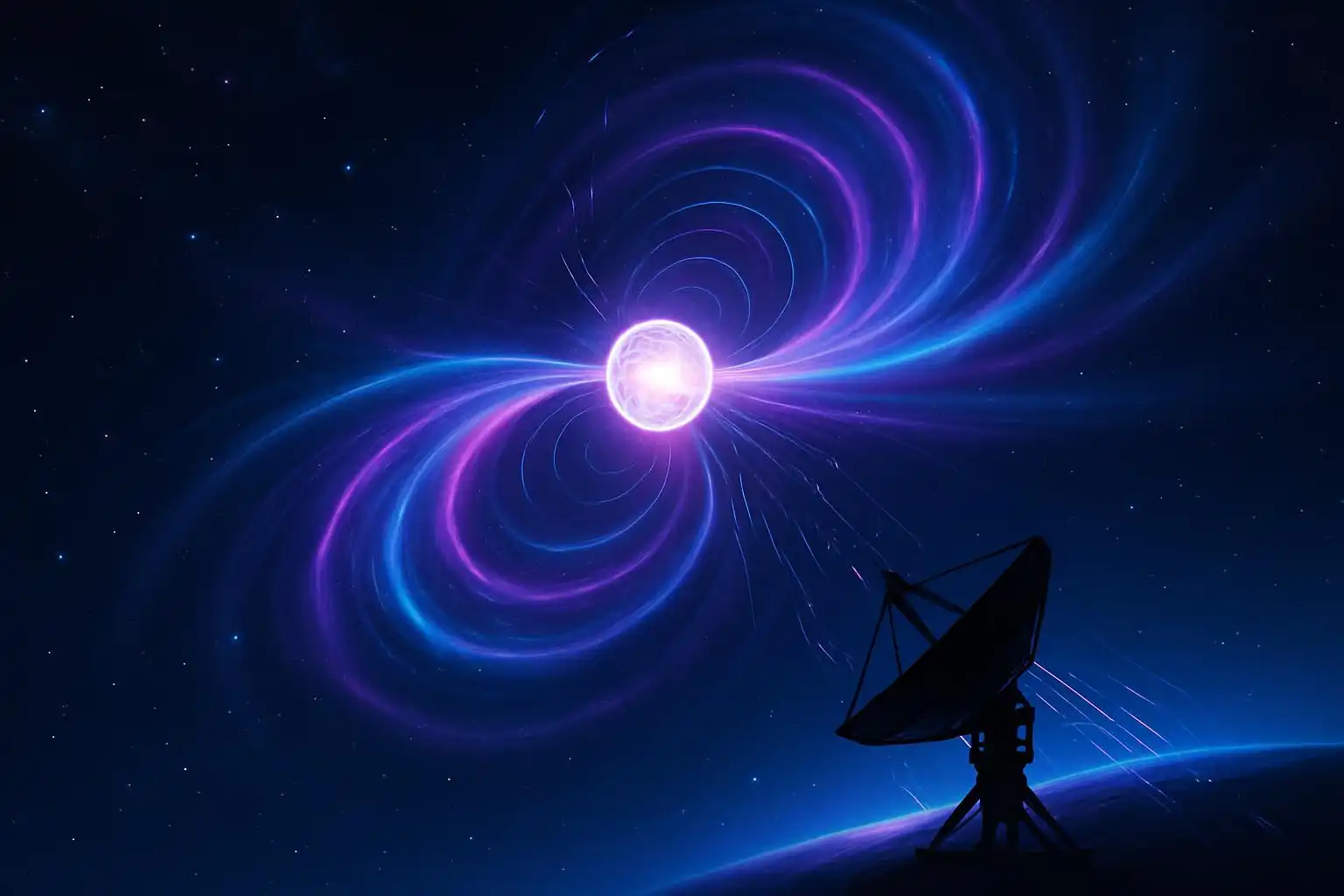

You know that feeling when your phone blows up with notifications at 3 a.m. and you’re like, “Who is texting me right now?” That’s basically how astronomers felt in 2007 when they first spotted fast radio bursts—FRBs for short—these millisecond-long blasts of radio energy coming from deep space that are so bright, so sudden, and so weird that the first reaction was: “Is someone trying to reach us?”
Spoiler: They’re not. But the fact that we even had to ask tells you everything about how FRBs mess with our heads.
The Cosmic Notification You Can’t Ignore
Fast radio bursts are exactly what they sound like: insanely powerful pulses of radio waves that last anywhere from a fraction of a millisecond to a few milliseconds. In that blink-and-you-miss-it window, a single FRB releases as much energy as the Sun puts out in days. Some are one-offs, like a cosmic drive-by. Others repeat, like that friend who keeps sending you TikToks at 2 a.m.
The first FRB—FRB 010724, now affectionately called the “Lorimer Burst” after astronomer Duncan Lorimer—was discovered in 2007, buried in archival data from the Parkes radio telescope in Australia. It had actually happened in 2001, but nobody noticed until Lorimer and his team went digging through old observations. Imagine finding a six-year-old voicemail from an unknown number that just screams static for three milliseconds and then hangs up. What do you even do with that?
Since then, we’ve detected hundreds of FRBs. They come from all over the sky, many from millions to billions of light-years away, and we still don’t have a single, settled explanation for what causes them. Which is both thrilling and maddening, like a mystery box that keeps arriving at your door with no return address.
Why They’re Not a Song (Even Though Your Brain Wants Them to Be)
Here’s the thing: FRBs are not music. They’re not a signal. They’re not the universe’s way of humming a tune. I know the term “radio burst” makes it sound like you could tune in on your car stereo and catch some intergalactic banger, but radio waves in astronomy are just a type of light—electromagnetic radiation with longer wavelengths than visible light. Our eyes can’t see them; our ears can’t hear them. Radio telescopes convert them into data, not sound.
But because FRBs are so rhythmic—some repeat with eerie regularity, like FRB 20180916B, which has a roughly 16.35-day activity cycle with bursts clustered in an active window—our brains want to hear a pattern. We’re wired to find meaning in repetition. It’s the same reason you think your Spotify shuffle is “playing favorites” when it’s actually random. (It’s not. You just notice the coincidences.)
If you did somehow convert an FRB into sound, it wouldn’t be melodic. It’d be more like a sharp, violent crack—a cosmic thunderclap. Think the sound effect from the THX logo before a movie, but compressed into a millisecond and cranked to eleven. Not exactly Billboard Hot 100 material.
What’s Actually Going On (Probably)
So if FRBs aren’t alien DJs, what are they?
The leading theory involves magnetars—neutron stars with magnetic fields so obscenely strong they make your refrigerator magnet look like a Post-it note. A neutron star is already bonkers: the collapsed core of a dead massive star, squeezed down to the size of a city but packing more mass than the Sun. A teaspoon of neutron-star stuff weighs about a billion tons. That’s roughly the mass of every car on Earth, crammed into something the size of a sugar cube.
Now take that and crank the magnetic field up by a factor of a thousand. That’s a magnetar. Its magnetic field is so intense it can warp the quantum vacuum around it and would be catastrophically dangerous to ordinary matter if you got too close. (Don’t get too close.)
When a magnetar’s crust cracks—like a starquake, but way more metal—it can unleash a colossal burst of energy. Some of that energy gets funneled along the magnetic field lines and blasted out as radio waves. Boom: FRB. We actually caught one red-handed in April 2020, when a magnetar in our own galaxy—SGR 1935+2154, about 30,000 light-years away—let off an FRB that our telescopes picked up. It was the smoking gun we’d been waiting for.
But here’s the kicker: not all FRBs fit the magnetar model. Some are too bright. Some repeat in ways that don’t make sense if it’s just a cracking crust. Some seem to come from regions with way too much gas and dust around them. So magnetars are probably part of the story, but maybe not the whole story. Other candidates include colliding neutron stars, black holes snacking on nearby matter, or some exotic physics we haven’t dreamed up yet.
The Fermi Paradox Walks Into a Bar (and Hears an FRB)
Of course, the moment FRBs hit the news, the internet did what the internet does: “ALIENS?” And look, I get it. The idea that an advanced civilization might be beaming energy across the cosmos—maybe to power interstellar spacecraft, like physicist Avi Loeb has suggested—is cool. It’s the plot of Contact but with more math.
But here’s the thing: if you’re an alien civilization trying to send a message, you’d probably want it to be, you know, decipherable. FRBs are chaotic, inconsistent, and come from random directions. They don’t encode information in any obvious way. They’re more like cosmic fireworks than a carefully crafted telegram.
Plus, we’ve now seen FRBs from galaxies billions of light-years away. For the most distant ones, if those are alien signals, they were sent when the universe was, like, half its current age. That’s a long time to wait for a reply. Even the worst texter you know would’ve given up by then.
So yeah, FRBs are almost certainly natural. But the fact that we had to seriously consider the alternative? That’s the Fermi paradox in a nutshell. We’re out here scanning the cosmos, hoping for a sign of life, and every weird blip makes us wonder, “Is this it?” Spoiler: it usually isn’t. But we keep looking, because the one time it is? That’s the ballgame.
Why You Should Care (Even If You’re Not an Astronomer)
Here’s the thing about FRBs: they’re not just cosmic curiosities. They’re actually useful. Because these bursts travel billions of light-years through space, they pick up information about everything they pass through—gas, plasma, magnetic fields, the whole intergalactic medium. By studying how the radio waves get stretched and dispersed, we can map out the universe’s structure in ways we couldn’t before. FRBs are like cosmic X-rays, revealing the hidden scaffolding of space.
And every time we detect a new one, we’re reminded that the universe is still full of surprises. We’ve been doing astronomy for thousands of years, and we’re still finding phenomena that make us go, “Wait, what?” That’s not a bug; it’s a feature. The universe doesn’t owe us easy answers.
The Punchline
Fast radio bursts are not a song. They’re not a message. They’re probably not aliens (sorry). But they are a reminder that the cosmos is stranger, more violent, and more fascinating than we ever imagined. They’re the universe’s way of saying, “You thought you had me figured out? Cute.”
And honestly? I’m here for it. Because every FRB we detect is another clue in the biggest mystery we’ve got: what’s actually out there, and how does it all work?
So the next time your phone goes off at 3 a.m., remember: somewhere out there, a magnetar just cracked its crust, a blast of radio energy is tearing through space at the speed of light, and we’re lucky enough to be here, with our telescopes pointed up, ready to catch it.
The universe is calling. We’re just learning how to listen.



Leave a Reply