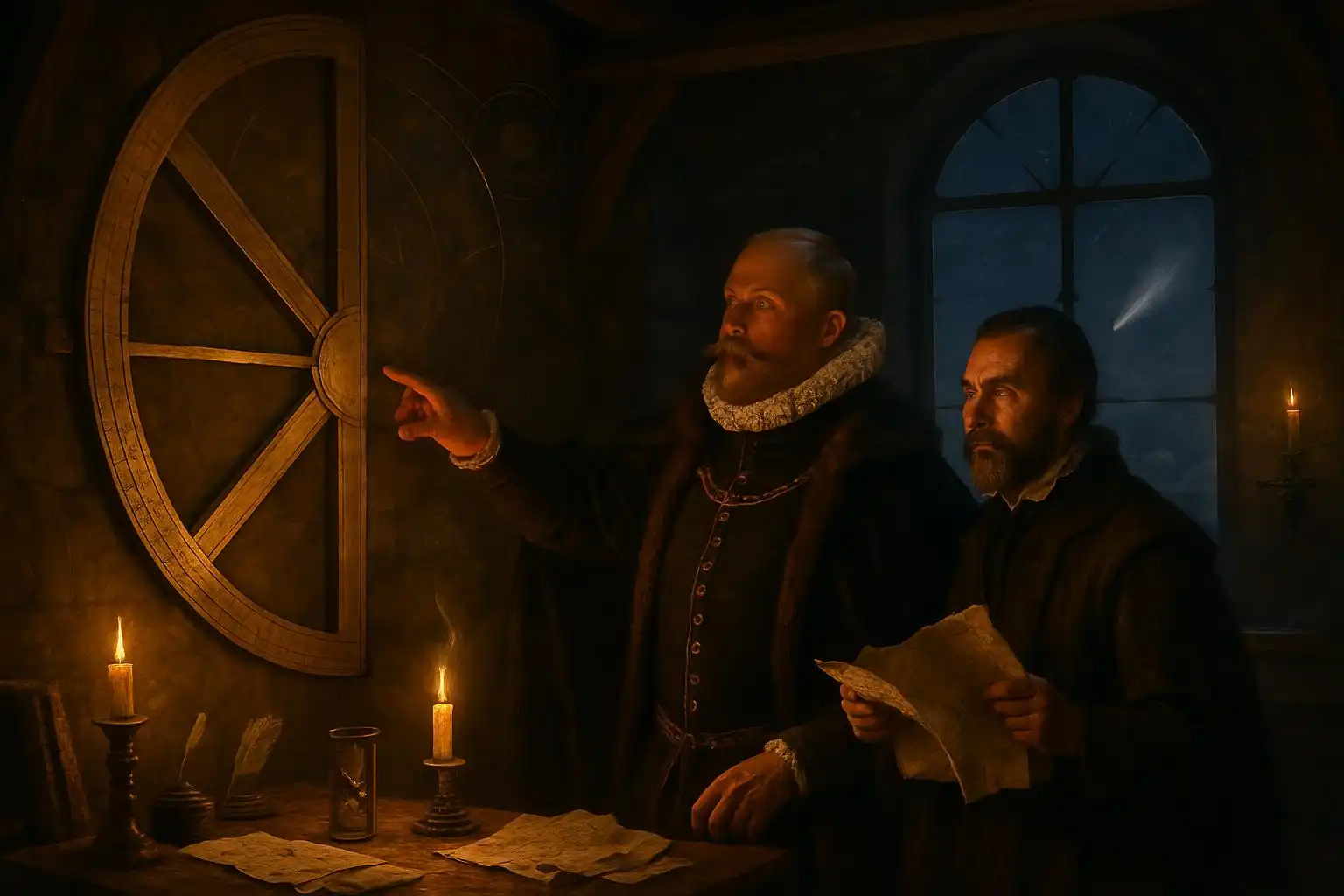

On the morning of February 4, 1600, Johannes Kepler climbed the stone steps of Benátky Castle, twenty-two miles northeast of Prague, carrying a single leather satchel and a letter of introduction he had rewritten three times. Through the narrow windows he could see the Bohemian countryside still locked in winter, the Jizera River a gray ribbon below. Inside, in a high-ceilinged chamber warmed by a tile stove, sat Tycho Brahe—fifty-three years old, mustache waxed to sharp points, the prosthetic nose that replaced the one he’d lost in a duel glinting in the firelight. Between them, unspoken, lay the most precise record of planetary motion ever compiled, locked in Tycho’s cabinets and memory, and a question that would consume the next decade: what path does Mars actually follow across the heavens?
Kepler was desperate. The Lutheran school where he had taught mathematics in Graz had been closed by Catholic authorities; his wife Barbara was pregnant and ill; his salary was nine months in arrears. He needed work. Tycho needed a calculator—someone to wrestle his decades of observations into the theoretical framework that would secure his legacy. The Tychonic system, published in 1588, was an elegant compromise: the Sun and Moon orbited Earth, but the five planets orbited the Sun. It preserved a stationary Earth while explaining Mercury’s limited elongation. Tycho believed his data would prove it. He had not counted on Kepler’s stubbornness, nor on the particular devil hiding in the motion of Mars.
The instrument that made everything possible stood in Tycho’s observatory on the island of Hven, where he had ruled for two decades before a dispute with the Danish king sent him into exile. The great mural quadrant, mounted permanently on a north-south wall, was a ninety-degree arc of brass nearly six feet in radius, its edge divided into minutes of arc—each degree split into sixty parts, each readable to within half a minute. Tycho had designed it himself, commissioning the finest craftsmen in Augsburg, supervising the engraving of the scale, the balancing of the sighting arm. An observer lay on his back on a curved bench, eye to the sights, calling out the moment a star or planet crossed the meridian. An assistant read the angle from the scale by candlelight. Night after night, year after year, Tycho and his team had measured the heavens with a precision ten times better than any predecessor—accurate to two minutes of arc, one-fifteenth the width of the full Moon.
In the basement of Benátky, Tycho kept the logbooks. Thick volumes in his own hand and those of his assistants, recording thousands of observations: the altitude of Mars on September 12, 1593; Jupiter’s position on November 3, 1595; the comet of 1577, tracked across sixty degrees of sky, proving it moved beyond the Moon and shattering Aristotle’s crystal spheres. Tycho guarded them jealously. He had spent a fortune—first the Danish crown’s, then his own, then the Holy Roman Emperor’s—building Uraniborg and Stjerneborg, the twin observatories on Hven, equipping them with quadrants, sextants, armillary spheres, celestial globes. The data was his capital, and he rationed it carefully.
Kepler received Mars.
It seemed a reasonable assignment. Mars was bright, easily observed, and its retrograde loops were pronounced—a good test case for any planetary theory. Tycho himself had wrestled with Mars for years, trying to fit it into his system, adjusting epicycles and equants. He estimated the work would take Kepler eight days. “I confess,” Kepler wrote years later in the introduction to Astronomia Nova, “that when Tycho died, I quickly took advantage of the absence, or lack of circumspection, of the heirs, by taking the observations under my care, or perhaps usurping them.” But that was later, after Tycho’s sudden death in October 1601, following days of urinary illness and uremia. In the spring of 1600, Kepler had only a few dozen Martian observations and a problem he did not yet understand.
The problem was this: Mars refused to move in a circle. Not quite. Kepler began with the traditional tools—circles upon circles, the epicycle-and-deferent machinery inherited from Ptolemy and refined by Copernicus. He placed the Sun at the center and Mars on an epicycle, adjusting the sizes, the speeds, the angles. He could match Tycho’s observations to within eight minutes of arc. Eight minutes—a quarter of the Moon’s width, invisible to the naked eye, well within the tolerance of any observer before Tycho. Kepler could have stopped. He could have declared victory, published his theory, claimed his place among astronomers. Instead, he wrote one of the most consequential sentences in the history of science: “Since divine goodness has given to us in Tycho Brahe a most careful observer, from whose observations the error of eight minutes in this calculation of Mars is shown, it is fitting that we recognize and honor this gift of God with a grateful mind… These eight minutes alone will lead the way to the reformation of all astronomy.”
Eight years of work followed. Not eight days—eight years. Kepler tried seventy different circular combinations. He invented the “vicarious hypothesis,” a model that predicted Mars’s longitude perfectly but failed for latitude and distance. He abandoned the equant, then reluctantly brought it back. He moved the center of Mars’s orbit away from the Sun, then struggled to explain the planet’s varying speed. He filled notebooks with calculations, each line a trigonometric labor—no logarithms yet, no calculus, just sines and cosines computed by hand from tables. He wrote to his former teacher Michael Maestlin, to the Imperial Councillor Herwart von Hohenburg, explaining his progress, his frustrations. “My opinion of Mars is that… the orbit is not a circle but an oval figure,” he wrote in July 1603. But what oval? And why?
The breakthrough came in stages, and from an unexpected direction. Kepler realized that Mars moved faster when closer to the Sun and slower when farther away—not in the arbitrary way demanded by epicycles, but in a precise relationship. He imagined a force emanating from the Sun, pushing the planets along their paths, weakening with distance. It was wrong in detail—Kepler thought the force was like light, spreading out in a plane rather than through space—but it led him to a correct mathematical law: a line from the Sun to Mars sweeps out equal areas in equal times. This was the second law, though he discovered it before the first. Armed with this principle, he could calculate where Mars should be at any moment. But the calculations were brutal. To find a single position required summing infinitesimal triangular areas, an approximation to what would later be called integration. Kepler divided Mars’s orbit into 360 parts and summed them one by one.
And still the orbit was wrong. The distances didn’t match. Kepler tried an egg shape, with the narrow end pointing toward the Sun. Closer, but not right. He tried variations, adjustments, epicycles on his oval. Nothing worked. In desperation, in the spring of 1605, he returned to a calculation he had abandoned months earlier. He had been approximating an oval with a circle of slightly smaller radius, using the difference to simplify the arithmetic. Now he checked the approximation more carefully. The shape he had been assuming, the shape hidden in his calculations, was not an oval at all. It was an ellipse—a specific, well-defined curve, one of the conic sections the ancient Greeks had studied, with the Sun not at the center but at one focus.
He tested it against Tycho’s observations. Mars on opposition in 1593, in 1595, in 1600. The quadrature positions, when Mars stood ninety degrees from the Sun. The retrograde loops. Every measurement, to within the precision of Tycho’s instruments. The ellipse fit. “I have the answer,” Kepler wrote in a letter to David Fabricius in July 1605. “The orbit of the planet is a perfect ellipse.”
Fabricius, a careful astronomer himself, was appalled. Ellipses were messy, asymmetric, philosophically unsatisfying. Surely Kepler could add another epicycle or two and preserve the ancient perfection of the circle? Kepler could have. But he had spent eight years in the wilderness of Mars, and he had learned to trust Tycho’s numbers more than Aristotle’s aesthetics. “I have cleared the Augean stables,” he wrote in the dedication of Astronomia Nova to Emperor Rudolf II, comparing his labor to that of Hercules. “I have prepared a vehicle for the contemplation of the heavens.”
Astronomia Nova, the New Astronomy, was published in 1609, nine years after Kepler climbed the steps at Benátky. It is a strange book, part technical treatise, part memoir, part argument with the reader. Kepler left in the false starts, the dead ends, the seventy failed hypotheses. He wanted to show how he had arrived at the truth, not simply to announce it. The first law—that planets move in ellipses with the Sun at one focus—appears almost casually, buried in Chapter 58. The second law, the equal-area rule, is scattered across several chapters, never quite stated in the clean form we teach today. Kepler was not writing a textbook. He was narrating a struggle, a decade-long wrestling match with the most precise data ever gathered and the question of what it meant.
The irony is that Tycho’s own system, the compromise he hoped his observations would vindicate, could not survive those observations. The Tychonic model required Mars to move in a circle around the Sun, which in turn moved in a circle around Earth. But Mars did not move in a circle. The eight-minute discrepancy that Kepler could not ignore was the eight-minute discrepancy that doomed Tycho’s cosmos. The instrument Tycho built to prove his theory instead provided the evidence to undermine it—and, incidentally, to powerfully support the Copernican hypothesis, though in a form Copernicus would scarcely have recognized. Kepler’s ellipses were not the stately circles of De Revolutionibus. They were stranger, more particular, the signature of a universe governed not by geometry alone but by physical force.
The mural quadrant itself was lost. When Tycho fled Hven in 1597, he transported many of his instruments; those that remained behind or were later dispersed met various fates, and the great fixed quadrant did not survive. But the logbooks endured, and the numbers in them, and Kepler’s willingness to believe those numbers even when they contradicted two thousand years of circular orthodoxy.
What does the story of Kepler and Mars reveal about how science works? Not the tidy narrative of hypothesis, experiment, conclusion we sometimes teach, but something messier and more human. It shows the role of precision: that two minutes of arc, a difference invisible to the unaided eye, can be the difference between truth and comfortable error. It shows the necessity of stubbornness: Kepler could have stopped at eight minutes and been celebrated; instead he spent eight years chasing a discrepancy no one else would have worried about. It shows the accident of patronage and personality: if Tycho had been more generous with his data, if Kepler had been less desperate for employment, if the Graz school had remained open, the ellipse might have waited another generation. And it shows the strange fate of instruments and their makers: that Tycho Brahe, who believed Earth stood still at the center of creation, built the tool whose data would be turned against that belief, and that the observations gathered to defend one cosmos became the foundation of another.
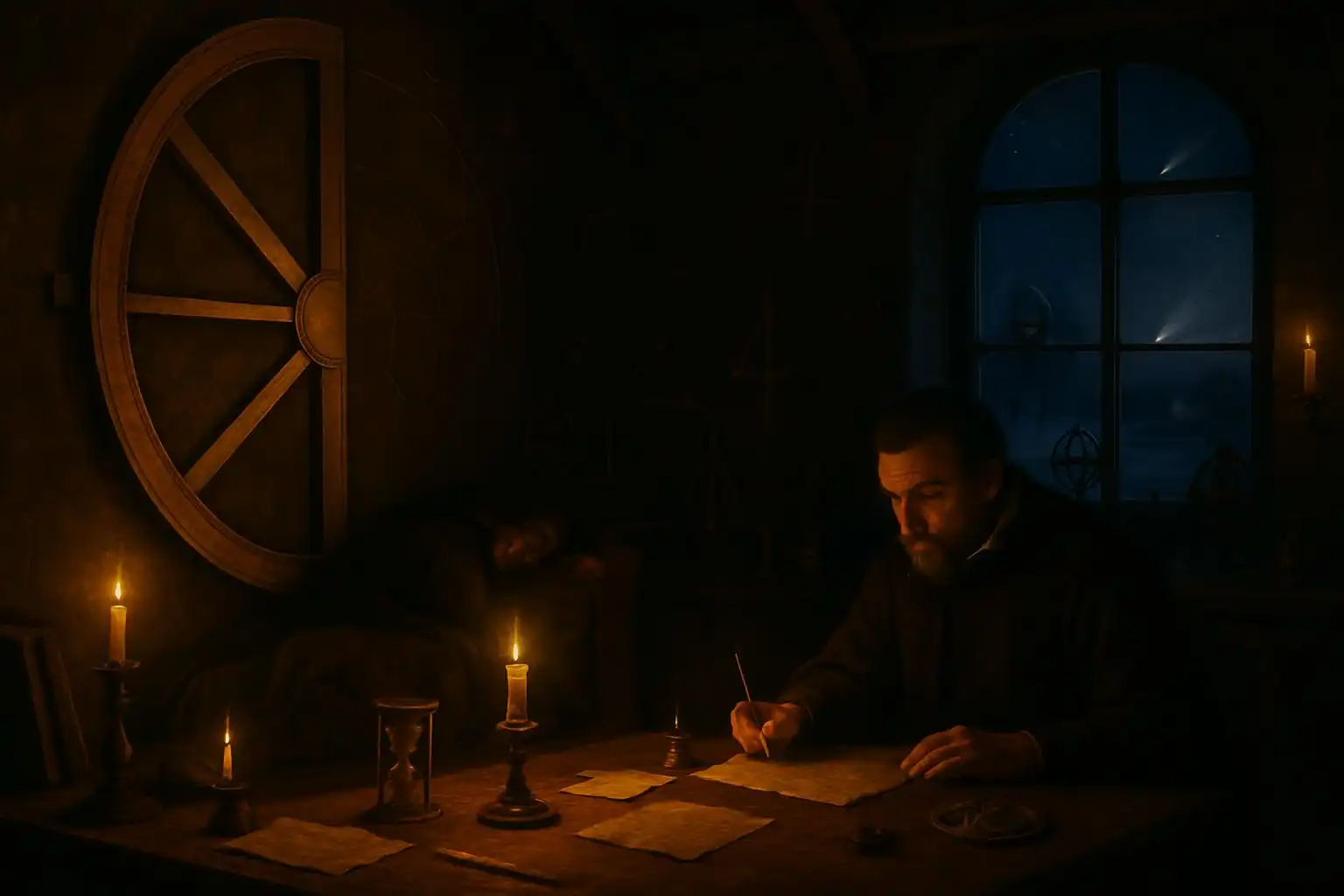
On Kepler’s desk in Prague, in the winter of 1605, lay a stack of papers covered in numbers—longitudes, latitudes, distances, all measured from a wall in a Danish observatory that no longer existed, recorded by a man two years dead, describing the motion of a red planet that, it turned out, traveled not in the perfect circles of Aristotle’s heaven but in an ellipse, forever falling toward the Sun and forever missing. The numbers were all that remained. But the numbers, in the end, were enough.


Leave a Reply