
The Day the Dish Fell
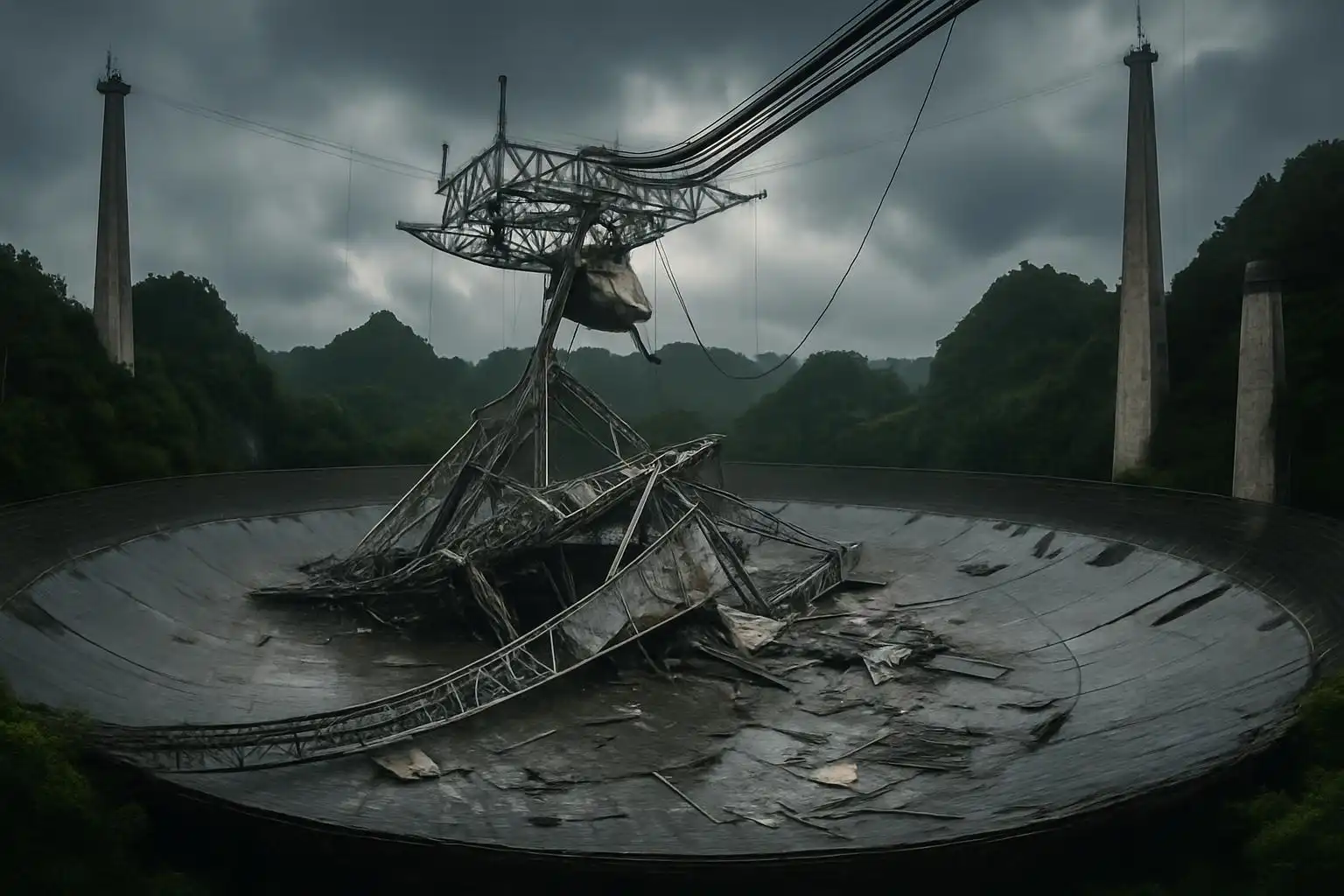
On December 1, 2020, the 900-ton instrument platform of the Arecibo Observatory in Puerto Rico fell 450 feet onto the 305-meter reflector dish below. The collapse was catastrophic and, according to the engineers who had been monitoring the structure for months, not entirely surprising. What followed was a reckoning — not just about aging infrastructure, but about the institutional decisions, funding shortfalls, and bureaucratic delays that had been quietly accumulating for years inside the National Science Foundation.
This is not a story about radio astronomy. It is a story about who knew the cables were failing, when NSF decided it could not afford to fix them, and what the fight over Arecibo’s replacement reveals about how American science manages — and mismanages — its most iconic instruments.
The Cables, the Cracks, and the Timeline
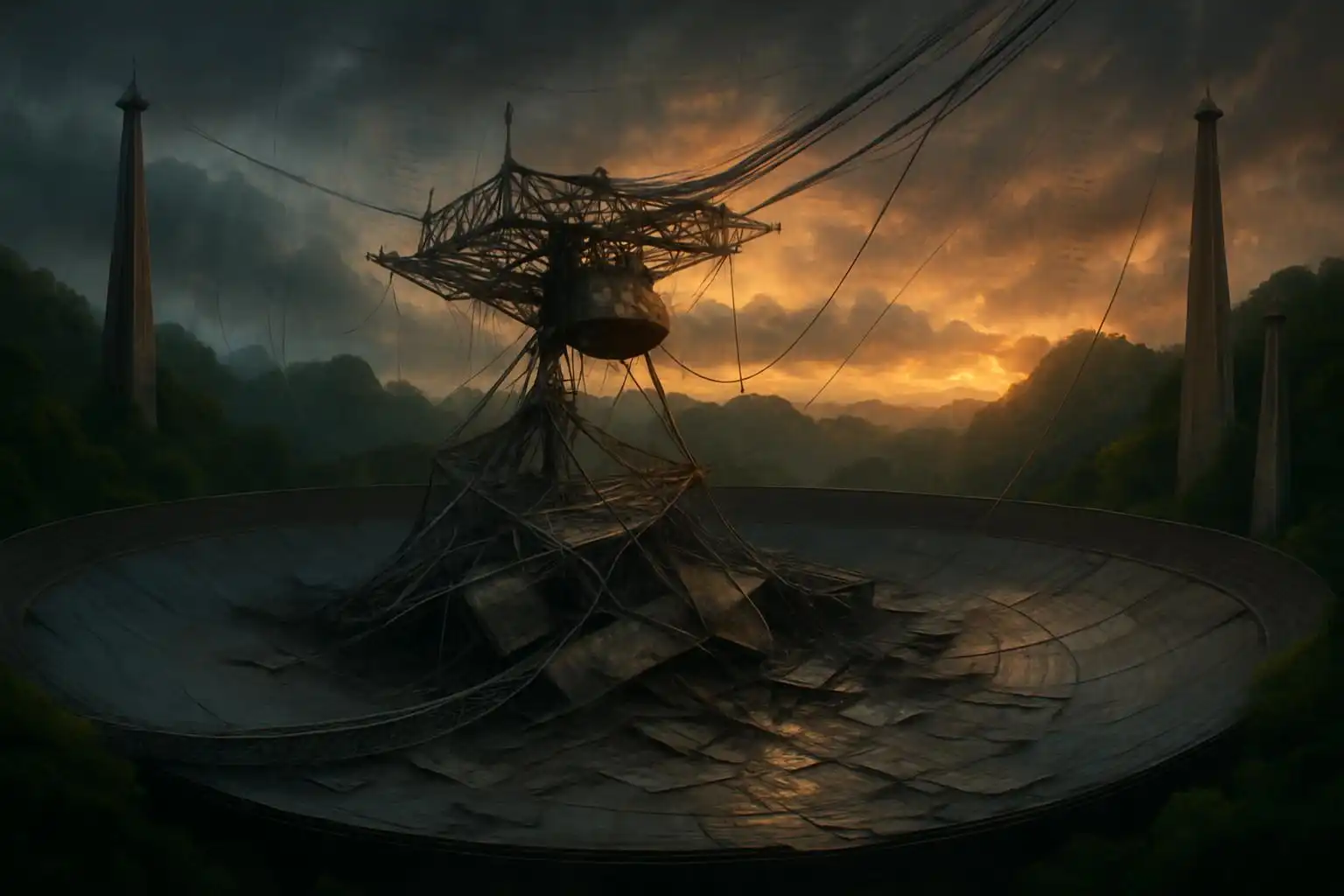
The proximate cause of the collapse was a sequence of failures involving both auxiliary and main cables supporting the platform suspended above the dish. But the structural vulnerabilities at Arecibo were not secrets discovered in the days before the collapse. They were documented, debated, and ultimately deferred for years.
In August 2020, an auxiliary cable slipped from its socket in one of the support towers, tearing a gash in the reflector dish below. NSF commissioned engineering assessments. The University of Central Florida, which managed the facility under a cooperative agreement with NSF, brought in outside firms. The reports were not reassuring. A second cable — this one a main support cable — snapped on November 6, 2020. At that point, engineers from Thornton Tomasetti, the structural firm retained to assess the damage, delivered a stark conclusion: the remaining cables were carrying loads beyond their designed capacity and were at risk of sudden, unpredictable failure. Controlled demolition, they advised, was the only safe option.
NSF announced on November 19, 2020, that it would decommission and demolish the observatory. Twelve days later, before demolition could begin, the structure collapsed on its own.
The question that the astronomy community immediately began asking — and that congressional representatives from Puerto Rico demanded answers to — was not whether the collapse had been handled correctly in those final weeks. It was why Arecibo had been allowed to deteriorate to that point in the first place.
A Decade of Deferred Maintenance
To understand the collapse, you have to go back to the 2010 Decadal Survey, the once-a-decade priority-setting exercise conducted by the National Academies of Sciences, Engineering, and Medicine that effectively sets the agenda for U.S. astronomy funding. The 2010 survey, New Worlds, New Horizons in Astronomy and Astrophysics, did not recommend Arecibo as a top priority for continued major investment. In a budget-constrained environment, that signal mattered.
NSF’s Division of Astronomical Sciences had been wrestling with what insiders called the “portfolio problem” for years: too many aging facilities, not enough money to maintain them all at a world-class level. In 2012, NSF floated the idea of divesting Arecibo entirely — finding another operator or shutting it down — as part of a broader effort to concentrate resources on newer facilities. The proposal triggered fierce pushback from the Puerto Rican scientific community, from astronomers who relied on Arecibo’s unique capabilities for pulsar timing and near-Earth asteroid radar tracking, and from members of Congress.
Senator Bill Nelson of Florida (later NASA Administrator) and Representative José Serrano of New York were among the legislators who pushed back against divestment. Arecibo survived, but with a reduced NSF budget line. By the late 2010s, under divestment arrangements, direct NSF support was being reduced toward roughly $2 million per year — a level that facility managers said was insufficient for the kind of proactive maintenance the aging structure required.
“The funding model for Arecibo was essentially: keep the lights on and hope nothing breaks,” one former facility manager told Science magazine in the weeks after the collapse. “There was no capital reserve for major structural repairs.”
NSF’s November Decision: Defensible or Too Late?
When NSF’s November 19 announcement came, the agency framed it as a responsible response to an acute safety crisis. NSF Director Sethuraman Panchanathan said in a statement that the decision had been “an incredibly difficult one” but that “the safety of workers and visitors” had to come first.
Critics were less charitable. Representative Darren Soto of Florida, whose district includes a significant Puerto Rican constituency, called for a congressional investigation. “We need to understand how we got here,” Soto said at a December 2020 hearing. “Was this a failure of funding, a failure of oversight, or both?”
The engineering record suggests it was both. The auxiliary cable that failed in August 2020 was not original equipment — it had been added in the 1990s as part of an upgrade, and questions had been raised about its long-term load-bearing properties. The main cable that snapped in November was original, installed in the 1960s, and had never been replaced. NSF’s own internal reviews, made public through congressional inquiries, showed that deferred maintenance had been flagged in facility assessments as far back as 2017.
Estimates for major repair or replacement scenarios varied widely and depended on scope; some proposals for full cable replacement and structural reinforcement ran into tens of millions of dollars, with figures as high as $50 million to $100 million discussed for more ambitious work. For context, NSF’s entire budget for astronomical sciences in fiscal year 2020 was approximately $250 million. Such a repair bill, in other words, was not trivial. But it was also not impossible — had the decision to invest been made earlier, before the cables reached the point of imminent failure.
The Fight Over What Comes Next
The collapse of Arecibo did not end the political fight. It redirected it.
Within weeks, Puerto Rican scientists, led by researchers at the University of Puerto Rico at Arecibo and the Ana G. Méndez University system, began advocating for a next-generation facility on the island. The proposal, eventually formalized as the Next Generation Arecibo Telescope (NGAT), called for a phased array instrument that would surpass the original observatory’s capabilities. Early cost estimates ran to $450 million or more.
NSF, for its part, commissioned a study through the Mathematical and Physical Sciences Directorate to assess options for the Arecibo site. The study, released in 2021, outlined several scenarios ranging from a modest educational facility to a full scientific replacement. It carefully avoided recommending a specific path — a hedge that frustrated advocates who wanted a clear commitment.
The 2020 Decadal Survey, Pathways to Discovery in Astronomy and Astrophysics for the 2020s (released in November 2021, after the collapse), did not include a next-generation Arecibo telescope among its top recommended projects. This was a significant blow to NGAT advocates. The survey’s major priorities included technology maturation for a future large infrared/optical/ultraviolet space telescope, later developed under the Habitable Worlds Observatory concept, as well as the U.S. Extremely Large Telescope Program and the CMB-S4 experiment; it also recommended continued development of the ngVLA rather than treating it as one of a simple top-three set. Those projects carried their own multi-billion-dollar price tags, and the committee had been explicit that its recommendations were constrained by realistic budget projections.
“The Decadal Survey process is supposed to be about science priorities,” said one member of the survey’s radio astronomy panel, speaking on background. “But it’s impossible to separate science priorities from politics when you’re talking about a facility that has the symbolic weight Arecibo has.”
The Institutional Lesson
The Arecibo collapse is, at its core, a story about what happens when a scientific institution is allowed to become too important to abandon but not important enough to properly fund. NSF was caught in a trap of its own making: Arecibo’s scientific and cultural significance made divestment politically untenable, but the agency’s constrained budget made adequate maintenance equally untenable. The result was a slow-motion crisis that ended in a very fast collapse.
The lesson is not simply that NSF should have spent more money on Arecibo, though that is true. The deeper lesson is structural. The United States has no systematic mechanism for managing the end-of-life of major scientific infrastructure. The Decadal Survey process is excellent at identifying new priorities but poorly equipped to make hard calls about retiring old ones. NSF’s cooperative agreement model — in which universities manage facilities on the agency’s behalf — diffuses accountability in ways that make it easy for deferred maintenance to accumulate without triggering an institutional alarm.
The cables at Arecibo did not fail because of bad luck or unforeseeable physics. They failed because a series of institutional actors, each operating rationally within their own constraints, collectively produced an irrational outcome. That is the kind of failure that tends to repeat itself — at the next aging observatory, the next underfunded facility, the next instrument that is too beloved to kill and too expensive to save.
The dish is gone. The fight over what replaces it continues. And the question of how American science manages the infrastructure it has already built remains, as of this writing, unanswered.


Leave a Reply