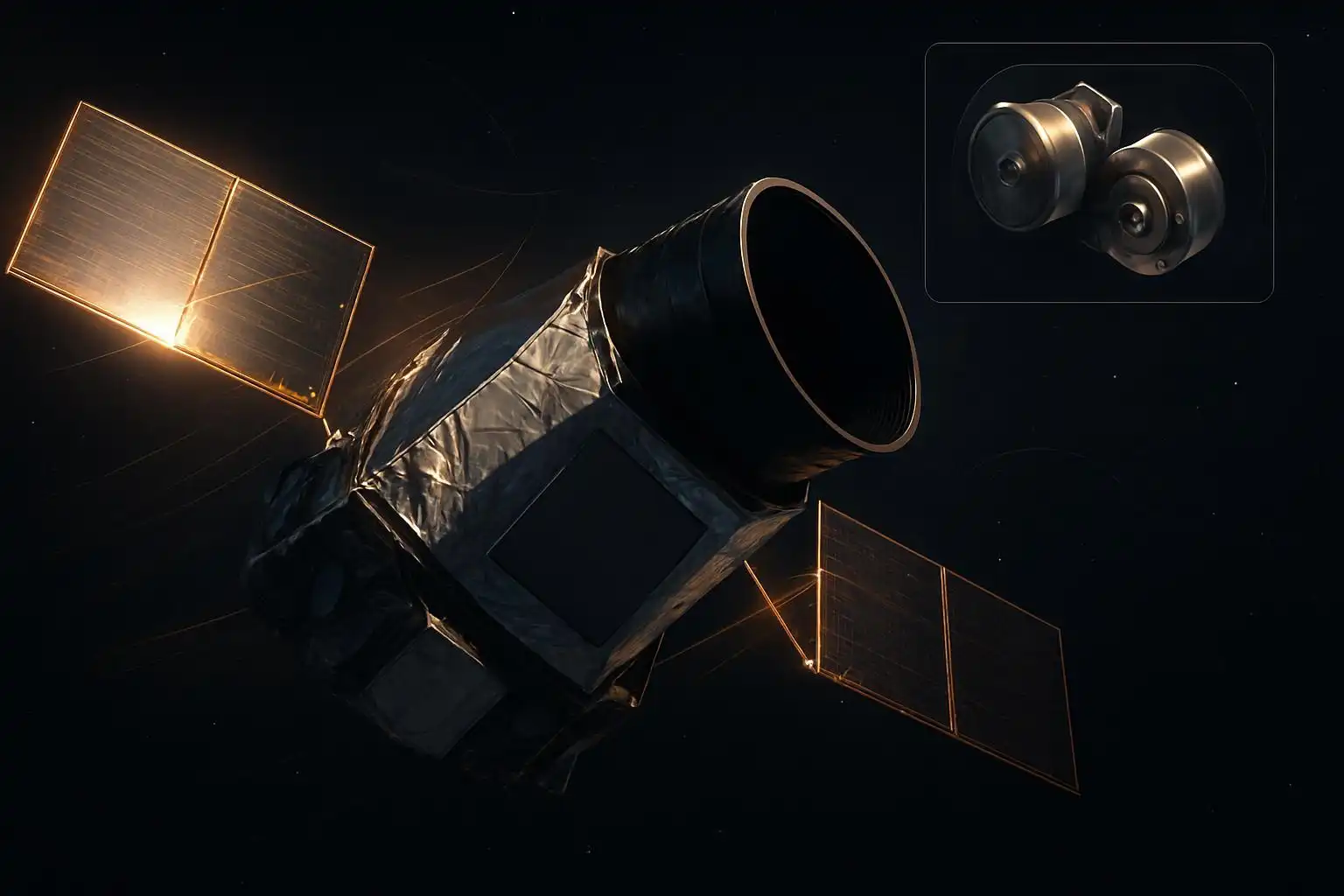

The Unglamorous Heart of a Planet Hunter
Nobody writes poems about reaction wheels. They don’t appear in press releases alongside artist renderings of alien worlds. They’re not the instrument that detects the 0.01% dip in starlight when a planet crosses its host star. But in July 2012, when Reaction Wheel 2 aboard NASA’s Kepler Space Telescope began showing elevated friction, engineers in Boulder and at Ames Research Center felt a very specific kind of dread — the kind that comes from knowing that a single spinning gyroscope is now the most important object in the solar system.
This is the story of those wheels, what they did, what happened when they failed, and the audacious engineering hack that turned a crippled observatory into a second act that nobody planned for.
What Kepler Was Actually Doing
Before we get to the bearings, let’s be precise about the observing strategy, because it’s what made the pointing requirement so brutal.
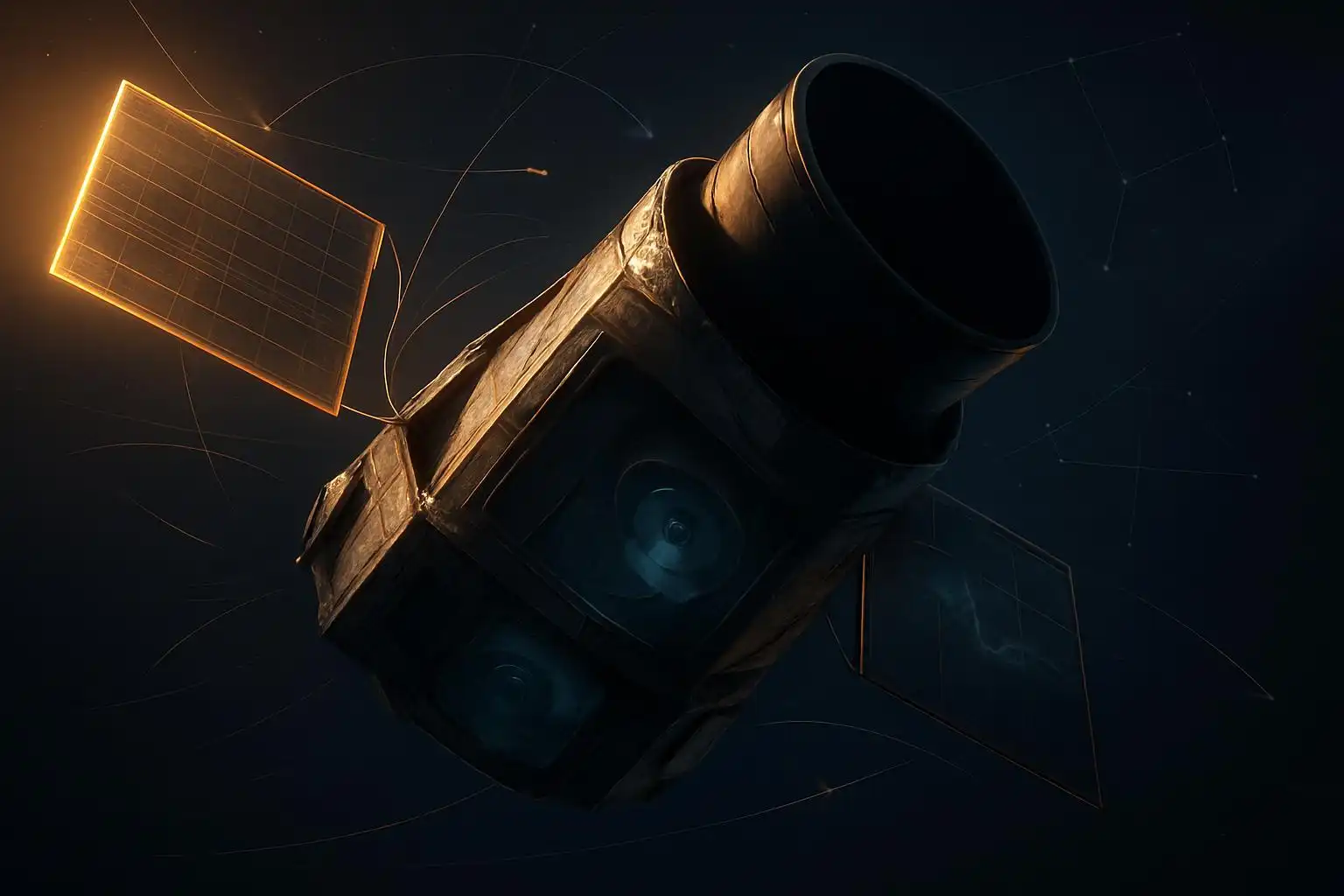
Kepler launched on March 7, 2009, into an Earth-trailing heliocentric orbit — not a low Earth orbit like Hubble, not a halo orbit around L2 like JWST. It drifted away from Earth at roughly 0.1 AU per year, which had implications for data downlink that we’ll return to. The spacecraft carried a single scientific instrument: a 0.95-meter aperture Schmidt telescope feeding a 42-CCD mosaic photometer covering 115 square degrees of sky — a field of view roughly hundreds of times the area of the full Moon. The target field sat in the constellation Cygnus, chosen because it was continuously visible without the Sun or Earth intruding, and because it was rich in Sun-like stars at distances of a few hundred to a few thousand light-years.
The science was transit photometry. Kepler stared at approximately 150,000 stars simultaneously and measured their brightness with a precision of 20–80 parts per million (ppm) on a long cadence of about 29.4 minutes, with a short cadence mode at 1 minute for select targets. An Earth-sized planet transiting a Sun-sized star produces a signal of roughly 84 ppm — a dimming of 0.0084%. To detect that reliably, you need at least three transits (so a minimum of three years for an Earth-analog in the habitable zone), and you need the photometric noise floor to be well below that signal.
That noise floor is set, in part, by how steadily you can hold the telescope. Kepler’s pointing requirement was 3 milliarcseconds (mas) over 15 minutes. For context, 1 arcsecond is 1/3600 of a degree. Three milliarcseconds is 1/1,200,000 of a degree. If the spacecraft drifted more than that, stars would walk across CCD pixel boundaries, and the pixel-to-pixel sensitivity variations — flat-field errors — would inject false photometric signals. Systematics, not shot noise, would become the dominant error source.
Three reaction wheels, running in combination, held the spacecraft to that spec. A fourth was a spare.
Reaction Wheels 101
A reaction wheel is conceptually simple: a flywheel spun by an electric motor, mounted inside the spacecraft. By Newton’s third law, when you spin the wheel up, the spacecraft body rotates the other way. By varying the spin rate of wheels oriented along different axes, you can torque the spacecraft in any direction without expelling propellant. Kepler’s four wheels were arranged in a tetrahedral configuration — any three could provide full three-axis control, which is why losing one (Wheel 2, in July 2012) was survivable.
The wheels on Kepler were built by Goodrich (later UTC Aerospace Systems), spinning at up to 4,000 RPM. They are precision instruments in their own right: the bearings must operate in vacuum, across temperature swings from roughly -10°C to +40°C, for years without lubrication replenishment. The lubricant — a thin film of synthetic oil — is applied during ground assembly and must last the mission lifetime. There is no service call. There is no top-up.
When Wheel 2 started showing anomalous torque in July 2012, the team put it in a “wheel rest” — essentially parking it — and operated on three wheels. They were already down to their minimum. Then, on May 11, 2013, Wheel 4 failed completely. Kepler could no longer maintain the 3 mas pointing stability required for transit science. The primary mission was over.
The spacecraft was placed in a “Point Rest State,” its solar panels oriented toward the Sun to maintain power while the team figured out what to do next.
The Physics of the Hack
What followed was one of the most creative pieces of mission salvage in the history of space science.
The key insight came from engineers at Ball Aerospace and the Kepler team: if you can’t fight solar radiation pressure, use it. The Sun continuously exerts a small but non-negligible force on the spacecraft’s solar panels — roughly 1.4 × 10⁻⁵ N/m² at 1 AU. For a large, flat spacecraft like Kepler, this produces a measurable torque. The idea was to orient the spacecraft so that the solar radiation pressure torque balanced the residual torques from the two remaining functional wheels — essentially using the Sun as a virtual third reaction wheel.
The catch: this only works when the spacecraft is pointed near the ecliptic plane, because that’s where the solar pressure vector can be made to act as a useful restoring torque. Kepler’s original Cygnus field was at high ecliptic latitude — perfect for the original mission, completely incompatible with the new pointing constraint. The new mission, officially dubbed K2 and approved by NASA in May 2014, would observe fields along the ecliptic, each accessible for roughly 80 days before the geometry forced a field rotation.
Pointing stability with this technique settled at roughly 20–25 arcseconds RMS over 6 hours — significantly worse than the original 3 mas, but workable for brighter targets where photon noise is lower and for science cases that don’t require the same precision. K2 went on to observe over 500,000 stars across 20 “campaigns,” discovering hundreds of exoplanets, observing supernovae, star clusters, active galactic nuclei, and solar system objects. It ran until October 30, 2018, when the spacecraft finally exhausted its 12 kg of hydrazine fuel — the thrusters needed to periodically desaturate the reaction wheels.
What the Numbers Actually Mean
Let me put some of the engineering parameters in perspective, because the raw specs don’t convey the difficulty.
Photometric precision: 20 ppm on a 12th-magnitude star over 6.5 hours. The Hubble Space Telescope, with its 2.4-meter mirror and exquisite optics, achieves similar photometric precision in space. Kepler achieved it with a 0.95-meter aperture because it was designed from the ground up for this one task — wide field, stable pointing, continuous staring — rather than as a general-purpose observatory.
Data volume: Kepler’s photometer generated roughly 95 Megabytes per day of raw data. Because the spacecraft was in a heliocentric orbit drifting away from Earth, downlink required the large dish antennas of the Deep Space Network. Data was stored onboard and downlinked roughly once per month during a contact period, during which the spacecraft had to be reoriented away from its target field. The team designed the observation schedule around these downlink windows.
Catalog completeness: The Kepler Input Catalog (KIC) was constructed from ground-based photometry specifically to characterize the ~450,000 stars in the field well enough to select the best 150,000 targets. Stellar radius uncertainty directly translates to planet radius uncertainty — if you don’t know the star, you don’t know the planet. This drove a massive follow-up spectroscopy program that continued for years after the primary mission ended.
Total mission cost: Kepler came in at approximately $600 million, including launch. For context, JWST cost roughly $10 billion. Kepler is one of the most scientifically productive missions per dollar in NASA history, having confirmed over 2,700 exoplanets and statistically characterized the occurrence rates of planets around Sun-like stars.
The Bearing Failure in Context
It’s worth dwelling on the failure mode itself, because it illuminates a broader truth about space hardware.
Reaction wheel bearings fail due to lubricant degradation. In vacuum, conventional oil-based lubricants outgas and degrade over time. The wheels are typically lubricated with a perfluoropolyether (PFPE) oil — a synthetic fluorinated compound chosen for its low vapor pressure and radiation resistance. But even PFPEs degrade under radiation exposure and mechanical stress, forming acidic byproducts that can corrode bearing surfaces.
There were warning signs. Kepler’s Wheel 2 had shown elevated friction as early as 2009. The team tracked the telemetry carefully — bearing temperature, wheel current draw, speed — looking for trends. They knew the wheels were the mission’s single most critical failure point. Goodrich engineers had designed them to last 3.5 years, the planned mission duration. Kepler operated for 4.5 years in its primary mission configuration. In a very real sense, the wheels lasted longer than they were designed to.
This is a common pattern in space missions. Voyager 1 is still operating 47 years after launch. Hubble has been serviced five times, but its gyroscopes — a closely related technology — have been replaced and continue to be a source of operational anxiety. As of 2024, Hubble is operating on a single gyroscope after a failed attempt to return to three-gyro mode. The lesson is not that these components are poorly made. It’s that space is a profoundly hostile environment, and the margins between success and failure are measured in microns of bearing surface and nanograms of lubricant.
Legacy: What Kepler Taught Us to Build
Kepler’s successor, the Transiting Exoplanet Survey Satellite (TESS), launched in April 2018 and incorporated lessons learned from Kepler’s bearing failures. TESS uses four wide-field cameras rather than a single large photometer, observes in 27-day sectors rather than continuous staring, and is in a highly elliptical 13.7-day orbit that keeps it thermally stable and provides regular Earth contacts. Its reaction wheels are from a different vendor, with updated lubricant formulations.
The Nancy Grace Roman Space Telescope, scheduled for launch in 2027, will carry a 2.4-meter mirror (identical in diameter to Hubble’s) and a wide-field instrument covering 0.28 square degrees — about 100 times the area of Hubble’s Wide Field Camera 3. Its Galactic Bulge Time Domain Survey will perform microlensing exoplanet searches, and its reaction wheel assembly has been designed with the Kepler experience explicitly in mind. Redundancy, lubricant lifetime testing, and bearing telemetry monitoring are all part of the design heritage.
The Habitable Worlds Observatory (HWO), the flagship mission recommended by the 2020 Decadal Survey, will need to hold pointing to sub-milliarcsecond levels to use a starshade or coronagraph to directly image Earth-like planets. The pointing requirement is even more demanding than Kepler’s. The reaction wheels — or whatever pointing actuators are ultimately chosen — will again be the unglamorous heart of the mission.
The Quiet Satisfaction of a Telemetry Trend
I want to end not with statistics but with a human moment.
Somewhere in a control room in 2012, an engineer was watching a plot of Wheel 2’s current draw versus time. The trend had been there for months — a slow, almost imperceptible rise, the kind of thing you could convince yourself was measurement noise if you wanted to. But they didn’t convince themselves. They flagged it, documented it, and started contingency planning.
When the wheel finally failed in 2013, the team had already been working on the solar pressure balancing idea for months. The K2 proposal was ready. The science case was written. The operations concept had been simulated. The failure was a crisis, but it was a managed crisis — the kind that only looks like a disaster from the outside.
That’s what good mission operations looks like. Not the absence of failure, but the presence of people who have already thought about what to do when the bearing goes dry.
The wheels stopped spinning. The planet hunter found a second wind. And somewhere in the data archives, the statistical signature of billions of worlds is still waiting to be fully understood.


Leave a Reply