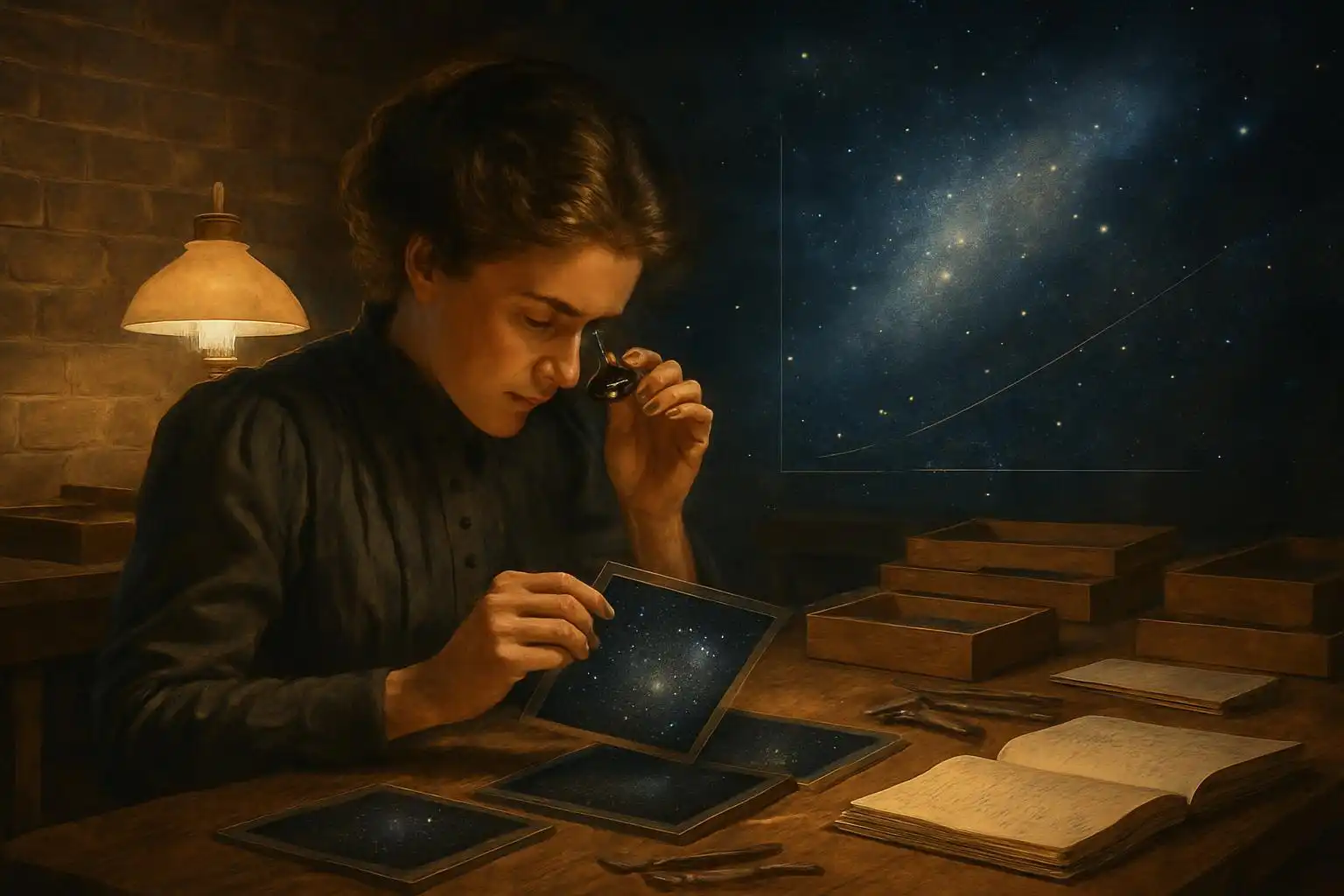

Cambridge, Massachusetts — March 1904
The room smelled of chemical fixer and lamp oil. Henrietta Swan Leavitt sat at a long wooden table in the brick building on Garden Street that housed the Harvard College Observatory, a magnifying loupe pressed to her eye, a stack of glass photographic plates at her elbow. Each plate — roughly the size of a hardback novel, dark and faintly iridescent — had been exposed on a telescope in Arequipa, Peru, where the southern sky hung low and brilliant over the Andes. On each one, the Small Magellanic Cloud spread like a smear of spilled salt, thousands of stars frozen in a silver-halide emulsion at the moment the shutter opened.
Leavitt’s job, as one of the women Edward Charles Pickering employed at the observatory for twenty-five cents an hour, was to measure. She compared the brightness of stars between plates taken weeks or months apart, noting which had brightened, which had faded, which had stayed the same. The women were called “computers,” a word that then meant a person who computes, not a machine. They were not, in the official hierarchy of the observatory, expected to theorize. But Leavitt was noticing something that no amount of institutional hierarchy could suppress: a certain class of variable star in the Cloud was behaving in a way that was almost indecently orderly.
The stars in question were Cepheid variables — stars that swell and contract with a rhythmic regularity, brightening and dimming like slow, enormous heartbeats. Leavitt had been cataloguing them since at least 1900, and by 1904 she had identified dozens in the Small Magellanic Cloud alone. What struck her, bending over plate after plate in that lamp-lit room, was that the brighter ones seemed to take longer to complete their cycles. The relationship was not random noise. It was a pattern.
The Logic Hidden in the Plates
To appreciate what Leavitt was seeing, it helps to understand what made the Small Magellanic Cloud so useful as a laboratory. Because all the stars in the Cloud were, to a reasonable approximation, at the same distance from Earth — they were members of the same distant system — any difference in their apparent brightness was a real difference in their intrinsic luminosity. You did not need to know the actual distance to the Cloud to compare the stars to one another. The Cloud was, in effect, a controlled experiment handed to Leavitt by the geometry of the cosmos.
In 1908, she published a preliminary note in the Annals of the Harvard College Observatory, listing 1,777 variable stars she had identified in the Magellanic Clouds. Buried near the end of the paper, almost as an aside, was the observation that the brighter Cepheids had longer periods. She was cautious: “It is worthy of notice,” she wrote, with the understatement characteristic of the era’s scientific prose, “that in Table VI the brighter variables have the longer periods.”
She continued measuring. More plates arrived from Arequipa. She refined her sample, focusing on twenty-five Cepheids whose periods she could determine with confidence. Then, in 1912, she published the result that would eventually reshape humanity’s picture of the cosmos. The paper appeared in Harvard College Observatory Circular No. 173, under the title “Periods of 25 Variable Stars in the Small Magellanic Cloud.” Pickering’s name appeared as the formal author — a common practice of the era that has rightly been criticized — but the work was entirely Leavitt’s.
The paper contained a graph. On one axis, the logarithm of the period; on the other, the apparent magnitude. The twenty-five points fell along two nearly straight lines (one for maximum brightness, one for minimum), as neat as a ruled diagram in a geometry textbook. “A straight line,” Leavitt wrote, “can readily be drawn among each of the two series of points corresponding to maxima and minima, thus showing that there is a simple relation between the brightness of the Cepheid variables and their periods of oscillation.”
Simple. The word barely contained what she had found.
What the Relationship Meant — and What It Needed
Leavitt had discovered a cosmic ruler, though she could not yet calibrate it. If you knew the period of a Cepheid variable anywhere in the sky, you could infer its intrinsic luminosity from the period-luminosity relation. Compare that intrinsic luminosity to its apparent brightness — how bright it looks from Earth — and the inverse-square law of light would give you the distance. The Cepheids were standard candles, and Leavitt had found the key to reading them.
The catch was calibration. The period-luminosity relation told you the relative luminosities of Cepheids — this one is twice as bright as that one — but to get absolute distances, you needed to know the actual luminosity of at least one Cepheid whose distance was independently known. No Cepheid was close enough to Earth for its parallax to be measured with the instruments of 1912. The ruler existed; its units had not yet been stamped on.
The Danish astronomer Ejnar Hertzsprung, who had been independently thinking about the same problem, moved quickly. In 1913 he used statistical methods — averaging the proper motions of a small number of nearby Cepheids to extract a rough distance — to make the first calibration attempt. His result was published in a paper whose units contained a computational error that went uncorrected for years, but the method was sound. The American astronomer Harlow Shapley, working at Mount Wilson Observatory in California, made his own calibration in 1918, using the 60-inch reflector on the mountain to study Cepheids in globular clusters. Shapley’s calibration was bolder and, in some respects, too bold: it led him to a model of the Milky Way that was genuinely revolutionary but also, in its outermost dimensions, somewhat inflated by dust absorption he could not yet account for.
None of this diminishes what Leavitt found. The ruler was hers.
The Woman Behind the Measurement
Henrietta Leavitt was born in 1868 in Lancaster, Massachusetts, the daughter of a Congregationalist minister. She attended Oberlin College and then Radcliffe, where she took a course in astronomy in her senior year — almost as an afterthought, by her own account — and found herself captivated. She joined the Harvard computers in 1895, working first as a volunteer, then for the famous twenty-five cents an hour. She was largely deaf by the time she began her most important work, a condition that had developed in her twenties and that she managed with the same quiet practicality she brought to everything else.
Her correspondence with Pickering survives in the Harvard Observatory archives. The letters are businesslike, precise, occasionally touching in their matter-of-factness. She wrote to him from her family home in Wisconsin in 1902, apologizing for an extended absence caused by illness, and expressing her eagerness to return to the plates. “I am more sorry than I can tell you,” she wrote, “to have the work so interrupted.” Pickering’s replies were cordial but administratively clipped — he ran a large operation and had many computers to manage. He recognized Leavitt’s abilities; he also, in the manner of his era, channeled them almost entirely into measurement and cataloguing rather than the theoretical interpretation that might have brought her wider fame in her own lifetime.
She died in December 1921, of cancer, at the age of fifty-three. Earlier that year, she had been appointed head of stellar photometry at the observatory, a title that acknowledged her expertise without granting her the professorial status that male astronomers of comparable achievement held as a matter of course. The Swedish mathematician Gösta Mittag-Leffler, apparently unaware she had died, wrote in 1925 to inquire whether she might be nominated for the Nobel Prize in Physics. Harlow Shapley informed him that Leavitt had died. The Nobel committee did not award prizes posthumously.
The Ruler Put to Work: Shapley, Curtis, and the Island Universes
The years immediately following Leavitt’s 1912 paper were years of mounting tension over a question that had simmered in astronomy for more than a century: what were the spiral nebulae? Were they relatively nearby clouds of gas and dust within the Milky Way, or were they vast independent star systems — “island universes,” in the phrase Immanuel Kant had used in 1755 — lying at distances so enormous that the Milky Way itself would be just one among millions?
The debate came to a formal head at the National Academy of Sciences in Washington on the evening of April 26, 1920, in what has since been called the Great Debate. Harlow Shapley argued that the Milky Way was enormous — perhaps 300,000 light-years across — and that the spiral nebulae were minor features within or near it. Heber Curtis of the Lick Observatory argued for a smaller Milky Way and for the island universe hypothesis: the spirals were galaxies in their own right, each comparable to the Milky Way, each unimaginably remote.
Both men used Cepheids, or the absence of them, as evidence. Both men made errors. Shapley’s Milky Way was too large because he did not know that interstellar dust was dimming his distant Cepheids, making them appear farther away than they were. Curtis’s spirals were placed at the right order of magnitude but for partially wrong reasons. The debate itself was less a knockout than a draw — a vivid, contentious draw, conducted in letters that crackle with the personal stakes involved. Shapley wrote to his Princeton colleague Henry Norris Russell in the months before the debate with barely concealed anxiety: “I am not sure whether I am to be congratulated or commiserated,” he confided, knowing that his model of a giant Milky Way was vulnerable on several fronts.
The resolution came not in Washington but on a mountain in California, and it came through Leavitt’s ruler.
Plate H335H and the Andromeda Nebula
Edwin Hubble had been using the 100-inch Hooker telescope at Mount Wilson — then the largest operational telescope in the world, its mirror ground from a single 100-inch disc of glass and installed in 1917 — to photograph the Andromeda Nebula (then catalogued as M31) with a patience bordering on obsession. He had been searching for novae, the brief stellar explosions that flare and fade over days or weeks, hoping to use them as distance indicators.
On the night of October 5–6, 1923, he exposed a plate designated H335H. When he examined it the next morning, he found what he first thought was another nova — a star that had not appeared on earlier plates. But when he compared H335H against previous images of the same region, he realized the star had not simply appeared; it had varied. It had been present before, at different brightnesses. He crossed out the “N” he had written on the plate in grease pencil and wrote “VAR!” — the exclamation point surviving as one of the most dramatic punctuation marks in the history of science.
The variable was a Cepheid. Using Leavitt’s period-luminosity relation, calibrated by Shapley’s (imperfect but serviceable) zero-point, Hubble calculated the distance to the Andromeda Nebula. His result, reported in The New York Times on November 23, 1924, and presented to astronomers in early 1925, placed Andromeda at roughly 900,000 light-years — far beyond any plausible boundary of the Milky Way. A detailed Astrophysical Journal treatment of M31 came later; Hubble’s 1925 Astrophysical Journal Cepheid paper concerned NGC 6822. The island universe hypothesis was confirmed. The Milky Way was one galaxy among many.
In the papers and announcements through which these results circulated, Leavitt’s role was not consistently foregrounded. The period-luminosity relation could appear as an established astronomical tool rather than as a discovery made by a specific person sitting at a specific table in Cambridge, Massachusetts, with a loupe and a stack of glass plates.
What the Episode Reveals
Historians of science sometimes describe the Leavitt story as a straightforward tale of credit denied — a woman’s discovery appropriated by the men around her. That reading is not wrong, but it is incomplete. The fuller picture is more interesting and more uncomfortable.
Pickering genuinely believed that the division of labor at the Harvard Observatory was rational and efficient: the women measured, the men theorized, and the institution as a whole advanced knowledge. He was not malicious; he was a man of his era operating within structures he had largely inherited and saw no reason to question. Shapley, who came later, was more complicated — capable of generosity toward women astronomers (he hired Cecilia Payne, whose work on stellar composition would transform astrophysics) and simultaneously capable of the casual erasure visible in his failure to foreground Leavitt’s contribution when he used her relation to build his model of the Milky Way.
Hubble’s handling of Leavitt’s contribution is more complicated than a simple silence, because attribution varied among the relevant announcements and papers. Still, he tended to present the period-luminosity relation primarily as a tool for his own distance work, not as Leavitt’s central discovery — a discovery made by a woman who died three years earlier and never held a professorship.
What the episode reveals about how science actually works is this: discovery is rarely a single moment. It is a chain of measurements, calibrations, corrections, and reinterpretations, each link forged by a different pair of hands. Leavitt found the pattern. Hertzsprung and Shapley calibrated it, imperfectly. Hubble applied it, brilliantly and incompletely. Later astronomers — Walter Baade, working at Mount Wilson during the Second World War with the advantage of a darkened Los Angeles — would discover that there were two populations of Cepheids with different period-luminosity relations, and that Hubble had used the wrong one, placing Andromeda at roughly half its true distance. The ruler was real; its markings needed revision.
And through all of this, the glass plates from Arequipa sat in their wooden trays in Cambridge, holding the silver image of the Small Magellanic Cloud, the twenty-five variable stars whose periods Leavitt had measured with such care. They are still there. The Harvard plate collection — nearly half a million plates spanning more than a century — is now being digitized, each image scanned and uploaded so that the measurements Leavitt made by lamplight can be checked, refined, and extended by astronomers who will never hold the original glass. The plates outlasted the woman who read them. So did the discovery.



Leave a Reply