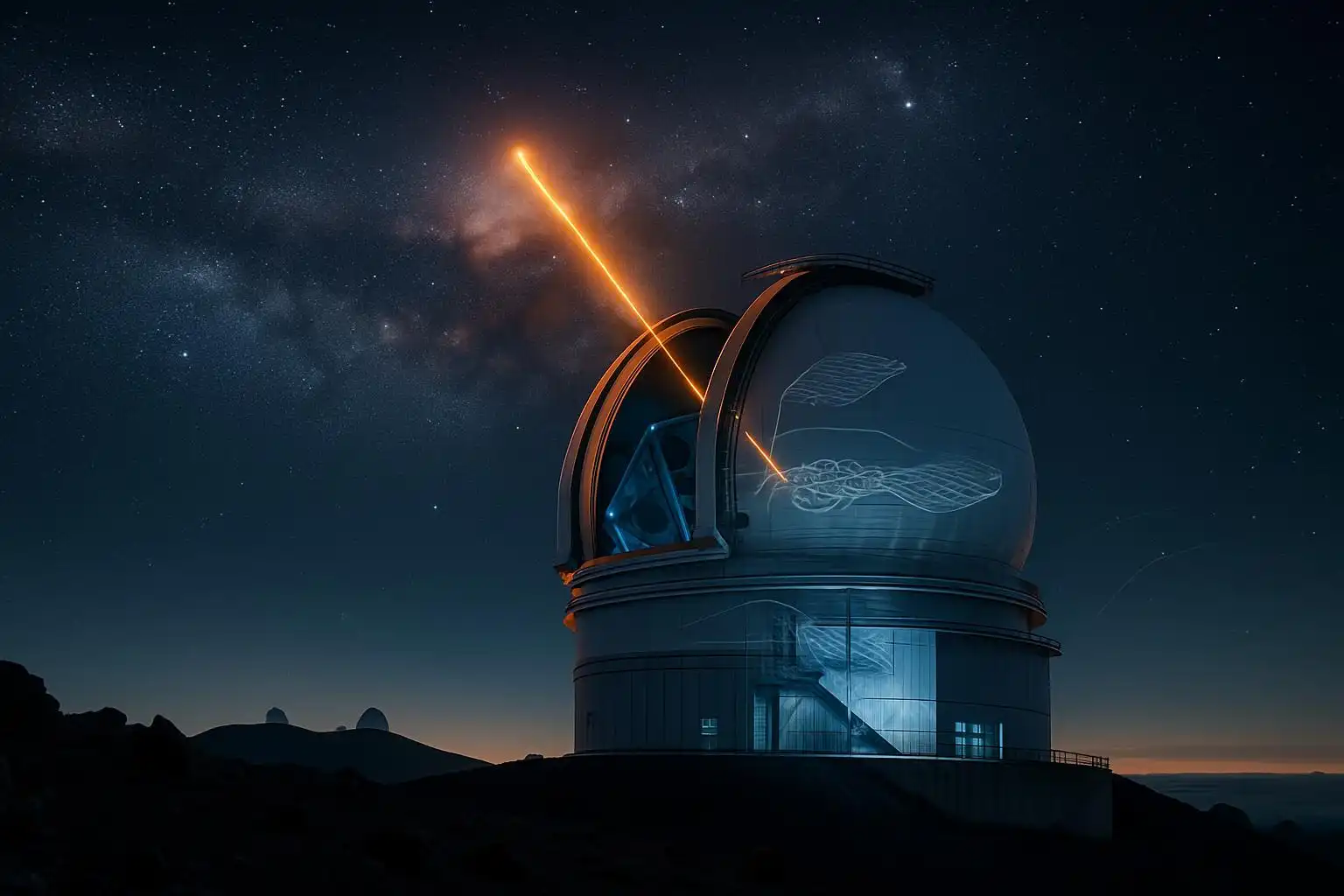

There is a layer of sodium atoms sitting roughly 90 kilometers above Mauna Kea, deposited there by ablating meteors over geological timescales. On most clear nights, a 20-watt laser beam shoots upward from the Keck II telescope, tuned to precisely 589.0 nm — the D2 line of neutral sodium — and excites those atoms into fluorescence. The result is an artificial star, about 1 arcsecond in diameter as seen from the ground, glowing orange against the black sky. That artificial star is the reference source for Keck’s laser guide star adaptive optics system, known as LGSAO, and it is the reason Keck II can routinely deliver near-diffraction-limited images at K band (2.2 µm) over a field of view that would otherwise be smeared beyond recognition by atmospheric turbulence.
This article is about that system — not adaptive optics in general, not every AO system on every large telescope, but specifically what Keck LGSAO does, why the sodium D2 line is the right choice, how the wavefront sensor reads the beacon, and what ultimately limits the Strehl ratio you can achieve on a given night.
Why 589 nm?
Sodium’s D2 transition — the 3s ²S₁/₂ → 3p ²P₃/₂ line at 589.0 nm — is the workhorse of laser guide star systems worldwide, and the reason comes down to cross-section and abundance. The mesospheric sodium layer has a column density of roughly 3–5 × 10⁹ atoms cm⁻², and the D2 line has an absorption cross-section near 10⁻¹² cm² under natural Doppler broadening. That combination produces a fluorescent return bright enough to serve as a wavefront reference with a 20 W laser, which is the power class Keck operates. No other atomic transition in a naturally occurring mesospheric layer offers comparable brightness at a power level that is both technically feasible. Aircraft avoidance procedures — shuttering the laser during transits — are required precisely because the beam poses a hazard to aircraft, and those procedures are a non-negotiable part of operating the system.
The D2 line is also conveniently placed. At 589 nm the atmosphere is reasonably transparent, the laser does not overlap with common astronomical emission lines used in science observations, and the photon return — typically 1–5 × 10⁶ photons m⁻² s⁻¹ at the telescope aperture — is sufficient for a Shack-Hartmann wavefront sensor running at several hundred hertz. The sodium layer itself varies in altitude between about 85 and 100 km and in column density with season and meteor activity, which introduces some operational complexity, but the system handles this through continuous focus tracking, which I will return to shortly.
One subtlety worth noting: the laser must be tuned not just to 589.0 nm in the lab frame but to the Doppler-shifted frequency seen by the sodium atoms as the laser beam propagates upward. The atoms are moving thermally at a few hundred meters per second, and the vertical component of that velocity distribution broadens the absorption profile. Modern Keck laser systems use a sum-frequency Nd:YAG architecture — combining 1064 nm and 1319 nm beams in a periodically poled lithium niobate crystal — that produces a narrow linewidth output tunable across the sodium D2 profile. Locking the laser to the peak of that profile maximizes photon return.
The Wavefront Sensing Geometry
The Keck LGSAO wavefront sensor is a Shack-Hartmann device with a lenslet array that samples the 10-meter primary in a grid of subapertures, each roughly 0.56 meters across at the primary mirror plane. Each lenslet forms a small image of the laser guide star on a CCD, and the displacement of that image from its reference position encodes the local wavefront slope across that subaperture in both x and y. With approximately 240 illuminated subapertures, the sensor delivers roughly 480 slope measurements, which the wavefront reconstruction algorithm assembles into an estimate of the full wavefront error; that estimate is then applied as a correction to the deformable mirror.
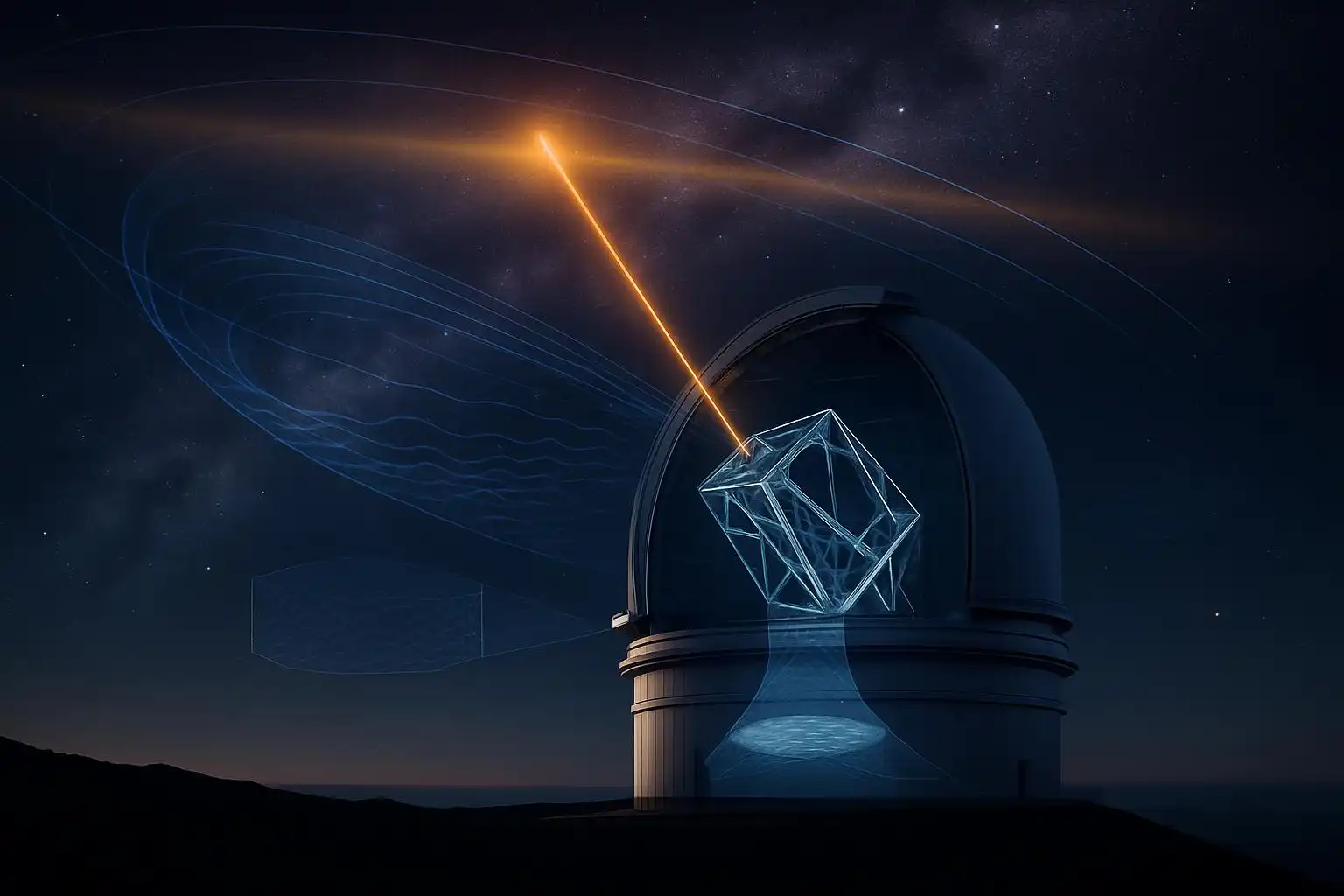
Here is where the geometry of a laser guide star differs fundamentally from a natural guide star. A natural guide star is, for practical purposes, at infinity — its light arrives as a plane wave before the atmosphere scrambles it. The laser guide star is at 90 km. Light from a finite-altitude source fans outward in a cone, so the beam samples a slightly different column of atmosphere in each subaperture than the science target does. This is the cone effect, also called focal anisoplanatism. At Keck’s aperture of 10 meters and a sodium altitude of 90 km, the fractional mismatch between the laser-sampled cone and the full cylindrical column above the telescope is significant. The result is a residual wavefront error that cannot be corrected no matter how good the wavefront sensor or deformable mirror, because the sensor simply never measured the turbulence in the outer annulus of the beam path. At K band (2.2 µm), this focal anisoplanatism error contributes roughly 100–150 nm rms to the wavefront budget on a typical night, which translates directly into a Strehl ceiling.
The Deformable Mirror and Tip-Tilt Separation
Keck LGSAO uses a continuous facesheet deformable mirror with 349 actuators, controlled at up to 2 kHz. The mirror sits in a pupil-conjugate plane in the AO bench, and the wavefront reconstructor maps the slope measurements from the Shack-Hartmann sensor to actuator commands using a least-squares matrix inversion. In practice the system runs at a loop frequency of around 500–1000 Hz depending on guide star brightness, with a latency of a few milliseconds between measurement and correction.
There is one critical thing the laser guide star cannot measure: overall image motion, or tip-tilt. Because the laser beam travels up through the atmosphere and back down again, any atmospheric tilt that shifts the upward beam also shifts the downward return in the opposite direction — the two effects cancel, and the wavefront sensor sees zero net motion. This is a fundamental limitation of any single laser guide star system. Keck solves it by requiring a separate natural guide star, used only for tip-tilt correction. This star can be much fainter than a full natural guide star AO reference — R ≈ 18 is achievable — because it only needs to supply two numbers (x and y image position) rather than a full wavefront measurement. The tip-tilt star can be up to about 60 arcseconds away from the science target, which dramatically increases sky coverage compared to natural guide star AO, where the reference star must typically be within 30–40 arcseconds and brighter than R ≈ 13.
The Sodium Layer Focus Problem
Because the sodium layer is not at a fixed altitude, the laser guide star does not sit at a fixed distance from the telescope. As the layer moves between 85 and 100 km, the apparent focus of the guide star changes, and if uncorrected this would be interpreted by the wavefront sensor as a large focus error in the science beam — even when the atmosphere is perfectly calm. Keck LGSAO addresses this with a dedicated low-bandwidth focus sensor that continuously monitors the range to the sodium layer using the pulse timing of a modulated laser and feeds corrections into the wavefront reconstructor. Without this, the system would chase a spurious focus signal all night.
What Limits Strehl at K Band?
The K-band Strehl ratio — the ratio of the peak intensity of an AO-corrected point spread function to the theoretical diffraction-limited peak — is the standard figure of merit for AO performance. At Keck in good conditions, LGSAO delivers Strehl ratios of 20–35% at K band. That sounds modest compared to what natural guide star AO can achieve (50–60% or better in the best conditions), and the difference reflects the irreducible error terms that laser guide stars cannot eliminate.
The wavefront error budget at K band breaks down roughly as follows. Atmospheric fitting error — how well the deformable mirror’s finite number of actuators can match the turbulence — contributes perhaps 80–120 nm rms on a night with median seeing (0.4–0.5 arcsec at Mauna Kea, measured at 0.5 µm). Bandwidth error, from the finite loop speed and latency, adds another 50–80 nm. Focal anisoplanatism from the cone effect contributes 100–150 nm. Measurement noise from photon-starved subapertures adds 30–50 nm. Residual tip-tilt error from the natural guide star sensor contributes 20–40 nm depending on the guide star brightness and separation.
These terms add in quadrature to a total wavefront error of roughly 200–250 nm rms in median conditions. The Maréchal approximation — Strehl ≈ exp(−(2π σ/λ)²), where σ is the rms wavefront error and λ is the wavelength — gives a useful sense of the penalty each error term imposes, but it is important to note that the approximation breaks down when σ/λ is not small. A total rms error of ~230 nm at 2.2 µm gives (2π × 230/2200)² ≈ 0.43, and exp(−0.43) ≈ 0.65 — but this already-optimistic estimate assumes all error sources are captured in a single Gaussian phase screen, and in practice additional non-common-path errors, uncorrected high-order modes, and the breakdown of the Maréchal approximation itself push the realized Strehl to the 20–35% range actually observed. At shorter wavelengths the penalty is steeper: at H band (1.65 µm) the same wavefront error produces lower Strehl because the (σ/λ)² factor grows, and at J band (1.25 µm) the system barely improves on seeing-limited performance.
This is why K band is the workhorse for Keck LGSAO science. The longer wavelength is more forgiving of residual wavefront error, and the diffraction limit of a 10-meter telescope at 2.2 µm is 46 milliarcseconds — still fine enough to resolve the central arcsecond of a galaxy, probe the orbits of stars around the Galactic Center, or measure the angular diameters of nearby giant stars.
The Galactic Center as a Test Case
The Galactic Center program at Keck is perhaps the most celebrated application of LGSAO. The science target — the dense cluster of stars within 1 arcsecond of the supermassive black hole Sgr A* — has no bright natural guide star nearby, making natural guide star AO extremely difficult in this crowded, high-extinction field. The laser guide star system, with its relaxed requirements on the tip-tilt star, opened the region to routine diffraction-limited K-band imaging and greatly extended sky coverage and sensitivity compared to earlier speckle and natural guide star AO techniques. Over two decades of monitoring, the astrometric precision achieved with LGSAO has been sufficient to trace complete orbits of stars like S2 around Sgr A*, measure the black hole mass to better than 1%, and detect post-Newtonian precession in the orbital plane. The integration times involved are typically 30–60 minutes per epoch, with individual frames of 10–30 seconds to avoid saturation on the brightest cluster members. The pixel scale on NIRC2, the primary science camera behind LGSAO, is 9.952 milliarcseconds per pixel in its narrow-field mode — chosen to well-sample the K-band diffraction limit of the 10-meter aperture.
That pixel scale is not an accident. It is the result of deliberate optical design: the NIRC2 camera optics map the telescope focal plane onto a 1024 × 1024 pixel HAWAII detector array such that the 46 mas diffraction limit is sampled by roughly 4–5 pixels across the PSF core. The narrow-field mode is the right choice for crowded-field astrometry; a wider 40 mas/pixel mode exists for extended objects where field coverage matters more than resolution.
Engineering Behind the Beacon
It is easy to describe the laser guide star as a “sodium beacon” and move on, but the engineering required to produce, launch, and stabilize that beacon is substantial. The laser itself — a sum-frequency solid-state system producing 20 W at 589 nm with a linewidth of a few MHz — must maintain frequency lock on the sodium D2 line across temperature excursions and vibration over a full night of observing. The launch telescope, mounted on the side of the Keck II secondary support structure, must point the beam to within a fraction of an arcsecond of the science field so the guide star appears within the wavefront sensor’s field of view. A beam-steering mirror inside the launch path corrects for atmospheric refraction and parallax between the launch aperture and the main telescope aperture.
There is also a shutter interlock system that blanks the laser whenever an aircraft or satellite is in the beam path — a requirement from the Federal Aviation Administration and the U.S. Space Command. A network of spotters and automated aircraft detection systems monitors the sky above Mauna Kea, and the laser is interrupted for the duration of any transit. On a busy night this can cost several minutes of observing time, but it is a non-negotiable constraint of operating a high-power laser from a ground-based observatory.
The deformable mirror itself deserves a moment of appreciation. Its 349 actuators must each respond to commanded voltages within microseconds, maintain position stability at the nanometer level over hours, and do so reliably in the cold, low-humidity environment of the Keck AO bench. The actuator pitch — the spacing between adjacent actuators projected onto the primary mirror — is about 56 cm, which sets the spatial frequency cutoff of the correction and determines the fitting error term in the wavefront budget. A mirror with more actuators would reduce fitting error but increase the complexity of the reconstruction matrix and the demands on the real-time control computer.
What Comes Next
Keck is developing a next-generation AO system, Keck All-Sky Precision Adaptive Optics (KAPA), which will deploy multiple laser guide stars simultaneously to reduce the cone effect through tomographic wavefront reconstruction. By using four laser beacons arranged in a constellation around the science field, the system can sample the three-dimensional turbulence volume above the telescope rather than a single cone, and a tomographic reconstructor can then synthesize the wavefront error in the direction of any science target within the constellation. The projected Strehl improvement at K band is significant — from the current 20–35% to potentially 50% or better — with a corresponding gain in sensitivity and astrometric precision.
But that is a future article. For now, the single-laser LGSAO system on Keck II remains one of the most productive AO systems in the world, having enabled science on stellar orbits, exoplanet atmospheres, galaxy kinematics, and gravitational lensing that would have been impossible from the ground without it. The sodium layer at 90 km, the 589 nm photons that excite it, the 349-actuator mirror that responds 1000 times per second, and the 9.952 mas/pixel detector that records the result — each of those numbers represents an engineering choice made under real constraints, and together they define what it means to see the universe clearly from the bottom of an atmosphere.



Leave a Reply