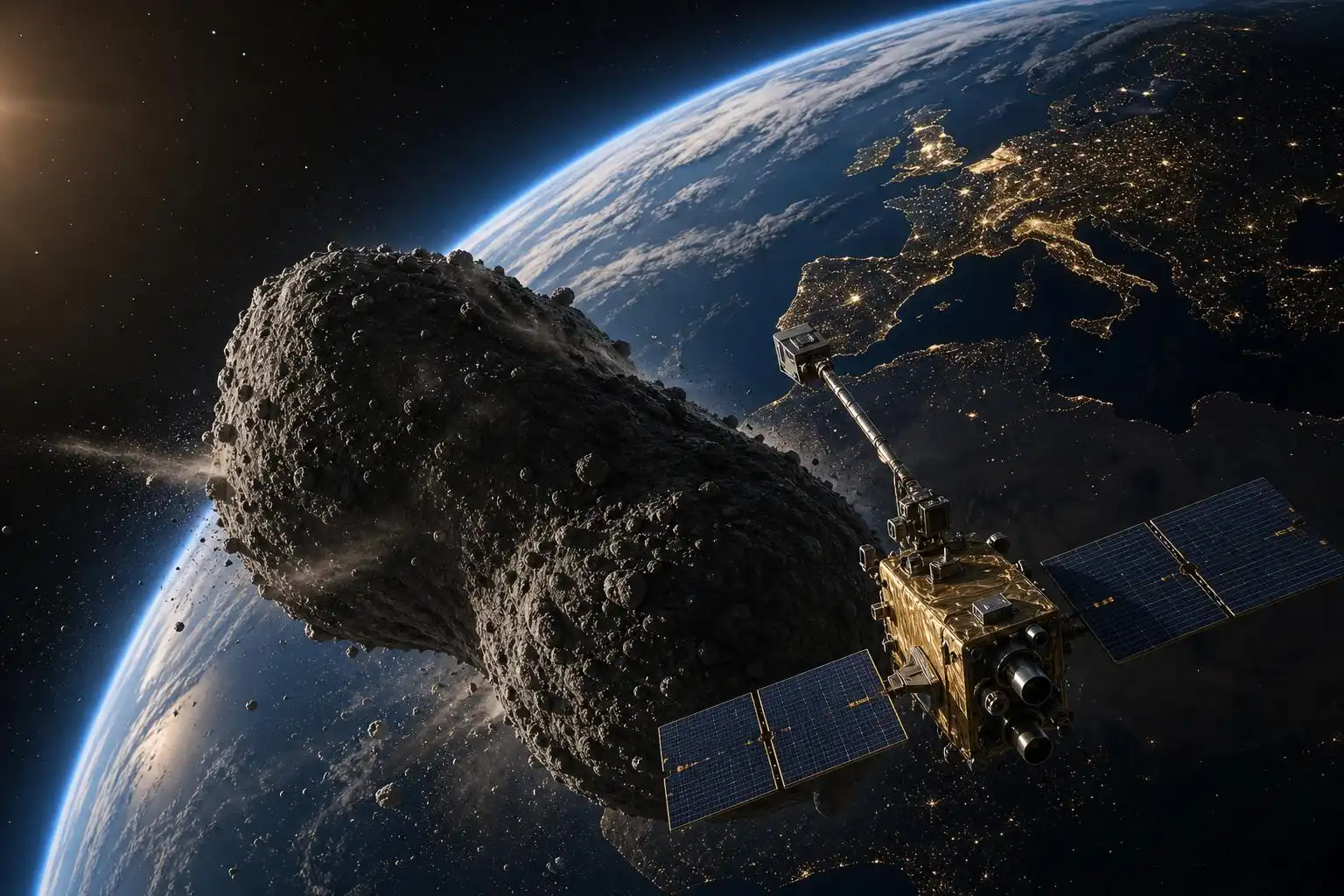

There is a date already circled on the calendars of every planetary scientist I know: Friday, 13 April 2029. On that evening, an asteroid roughly the size of the Eiffel Tower laid on its side — 375 metres of ancient, tumbling rock — will streak across the sky close enough to be seen with the naked eye from Europe, Africa, and western Asia. Up to two billion people will be able to look up and watch it pass. No telescope required. No special glasses. Just a clear night and the knowledge that the object sliding overhead is (99942) Apophis, and that it will come within 32,000 kilometres of Earth’s surface [1].
To put that distance in perspective: the geosynchronous satellites that beam your television signal and GPS coordinates down to Earth orbit at roughly 36,000 kilometres. Apophis will pass below that ring of infrastructure. The Moon, by comparison, sits about 384,000 kilometres away — more than ten times farther. This is not a near-miss in the loose, astronomical sense of the word. This is a genuine close shave, the kind that happens for an object of this size only once every 5,000 to 10,000 years [1]. And for the first time in human history, we will have a spacecraft already there, watching every second of it.
The Mission: Ramses
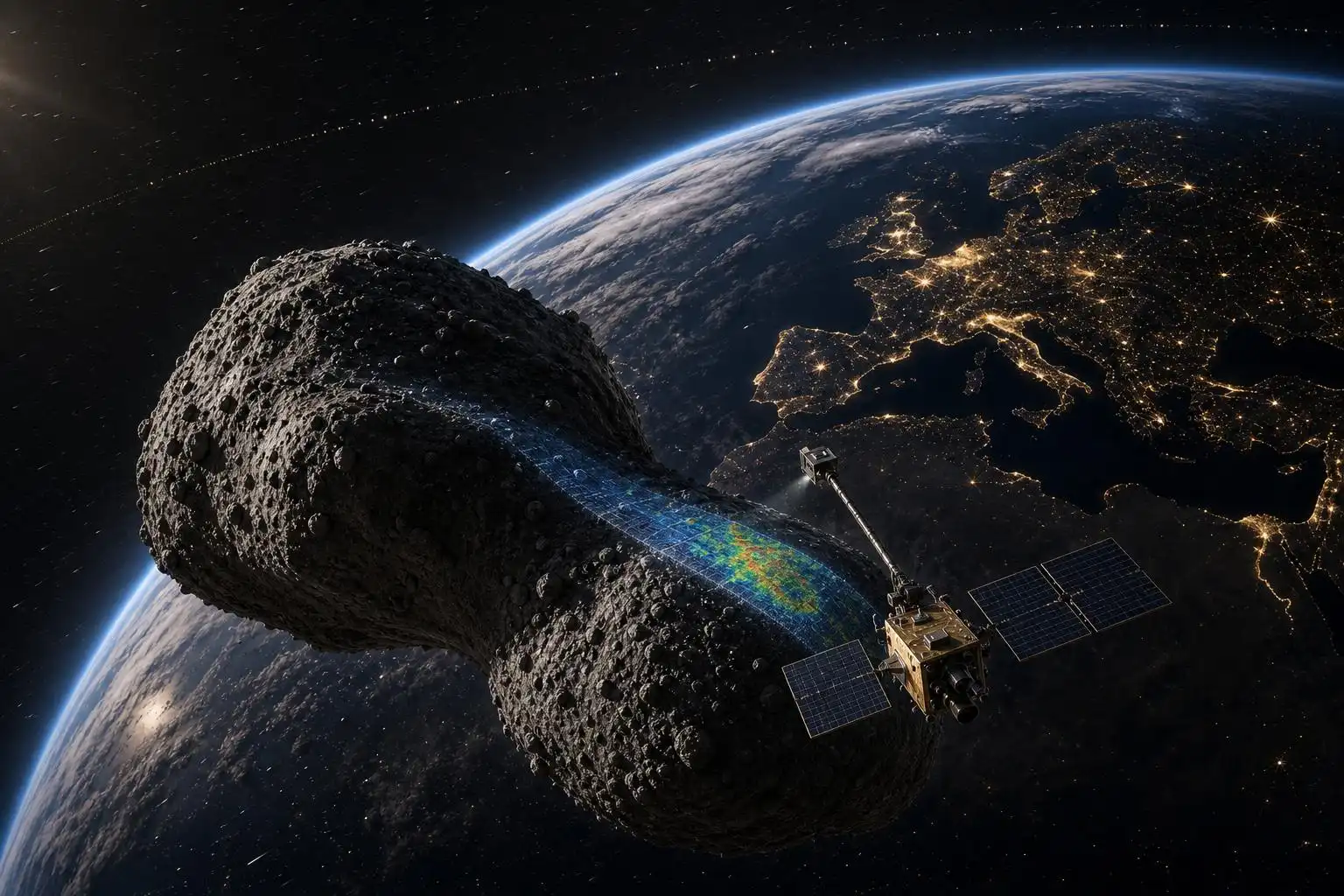
On 7 May 2026, ESA and JAXA signed a Memorandum of Cooperation formalising the Rapid Apophis Mission for Space Safety — Ramses. The name is deliberate. Like its Egyptian namesake, this mission is meant to endure, to document, to bear witness [1] [3].
ESA leads spacecraft design, integration, and operations. JAXA contributes the hardware that makes the mission affordable and technically elegant: lightweight solar arrays drawn from JAXA’s deep experience with interplanetary probes, an infrared imager for surface thermal mapping, and a seat aboard Japan’s H3 rocket for the 2028 launch. The partnership is not a new relationship — both agencies have worked together on BepiColombo, the dual-spacecraft Mercury mission, and on EarthCARE, the joint Earth-observation satellite. JAXA also contributed to ESA’s Hera mission, which will arrive later this year at the Didymos binary asteroid system to help turn asteroid deflection by kinetic impact into a reliable and understood technique. Ramses is the next chapter in that ongoing story [1].
The spacecraft will launch in 2028 and rendezvous with Apophis well before the April 2029 flyby, giving the science team time to characterise the asteroid’s baseline state — its rotation rate, surface temperature distribution, boulder density, and shape — before Earth’s gravity begins to work on it. That before-and-after comparison is the scientific heart of the mission.
What Earth’s Gravity Will Do to a Rubble Pile
Here is where the physics gets genuinely strange. Apophis is almost certainly what planetary scientists call a rubble pile: not a monolithic chunk of rock, but a gravitationally bound collection of boulders, gravel, and dust, loosely held together by its own weak self-gravity and a thin regolith skin. Think of it less like a billiard ball and more like a sandbag — coherent enough to hold its shape in the vacuum of space, but susceptible to tidal forces when something massive gets close.
As Apophis sweeps through Earth’s gravitational field in April 2029, tidal stresses will ripple through its interior. Boulders may shift. Landslides may cascade across the surface. The asteroid’s rotation rate — currently about 30.6 hours per revolution — may change measurably. Its shape, which ground-based radar has resolved as a contact binary with two lobes connected by a narrow neck, could be subtly reshaped. None of these changes are catastrophic for the asteroid, but they are scientifically priceless: a natural experiment in asteroid geophysics that no laboratory on Earth can replicate.
Ramses will capture all of it. The JAXA-provided infrared imager will map thermal inertia across the surface — the rate at which different regions heat up and cool down as Apophis rotates. High thermal inertia means bare rock; low thermal inertia means fine, insulating regolith. By tracking how those thermal signatures shift before and after the flyby, scientists can infer whether surface material has been redistributed. Visible cameras will document changes in boulder positions and crater morphology at resolutions fine enough to detect metre-scale movements. And because Ramses will be orbiting or station-keeping near Apophis throughout the encounter, its radio link back to Earth will serve as a precise gravitational probe — tiny Doppler shifts in the signal will reveal how Earth’s tidal pull tugs on the spacecraft’s trajectory, which in turn constrains Apophis’s bulk density and internal mass distribution.
Why Composition Is the Key to Deflection
Knowing what Apophis is made of is not merely academic. It is the prerequisite for any future deflection strategy.
DART worked by kinetic impactor: crash a spacecraft into an asteroid and transfer momentum. The technique worked beautifully at Dimorphos, shortening its orbital period around Didymos by about 33 minutes — far more than models predicted, because the ejecta plume carried away additional momentum. But the efficiency of that momentum transfer depends critically on the asteroid’s composition and porosity. A rubble pile absorbs impacts differently than a solid rock. A carbonaceous, volatile-rich body behaves differently from a silicate one. A loose aggregate can swallow a kinetic impactor like a pillow, while a coherent monolith transfers the momentum cleanly.
This is why the infrared imager on Ramses matters so much. Infrared spectroscopy in the 1–5 micron range is sensitive to the mineralogical fingerprints of silicates, hydrated minerals, and organics. By comparing Apophis’s spectral signature to meteorite libraries built up over decades of laboratory work, scientists can assign it a taxonomic class — S-type (silicate-rich, like ordinary chondrites), C-type (carbon-rich, like carbonaceous chondrites), or something rarer — and begin to model how it would respond to a future deflection attempt. JAXA has particular expertise here: the Hayabusa2 mission returned samples from the C-type asteroid Ryugu in December 2020, and the spectral data from Hayabusa2’s NIRS3 near-infrared spectrometer has become a reference dataset for the entire field.
Apophis is currently classified as an Sq-type asteroid, a transitional class between S-types and Q-types, suggesting a surface partially weathered by the solar wind. Whether that classification holds up under close scrutiny from Ramses’s imager — and whether the subsurface material exposed by any tidal landslides matches the surface — will tell us something fundamental about how space weathering operates on small bodies.
The Rarity of This Moment
It is worth sitting with just how unusual April 2029 actually is. Apophis was discovered in June 2004, and for a brief, alarming period in December of that year, orbital calculations placed its impact probability for 2029 at nearly 3 percent — the highest ever calculated for a known near-Earth object of its size. Refined observations quickly ruled out the 2029 impact, and subsequent radar observations in 2021 definitively eliminated any impact risk through at least 2068. The 2029 flyby is safe. But safe does not mean uninteresting.
Astronomers have been watching asteroids fly past Earth for as long as we have had telescopes, but we have never had a spacecraft already in position to observe one during a close encounter with Earth’s gravitational field. The closest analogue in the mission archive is perhaps Cassini’s observations of Saturn’s tidal effects on Enceladus — the way Saturn’s gravity flexes that icy moon and drives the tiger-stripe fractures near its south pole, pumping heat and water vapour into space. The physics is the same: a large body’s gravity deforming a smaller one. But Enceladus is a geologically active moon with an internal ocean and a heat source. Apophis is a cold, airless rubble pile. Watching tidal forces act on it in real time, with an instrument suite positioned just kilometres away, is genuinely unprecedented.
For planetary defence specifically, the data Ramses collects will feed directly into the models used to assess risk from the thousands of other near-Earth objects we are still cataloguing. Every improvement in our understanding of how rubble piles respond to tidal stresses, and how their surfaces evolve during close planetary encounters, sharpens the tools we would reach for if we ever found an object that was not going to miss.
A New Kind of International Partnership
The ESA-JAXA collaboration on Ramses also signals something important about how planetary defence is maturing as a discipline. It is no longer the province of a single agency running a single mission. DART was NASA-led but internationally supported. Hera was ESA-led with JAXA hardware contributions. Ramses inverts the model slightly: ESA leads the spacecraft, JAXA provides the rocket and a key science instrument, and both agencies share the data.
As JAXA President Dr. Hiroshi Yamakawa noted at the signing, the cooperation is expected to “further advance international efforts in this field” [3]. That is diplomatic language for something genuinely consequential: the recognition that protecting Earth from asteroid impacts is too important, and too technically demanding, for any one country to handle alone. The infrastructure of planetary defence — the survey telescopes, the characterisation missions, the deflection testbeds — is being built as a shared global asset.
When Apophis makes its pass on that Friday evening in April 2029, the people watching from their balconies and rooftops will see a faint moving star, unremarkable to the untrained eye. What they will not see is the spacecraft riding alongside it, a few kilometres off, its infrared imager reading the temperature of every boulder, its cameras watching for the first tremor of a tidal landslide, its radio signal threading back to Earth with data that will rewrite the textbooks on small-body geophysics. That is the part worth knowing about. That is what Ramses is for.
References
- ESA and JAXA team up on planetary defence, Ramses mission to asteroid Apophis — European Space Agency
- NASA’s Psyche Mission Captures Mars During Gravity Assist Approach — NASA Science
- ESA and JAXA Join Forces in Historic Collaboration to Protect Earth from Potential Asteroid Impacts — The Daily Galaxy


Leave a Reply