

Chandra’s X-Ray Eyes: Engineering the Sharpest Mirror Ever Flown in Space
On July 23, 1999, a Columbia Space Shuttle crew released the heaviest payload ever deployed from an orbiter — 22,753 kilograms of spacecraft, Inertial Upper Stage, and the most precisely figured optical surface humanity had ever launched. The Chandra X-ray Observatory didn’t just represent a new telescope. It represented a fundamental rethinking of what a mirror could be, what an orbit could look like, and what it truly costs to open a new window on the universe.
Twenty-five years later, Chandra is still operating. And every photon it catches is a small miracle of engineering that almost didn’t happen.
Why X-Rays Break the Rules
Before you can appreciate what Chandra’s engineers built, you need to understand the basic problem they were up against. X-rays are brutal. A photon in the 0.1–10 keV energy range — Chandra’s working band — carries enough energy to pass straight through conventional mirror glass rather than reflect off it. Try to focus X-rays with a normal parabolic mirror and you get nothing. The photons simply vanish into the substrate.
The solution, developed theoretically by Hans Wolter in 1952, is grazing-incidence reflection. If you tilt a mirror nearly parallel to the incoming beam — angles of less than 1–2 degrees — X-rays will skim off the surface the way a flat stone skips across water. Chain two such surfaces together (a paraboloid followed by a hyperboloid, the so-called Wolter Type I geometry) and you can bring X-rays to a genuine focus.
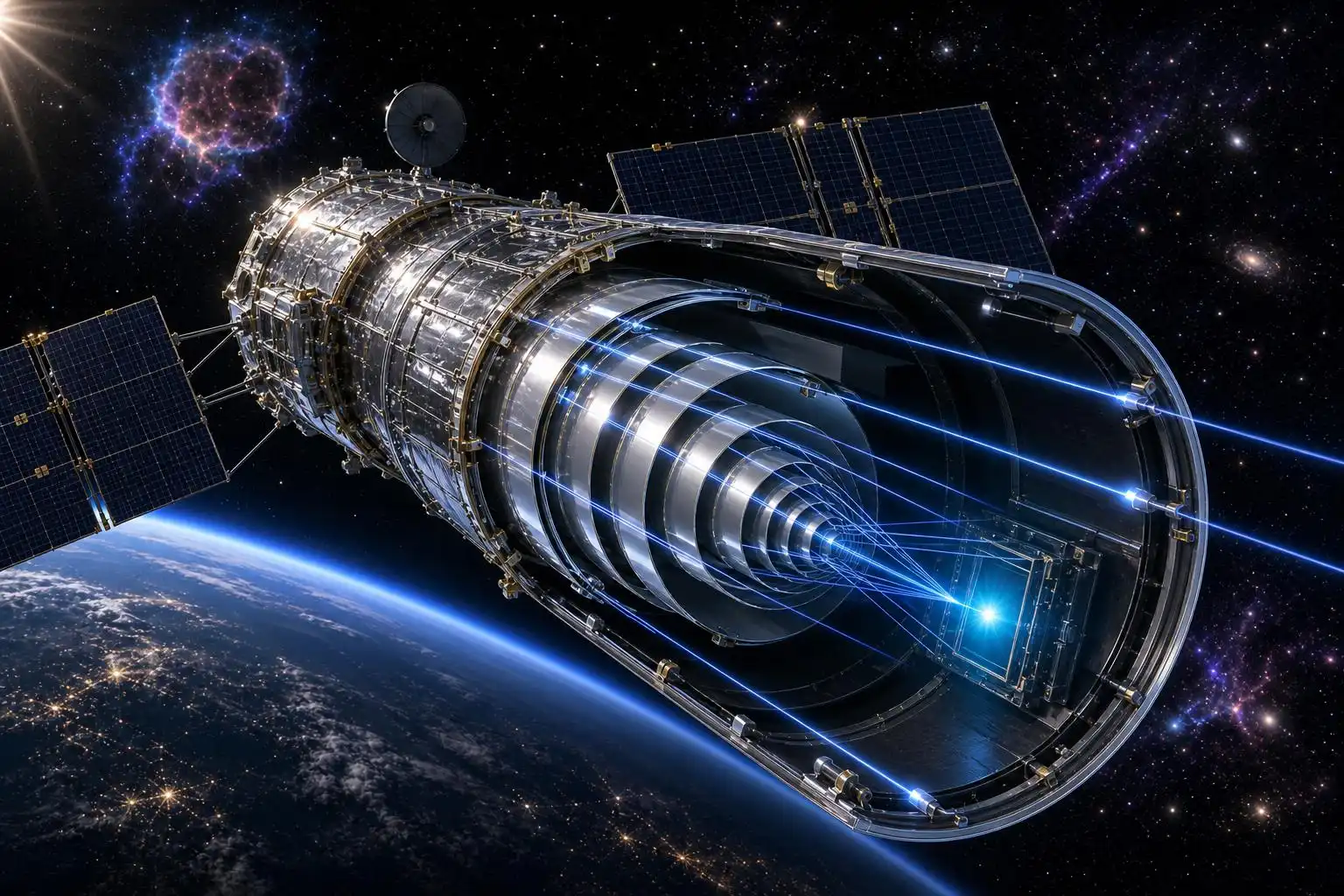
The catch is geometry. Grazing-incidence means your mirrors must be cylindrical shells, nested coaxially, with the X-ray beam traveling nearly parallel to the optical axis. Chandra flies four nested pairs of these shells. The outermost mirror pair has a diameter of 1.2 meters and a length of 84 centimeters. The innermost pair has a diameter of 0.65 meters. All eight mirror surfaces — four paraboloids, four hyperboloids — must be figured to an accuracy of 0.5 nanometers rms surface roughness. That’s roughly five hydrogen atoms laid side by side.
For context: Hubble’s primary mirror, the one that famously had its spherical aberration, suffered from a figure/conic error of about 2,200 nanometers. Chandra’s 0.5-nanometer surface roughness is a different measurement, but it conveys the extraordinary smoothness required to scatter X-rays as little as possible.
The Making of a Mirror That Shouldn’t Exist
The mirrors were fabricated by Hughes Danbury Optical Systems (later Raytheon) over a period of years that tested everyone’s patience and budget assumptions. The raw material is Zerodur, a glass-ceramic from Schott with a near-zero coefficient of thermal expansion — critical when your mirrors will swing between temperature extremes in orbit. Each blank was ground, polished, and then coated with a thin layer of iridium, chosen for its high X-ray reflectivity and chemical stability.
The polishing process was iterative and agonizing. Technicians used ion-beam figuring — essentially sandblasting the surface atom by atom with a controlled beam of argon ions — to remove material in precisely targeted spots. After each figuring run, the surface was measured interferometrically and the residual error map fed back into the next ion-beam pass. The cycle repeated, sometimes dozens of times, until the surface met spec.
The resulting mirrors are not just smooth. They are smooth and accurate. Smoothness controls scattered light (X-ray telescopes are particularly vulnerable to scattering, which smears point sources into halos). Accuracy controls the shape of the point-spread function — how tightly the telescope can concentrate a point source of X-rays onto the detector.
Chandra’s on-orbit angular resolution is 0.5 arcseconds half-power diameter. That’s comparable to Hubble in visible light. No other X-ray telescope in history has come close. XMM-Newton, launched five months after Chandra, achieves roughly 6 arcseconds FWHM and a half-energy width closer to 15 arcseconds. The Japanese Suzaku mission managed about 2 arcminutes. Chandra’s resolution advantage is not incremental. It is categorical.
An Orbit Nobody Wanted to Pay For
The mirrors are only half the story. To do science, Chandra also needed an orbit, and the orbit its scientists wanted was deeply unpopular with the people writing checks.
The problem with low Earth orbit for an X-ray observatory is the radiation belts. Charged particles trapped in Earth’s magnetic field constantly bombard spacecraft electronics and, more critically, X-ray detectors. Early X-ray satellites spent large fractions of their orbits behind Earth or being hammered by particle radiation, cutting their useful observing efficiency to perhaps 30–40%.
Chandra’s project scientists pushed for a highly elliptical orbit with an apogee of 139,000 kilometers — roughly one-third of the way to the Moon — and a perigee of about 16,000 kilometers. This orbit keeps Chandra above the radiation belts for approximately 85% of each 64-hour orbital period, dramatically improving observing efficiency.
The price was a large launch-and-propulsion stack. Getting Chandra to that orbit required an Inertial Upper Stage booster plus a built-in propulsion system that fired its engines multiple times over several days after deployment. The Inertial Upper Stage separated after its burns; Chandra’s onboard propulsion system remained part of the spacecraft. Total mission cost at launch: approximately $1.65 billion, making Chandra one of NASA’s four original “Great Observatories” and the most expensive X-ray mission ever flown.
The orbit also has a consequence nobody fully appreciated until operations began: Chandra can never be serviced. Hubble’s 600-kilometer circular orbit made it accessible to the Shuttle. Chandra’s 139,000-kilometer apogee is simply unreachable. Whatever breaks, stays broken. Whatever degrades, stays degraded. The mission was designed to last five years. It has now lasted twenty-five, and the engineering margins baked in by the original team deserve enormous credit.
The Instruments Behind the Mirrors
Chandra’s focal plane hosts two primary detector systems, selectable by moving the telescope’s aimpoint.
The Advanced CCD Imaging Spectrometer (ACIS) is an array of ten CCD chips covering both imaging and spectroscopic configurations. ACIS provides moderate spectral resolution (E/ΔE of roughly 20–50) across the full 0.1–10 keV band. Within months of launch, the team discovered that ACIS had suffered radiation damage, mainly from low-energy protons scattered through the mirrors during passages through the radiation belts early in the mission — the CCDs showed increased charge transfer inefficiency that degraded their spectral resolution. The team adapted by changing operating procedures, lowering detector temperatures, and applying calibration and charge-transfer-inefficiency corrections, partially recovering performance. It was the first real test of operating a complex instrument without the option of a house call.
The High Resolution Camera (HRC) uses microchannel plate detectors — essentially a stack of tiny glass tubes that multiply electrons when struck by an X-ray photon. The HRC sacrifices spectral resolution for timing and spatial resolution, and it remains the sharpest-imaging detector on the spacecraft.
For high-resolution spectroscopy, Chandra carries two grating assemblies: the High Energy Transmission Grating (HETG) and the Low Energy Transmission Grating (LETG). These can be inserted into the beam to disperse X-rays by wavelength, yielding resolving powers of up to 1,000 — sufficient to resolve individual emission lines from hot plasmas, measure Doppler shifts in stellar winds, and map the temperature and density structure of supernova remnants with a precision that still astonishes researchers.
Operations: The Quiet Heroism of a Control Room in Cambridge
Chandra is operated by the Chandra X-ray Center at the Harvard-Smithsonian Center for Astrophysics in Cambridge, Massachusetts — an unusual arrangement that keeps science and operations tightly coupled. The spacecraft communicates through NASA’s Deep Space Network, and its data rate is modest by modern standards: roughly 48 kilobits per second during contact periods. In an era of JWST’s 28 megabits per second downlink, that number sounds quaint. But Chandra’s X-ray photon count rates are themselves modest — a bright X-ray source might deliver a few hundred counts per second — so the bandwidth is adequate.
What is not modest is the pointing precision required to keep a 0.5-arcsecond telescope on target. Chandra uses six gyroscopes for attitude control (compared to Hubble’s original six, of which only three are currently functional). The aspect camera — a separate optical telescope that tracks field stars — provides the absolute pointing reference that ties Chandra’s X-ray images to known celestial coordinates. The resulting absolute astrometric accuracy is better than 0.6 arcseconds, meaning that when Chandra detects an X-ray source, astronomers can identify its optical or radio counterpart with confidence.
The control team has managed a long list of anomalies over the years. In 2018, a gyroscope glitch put the spacecraft into safe mode and briefly threatened operations; the team recovered full functionality within a week. In 2022, a computer board failure in the science instrument module required switching to a backup system. Each anomaly is a reminder that Chandra operates alone, at distances where a rescue mission is not a contingency anyone is planning.
What Chandra Has Taught Us
A full accounting of Chandra’s science would require a library. A few highlights establish the stakes.
Supernova remnants are where Chandra has perhaps done its most transformative work. Images of Cassiopeia A — a supernova remnant roughly 11,000 light-years away — show the blast wave, the reverse shock, and the neutron star at the center in exquisite detail. Chandra detected a thin ring of emission consistent with the first direct evidence of cosmic ray acceleration at a supernova shock front, confirming a decades-old theoretical prediction. The neutron star at Cas A’s center has also been observed to cool measurably over Chandra’s observing baseline — the first direct detection of neutron star cooling, constraining models of dense nuclear matter.
Black holes at every mass scale have been studied with Chandra. The telescope provided the first direct evidence that Sagittarius A*, the supermassive black hole at the Milky Way’s center, is accreting gas at an extremely low rate — far below what simple models predicted. Chandra observations of galaxy clusters have mapped the hot intracluster medium in unprecedented detail, revealing shock fronts, cavities blown by AGN jets, and cold fronts that trace the merger histories of clusters. These observations have contributed directly to constraints on dark matter cross-sections — Chandra data from the Bullet Cluster, combined with gravitational lensing, provided one of the most compelling pieces of evidence that dark matter is collisionless.
Stellar coronae — the hot, magnetically active outer atmospheres of stars — have been characterized across spectral types, ages, and activity levels. Chandra’s grating spectrometers have resolved the emission line forests of stellar coronae, measuring plasma temperatures, densities, and elemental abundances with a precision that ground-based observatories cannot approach.
The Budget Fight That Never Ends
In 2024, NASA’s FY2025 budget request proposed steep reductions to Chandra’s budget, cutting funding from about $68 million to about $41 million in FY2025 and then to a minimal closeout level in later years. The proposal triggered an immediate and vocal response from the astronomical community. Chandra’s science productivity — it remains among the most heavily oversubscribed observatories in the world, with proposal pressure (the ratio of requested time to available time) consistently above 6:1 — made the cuts hard to justify on scientific grounds.
The episode illustrated a structural problem in NASA’s science budget: flagship missions from the 1990s and 2000s are expensive to operate, and new flagship missions (JWST, and eventually Roman) compete for the same limited pot of money. Chandra’s annual operating cost is approximately $68 million — substantial, but a fraction of what it would cost to replace its capabilities. No replacement X-ray observatory with comparable angular resolution is currently funded or in development. The proposed successor concepts, including Lynx and the more modest New Athena (now simply Athena, restructured after ESA budget pressures), are decades away at best.
For now, Chandra continues to operate on reduced margins. The spacecraft’s orbit is slowly decaying — not toward reentry, but toward a more elliptical shape that will eventually increase radiation belt passages. The thermal environment is changing as the spacecraft ages and some heaters have been turned off to save power. The team manages these constraints with the quiet competence of people who have been doing this for a quarter century.
What 0.5 Arcseconds Actually Means
There is a number worth sitting with: 0.5 arcseconds. It is the half-power diameter of Chandra’s point-spread function. It means that if you point Chandra at two X-ray sources separated by half an arcsecond on the sky — roughly the apparent width of a dime seen from 7.4 kilometers away — Chandra can tell them apart.
Achieving that resolution required mirrors polished to five hydrogen atoms of roughness. It required an orbit that took years to negotiate and a propulsion system to help reach. It required detectors that survived radiation damage and software patches that partially compensated for what the radiation took away. It required a control team that has been troubleshooting anomalies for twenty-five years without the option of sending anyone up to fix anything.
Every Chandra image is, at some level, a document of that effort. The hot gas swirling around a neutron star. The shock wave of a galaxy cluster merger. The faint X-ray afterglow of a gamma-ray burst. These are not just scientific results. They are the residue of thousands of engineering decisions, each one of which had to be right.
That’s what it takes to build eyes that work in space.



Leave a Reply