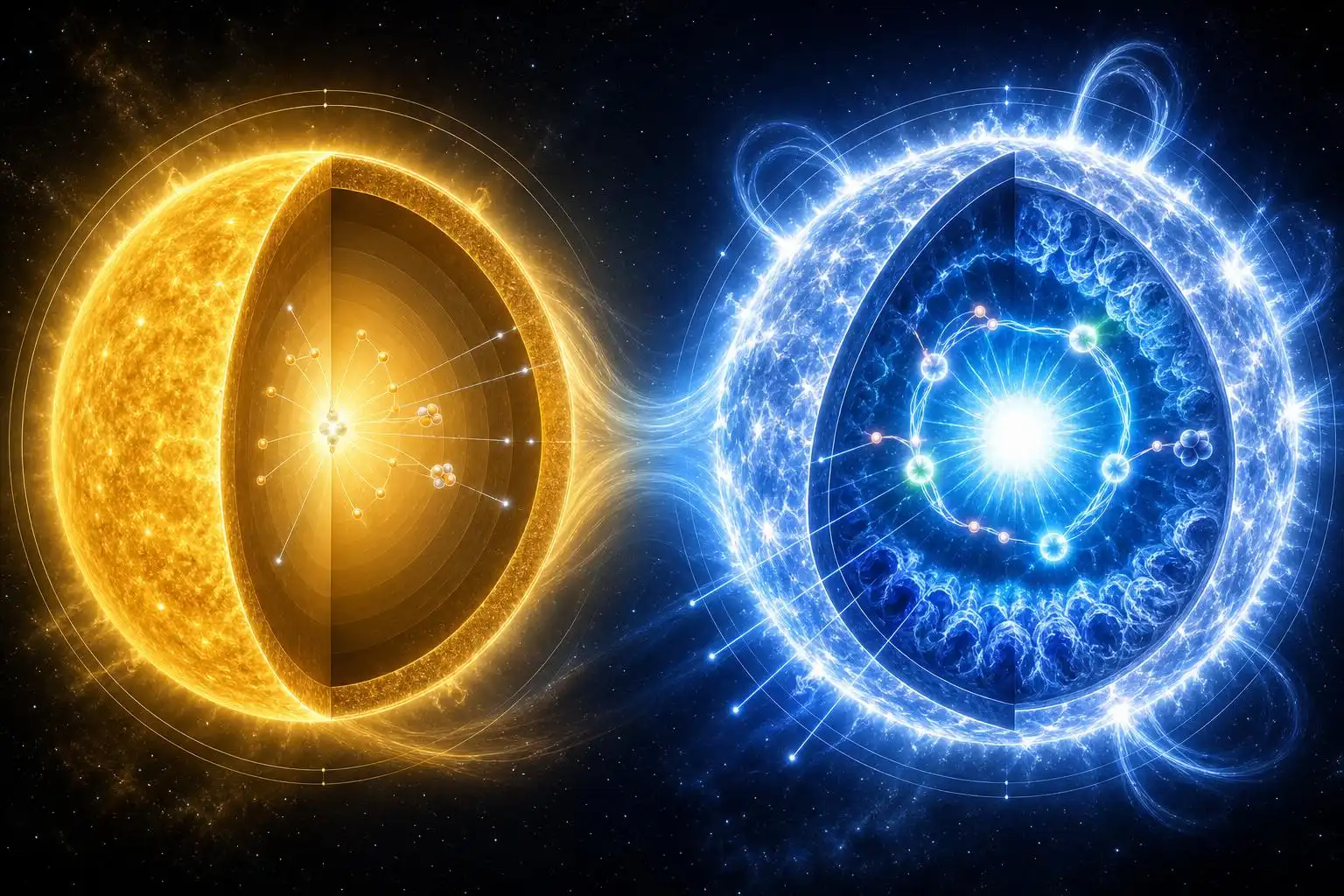

Every hydrogen-burning star on the main sequence is running one of two nuclear engines — or, more precisely, some blend of both. Below roughly 1.3 solar masses, the proton-proton (p-p) chain dominates. Above that threshold, the CNO cycle quietly takes over, and by the time you reach 2 M☉ it is contributing the overwhelming majority of a star’s luminosity. That crossover point is not arbitrary. It falls where it does — the precise mass depending on composition, metallicity, and evolutionary state — because of a steep temperature sensitivity that separates the two reaction networks in a way that reshapes everything from core structure to stellar lifetime.
The p-p Chain: Slow, Steady, Solar
The Sun runs mostly on the pp-I branch of the p-p chain. The rate-limiting step is the weak-force fusion of two protons into deuterium — a reaction so improbable that any given proton in the solar core waits, on average, about ten billion years before it finds a partner and reacts. That absurd slowness is precisely why the Sun has been burning for 4.6 Gyr and has another ~5 Gyr ahead of it.
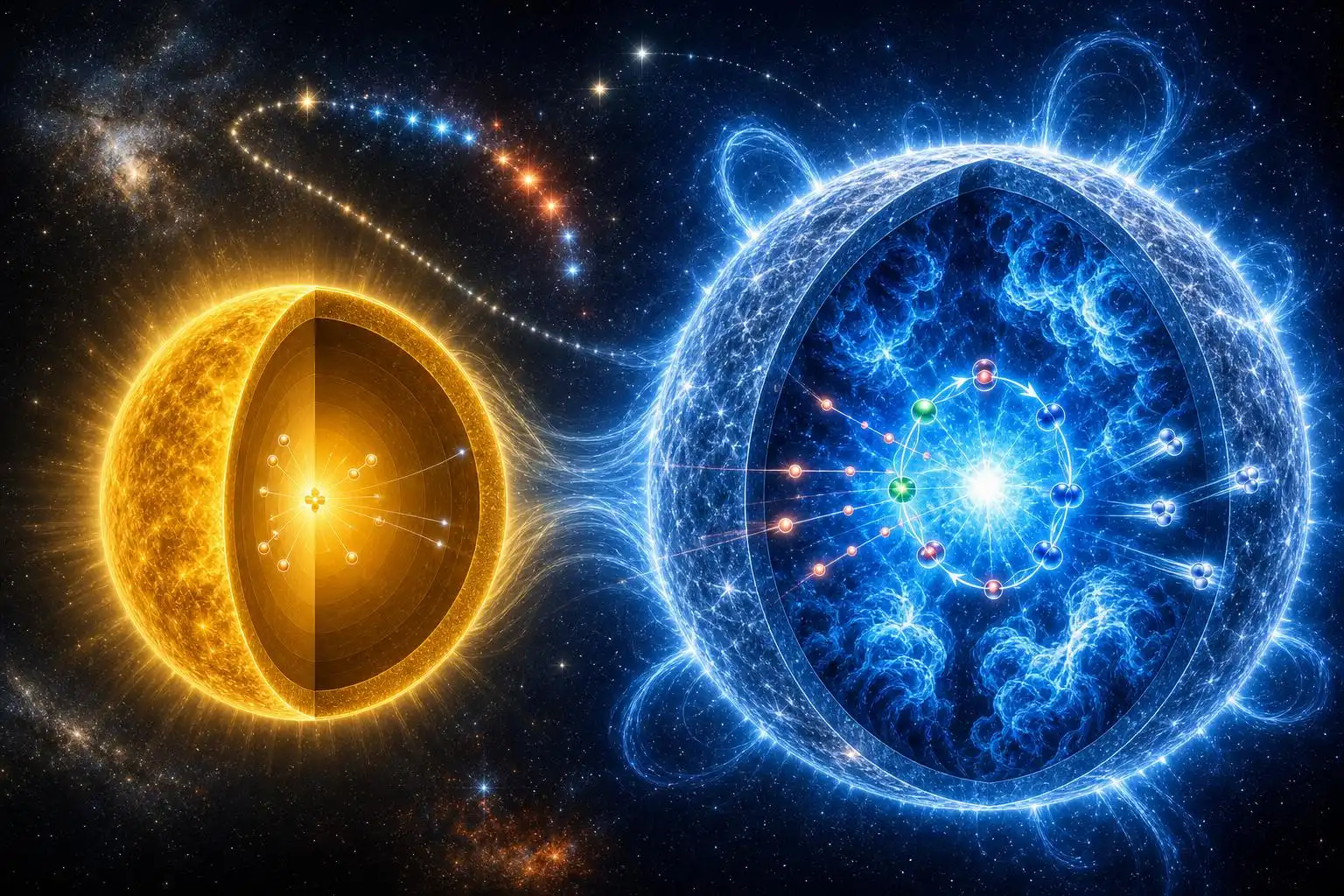
The energy generation rate for the p-p chain scales approximately as ε_pp ∝ T⁴ near solar temperatures (~1.5 × 10⁷ K). That’s a relatively gentle dependence. Crank up the temperature and you get more energy, but not explosively more. This means the p-p chain is a forgiving, self-regulating nuclear engine: small perturbations in temperature produce modest changes in energy output, and the star finds a stable equilibrium without drama.
The CNO Cycle: A Catalytic Furnace
The CNO cycle uses carbon-12 as a catalyst. A proton is captured by ¹²C to form ¹³N, which beta-decays to ¹³C; another proton capture produces ¹⁴N; a third gives ¹⁵O, which decays to ¹⁵N; a final proton capture on ¹⁵N releases an alpha particle and regenerates ¹²C. The net result is the same as the p-p chain — four protons in, one helium-4 out, two neutrinos and ~26.7 MeV released — but the catalyst is preserved and the pathway is entirely different.
The critical detail is the temperature sensitivity: ε_CNO ∝ T^~20 near 1.5 × 10⁷ K. That is not a typo. The CNO rate rises with roughly the twentieth power of temperature. This extreme sensitivity has two immediate consequences.
First, the CNO cycle only becomes competitive at temperatures above ~1.5–1.7 × 10⁷ K. In the Sun’s core, CNO contributes roughly 1–2% of total luminosity — a minor correction. But in a 2 M☉ star, where core temperatures reach ~2.5 × 10⁷ K, CNO dominates. By 10 M☉, CNO is essentially the only game in town, with core temperatures around 3.5 × 10⁷ K.
Second, the steep temperature dependence concentrates energy production into a very small central volume. In a CNO-dominated core, a tiny temperature increase produces a huge energy surge, which demands efficient transport. Radiation alone cannot carry the flux — the radiative temperature gradient becomes superadiabatic, and convection ignites.
The Convective Core Transition
This is the structural heart of the matter. The Sun has a radiative core and a convective envelope. A 2 M☉ star (spectral class A, sitting near the middle of the main sequence on the HR diagram at roughly L ~ 15 L☉, T_eff ~ 8,500 K) has the opposite: a convective core and a radiative envelope. The transition happens right at the CNO turnover mass.
In a convective core, material is continuously stirred. Fresh hydrogen is mixed down from slightly outer regions, and helium ash is distributed throughout the convective zone rather than accumulating only at the very center. This has a profound effect on main-sequence lifetime: a 10 M☉ star (L ~ 6,000 L☉, spectral class B2) burns through its convective core hydrogen faster in absolute terms but also has a larger fuel reservoir than a purely central-burning model would suggest.
The size of the convective core — typically expressed as a fraction of the total stellar mass — grows with stellar mass. In a 1.5 M☉ star it might encompass ~10% of the mass; in a 20 M☉ star it can exceed 20%. The exact boundary is set by the Schwarzschild criterion: convection occurs where the radiative gradient ∇_rad exceeds the adiabatic gradient ∇_ad. Because ε_CNO is so sharply peaked at the center, ∇_rad peaks sharply there too, guaranteeing that the innermost region goes convective first.
Convective Overshooting: The Open Question
Here is where the clean textbook picture runs into genuine uncertainty. The Schwarzschild criterion tells you where a fluid parcel is locally unstable to convection, but it says nothing about the momentum of a convective eddy as it crosses that boundary. A rising blob of hot gas doesn’t stop dead at the formal convective boundary — it overshoots into the stable region above, mixing material beyond what the criterion predicts.
Convective overshooting is parameterized (crudely) as a fraction α_ov of the pressure scale height H_p. Values of α_ov ~ 0.1–0.3 are inferred from observations of eclipsing binary stars, where precise masses and radii can be measured and compared to stellar models. But the physics of overshooting is not well understood from first principles. Three-dimensional hydrodynamic simulations of stellar convection — groups like the Multidimensional Stellar Implicit Code (MUSIC) project and work from the University of Exeter — show that overshooting is neither a simple diffusive process nor a clean step function. The real boundary is a turbulent, intermittent zone.
Why does this matter? Because overshooting directly controls how much hydrogen a massive star burns on the main sequence, which sets its position on the HR diagram at terminal-age main sequence (TAMS), which in turn affects its evolution onto the red giant branch and ultimately the mass of the helium core it carries into later burning stages. A 20% uncertainty in α_ov propagates into meaningful uncertainty in the predicted mass of a pre-supernova iron core.
Reading the CNO Turnover in Stellar Populations
One of the cleanest observational signatures of the p-p/CNO transition is the main-sequence morphology in star cluster color-magnitude diagrams. Below the turnover mass, stars have radiative cores (note that the lowest-mass M dwarfs are fully convective, but in the intermediate range relevant to this transition the cores are radiative) and their main-sequence widths are narrow — they don’t swell much before turning off. Above the turnover, stars develop convective cores whose effective extent is enlarged by overshooting, and they develop a characteristic hook shape near the main-sequence turnoff in young clusters.
The “main-sequence hook” — a slight blueward extension of the turnoff before the subgiant branch — is a direct signature of convective core hydrogen exhaustion and the size of the mixed core. Fitting isochrones to this feature in clusters like NGC 1866 in the Large Magellanic Cloud (age ~200 Myr, turnoff mass ~3.5 M☉) has been used to constrain α_ov observationally. The result is a rare case where nuclear physics, convection theory, and observational photometry converge on the same number — and still disagree at the 20–30% level.
What the Temperature Sensitivity Buys You
It’s worth pausing on just how physically strange a T²⁰ dependence is. In a CNO-burning core, if you could somehow raise the temperature by 10% — say from 2.5 × 10⁷ K to 2.75 × 10⁷ K — the energy generation rate would increase by a factor of (1.1)²⁰ ≈ 6.7. A 10% temperature perturbation produces nearly a sevenfold surge in power output. This is why CNO-burning stars cannot tolerate even modest central temperature fluctuations without triggering convection: the only way to carry that flux is to move mass.
Contrast this with the p-p chain’s T⁴ dependence: a 10% temperature rise gives (1.1)⁴ ≈ 1.46 — a 46% increase, easily handled by radiation. The Sun’s radiative core is stable precisely because the p-p chain is so temperature-insensitive.
This single number — the power-law index of the energy generation rate — is the reason two stars of nearly the same mass can have fundamentally different internal architectures. A 1.1 M☉ star and a 1.5 M☉ star look superficially similar on the HR diagram (both near the upper main sequence, spectral classes G2 and F3 respectively), but their interiors are organized on opposite principles. The heavier star has already crossed the CNO threshold; its core is churning with convection while its envelope sits in radiative silence.
The Nitrogen Anomaly
One last observational fingerprint. In the CNO cycle, the slowest reaction is the proton capture on ¹⁴N to form ¹⁵O — the rate-limiting step of the entire cycle. As a result, ¹⁴N accumulates at the expense of ¹²C and ¹⁶O. In a star that has mixed CNO-processed material to its surface — through rotational mixing, convective dredge-up, or mass transfer — you expect to see elevated nitrogen and depleted carbon relative to solar abundances.
This is precisely what is observed in many massive OB stars and in the nitrogen-enhanced “ON” spectral subclass (as distinct from “OC” stars, which are relatively carbon-strong and nitrogen-weak). The surface CNO anomalies in stars like ζ Puppis (O4 supergiant, ~40 M☉) show nitrogen enhancements of factors of 5–10 and carbon depletions consistent with partial CNO equilibrium. These are not exotic objects — they are ordinary massive stars whose rotation has dredged up core material. But the abundance pattern is a direct readout of the nuclear cycle running in their interiors, a chemical memory of reactions happening at 3 × 10⁷ K, millions of kilometers beneath the photosphere.
The CNO cycle, in other words, writes its signature not just in the structure of the star but in the light it emits. Every spectrum of a nitrogen-enhanced O star is a postcard from a convective core running on a T²⁰ nuclear engine — and a reminder that the periodic table itself is shaped, atom by atom, by the temperature sensitivity of a reaction network discovered in 1938 by Hans Bethe and Carl Friedrich von Weizsäcker, working independently, in one of the great parallel discoveries in the history of physics.



Leave a Reply