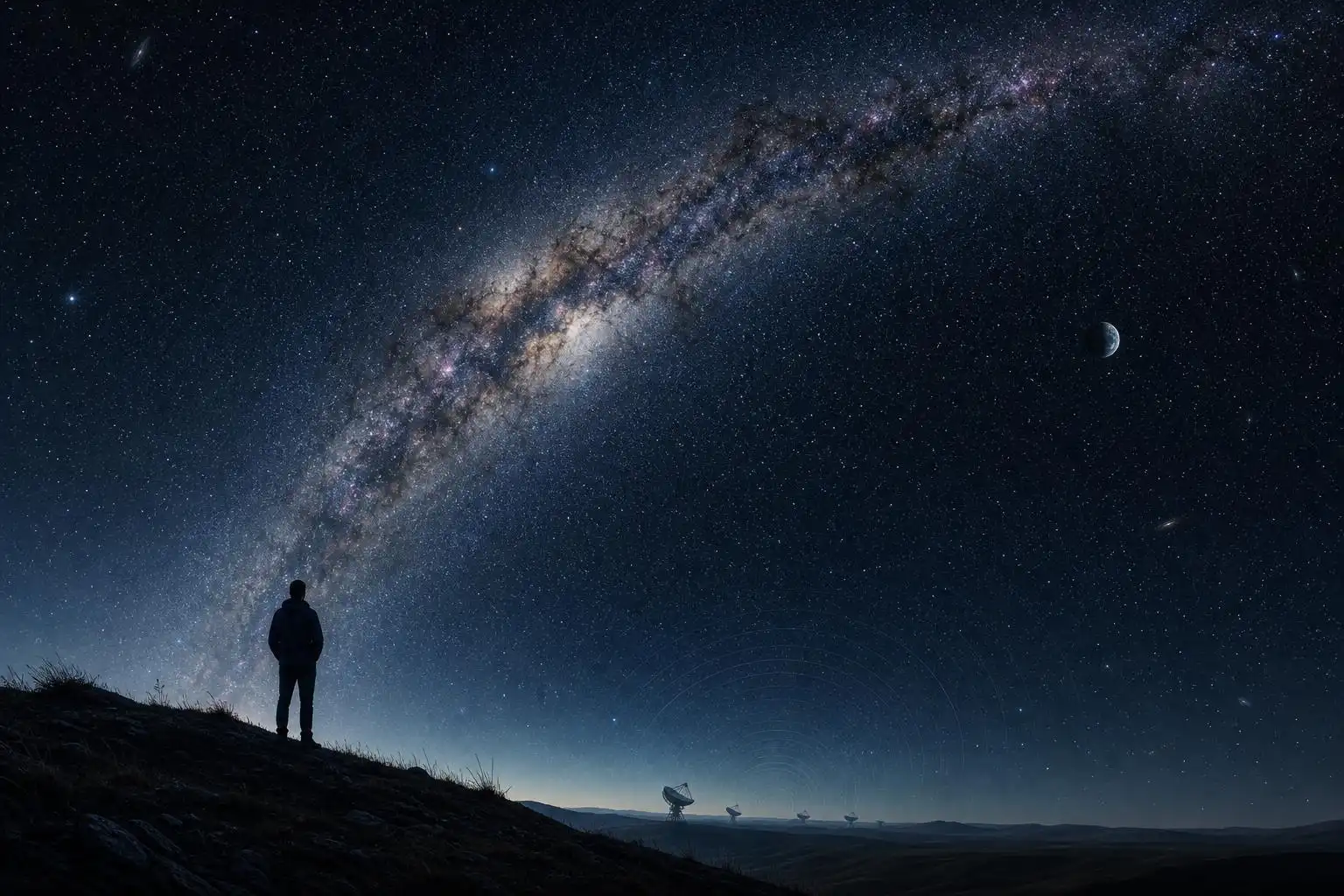

Step outside on a clear night. Look up. There are roughly two trillion galaxies in the observable universe — some small dwarfs, others vast systems with hundreds of billions of stars — and together they contain an almost unimaginable number of stars, many of those stars circled by planets, many of those planets sitting in the kind of cozy, not-too-hot, not-too-cold zones where liquid water can pool and life — at least the kind we know — might get started.
The math is staggering. Even if only one in ten thousand stars hosts a planet with life, and only one in ten thousand of those planets eventually produces a civilization, the Milky Way alone could still contain thousands of intelligent species. Some of them, statistically, should be billions of years older than us — which means they have had billions of years to spread across the galaxy, build radio transmitters, send probes, or at minimum leave some kind of fingerprint on the cosmos.
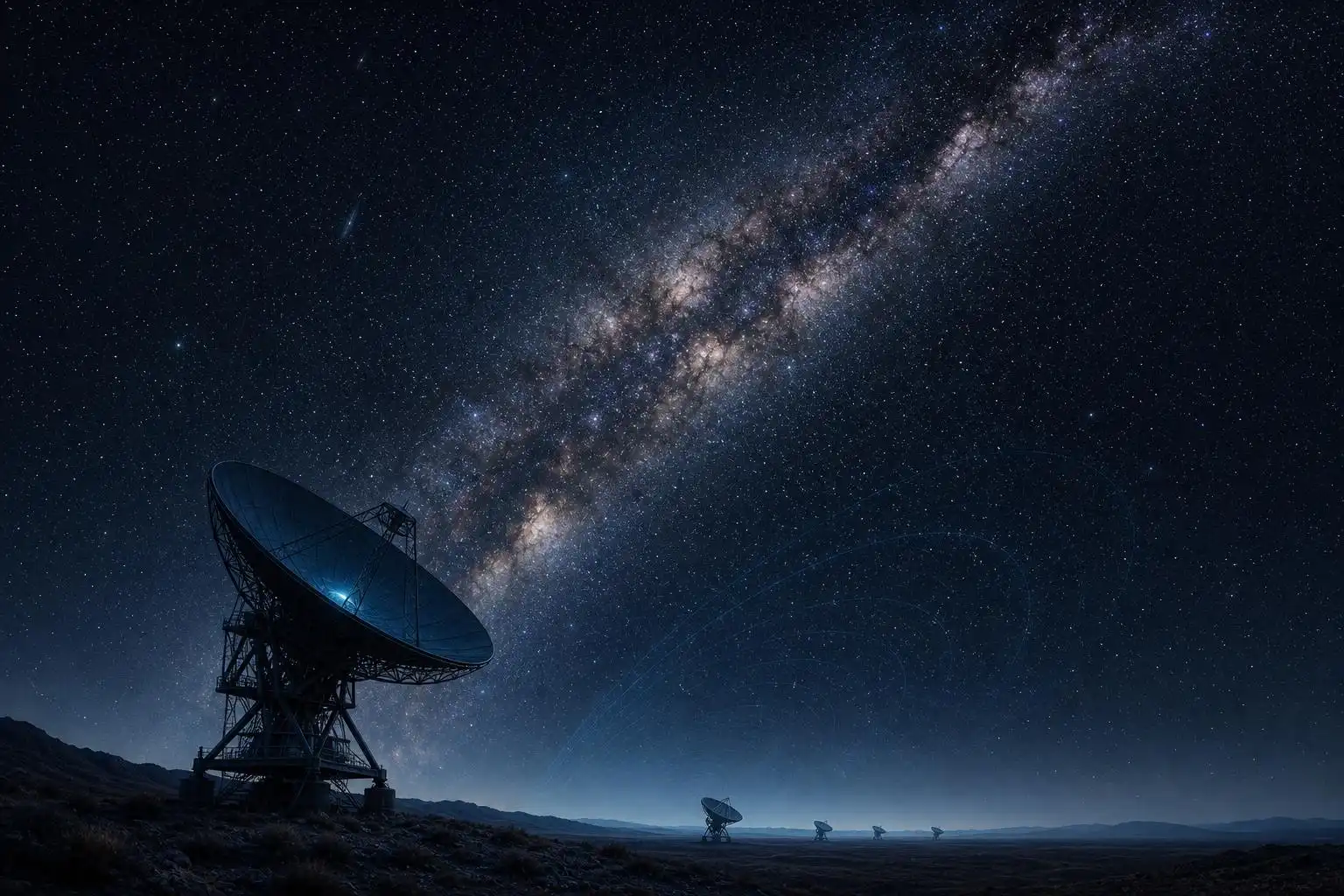
So here is the question that a physicist named Enrico Fermi reportedly blurted out over lunch at Los Alamos in 1950, and that has haunted scientists ever since:
Where is everybody?
The Silence That Shouldn’t Be There
This is the Fermi Paradox, and it is less a paradox in the formal logical sense and more a profound mismatch — a gap between what the numbers seem to predict and what we actually observe, which is: nothing. No signals. No visitors. No megastructures blotting out distant stars (well, mostly — more on that in a moment). No alien equivalent of our own radio leakage, which has been drifting outward from Earth at the speed of light for over a century now.
The silence is the strange part. Not because we expected to find aliens easily, but because the universe is so old and so large that the absence of any evidence feels like it requires an explanation.
Think of it this way. The Milky Way is about 100,000 light-years across. A civilization with even modest spacefaring technology — not faster-than-light travel, just slow, patient, generational voyages — could theoretically colonize the entire galaxy in somewhere between one and ten million years. That sounds like a long time, but the Milky Way is over 13 billion years old. Ten million years is less than 0.1% of the galaxy’s age. If even one civilization had arisen and decided to expand, it would have had time to fill the galaxy tens of thousands of times over before our Sun even formed.
And yet: silence.
The Proposed Solutions (And Why None of Them Are Fully Satisfying)
Scientists and philosophers have proposed dozens of explanations for the Fermi Paradox. They fall into a few broad camps, and each one carries its own unsettling weight.
1. We Are Alone (or Nearly So)
Maybe life is just extraordinarily rare. Maybe the jump from chemistry to biology — from amino acids to a self-replicating molecule — is so improbable that it has only happened once, or a handful of times, in the entire observable universe. This is sometimes called the Rare Earth hypothesis. It is humbling in a different direction: not that we are surrounded by life and can’t find it, but that the universe is genuinely, mostly dead, and we are an extraordinary accident.
2. Life Is Common, Intelligence Is Not
Perhaps simple microbial life is everywhere — in the oceans under Europa’s ice, in the clouds of Venus, in the subsurface of Mars — but the leap to complex, tool-using, civilization-building intelligence is vanishingly rare. After all, life existed on Earth for nearly four billion years before anything with a brain showed up. That might not be a coincidence. It might be the rule.
3. The Great Filter
This is the one that keeps astrobiologists up at night. What if there is some step in the development of a civilization — some hurdle so difficult that almost no one clears it? This “Great Filter” might be behind us (the origin of life, the emergence of the eukaryotic cell, the development of multicellular organisms) or it might be ahead of us. If it is ahead, it means that every civilization eventually destroys itself — through war, climate collapse, engineered pandemics, artificial intelligence, or something we haven’t imagined yet. In that scenario, the silence of the universe is a warning.
Philosopher Nick Bostrom has written that discovering microbial life on Mars would actually be bad news for humanity. If life arose independently on Mars, it suggests the Great Filter is probably not in our past — the origin of life is apparently easy — which means it is probably still waiting for us.
4. They Are Here, and We Don’t Recognize Them
Some researchers suggest that we are looking for the wrong things. We listen for radio signals because we use radio. But a civilization a billion years more advanced than us might communicate in ways we can’t detect, using physics we don’t understand. They might be all around us, and we simply lack the instruments to know it. The “zoo” hypothesis suggests advanced civilizations deliberately leave us alone, the way a wildlife photographer avoids disturbing the animals. A related but darker idea, the “dark forest” hypothesis, is that civilizations stay hidden because revealing themselves to unknown others could be dangerous.
5. The Universe Is Simply Too Big
Even at the speed of light, a signal from the nearest star takes over four years to arrive. From the far side of the Milky Way, 100,000 years. From Andromeda, 2.5 million years. Maybe civilizations exist and are broadcasting, but the distances are so vast that their signals have not reached us yet, or ours have not reached them. The universe is not just big — it is old in patches, and the timing has to be right. Two civilizations could exist and never overlap in the narrow window of cosmic time when both are listening.
The Wow! Signal and the Tantalizing Almost
On August 15, 1977, a radio telescope at Ohio State University detected something remarkable. It was a strong, narrowband signal at almost exactly the frequency that scientists had long predicted an alien civilization might use for communication — 1420 MHz, the frequency at which hydrogen atoms naturally emit radiation, known to any civilization that understands physics. Astronomer Jerry Ehman circled the printout and wrote “Wow!” in the margin.
The signal has never been detected again. It lasted 72 seconds — the length of time the telescope could observe any given patch of sky — and then it was gone. It remains unexplained.
It might have been terrestrial interference. It might have been a natural astrophysical phenomenon we don’t fully understand. It might have been something else entirely. We don’t know.
That “we don’t know” is one of the most honest and thrilling phrases in science.
What the Silence Means to You, Personally
Here is why the Fermi Paradox matters to someone who isn’t an astronomer, who doesn’t spend their days thinking about radio frequencies and stellar habitable zones.
It matters because it is, at its core, a question about our place in the story.
If we are alone — truly alone — then every piece of music ever written, every act of love, every moment of curiosity, every child asking “why?” at the edge of a tide pool is the only such thing in the universe. The cosmos is not indifferent; it is, in a sense, ours. That is not a small thing. It is almost unbearably large.
If we are not alone — if the universe is full of minds and we simply haven’t found each other yet — then we are part of something even larger: a community of consciousness scattered across the dark, each one looking up, each one asking the same questions, each one waiting.
And if the Great Filter is ahead of us — if civilizations routinely fail to survive their own technologies — then the silence is a message: one we are still deciding whether to hear.
The Most Important Thing About the Paradox
Enrico Fermi asked his question in 1950, and we are no closer to a definitive answer. The James Webb Space Telescope is now scanning the atmospheres of distant exoplanets for biosignatures. SETI researchers are combing through radio data with increasingly powerful algorithms. Astrobiologists are designing missions to the oceans of Europa and Enceladus.
We have been looking for decades, and we are now looking with better tools than ever.
And that might be the most important thing of all — not the silence, but the fact that we noticed it. That we found the absence strange enough to investigate. That a species that has only been building radio telescopes for about 70 years, on a pale blue dot orbiting an unremarkable star in the outer arm of an average galaxy, looked up at two trillion galaxies and thought: Something seems missing. Let’s find out what.
That impulse — the refusal to accept the silence as an answer — might be the most distinctly human thing there is.
Or maybe it’s not just human. Maybe that’s the point.


Leave a Reply