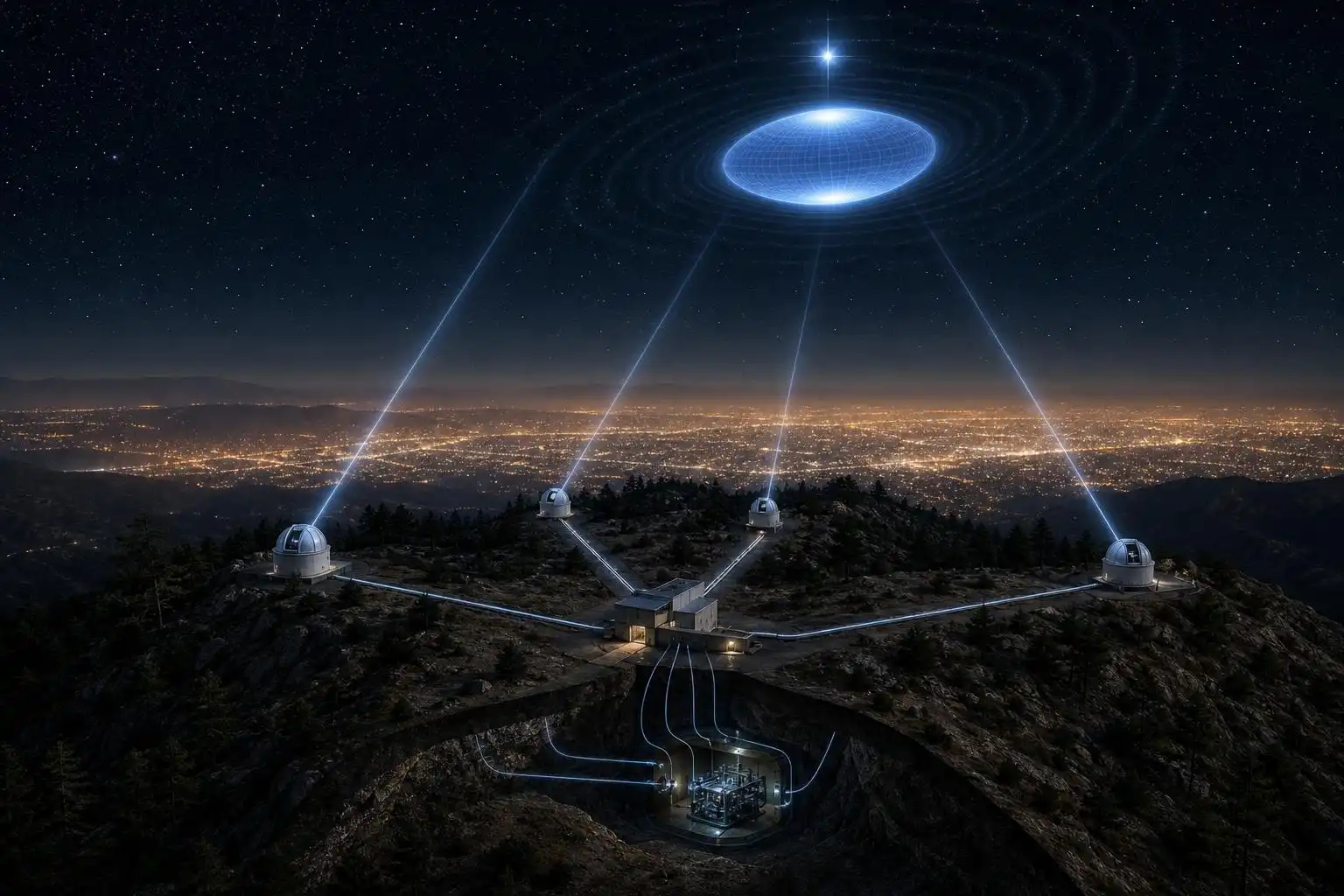

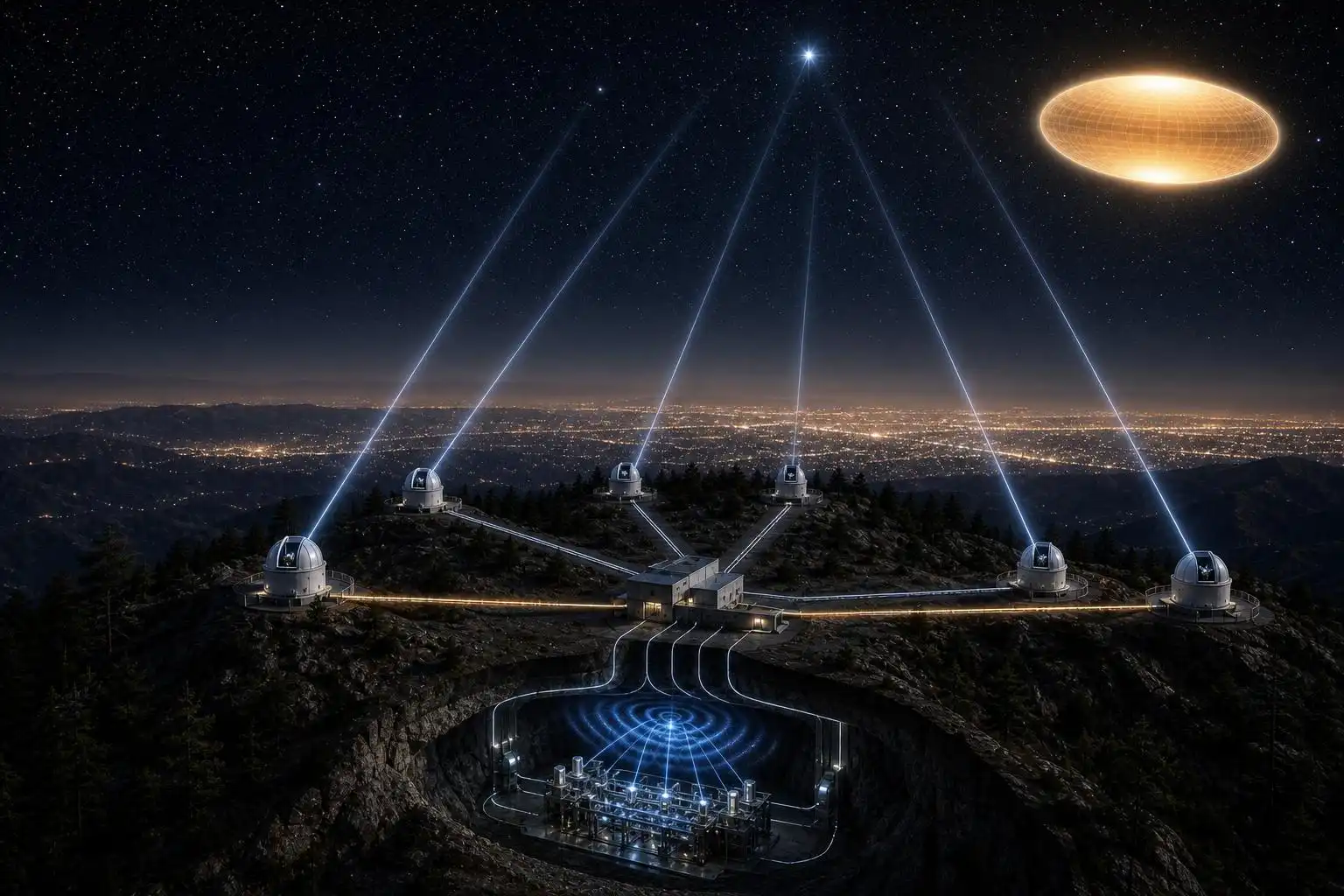
On the summit of Mount Wilson, above the Los Angeles Basin’s famous smog and light pollution, six one-meter telescopes are spread across a ridge in a Y-shaped array. Individually, they are modest instruments — nothing that would attract headlines in an era of thirty-meter giants. But connected by underground light pipes to a central beam-combining laboratory, they form the Center for High Angular Resolution Astronomy interferometer, CHARA, and their maximum baseline of 330 meters makes them the longest-baseline optical/infrared imaging interferometer on Earth. At that separation, CHARA routinely achieves angular resolutions below 0.5 milliarcseconds — fine enough to resolve the actual disk of a star like Altair, not merely measure its brightness and infer a size, but image the oblate shape of a rapidly rotating sun spinning so fast that its equatorial radius is measurably larger than its polar radius.
That is the story worth telling in detail: not interferometry in general, but this specific number — 330 meters — and what it physically means to combine starlight coherently across that distance.
The Resolution Limit and Why Baselines Matter
The Rayleigh criterion tells us that a single circular aperture of diameter D resolves angles down to roughly 1.22 λ/D radians. A one-meter telescope at visible wavelengths (say, 700 nm) resolves about 0.17 arcseconds in the absence of atmospheric seeing. That is already inadequate for stellar disks: even the largest apparent stellar disk in the sky, that of R Doradus, subtends only about 57 milliarcseconds. Most main-sequence stars and giants we care about are smaller than 5 milliarcseconds. No single filled aperture realistically built on the ground will resolve them.
An interferometer replaces the filled aperture with a pair (or more) of separated apertures and measures the fringe visibility — how much contrast remains in the interference pattern formed when the two beams are combined. A point source produces fringes of maximum contrast (visibility = 1). As the source’s angular diameter grows relative to λ/B, where B is the baseline, the fringes wash out. Visibility drops to zero when the source angular diameter θ ≈ 1.22 λ/B. By measuring visibility as a function of baseline length and orientation, you reconstruct the source’s brightness distribution through a Fourier relationship: the complex visibility is the Fourier transform of the sky brightness distribution, sampled at spatial frequency B/λ.
At CHARA’s maximum baseline of 330 meters and a wavelength of 700 nm, the resolution limit is:
θ = λ/B = 700 × 10⁻⁹ m / 330 m ≈ 2.1 × 10⁻⁹ radians ≈ 0.43 milliarcseconds
That is the number that matters. It is what allows CHARA to directly measure the angular diameters of nearby main-sequence stars — objects that are genuinely stellar in size, not the bloated giants that earlier, shorter-baseline interferometers were confined to studying.
Optical Path Length: The Engineering Problem
Resolving power is the easy part to state. Making it work is another matter entirely.
For two beams to interfere, their optical path lengths must be matched to within a coherence length — roughly λ²/Δλ, where Δλ is the bandwidth of the light being combined. For a broadband visible channel with Δλ ~ 50 nm centered at 700 nm, the coherence length is about 10 micrometers. Ten micrometers. CHARA must equalize the path lengths of starlight arriving at two telescopes separated by up to 330 meters to better than ten micrometers, in real time, as the Earth rotates and the geometric path difference continuously changes.
This is accomplished with delay lines — long vacuum pipes or air paths along which a movable mirror trolley slides on precision rails. As the star moves across the sky, a control computer calculates the changing geometric delay and drives the trolley to compensate. At CHARA, the delay lines run underground between the telescope stations and the beam-combining lab, with each arm capable of introducing up to ~60 meters of additional path. The trolleys move continuously, tracking the sidereal rate of path change, while a fast fringe tracker — operating at hundreds of Hz — corrects residual fluctuations caused by atmospheric turbulence and vibration.
The fringe tracker is, in a real sense, the interferometric analog of an adaptive optics system. Where AO corrects the wavefront across a single aperture, the fringe tracker corrects the differential piston — the average phase difference between the two apertures — fast enough that the science camera can accumulate signal without the fringes blurring out. CHARA’s PAVO, CLASSIC, CLIMB, VEGA, MIRC-X, and MYSTIC beam combiners each have their own fringe-tracking arrangements, operating at different wavelengths and with different numbers of baselines simultaneously.
Six Telescopes, Fifteen Baselines
One of CHARA’s structural advantages is its number of apertures. With six telescopes — labeled S1, S2, E1, E2, W1, W2 — the array simultaneously provides C(6,2) = 15 distinct baselines, ranging from the shortest (~34 meters, between adjacent stations) to the longest (330 meters, between S2 and W2). Each baseline samples a different spatial frequency and orientation in the Fourier plane — the uv plane, in interferometrist’s terminology, where u and v are the east-west and north-south components of the baseline vector measured in units of wavelength.
As the Earth rotates, each baseline traces an elliptical arc in the uv plane, so a single night of observation fills in a substantial swath of Fourier coverage. With fifteen baselines rotating simultaneously, CHARA can accumulate enough uv coverage in a few hours to attempt genuine image reconstruction — not just fitting a simple geometric model (uniform disk, Limb-darkened disk, binary point sources) but inverting the Fourier data to produce an actual image.
This is how the 2007 Altair result was achieved. Using CHARA’s MIRC beam combiner in the near-infrared H band, a team led by John Monnier produced the first image of a main-sequence star other than the Sun. Altair (α Aquilae), a rapidly rotating A7 star just 5.1 parsecs away, has an equatorial angular diameter of 3.46 ± 0.08 milliarcseconds and a polar diameter of 2.99 ± 0.08 milliarcseconds — a ratio of 1.16, consistent with a star rotating at about 90% of its breakup velocity. The image revealed not just the oblate shape but gravity darkening: the equatorial regions, puffed outward by centrifugal force, are cooler and dimmer than the poles. That is a stellar physics result, obtained purely from the geometry of how near-infrared photons interfered across 330 meters of California ridge.
Atmospheric Seeing and Coherence
Mount Wilson sits at 1,742 meters elevation. Its seeing — typically 1 to 2 arcseconds in the V band — is mediocre by the standards of Paranal or Mauna Kea. For a conventional imaging telescope, that would be disqualifying. For an interferometer, it matters differently.
Atmospheric turbulence corrupts the wavefront arriving at each aperture, reducing the coherence of the light before it even enters the delay lines. The relevant quantity is the Fried parameter r₀ — the coherence length of the atmosphere, typically 10–20 cm in the visible at a good site. If the telescope aperture exceeds r₀, the collected light is spread across multiple turbulent cells, each with independent phases, and the fringe visibility drops precipitously.
CHARA’s telescopes are deliberately one meter in diameter — larger than r₀ at visible wavelengths at Mount Wilson, which means each aperture collects multiple turbulent cells. To recover coherence, some CHARA beam combiners feed their light through single-mode optical fibers, which act as spatial filters: they transmit only the fundamental mode, discarding the incoherent high-order wavefront errors. The price is flux — most of the collected light is rejected by the fiber — but what emerges is spatially coherent, capable of forming high-contrast fringes. Other beam combiners add partial AO correction upstream to improve fiber coupling efficiency and recover more of the lost flux.
The atmosphere also imposes a coherence time τ₀ — typically 5–20 milliseconds in the visible — within which the fringe phase is approximately stable. Exposures longer than τ₀ blur the fringes unless a fringe tracker is running. This is why faint-star interferometry is hard: the fringe tracker needs enough photons in each τ₀ interval to measure and correct the phase, which sets a practical limiting magnitude. CHARA’s current fringe trackers operate to roughly V ~ 8 or H ~ 7 without adaptive optics assistance, which covers a scientifically rich but not unlimited target list.
What 330 Meters Has Actually Measured
The Altair image is the headline result, but the catalog of CHARA science built on angular diameter measurements is broad and deep. Directly measured angular diameters, combined with parallax distances from Hipparcos and Gaia, yield linear radii independent of any stellar model. Combined with bolometric fluxes, they yield effective temperatures. These are fundamental parameters in the strictest sense — no isochrone, no spectral synthesis, no assumption about interior structure required.
CHARA has measured angular diameters for dozens of stars across the HR diagram: subgiants and giants used as interferometric calibrators for years have had their diameters pinned at the 1% level. More importantly, CHARA has pushed into the main sequence — measuring sun-like stars with diameters of 1–2 solar radii at distances of 10–50 parsecs, where the angular diameters are 0.5–2 milliarcseconds. These measurements test stellar evolution models directly: when a model predicts a radius for a star of known mass, metallicity, and age, and CHARA measures a different radius at the 3% level, something in the physics is wrong. This is exactly the tension that emerged with low-mass K and M dwarfs, where interferometric radii are systematically larger than model predictions — a discrepancy that has driven a decade of theoretical work on magnetic activity and convection.
CHARA has also resolved binary systems, measuring orbital inclinations and semi-major axes in angular units that, combined with spectroscopic velocity amplitudes, yield dynamical masses without distance assumptions. And with the MYSTIC beam combiner operating in the K band (2.0–2.4 μm), CHARA has begun resolving the circumstellar disks and dust shells around evolved giants and Be stars — structures at scales of a few milliarcseconds that were previously accessible only to infrared interferometers with larger apertures, such as the VLTI.
The Engineering Discipline Behind the Fringes
It is worth pausing on what it takes to maintain coherence across 330 meters of real estate on a California hilltop. The light pipes — evacuated or nitrogen-purged beam trains — must hold alignment at the sub-arcsecond level as temperature changes cause differential expansion in the mirror mounts, as wind shakes the telescope tubes, as the trolleys rumble along their rails. Vibration isolation is not optional; it is engineered into every mount and pier. The path-length metrology system — laser interferometers measuring the trolley positions — must be accurate to nanometers over meter-scale travels.
And all of this runs simultaneously on multiple baselines, with the science camera reading out in milliseconds and the fringe tracker feeding corrections back to the delay line actuators at kilohertz rates. The control system is not a convenience; it is the instrument. Without it, 330 meters of baseline is just a very expensive way to collect photons that will never interfere.
That is the thing I find most striking about CHARA: the measurement is the engineering. The angular diameter of Altair — 3.46 milliarcseconds, oblate, gravity-darkened, real — exists because someone built delay lines that move to nanometer precision across sixty meters of underground tunnel, and someone else wrote a fringe tracker that outruns the atmosphere, and someone else designed a fiber injection system that throws away most of the light in order to save the coherence. The pretty image is downstream of all of that. The discipline is in the tunnel.



Leave a Reply