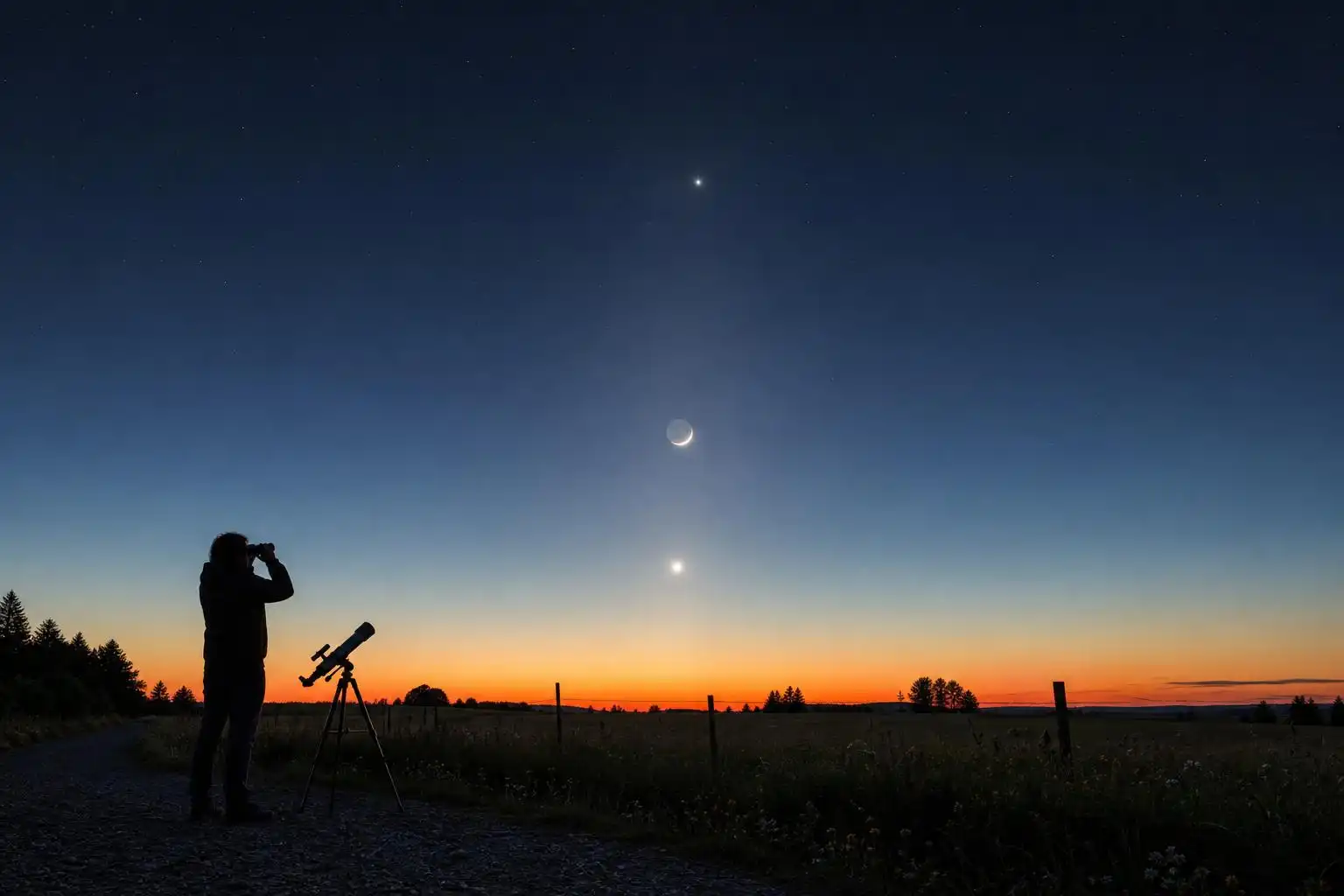

There are weeks on the observing calendar that feel like gifts — nights where even a five-minute trip to the driveway is worth the effort. The week of May 15–22, 2026 is one of those weeks. A crescent Moon is threading its way through a tight grouping of brilliant planets in the western sky, the zodiacal light is still putting on a show before it fades for the season, and for those of you with a serious telescope and a taste for galaxies, the New Moon window is cracking open one of the finest edge-on spirals in the northern sky. Let me walk you through it all.
The Crescent Parade: Moon, Venus, and Jupiter
The headline event this week is a slow-motion celestial waltz happening right after sunset in the west. Venus has been dominating the evening sky for weeks now — you can’t miss it, blazing away at around magnitude –3.9, the first “star” to pop out as twilight deepens. Jupiter sits higher up, fainter but still unmistakably bright at around magnitude –1.9. And this week, a young crescent Moon is sliding between them, giving the whole scene a sense of geometry that makes the ecliptic almost tangible.
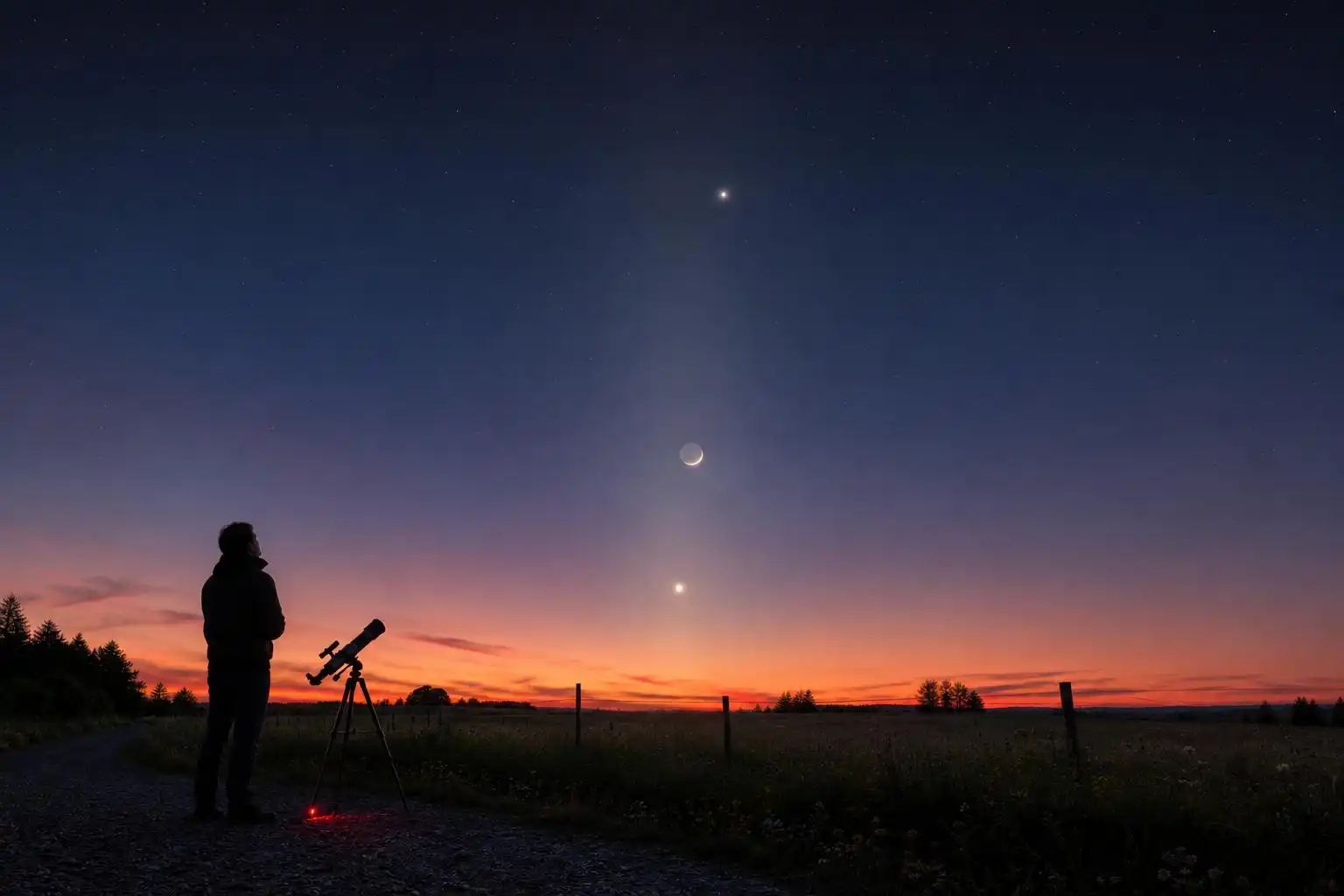
On the evening of May 18, the crescent Moon hangs just 2° north of Venus in the darkening sky — close enough that you can cover both with an outstretched thumb [1]. If you have a pair of 7×50 or 10×50 binoculars, this is the moment to grab them. Venus will show a small, distinctly gibbous disk of its own through any telescope — about 12″ wide and 83 percent illuminated. The Moon’s earthshine should also be gorgeous on a night like this, the dark limb glowing faintly with light reflected off our own planet’s oceans and clouds.
By the evening of May 19, the Moon has moved on, and now it sits suspended between Venus to its lower right and Jupiter to its upper left, the three bodies tracing out the line of the ecliptic like pearls on a string [2]. I genuinely love these moments because they make the abstract concept of the solar system’s plane suddenly concrete. You’re not looking at random dots — you’re looking along the floor of the solar system, the same plane where Earth orbits, where the zodiacal dust settles, where everything of consequence in our immediate cosmic neighborhood resides. Stand outside at dusk, face west, and let that sink in for a moment.
After the 19th, the Moon continues eastward and upward toward Jupiter, and the two planets themselves continue to close the gap between them for the rest of the month [2]. Keep watching this region of sky in the evenings ahead — it’s going to stay interesting.
Catching the Zodiacal Light Before It Fades
If you’re under reasonably dark skies — Bortle 4 or better — and you’re out in the early evening this week, look west after astronomical twilight ends. The zodiacal light is still visible in the western sky after sunset in mid-May, though it’s becoming increasingly difficult to see as spring turns toward summer [3]. This is essentially your last good window until it reappears in the predawn eastern sky in late summer and early fall.
What you’re looking for is a soft, diffuse cone of light rising from the western horizon and tilting along the ecliptic — the same line that Venus and Jupiter are marking for you. It’s not dramatic. It doesn’t jump out. But once your eyes have fully dark-adapted (give it 20 minutes away from white light), and once you know what you’re looking for, it has a gentle, milky presence that I find deeply moving. This is sunlight scattering off ancient comet dust — particles shed by comets over millions of years as they swung through the inner solar system and were baked by the Sun [3]. That faint glow is a fossil record of countless cometary passages.
The New Moon on May 16 means this week is your best shot. No moonlight to wash it out, no competition from the crescent until it’s already set well before true darkness. Get out early in the week if you can.
The Whale Galaxy: A Deep-Sky Reward
With the New Moon providing the darkest skies of the month, this is also the ideal time to point your telescope at NGC 4631 in Canes Venatici — the Whale Galaxy [4]. It’s high in the south by 10 p.m. local time, which is exactly where you want a target like this: above the worst of the horizon murk, in a part of the sky where transparency tends to be better.
NGC 4631 is an edge-on spiral at a distance of roughly 25 million light-years. Through a 6-inch scope at moderate magnification (say, 100–150×), it appears as an elongated, somewhat irregular streak of light — noticeably uneven in brightness, with a brighter core region and a mottled texture that hints at the spiral structure lurking within. The “Whale” nickname is apt: the galaxy is slightly bowed and asymmetric, wider at one end, tapering toward the other, like a cetacean in profile.
What I love about this target is the companion. Just to the northwest of the Whale, look for NGC 4627 — a small dwarf elliptical galaxy glowing at around 12th magnitude [4]. In an 8-inch Dobsonian under good skies, it’s a faint, round smudge, easily overlooked if you’re not hunting for it. But knowing it’s there — a gravitational companion to the Whale, likely interacting with it over cosmic timescales — changes the view. The two make a lovely pair in the same eyepiece field at low power.
To find the Whale, start at Cor Caroli (Alpha Canum Venaticorum, magnitude 2.9), the brightest star in Canes Venatici, located about 16° south of the handle of the Big Dipper. From Cor Caroli, NGC 4631 lies roughly 6.5° to the south-southwest. At RA 12h 42m, Dec +32° 32′, it’s well-placed for northern hemisphere observers and should be a straightforward star-hop with a finder chart.
A Note on Jupiter’s Moons
One more treat for those of you with a telescope trained on Jupiter this week: on the night of May 15–16, there was a double shadow transit — two of Jupiter’s Galilean moons casting their shadows onto the cloud tops simultaneously [3]. If you missed it, don’t despair. Jupiter’s moon system is endlessly active, and even on a quiet night, watching the four Galilean moons shift their positions from night to night — or even hour to hour — is one of the most satisfying things a small telescope can show. Any night you point a 60mm refractor at Jupiter, you’re replicating Galileo’s observations from 1610. That never gets old.
Your Plan for the Week
Here’s how I’d prioritize it if I were you:
Monday, May 18: Get outside 30–45 minutes after sunset. Face west. Find Venus blazing low in the twilight, then look 2° above it for the crescent Moon. Binoculars will be spectacular. If you have a small scope, try Venus — it should show a small, mostly illuminated gibbous disk.
Tuesday, May 19: Same drill, a little later. Now the Moon sits between Venus and Jupiter, and the three-body alignment along the ecliptic is at its most photogenic [2]. Wide-angle shots with a camera on a tripod will be stunning.
Any clear evening this week: Once twilight ends and your eyes are dark-adapted, look for the zodiacal light in the west. Bortle 4 or darker is ideal; Bortle 5 is worth a try. This is your last good spring evening window for it [3].
Any night this week: Point your telescope at NGC 4631 in Canes Venatici. It’s high, it’s well-placed, and the dark skies around New Moon are a gift. Look for the Whale, then hunt for the dwarf companion NGC 4627 to the northwest.
The sky is generous this week. All it asks is that you step outside.
References
- The Sky Today on Monday, May 18: The Moon hangs with Venus — Astronomy Magazine
- The Sky Today on Tuesday, May 19: Three in a row — Astronomy Magazine
- The Sky This Week from May 15 to 22: The Moon greets Jupiter and Venus — Astronomy Magazine
- The Sky Today on Saturday, May 16: Whale watching — Astronomy Magazine



Leave a Reply