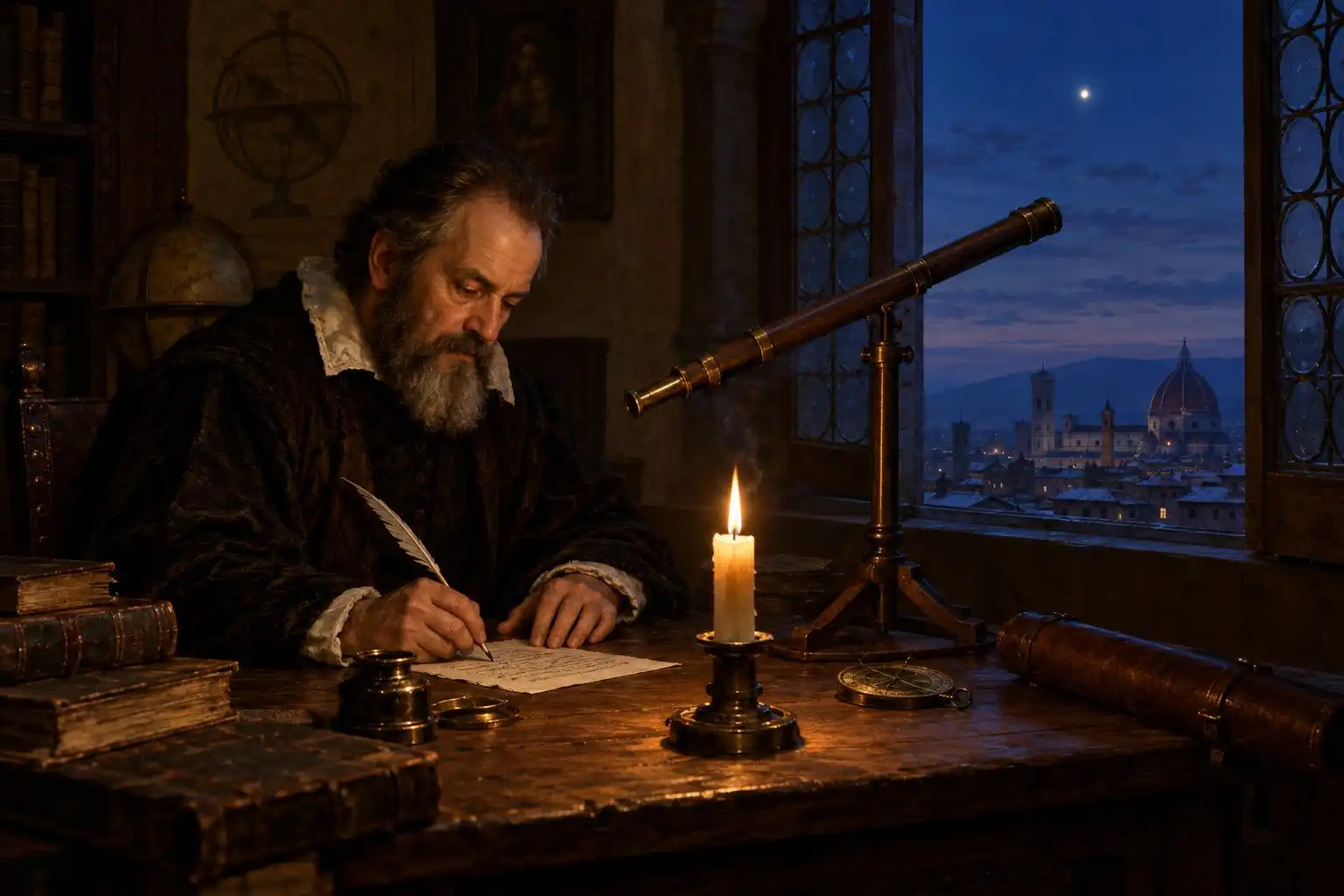

On 11 December 1610, Galileo Galilei sat in Florence with a letter to send and a discovery he was not yet ready to give away. At night, through a narrow tube of glass and metal, Venus had ceased to look like the bright, featureless point familiar to anyone walking home at dusk. It had a shape. Galileo wrote an apparently nonsensical line of Latin to Giuliano de’ Medici, the Tuscan ambassador at the imperial court in Prague: “Haec immatura a me iam frustra leguntur o.y.”
The jumble was an anagram. Its solution announced that Venus imitated the shapes of the Moon. Galileo wanted a dated claim before a rival could publish the observation, but he also wanted time to keep watching. His caution was justified. The changing face of Venus threatened an ancient arrangement of the heavens, yet it did not prove the arrangement Galileo most wanted to be true. Between those two facts lay the argument of his life.
A Planet in the Twilight
Watching Venus through an early telescope was harder than imagining it through one. Galileo’s instrument offered a cramped field of view, and the planet’s brilliance could blur its outline. Venus stayed close to the Sun in the sky, so observations demanded the awkward light of dawn or dusk. It was not enough to glimpse a horn once. Galileo needed to see whether its shape and apparent size changed in a repeatable pattern.
He had spent much of 1610 persuading people to look again at things they thought they knew. In January, while still teaching at Padua, he had tracked four points of light beside Jupiter and recognized that they traveled with the planet. In March, his Venetian booklet Sidereus Nuncius—The Starry Messenger—presented those objects as the Medicean stars, named for the ruling family of Tuscany. By autumn he had left Padua for a court appointment in Florence, where discoveries could bring prestige as well as opposition.
The telescope had not made him universally credible. A dark patch at the edge of a lens, an unsteady hand, or a mistaken interpretation could produce a marvelous report. Some observers could not make Galileo’s instruments show them what he described. Others saw Jupiter’s companions but disagreed about their significance. Galileo’s claims circulated among people whose judgments mattered to his new position. He needed observations that would survive not only a skeptical glance but sustained scrutiny.
Venus offered such a test because its brightness concealed a useful geometry. Like the Moon, a planet reflecting sunlight shows different portions of its lit side as seen from Earth. The shape visible through the telescope depends on where Venus stands relative to the Sun and the observer. For the first time, an argument about the architecture of the world could be pursued by watching a small white disk change night after night.
What the Old Arrangement Allowed
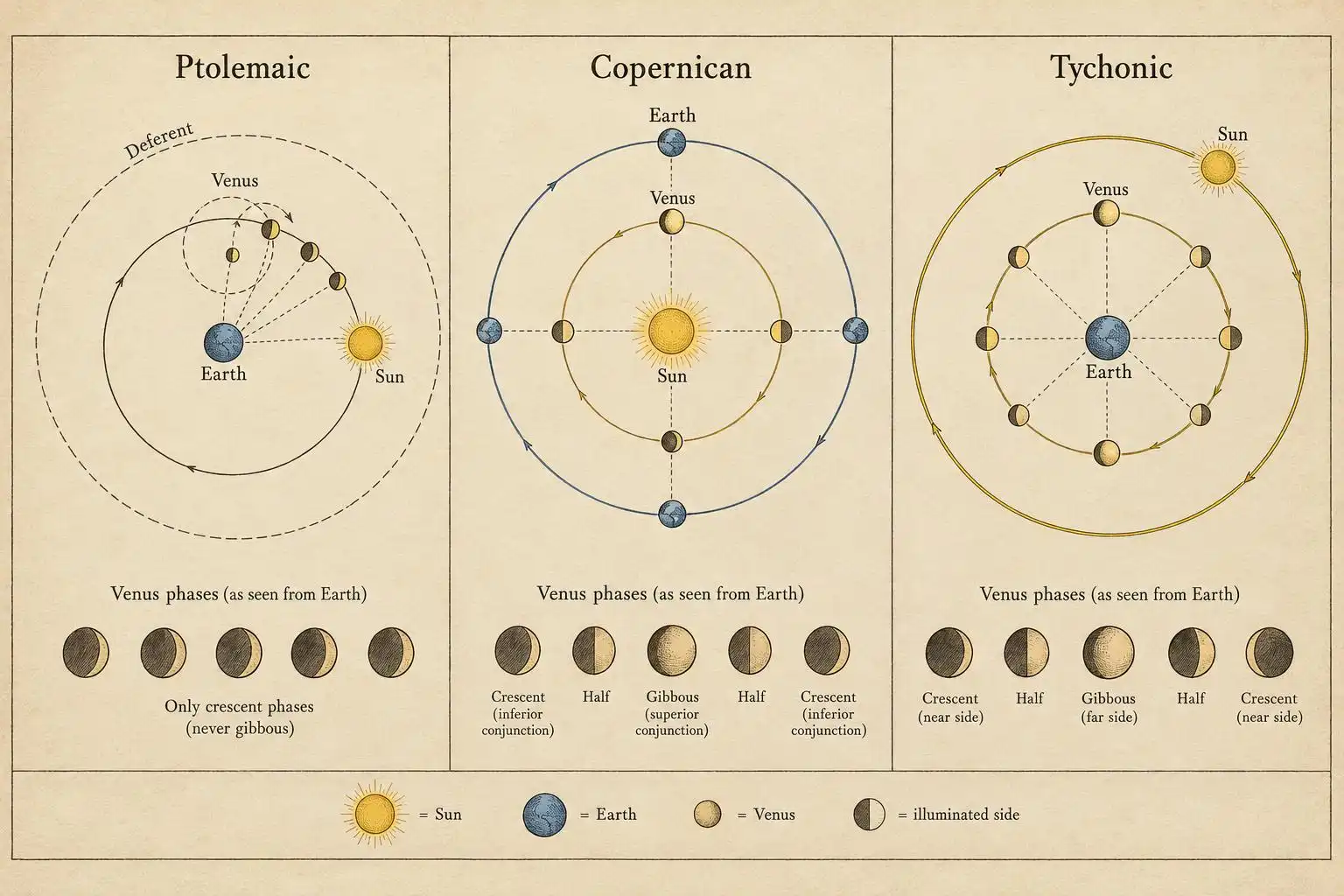
In the familiar geocentric astronomy taught from Claudius Ptolemy’s Almagest, Venus traveled on a small circle, or epicycle, whose center moved around Earth. The scheme kept Venus near the Sun in our sky, as ordinary sight required. In the customary ordering of the planetary spheres, Venus remained on Earth’s side of the Sun. Its position could vary, but it could not swing around to show us most of a sunlit hemisphere.
That distinction mattered more than the mere appearance of a crescent. A Venus that stays between Earth and Sun can display a narrow sunlit portion; a crescent alone is no fatal blow to the old scheme. A gibbous Venus, its disk more than half illuminated, is another matter. To see that shape, an observer must view Venus from a position that the standard Ptolemaic arrangement did not give Earth.
Galileo had a ready alternative. In Nicolaus Copernicus’s De revolutionibus, published in 1543, Venus circles the Sun inside Earth’s orbit. When Venus passes to the far side of the Sun, its illuminated face points largely toward us and the planet looks small and nearly full. When it moves nearer Earth, its apparent disk grows while the visible sunlit portion narrows. Shape and size should change together, in opposite directions.
This made the telescope more than an instrument for collecting curiosities. Galileo could compare a sequence of appearances with a prediction about where a planet must be. The observation did not require him to touch Venus or measure the distance to the Sun. It required him to keep looking long enough to tell a changing geometry from the tricks of glass and twilight.
A Secret Sent to Prague
Galileo’s December anagram belonged to a culture in which priority was valuable and communication slow. A scholar could seal a discovery inside a puzzle, circulate it to witnesses, and later reveal the solution. The device protected a claim without handing competitors the observation in usable form. Kepler, working in Prague as imperial mathematician, was among the people whose interest Galileo hoped to catch through Giuliano de’ Medici.
The secrecy also exposed a weakness in Galileo’s case. An encrypted sentence was not evidence that another astronomer could test. It gave no sequence of dates, no drawings, and no account of what the telescope had shown on an unfavorable evening. Its strongest message was social: Galileo was telling influential readers that he had seen something worth claiming before they knew exactly what it was.
On 1 January 1611, Galileo explained the solution to Giuliano: “Cynthiae figuras aemulatur mater amorum”—the mother of love, Venus, imitates the shapes of Cynthia, the Moon. The phrase was elegant enough to travel, but the observation behind it was precise. Venus did not merely look odd. It passed through phases, and its visible disk changed size. Galileo argued that these appearances meant Venus went around the Sun.
He had reason to be pleased. The phases supplied a direct, visible objection to the conventional Ptolemaic placement of Venus. They were also easier to share than many of his other telescopic findings: a reader could be told when to look and could watch the planet change. Yet the sentence “Venus goes around the Sun” left another question unanswered. Did Earth go around the Sun too?
The Other Sun-Centered Venus
Tycho Brahe, who died in 1601, had constructed a world in which it did not. In his system, Earth remained fixed near the center. The Sun circled Earth, while Venus and the other planets circled the Sun. Brahe set out the arrangement in De mundi aetherei recentioribus phaenomenis, published in 1588. It was a serious attempt to make sense of planetary appearances without assigning Earth an annual journey through space.
Brahe’s resistance to a moving Earth was not a refusal to observe. His large instruments, including the mural quadrant at Uraniborg, had made him one of the finest naked-eye observers of the age. He had also confronted a stubborn absence: if Earth changed its position over the year, why could no one detect the corresponding shift in the positions of nearby stars? Copernicans could answer that the stars were immensely distant. Brahe found the scale that answer demanded difficult to accept.
The Tychonic arrangement gave Venus exactly the route Galileo’s telescope appeared to show: a circuit around the Sun. It therefore predicted the same broad sequence of phases, from a small, nearly full disk to a larger crescent. No adjustment after December 1610 was needed to make it accommodate the observation. Galileo’s Venus could rule out one established ordering without choosing between a moving Earth and Brahe’s stationary one.
That was not a minor technicality invented to spoil a triumph. It shaped the choices available to Galileo’s contemporaries. An astronomer could accept the telescope, reject the conventional Ptolemaic arrangement, and still decline Copernicus. To understand the debate, we have to leave that position open. Otherwise the phases appear to have settled a dispute that continued, with good reason, after other observers had seen them.
Witnesses at the Collegio Romano
In the spring of 1611, Galileo traveled to Rome. At the Collegio Romano, Jesuit mathematicians examined his telescopic discoveries and gave them public attention. Their response mattered: these were skilled observers with standing in Catholic intellectual life, not people obliged to applaud a Tuscan courtier. On 13 May, the college held a gathering in Galileo’s honor. The events of that visit helped make it harder to dismiss the new sights as defects in Galileo’s eyes or lenses.
Agreement about what a telescope revealed did not compel agreement about the structure of the universe. Jesuit astronomers could acknowledge the phases of Venus while retaining a stationary Earth and giving the planets orbits around the Sun. Galileo had won witnesses to a phenomenon. He had not won every implication he drew from it. The difference was particularly consequential in a world where scholarly argument, court patronage, and religious authority met in the same rooms.
Galileo continued making a broader case for Copernicus. His Letters on Sunspots, published in 1613, brought another set of telescopic observations into debates about the heavens. In 1616, Roman authorities prohibited teaching the claim that Earth moves as physical truth. Sixteen years later, Galileo published the Dialogue Concerning the Two Chief World Systems, staging a sustained comparison of geocentric and Copernican arguments. His trial followed in 1633.
It is tempting to draw a straight line from the little crescent in Galileo’s eyepiece to that trial. Such a line leaves out the years of dispute over how to interpret observations, the arguments about Scripture and authority, and Galileo’s own choices as a writer and courtier. It also gives Venus a verdict it could not deliver. The planet had exposed a failure in one model; it had not, by itself, demonstrated Earth’s motion.
What the Crescent Settled
The force of the Venus observation lay partly in how modest it was. Galileo did not have to show a vast new object or trust a single surprising sight. He watched a familiar planet change in a way that its position relative to the Sun could explain. The growing apparent disk of a crescent Venus made the case stronger still. A sequence of small changes carried more weight than one dramatic evening at the telescope.
Its limit was just as instructive. Both Copernicus and Brahe placed Venus on a path around the Sun, though they disagreed about Earth. The same observations could support that shared part of their systems while leaving their deepest disagreement intact. Other kinds of evidence, unavailable to Galileo’s telescope, would be needed to establish Earth’s annual motion directly.
Galileo’s anagram began as a private attempt to secure credit. What endured was the public possibility of checking his claim: another observer could point an instrument toward Venus and follow its changing light. The episode shows science working neither as the instant defeat of an old idea nor as the automatic victory of a new one. An observation can be decisive about one question and insufficient for the next. Knowing the difference is part of the discovery.


Leave a Reply
You must be logged in to post a comment.