
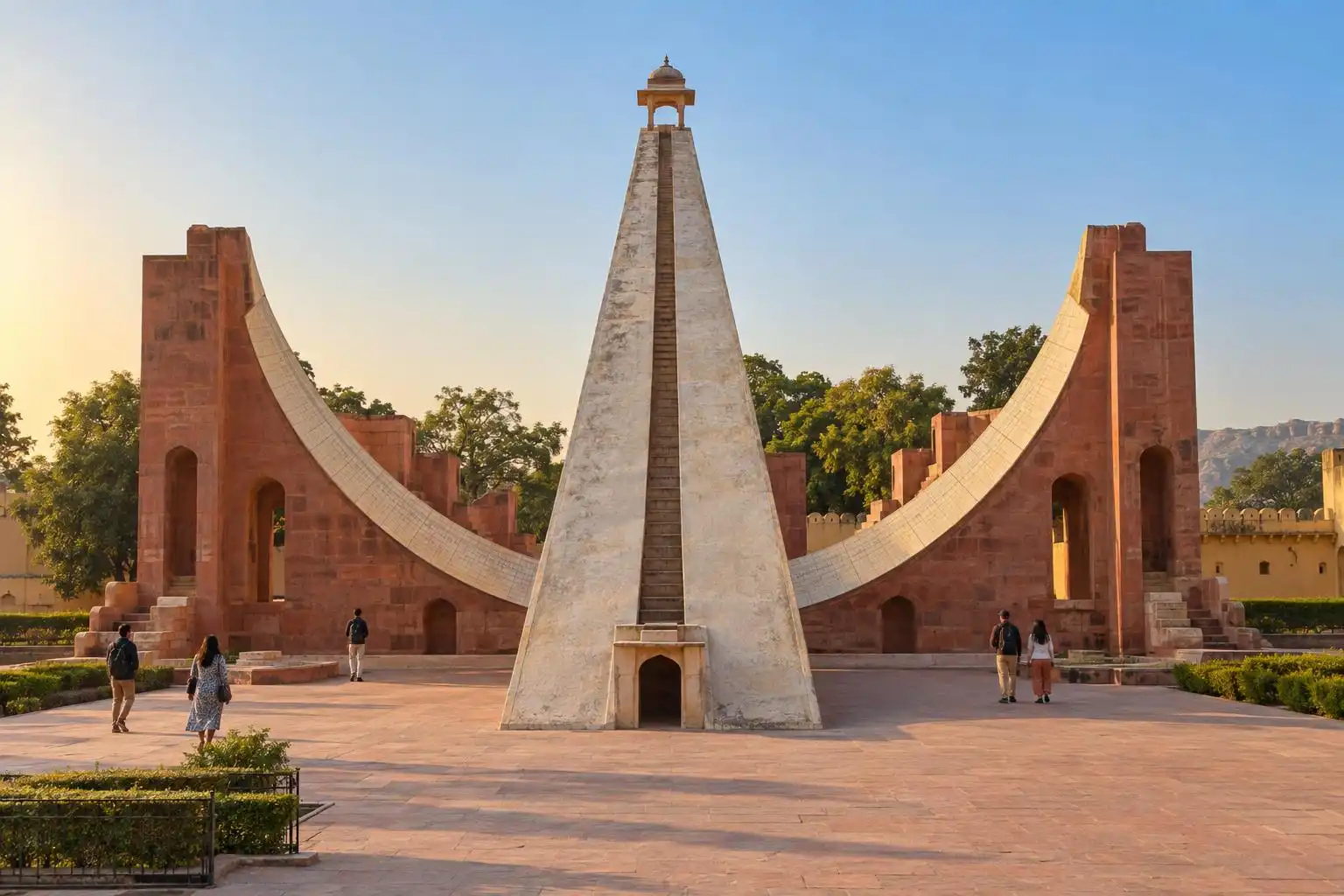

At Jaipur’s Jantar Mantar, a staircase climbs the sloping edge of a vast triangular wall. Its shadow moves across curved, graduated surfaces as the Sun crosses the sky. The structure, called the Samrat Yantra, makes a familiar astronomical act unusually visible: measuring time by observing motion. It is one instrument in an early eighteenth-century observatory built to ask not only what time it was, but where celestial bodies would appear.
A court astronomer’s ambitious project
Sawai Jai Singh II, ruler of the kingdom of Amber and founder of Jaipur, commissioned observatories in several North Indian cities. The Jaipur complex, built in the early eighteenth century, is the largest and best preserved. Its instruments include walls, bowls and open cylinders. They look like monumental architecture because, in many cases, the architecture is the measuring device.
Jai Singh worked within several astronomical traditions. Indian astronomical texts supplied methods for calculating celestial positions; Persian-language tables circulated through learned networks shaped by Islamic astronomy. He also sought European astronomical works. His project was not a simple contest between “old” and “new” science. It was an attempt to test inherited calculations against observation and make dependable tables for use at his court.
The astronomer Jagannatha Samrat was among the scholars associated with Jai Singh’s work. The Persian-language Zij-i Muhammad Shahi, produced under the ruler’s patronage, belongs to the tradition of astronomical tables known as zijs. Its title recalls an earlier model: the Zij-i Sultani of Ulugh Beg, whose fifteenth-century observatory at Samarkand had likewise joined large instruments to the work of calculating the heavens.
How a sundial becomes an observatory
The Samrat Yantra’s triangular wall is aligned with Earth’s axis. Its sloping edge acts as a gnomon—the part of a sundial that casts a shadow—while graduated quadrants on either side receive that shadow. As the Sun appears to travel across the sky, an observer can read local apparent solar time from the markings.
That reading is not automatically the time on a modern watch. Clock time is organized around standardized time zones and the average solar day; the instrument follows the actual Sun at Jaipur. Nor does the instrument’s enormous size guarantee equally enormous accuracy. A sharply defined shadow, sound alignment and careful reading all matter. Scale gives an observer room to mark fine divisions, but clouds, worn surfaces and the Sun’s soft-edged shadow still set practical limits.
The Samrat Yantra could do more than tell time. By observing the Sun’s changing position through the year, astronomers could investigate its seasonal motion. That distinction matters: this was not a decorative sundial enlarged for effect. Its form made particular celestial relationships measurable.
Bowls and cylinders for finding a position
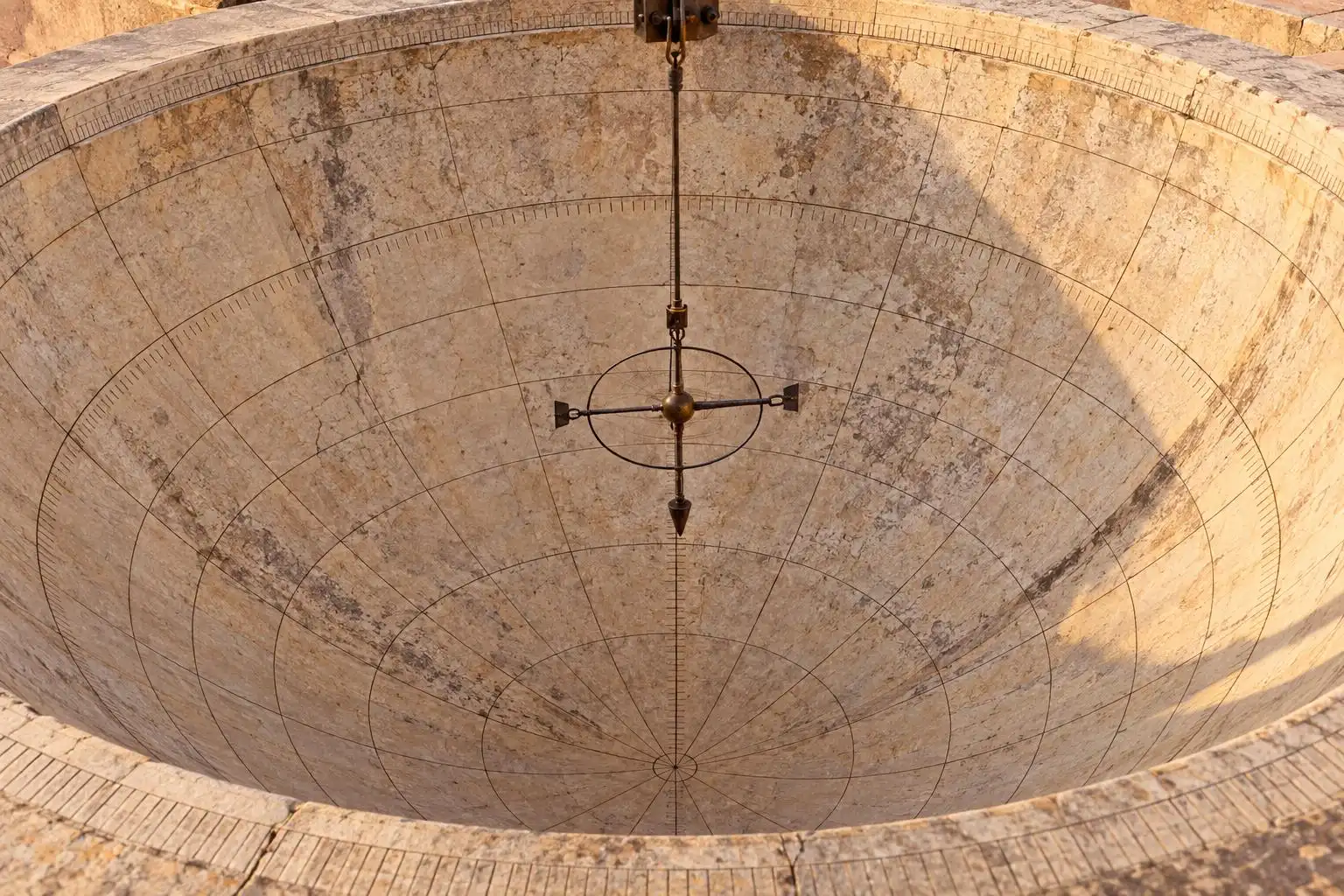
Other instruments at Jaipur address a different question: where is an object in the sky now? The Jai Prakash Yantra consists of complementary hemispherical bowls bearing coordinate markings. Their shapes represent the visible heavens turned into surfaces an observer can read. A small suspended plate can cast the Sun’s shadow onto the markings; at night, sighting arrangements allow observers to locate celestial objects.
The Rama Yantra approaches position through a different geometry. Its open-topped cylindrical structures have a central pillar and marked floors and walls. By sighting a celestial object from the appropriate place, an observer can read its altitude—height above the horizon—and azimuth, its direction around the horizon. Those two measurements specify a position in the local sky at a particular moment.
These instruments make an important feature of astronomy tangible. A star does not arrive with a single, self-evident address. Its position can be expressed relative to the horizon or in a coordinate system tied to the turning heavens. The choice depends on what an astronomer wants to observe or calculate. At Jantar Mantar, those systems occupy different physical spaces that a person can walk between.
Why build in stone in the age of telescopes?
Telescopes existed by Jai Singh’s lifetime, and large masonry instruments were not the only way to improve astronomical measurements. The observatories reflect a particular strategy: make reference lines stable, make divisions broad enough to read, and support repeated naked-eye observations at known locations. Their value must be judged by the questions they were designed to answer, not by whether they resemble a modern optical observatory.
Location was part of the calculation. An object’s altitude and the time it crosses a local meridian depend on where the observer stands. Jai Singh’s observatories extended beyond Jaipur to Delhi, Ujjain, Varanasi and Mathura, although the Mathura site no longer survives. Ujjain held longstanding significance as a reference point in Indian astronomical calculations. A network of sites offered ways to connect observations made under different local skies.
The instruments also reveal the work behind a table of predicted positions. Someone had to observe, record, compare and decide whether a discrepancy came from a calculation, an instrument or the conditions of observation. A monumental wall could make measurement more legible, but it could not remove the need for trained observers and critical judgment.
A different picture of astronomical progress
It is tempting to treat Jantar Mantar either as a timeless wonder or as a late survival from before telescopes. Both descriptions flatten its history. Jai Singh’s observatories arose in a world where Sanskrit, Persian and European astronomical knowledge could be consulted, compared and reworked. Their instruments were built for that active conversation.
Standing beside the Jai Prakash bowls, a visitor can see something that a diagram often hides: celestial coordinates are human constructions fitted carefully to a moving sky. Jaipur’s observatory deepens our understanding of astronomy because it shows measurement as both intellectual and physical work. To know the heavens, its observers built a place where their questions could cast shadows.


Leave a Reply
You must be logged in to post a comment.