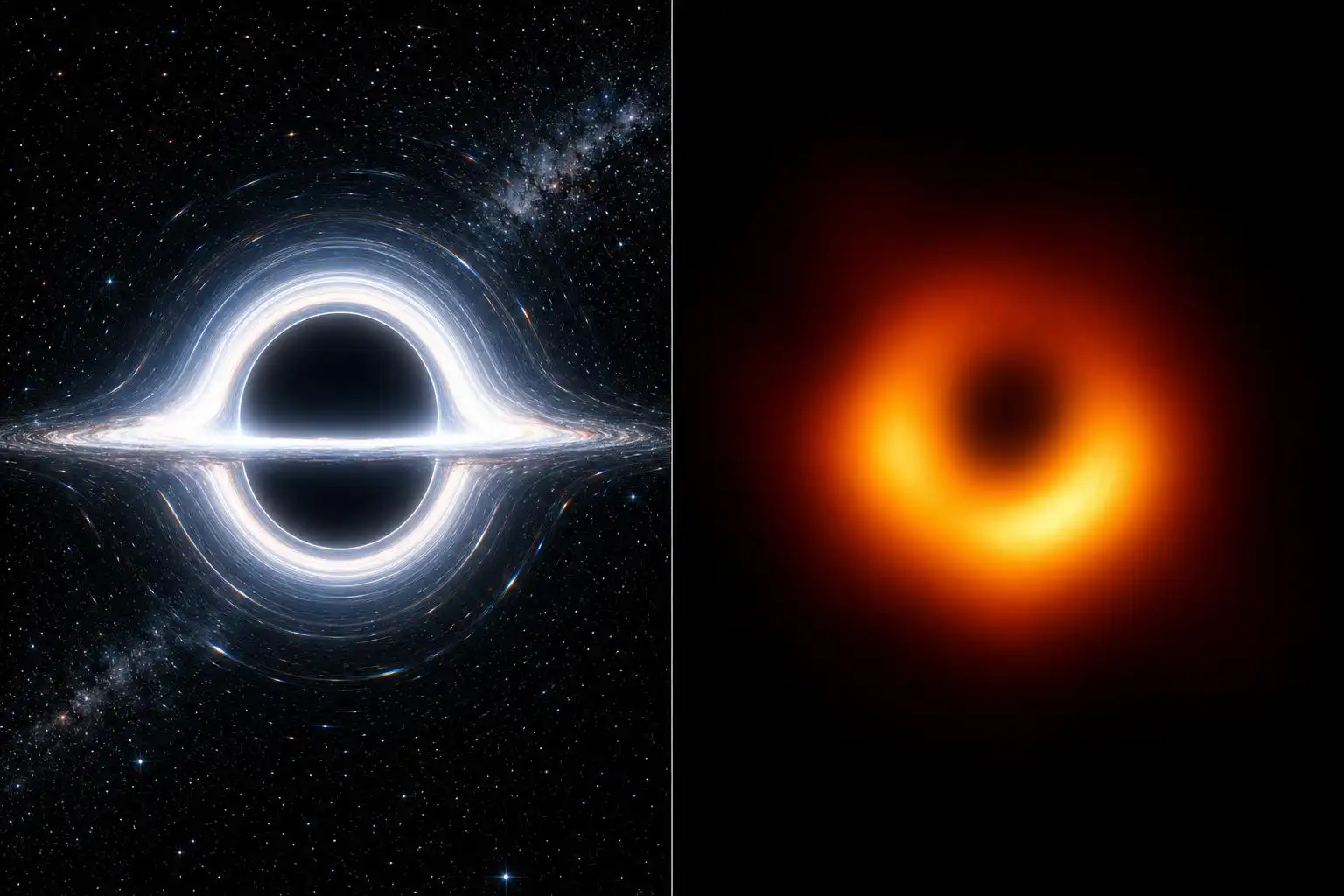

In 2014, Christopher Nolan dropped Interstellar on an unsuspecting public and broke a million brains. The wormhole near Saturn. The time-dilation ocean planet. Matthew McConaughey ugly-crying through five-dimensional space. And then there was Gargantua—the film’s supermassive black hole, rendered with such scientific rigor that it spawned a peer-reviewed paper and made astrophysicists do a rare thing: applaud a Hollywood production.
But here’s the thing. Five years after Interstellar hit theaters, humanity got its first actual photograph of a real supermassive black hole—M87*, sitting 55 million light-years away at the heart of galaxy Messier 87. And the comparison between Nolan’s fictional Gargantua and our very real M87* is one of the most fascinating show-vs-reality matchups since the The Martian tried to convince us a potato farm could save Mark Watney’s life.
Spoiler: Gargantua got a lot right. And a few things gloriously, cinematically wrong.
First, Let’s Talk About What Gargantua Actually Is
In the film, Gargantua is described as a supermassive black hole spinning at nearly the speed of light—what physicists call a maximally rotating, or Kerr, black hole. Its mass is roughly 100 million times that of our Sun. Its event horizon—the point of no return, the cosmic “you can’t go home again” line—is enormous. And crucially, it’s surrounded by an accretion disk: a swirling, superheated pancake of gas and dust that glows as material spirals inward to its doom.
Visual effects studio Double Negative worked directly with physicist Kip Thorne (who later won the Nobel Prize for his work on gravitational waves, because of course he did) to simulate Gargantua using actual general relativistic equations. What they produced was the most scientifically accurate CGI black hole ever put on screen—a perfectly symmetrical, luminous ring with a dark central shadow, and a disk that appears to arc over the top of the black hole due to gravitational lensing bending light around it.
It is, genuinely, stunning. And it is, genuinely, mostly correct.
Enter M87*: The Real Thing
On April 10, 2019, the Event Horizon Telescope collaboration released the first image of an actual black hole’s shadow. The EHT isn’t a single telescope—it’s a planet-spanning network of radio dishes that collectively act as an Earth-sized instrument, using a technique called very-long-baseline interferometry. Think of it as assembling a jigsaw puzzle where each piece is a different continent.
What they captured was M87*: a black hole with a mass of approximately 6.5 billion solar masses—about 65 times more massive than Gargantua. It sits at the center of one of the largest galaxies in the nearby universe, and it is, without exaggeration, a monster.
The image showed a bright, asymmetric ring of glowing plasma with a dark central shadow—the black hole’s silhouette against the inferno surrounding it. The ring wasn’t perfectly even; the southern side blazed brighter than the northern side. That asymmetry is physics doing exactly what Einstein predicted: the side of the accretion disk rotating toward us appears brighter due to Doppler beaming, like the headlights of a car driving toward you versus away from you.
Now. Compare that to Gargantua.
Where Gargantua Nailed It
The fundamental structure? Spot on. A dark shadow surrounded by a luminous ring, with light bending dramatically around the black hole’s gravity—Thorne and Double Negative got this right in ways that even surprised researchers when the real image dropped. The concept of photon rings—light that has orbited the black hole multiple times before escaping—is baked into Gargantua’s appearance and is a real feature of M87*’s physics.
The accretion disk geometry is also largely accurate. Gargantua’s disk is thin and equatorial, consistent with a rapidly spinning black hole, and the gravitational lensing effect that makes the top of the disk appear to fold over the black hole is a real optical consequence of extreme spacetime curvature. Thorne literally wrote the equations. This isn’t artistic license—it’s differential geometry rendered in 4K.
Where Hollywood Had to Cheat (And Why)
Here’s where it gets fun.
Gargantua is blue-white and serene. It looks like a celestial eye. It’s beautiful in a way that makes you want to fly a spacecraft toward it while Hans Zimmer plays an organ.
M87*? M87* looks like a blurry orange donut photographed by a camera that’s been through a washing machine. It is not cinematic. It does not inspire Hans Zimmer. It inspires the kind of reverence you feel when you’re looking at something genuinely alien and ancient and incomprehensibly violent—which is its own kind of awe, but a different kind.
The reason for the difference is partly resolution (the EHT image is the highest-resolution image ever made, and it still looks like that), and partly wavelength. The EHT observes in radio waves, not visible light. If you could see M87* with your eyes—which you cannot, because it’s 55 million light-years away and also because your eyes don’t detect radio waves—it would look different. Simulations of M87* in visible light actually look more like Gargantua than the famous orange donut does. So Nolan wasn’t entirely wrong about the aesthetics; he was just showing you a black hole in the light your eyes can process, not in the wavelengths radio telescopes use.
There’s also the matter of temperature and color. Gargantua’s disk is rendered relatively cool and white. Real accretion disks around active supermassive black holes are ferociously hot—millions of degrees—and emit X-rays. If you rendered an active accretion disk in the colors it actually emits, it would look like the inside of a nuclear reactor. Beautiful in a “please don’t look directly at it” kind of way.
The Time Dilation Planet: Where Interstellar Gets Philosophically Brave and Physically Iffy
One of the film’s most gut-punch moments involves Miller’s planet—a world orbiting so close to Gargantua that one hour there equals seven years on Earth. This is gravitational time dilation: the stronger the gravitational field, the slower time passes relative to a distant observer. It’s real. It’s in your GPS system right now, correcting for the fact that satellites in weaker gravity tick slightly faster than clocks on Earth’s surface.
But the scale in Interstellar? That’s where physicists start squinting.
To get a time dilation ratio of 7 years to 1 hour—roughly 61,000 to 1—Miller’s planet would need to be extraordinarily close to Gargantua’s event horizon. Like, uncomfortably, implausibly close. Thorne acknowledged this in his companion book The Science of Interstellar: the planet’s orbit as depicted is physically possible only if Gargantua is spinning at essentially the maximum rate allowed by physics (called the extremal Kerr limit), and even then, the tidal forces on the planet’s surface would be… significant. The waves we see on Miller’s planet? Those aren’t ocean waves. At that proximity to a black hole, those would be gravitationally-driven tidal surges that would make a tsunami look like a kiddie pool.
But you know what? The emotional truth of that scene—the horror of watching time slip away, of losing years to physics—is one of the most accurate depictions of what relativity feels like as a concept. Sometimes cinema earns its dramatic license.
M87*’s Jet: The Thing Interstellar Didn’t Show You
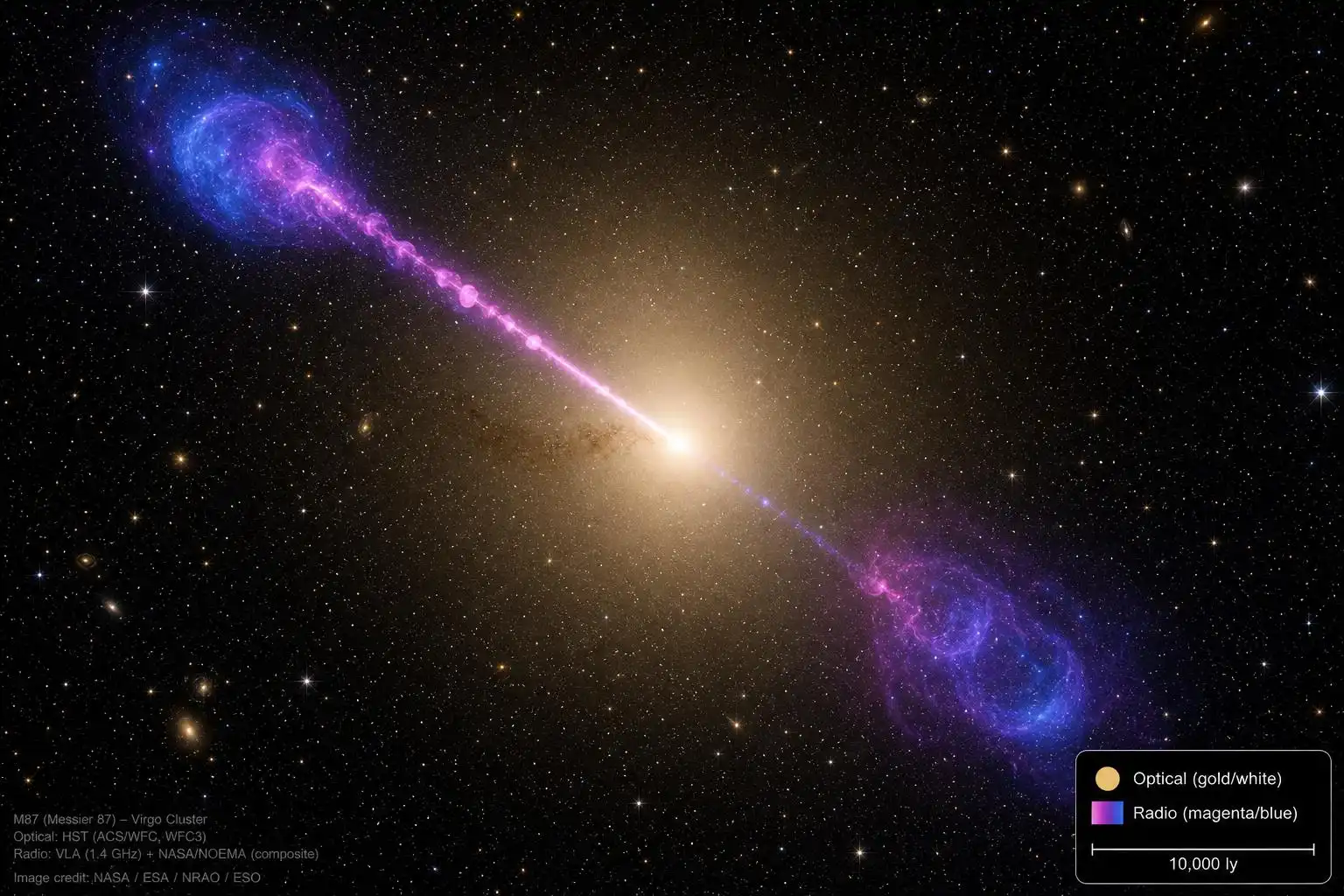
Here’s what the film left out entirely, and it’s arguably the most dramatic feature of a real supermassive black hole: the relativistic jet.
M87* is famous not just for its shadow image, but for the plasma jet it fires from its poles. This jet stretches roughly 5,000 light-years. It’s a column of superheated plasma accelerated to near-light-speed by the black hole’s magnetic field and rotation, shooting out into the galaxy like a cosmic blowtorch. Subsequent VLBI observations after the initial 2019 EHT image have captured the jet’s base—the point where it launches—in stunning detail, linking it directly to the black hole’s accretion disk.
To put that in sports terms: if M87*’s jet were a fastball, it would be a fastball thrown at 99.9% the speed of light. Aroldis Chapman’s 105 mph heater—the fastest ever recorded in MLB—is roughly 0.000016% the speed of light. M87*’s jet is not a fastball. M87*’s jet is something that makes a fastball look like you’re rolling a marble down a hallway.
Gargantua has no such jet in Interstellar, presumably because a 5,000-light-year plasma torch would have complicated the plot considerably.
What Gargantua Taught Us (No, Really)
Here’s the twist that makes this story genuinely remarkable: the simulations that Double Negative built to render Gargantua were so physically rigorous that they produced unexpected and visually rich results—specifically, detailed renderings of the complex structure of higher-order photon rings around a spinning black hole—that Thorne and his colleagues wrote up and published in Classical and Quantum Gravity. The rendering process generated scientifically useful visualizations that contributed to the literature on black hole optics.
A movie contributed to a peer-reviewed paper. A Hollywood blockbuster left a mark on the scientific literature on black hole optics. That is not a sentence I expected to type, and yet here we are.
The Bottom Line
Gargantua is the best fictional black hole ever put on screen—scientifically grounded, visually extraordinary, and responsible for an actual astrophysics paper. M87* is the best real black hole image humanity has ever captured—blurry, orange, asymmetric, and so mind-bending in its implications that the team that imaged it won the Breakthrough Prize and fundamentally changed what we know about the size and behavior of supermassive black holes.
One is a masterpiece of scientific filmmaking. The other is a masterpiece of the universe.
They’re both showing you the same thing: a place where spacetime ends, where gravity wins absolutely, where light itself cannot escape. One of them has Hans Zimmer. The other one is real.
And the fact that the real one is still that dramatic—without the score, without McConaughey, without a budget—is the most Interstellar thing about it.


Leave a Reply