
In the autumn of 1784, a young organist named John Goodricke sat in the garden of his family’s house in York, England, wrapped against the autumn chill, his notebook open on his knee. He was watching Eta Aquilae — a star whose variability Edward Pigott had first noticed on September 10, and whose rhythm Goodricke helped to pin down. Goodricke was twenty years old, profoundly deaf since infancy, and already one of the most careful variable-star observers in Europe. He had a pocket watch, a homemade photometric scale, and the patience of someone who had learned to read the world entirely through his eyes. Over subsequent observations he confirmed what the early reports suggested: Eta Aquilae pulsed with a period of just over seven days. He wrote the number down in his neat, unhurried hand, and went inside.
Goodricke would be dead about nineteen months after Pigott’s discovery, killed by pneumonia contracted during a long night of observing. He never knew that the class of stars he had begun to characterize — the Cepheid variables, named for the prototype Delta Cephei, which he had also measured — would eventually become the most important measuring sticks in the history of astronomy. He could not have imagined that a woman working in a basement in Cambridge, Massachusetts, more than a century later, would find in his pulsating stars the key to the size of the universe itself.
The story of Cepheid variables is, at its core, a story about light and time — and about how a pattern hiding in plain sight can go unnoticed for generations until someone with the right temperament, the right instrument, and the right question comes along.
For most of the nineteenth century, variable stars were curiosities: objects catalogued by observers like Friedrich Wilhelm Argelander, whose monumental Uranometria Nova of 1843 and subsequent Bonner Durchmusterung survey listed hundreds of them, but explained none. The pulsation itself — the actual physical mechanism by which a star expands and contracts, brightening as it compresses and dims as it swells — would not be understood until the 1910s and 1920s, when Harlow Shapley and, later, Arthur Eddington began to work out the thermodynamics involved. In the 1800s, Cepheids were simply logged: period noted, brightness range noted, position noted. They were facts without a theory.
What changed everything was not a new telescope but a new workforce. In 1877, Edward Charles Pickering became director of the Harvard College Observatory and embarked on a project of almost industrial ambition: a photographic survey of the entire sky, every star catalogued by spectrum and brightness. To do the mathematical work of measuring the glass plates, he hired women — first his own Scottish maid, Williamina Fleming, who proved so capable that she became a permanent staff member, and then a succession of educated women who worked for twenty-five cents an hour, less than the male assistants earned. They were called, with the condescension of the era, “computers.” The name did not diminish them.
Among them was Henrietta Swan Leavitt, who arrived at Harvard in 1895 and was assigned the Small Magellanic Cloud — a faint, irregular smear of light visible from the Southern Hemisphere, photographed by the observatory’s southern station in Arequipa, Peru. Leavitt’s task was to find variable stars in the Cloud and measure their brightness changes from plate to plate. She worked at a long wooden table under gas lamps, comparing photographic negatives with a loupe, marking each variable with a pin and recording its range in a ledger. It was painstaking, repetitive work. She loved it.
By 1908 she had found 1,777 variable stars in the Magellanic Clouds. She published a preliminary note in the Annals of the Harvard College Observatory, and buried in the text — almost as an aside — was an observation that would detonate across astronomy for the next two decades: the brighter Cepheids in the Small Magellanic Cloud had longer periods. “It is worthy of notice,” she wrote, with characteristic understatement, “that the brighter variables have the longer periods.”
She pressed on. By 1912, working from a set of twenty-five Cepheids whose periods she had carefully measured, she plotted period against apparent magnitude and found a clean, nearly linear relationship. The longer the period, the brighter the star. Because all the Cepheids in the Small Magellanic Cloud were, to a reasonable approximation, at the same distance from Earth — they were all members of the same distant system — differences in their apparent brightness reflected real differences in their intrinsic luminosity. Leavitt had discovered a period-luminosity relation: a Cepheid’s pulsation rate was a direct index of its true candlepower.
The implications were staggering, and Leavitt stated them plainly in her 1912 paper in the Harvard Circular: “A straight line can readily be drawn among each of the two series of points corresponding to maxima and minima, thus showing that there is a simple relation between the brightness of the Cepheid variables and their periods.” If you could calibrate the relation — if you could find the actual distance to even one Cepheid by some independent method, and thus convert apparent brightness into true luminosity — you could use any Cepheid anywhere in the sky as a distance indicator. Find a Cepheid, measure its period, read off its true brightness, compare that to how bright it appears, and the distance follows from the inverse-square law of light. A cosmic ruler, deployable across any distance at which a Cepheid could be detected.
Calibration was the hard part, and it occupied the next decade. The nearest Cepheids were too far away for the trigonometric parallax method — the only direct distance measure available — to give reliable results. Ejnar Hertzsprung in 1913 and Harlow Shapley in 1918 each attempted statistical calibrations using the proper motions of nearby Cepheids, essentially averaging out their random drifts across the sky to infer a mean distance. The results were uncertain, the error bars wide, and the two men disagreed in the details. But both arrived at a calibrated period-luminosity curve that placed even the nearest Cepheids at hundreds of light-years’ distance — making them intrinsically far more luminous than the Sun.
Shapley, working at Mount Wilson Observatory with the 60-inch Hale reflector, put the calibration to immediate and audacious use. He identified Cepheid-like pulsating variables in globular clusters — many of them later understood not as the same classical Cepheids Leavitt had calibrated, but as Population II/type II Cepheids or RR Lyrae-like cluster variables — and used period-luminosity relations to estimate their distances. By 1918 he had distances to dozens of clusters, and from their distribution in space he reconstructed the architecture of the Galaxy. The Sun, he announced, was not at the center. It was far out in the suburbs, roughly 50,000 light-years from the galactic core. The Milky Way itself was enormous — perhaps 300,000 light-years across, though later revisions would shrink this considerably. Shapley’s variable-star distances were the foundation of the whole argument.
This was the same Shapley who, two years later, would stand in the Baird auditorium of the Smithsonian Institution in Washington and argue, against Heber Curtis, that the spiral nebulae were merely nearby gas clouds within the Milky Way — that our Galaxy was the universe entire. He was wrong about the nebulae, but his method was right. The irony is exquisite: Shapley built the tool that would be used to refute him.
The refutation came from a man who was, by temperament, almost Shapley’s opposite. Edwin Hubble was meticulous, reserved, and — by the account of nearly everyone who worked with him — difficult to like. He had studied law at Oxford on a Rhodes Scholarship before abandoning it for astronomy, and he retained throughout his life a theatrical quality, a sense of performance, that grated on colleagues who valued modesty. He smoked a pipe with deliberate effect. He claimed, falsely, to have practiced law before returning to science. He wanted, badly, to win.
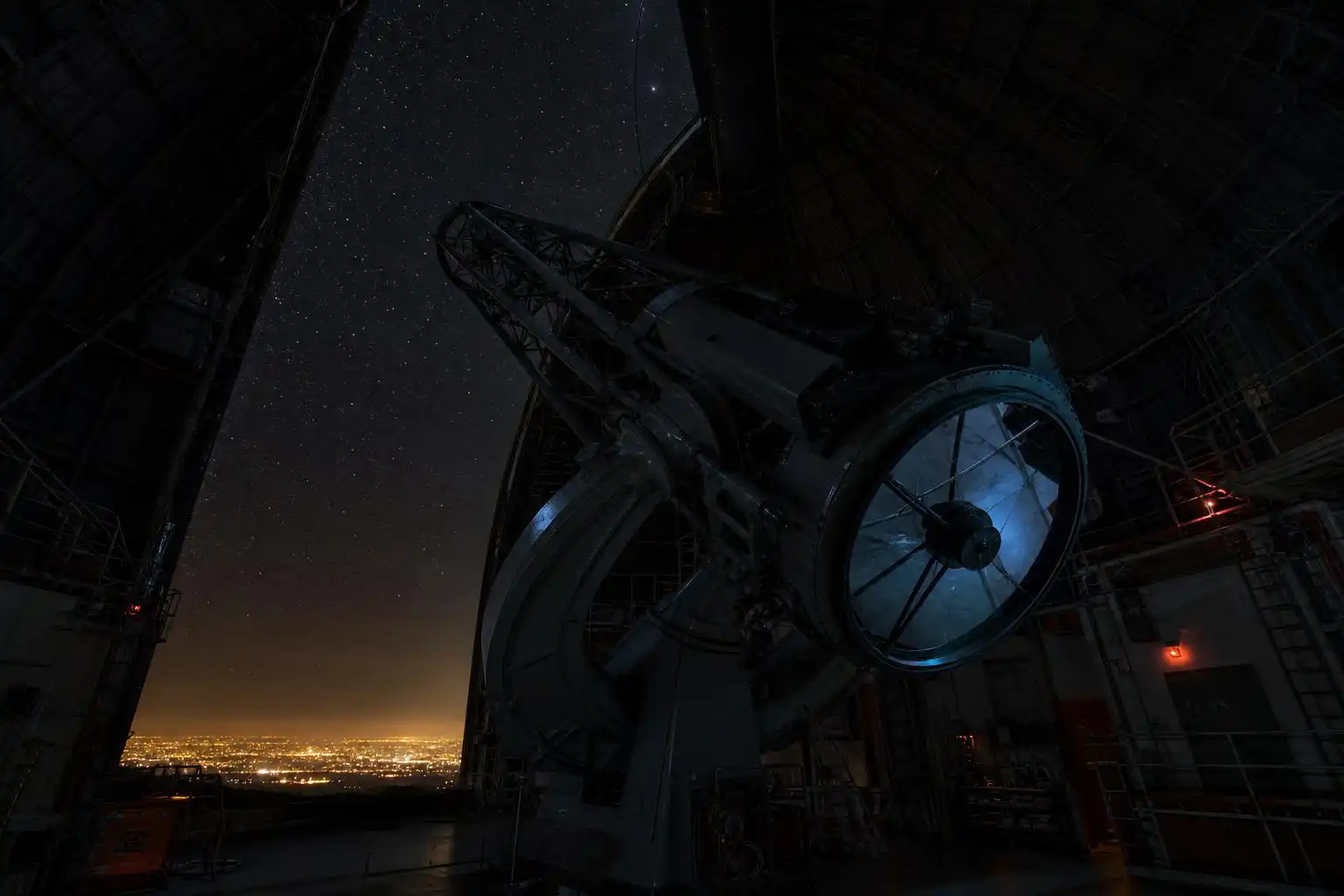
In the autumn of 1923, Hubble was working at the 100-inch Hooker telescope on Mount Wilson — then the largest telescope on Earth, its primary mirror ground by George Ritchey and its dome perched at 5,700 feet above the Los Angeles basin. He was photographing the Andromeda Nebula, M31, the great spiral that stretches across the constellation’s heart. On the night of October 5–6, he exposed a plate designated H335H for approximately forty-five minutes. When he examined it the next morning, he found three apparent novae — stars that had brightened suddenly in the nebula’s outer regions. He marked them with an “N” in red pencil on the plate.
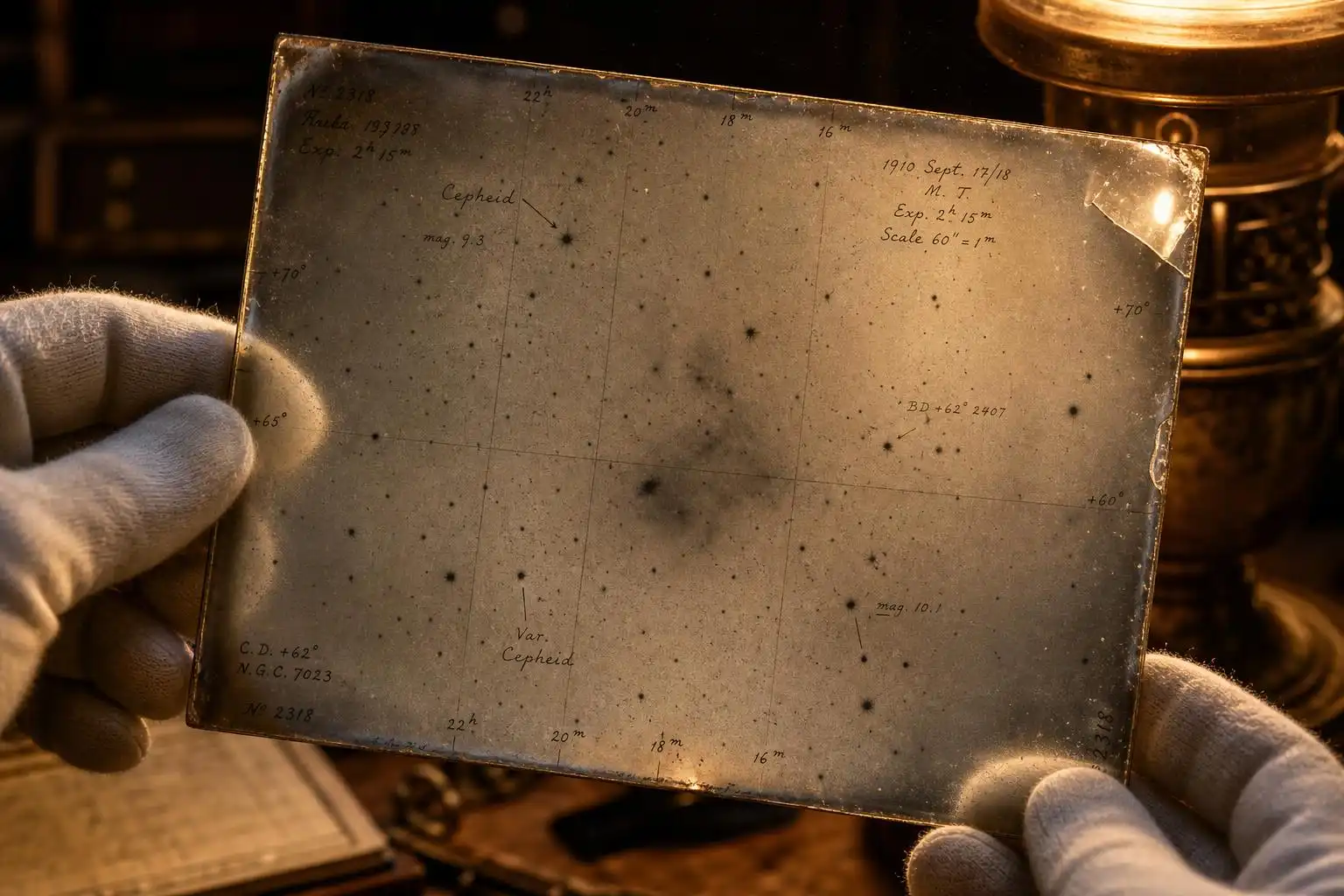
Then he went back through earlier plates. One of the objects, he realized, was not a nova at all. It brightened and dimmed with a regular period. He crossed out the “N” and wrote, in the same red pencil, “VAR!” — variable star. It was a Cepheid.
Over the following months he found more. By February 1924 he had enough measurements to apply Leavitt’s period-luminosity relation. The distance he calculated — using Shapley’s calibration, the same calibration Shapley had used to build his case for a continent-sized Milky Way — placed the Andromeda Nebula at roughly 900,000 light-years. (The modern value is about 2.5 million light-years; the calibration of the 1920s was off, partly because Shapley had not distinguished between two types of Cepheids with different luminosities — a correction Walter Baade would make in 1952.) Nine hundred thousand light-years was already, unambiguously, outside any reasonable boundary of the Milky Way. The Andromeda Nebula was not a gas cloud. It was a galaxy — an island universe, as Immanuel Kant had speculated in 1755 — separated from our own by a void almost incomprehensible in scale.
Hubble announced the result in a letter to Shapley in February 1924. Shapley, who received it at Harvard, reportedly showed it to a colleague and said, “Here is the letter that has destroyed my universe.” Whether he actually said it, the sentiment was accurate. Shapley had spent years arguing that the spirals were local. He was wrong, and Hubble’s Cepheids — Leavitt’s Cepheids, really — had proved it.
What is remarkable, looking back, is how much of this revolution rested on the work of a woman who was never given a faculty position, never allowed to direct her own research program, and died in 1921 before she could see the full consequences of her 1912 paper. Leavitt suffered from progressive hearing loss in her later years — a strange echo of Goodricke’s deafness across a century — and spent much of her career assigned to tasks chosen by Pickering and later observatory leadership, rather than pursuing the questions she found most interesting. When the Swedish mathematician Gösta Mittag-Leffler wrote to Harvard in 1924 to inquire about nominating Leavitt for the Nobel Prize in Physics, he was informed that she had died three years earlier. The Prize is not awarded posthumously.
The calibration she could not perform herself — the conversion of her relative period-luminosity scale into absolute distances — was carried out by men with access to larger telescopes and institutional support she was never offered. Her name appears in the acknowledgments of papers that transformed cosmology. It does not appear on the door of any observatory building at Harvard.
What does the Cepheid story reveal about how science actually works? Not, certainly, the textbook version: lone genius, crucial experiment, paradigm shift. What it reveals is something messier and more human. A deaf teenager in a York garden notices a rhythm in starlight and writes it down. A woman in a Cambridge basement finds a pattern in a thousand photographic plates and understates its importance with Victorian discretion. A competitive, pipe-smoking former lawyer uses that pattern to destroy the cosmological model of the man whose calibration he borrowed. And somewhere in the gaps — in the uncredited labor, the posthumous nominations, the red-penciled “VAR!” on a glass plate in a mountain-top observatory — the universe quietly reveals its size.
The Cepheids themselves are still at work. The Hubble Space Telescope, named for the man who crossed out the “N,” has measured Cepheid distances in dozens of galaxies, refining the Hubble constant — the rate at which the universe expands — with each new campaign. The James Webb Space Telescope has pushed the method further still, resolving individual Cepheids in relatively nearby galaxies — at distances of tens and, in favorable cases, more than a hundred million light-years — where its infrared vision helps reduce the effects of dust and stellar crowding. Leavitt’s straight line, drawn through twenty-five points in a Harvard Circular in 1912, still holds.
John Goodricke never saw it coming. Neither did she. That is, perhaps, the most honest thing one can say about discovery: the people who make it possible rarely live to see what they made possible. The universe is indifferent to credit. It simply waits, pulsing steadily, for someone to notice the rhythm and write it down.



Leave a Reply