
When European scholars of the twelfth century began translating Arabic manuscripts into Latin, they discovered something humbling: the sky they thought they knew had already been mapped, measured, and corrected — centuries earlier, with breathtaking precision — by astronomers working from Baghdad, Samarkand, and Córdoba. The Islamic Golden Age did not merely preserve Greek astronomy. It interrogated, revised, and in many cases surpassed it, producing a body of work that forms an indispensable foundation for modern astrophysics.
The House of Wisdom and a New Mandate for the Sky
In 830 CE, the Abbasid caliph al-Ma’mun expanded and patronized the Bayt al-Hikma — the House of Wisdom — in Baghdad, commissioning the translation of Ptolemy’s Almagest and simultaneously funding observational programs to test its claims. This was not passive scholarship. Al-Ma’mun ordered two geodetic expeditions into the Syrian desert to measure the length of one degree of latitude along Earth’s surface, yielding a value for Earth’s circumference that was remarkably close to the modern figure. The mandate was explicit: observe, calculate, and correct.
From this institutional soil grew a generation of astronomers who took Ptolemy seriously enough to challenge him.
Al-Battani and the Measured Year
Muhammad ibn Jābir al-Battani (c. 858–929 CE), born in Harran in what is now southeastern Turkey, spent decades at the observatory in Raqqa on the Euphrates, accumulating observations of the Sun, Moon, and planets with an accuracy that would not be matched in Europe for another six centuries. His masterwork, Kitāb al-Zīj al-Ṣābiʾ (the Sabian Tables), contained a solar year measurement of 365 days, 5 hours, 46 minutes, and 24 seconds — an error of only about two minutes from the value we use today.
More consequentially, al-Battani determined that the solar apogee — the point in the Sun’s apparent orbit farthest from Earth in the geocentric model — had shifted measurably since Ptolemy’s era. Ptolemy had placed it at a fixed longitude. Al-Battani showed it was moving, a phenomenon we now understand as the slow precession of Earth’s orbital ellipse. He also refined the value of the precession of the equinoxes to 54.5 arc-seconds per year (the modern value is about 50.3), correcting Ptolemy’s figure with instruments no more elaborate than large graduated circles and careful, repeated observation.
His trigonometric innovations were equally transformative. Al-Battani replaced Ptolemy’s chord-based geometry with the sine function — borrowed and refined from Indian astronomy — and introduced the concept of the cotangent, enabling far more efficient calculation of planetary positions. When Copernicus cited “Albategnius” in De Revolutionibus, he was acknowledging a debt that went far deeper than a footnote.
Abd al-Rahman al-Sufi and the Book of Fixed Stars
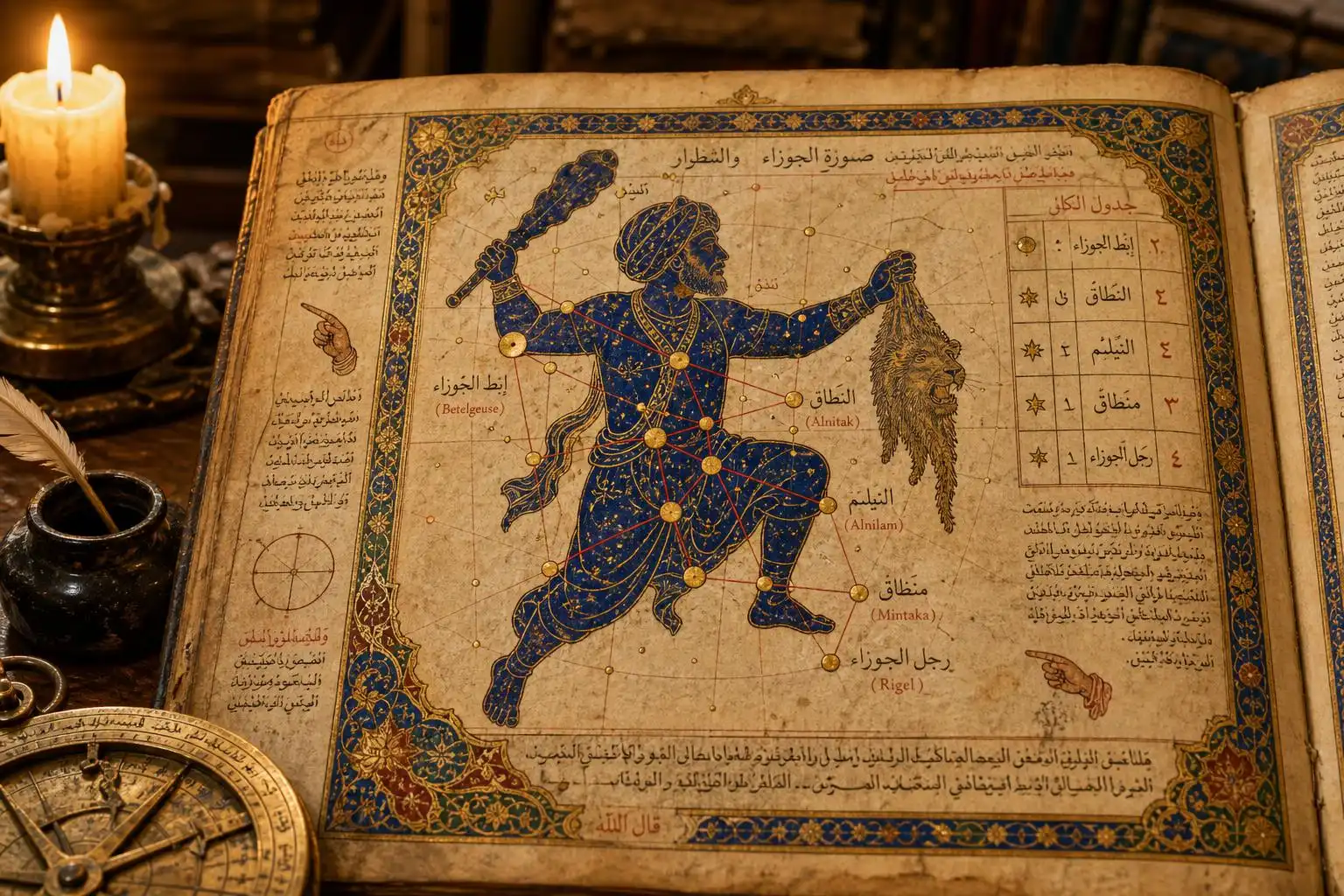
If al-Battani remapped time, Abd al-Rahman al-Sufi (903–986 CE) remapped the sky itself. Working in Isfahan under the patronage of the Buyid ruler Adud al-Dawla, al-Sufi produced his Kitāb Ṣuwar al-Kawākib — the Book of Fixed Stars — in 964 CE, a systematic survey of all 48 Ptolemaic constellations cross-referenced with Arabic folk star lore that had been accumulating for centuries among desert navigators and pastoralists.
The Book of Fixed Stars is not merely a catalogue. Each constellation entry includes two illustrations (one as seen on a globe, one as seen in the sky), magnitude estimates, and color descriptions. Al-Sufi corrected Ptolemy’s magnitude values for hundreds of stars, and his color notations — describing stars as aḥmar (red), aṣfar (yellow), or abyaḍ (white) — represent some of the earliest systematic stellar color classification in history.
His most celebrated observation appears almost as an aside. Describing the constellation Andromeda, al-Sufi notes a nubayyah — a “little cloud” — visible to the naked eye. This is the first recorded observation of what we now call the Andromeda Galaxy (M31), the nearest large galaxy to our own Milky Way, lying 2.537 million light-years away. Al-Sufi saw it not as a curiosity but as an object worthy of precise positional recording. He was doing extragalactic astronomy nearly a thousand years before the word “galaxy” entered the scientific vocabulary.
Ulugh Beg and the Samarkand Observatory
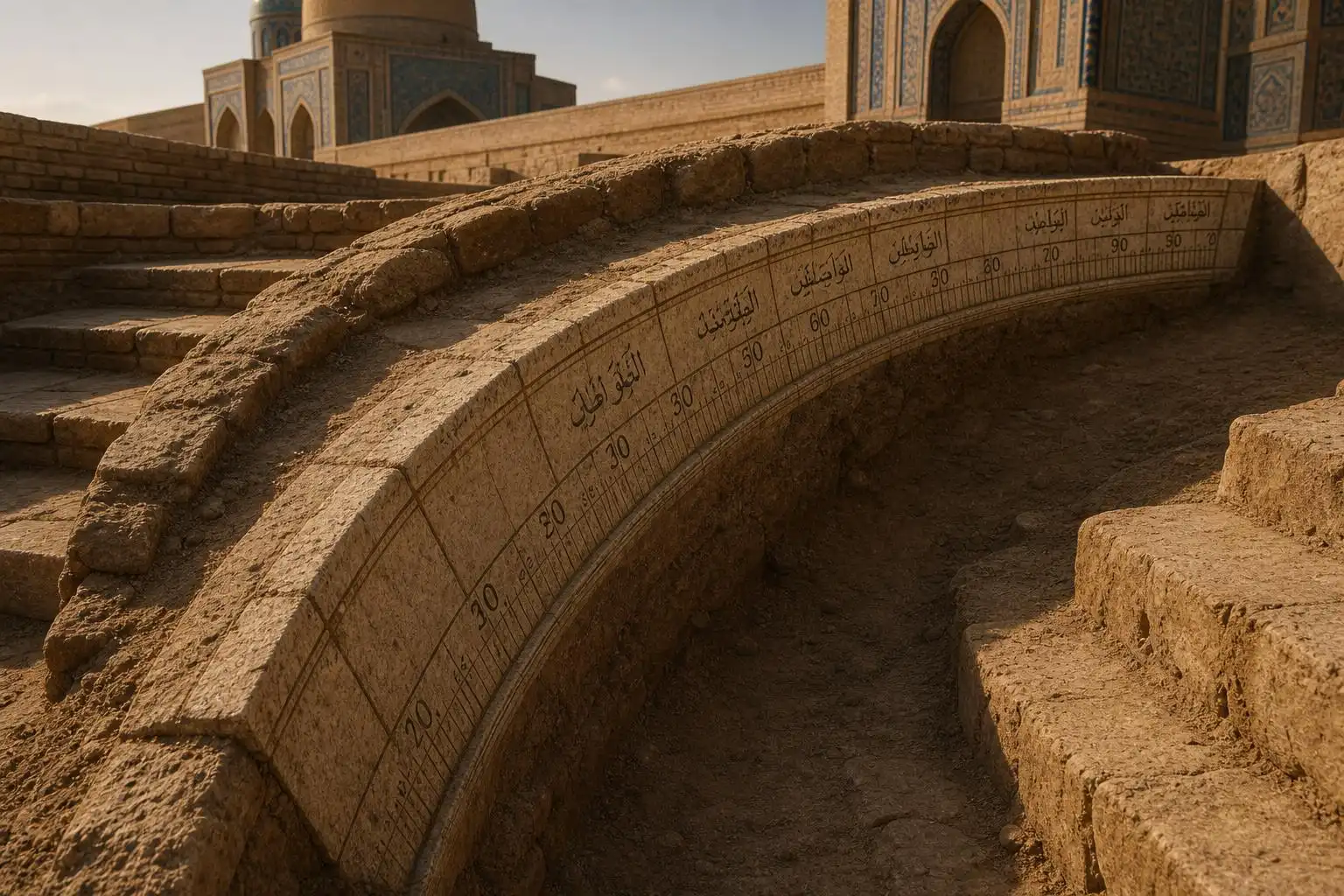
The grandest monument to Islamic observational astronomy stands — or rather, stood — in Samarkand, in present-day Uzbekistan. In 1420, the Timurid prince and astronomer Ulugh Beg commissioned an observatory on the Chupan-Ata hill overlooking the city. Its centerpiece was a Fakhrī sextant, a meridian arc with a radius of approximately 40 meters, built partly underground into the hillside. The instrument’s scale was so large that a single degree of angle corresponded to roughly 70 centimeters on its graduated surface — a resolution that dwarfed anything in Europe at the time.
Ulugh Beg assembled a team of scholars — including the mathematician al-Kāshī, who calculated π to sixteen decimal places — and set them the task of measuring the positions and magnitudes of a large catalogue of stars visible from Samarkand. The result, completed around 1437, was the Zīj-i Sultānī (the Sultan’s Tables), a star catalogue of 1,018 stars with positions measured independently of Ptolemy for the first time in over a millennium. His value for the sidereal year — 365 days, 6 hours, 10 minutes, and 8 seconds — was in error by only about 58 seconds.
Ulugh Beg was assassinated in 1449, and the observatory was destroyed within decades by religious conservatives who viewed its secular ambitions with suspicion. The underground arc of the Fakhrī sextant was rediscovered by archaeologists in 1908. It survives today as a trench in the earth, a ghost of one of the most precise scientific instruments of the medieval world.
What Islamic Astronomy Actually Means for Us
The conventional narrative presents Islamic astronomy as a relay race: the Greeks passed the baton, the Arabs carried it for a few centuries, and Europeans took it across the finish line. This framing is not merely incomplete — it is factually wrong.
Al-Battani’s detection of the moving solar apogee was not a preservation of Greek knowledge; it was a refutation of a specific Greek claim, made through superior instrumentation and more rigorous observational protocol. Al-Sufi’s first recorded observation of a galaxy beyond our own was not a footnote to Ptolemy; it was an entirely new category of celestial object, noted and documented without the conceptual framework to fully explain it — which is precisely what genuine discovery looks like. Ulugh Beg’s independent re-measurement of the entire visible sky was not translation; it was the largest original observational program between Hipparchus and Tycho Brahe.
These astronomers worked within a tradition that understood the sky as a text demanding active reading, not passive reception. The Arabic star names that still populate our sky charts — Aldebaran, Betelgeuse, Rigel, Deneb, Fomalhaut, Algol — are not decorative survivals. They are the residue of a naming culture that classified stars by their rising and setting behavior, their seasonal associations, their role in agricultural calendars, and their use in desert navigation. Every time a modern astronomer says “Betelgeuse,” they are pronouncing a version of Ibt al-Jauzā’ — “the armpit of the central one” — a name that encodes a whole tradition of embodied, practical sky knowledge.
The Islamic astronomical tradition does not deepen our understanding of the sky by adding colorful historical context to equations we already know. It deepens our understanding by demonstrating that the sky has always been a collaborative text — written across centuries, languages, and civilizations — and that the version of that text we read today is legible only because of the corrections, measurements, and discoveries made by scholars who have too often been rendered invisible by the histories we choose to tell.
The stars were there before Ptolemy named them, before al-Battani measured them, before Ulugh Beg counted them. What changes with each tradition is the quality of our attention — and the Islamic Golden Age raised that quality to a level the world would not see again for a very long time.


Leave a Reply