
There are weeks when the sky hands you everything at once, and the last stretch of August 2026 is one of them. A deep partial lunar eclipse, Saturn putting on a moon-watching clinic, a planetary nebula perfectly placed for late-night viewing, and a fine double star for anyone who wants a quieter challenge — this is a week worth staying up for, even if the nights are still warm and the dew point is punishing.
Let me walk you through it, night by night.
Wednesday–Thursday: Warm Up on Plato, Antares, and the Helix
Before the main event arrives, the waxing gibbous Moon gives us a couple of pleasant evenings for lunar touring. On the night of Thursday, August 20, with the Moon 60% illuminated and waxing gibbous, the terminator cuts through the northern highlands and throws the great walled plain Plato into sharp relief.[6] Plato sits along the northern rim of Mare Imbrium — the Sea of Rains — and its floor is famously dark and almost perfectly flat, poured smooth by ancient lava floods. At 100× in a 6-inch Dobsonian the floor looks like a still pond at midnight. Push to 150× or 180× on a night of steady seeing and you’ll start to hunt for the four small craterlets scattered across that dark floor — spotting even one is a genuine observing achievement. The surrounding mountain wall casts dramatic shadows inward as the terminator approaches; catch it within a night or two of this date and you’ll see those ramparts at their most theatrical.
That same evening, the Moon is closing in on Antares, the ruddy heart of Scorpius. Our satellite passes just 0.6° south of the red supergiant at 1 A.M. EDT on the 21st — a remarkably close conjunction that observers in the western U.S. will see play out in real time before the pair sets.[6] Even for those of us on the East Coast who’ll lose them to the horizon before the closest approach, the pairing is worth a look an hour after sunset when they’re still 20° up in the south.
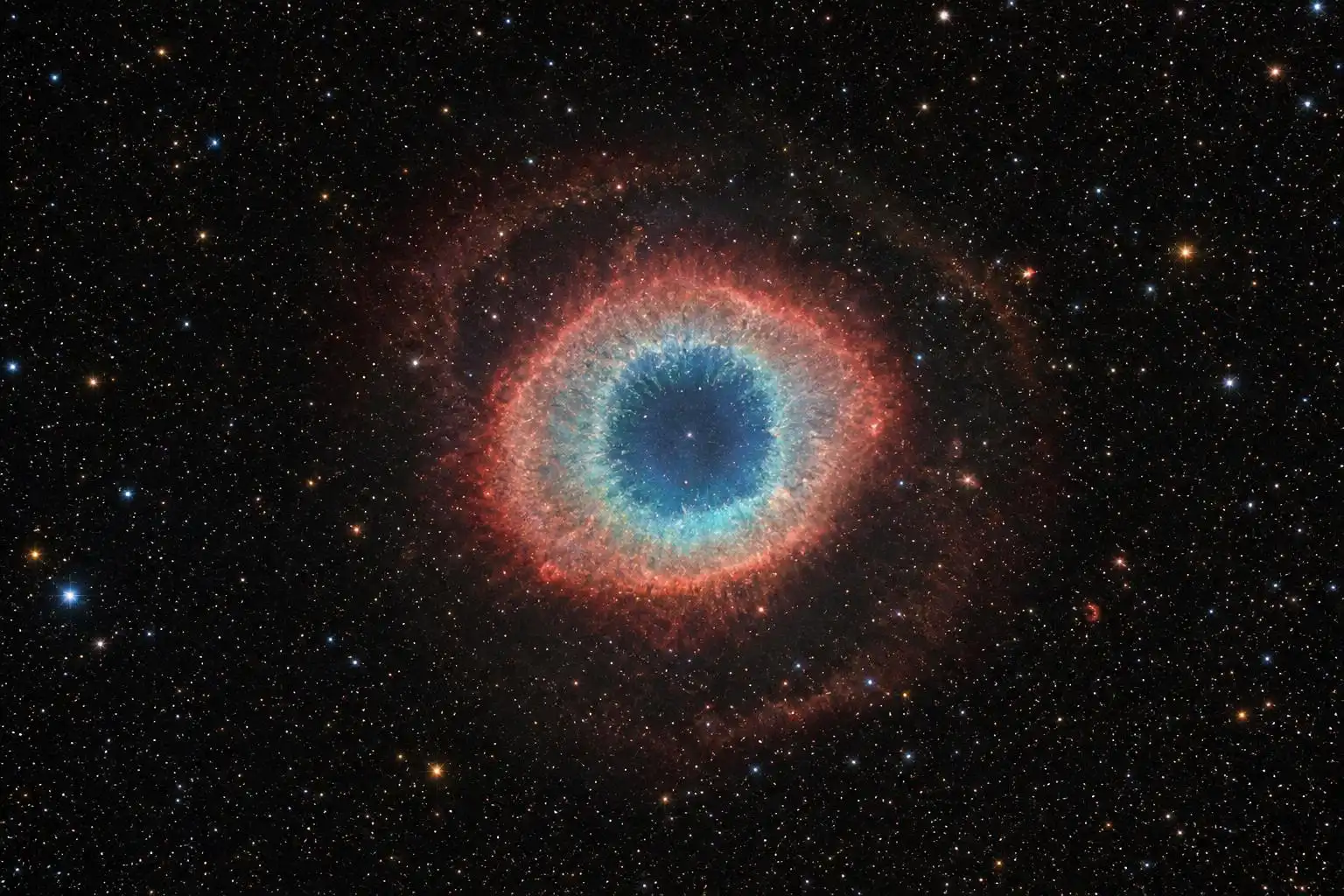
Wednesday night, August 19 (or more honestly, the wee hours of the 20th), belongs to a different kind of target entirely. Once the Moon has set and the sky south of the celestial equator darkens properly, slew to NGC 7293 — the Helix Nebula — in Aquarius.[5] The Helix is one of the larger planetary nebulae we know, with its inner portion covering some 16 arcminutes of sky, but its surface brightness is spread thin across that area, so it rewards low magnification and wide fields more than aperture. My go-to is a 35mm Panoptic in a 10-inch f/4.7 Dob: that combination gives me about 34× and a true field of nearly 1.5°, which frames the Helix with room to breathe. Under Bortle 4 skies it appears as a large, soft ring with a slightly brighter rim — the classic planetary nebula doughnut. A narrowband OIII filter snaps the contrast up considerably and is worth the investment if you don’t already own one.
To find it, start at Skat (Delta Aquarii), a 3rd-magnitude star that’s one of the easier landmarks in an otherwise faint constellation. The Helix lies about 7.8° to the southwest, in a sparse patch of sky.[5] It’s highest around 1 A.M. local daylight time, when it clears 30° of altitude in the south — not ideal geometry for northern observers, but good enough. Grab it while you can; it’s one of those objects that makes you feel the scale of stellar death in a way a photograph never quite does.
Thursday Night into Friday Morning: The Main Event
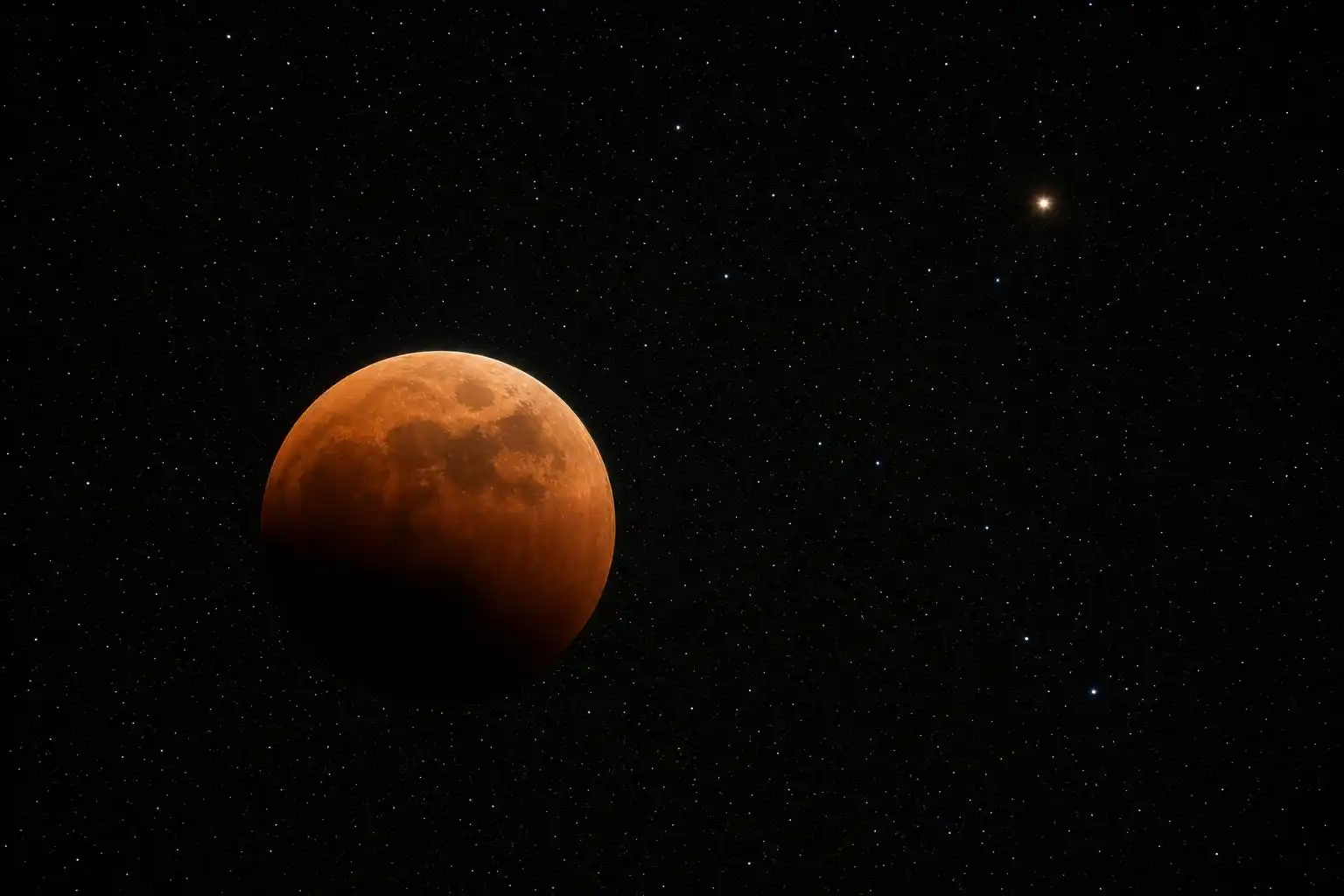
Now we get to the headline. On the night of Thursday, August 27, into the early hours of Friday the 28th, the full Sturgeon Moon rises into a partial lunar eclipse that will reach a stunning maximum depth of about 96% immersion in Earth’s umbra.[1] At that depth, this is about as close to a total eclipse as you can get without technically crossing the line. The sliver of Moon remaining outside the umbra will be lit by direct sunlight, while the vast majority of the disk will glow in the deep copper and blood-red tones that make lunar eclipses so viscerally striking.
Unlike a solar eclipse — which demands you be in exactly the right geographic corridor and lasts a few precious minutes at totality — a lunar eclipse is a slow, communal, forgiving event. The whole umbral phase unfolds over roughly two hours. You can wander inside for coffee, come back out, and the Moon will still be there, brooding. Anyone on the night side of Earth can watch.
What makes this eclipse particularly appealing for telescope users is the company the Moon keeps. Saturn will be shining nearby as the sky darkens, making for a striking visual pairing.[1] Both objects will be in or near Capricornus, the sea goat — a faint but historically rich zodiacal constellation that straddles the ecliptic.[1] At maximum eclipse, the reddened Moon and the pale gold of Saturn in the same binocular field will be one of the year’s most memorable naked-eye sights.
My plan for this night: start with binoculars as the Moon rises and the eclipse deepens. A 10×50 will show the color gradient beautifully — the umbral shadow has a soft, brownish inner region and a penumbral fringe that grades toward normal lunar brightness. Then swing to the telescope for Saturn. The ringed planet is well-placed this time of year, and even at moderate magnification (150×–200×) you’ll see the Cassini Division, the creamy cloud bands, and several moons strung out in a line. After spending a few minutes on Saturn, sweep back to the eclipsed Moon — the contrast in color and texture between the two worlds is remarkable.
Saturn’s Moons: A Clinic in Orbital Mechanics
If you were up in the predawn hours of Friday, August 21, you had a chance to watch Saturn’s moon Dione skim just north of the planet’s pole in a grazing occultation, while Titan stood nearby to the east and Tethys and Rhea were also visible in the field.[4] I find Saturn’s moon system endlessly watchable — even a modest 8-inch scope at 150× will show Titan easily (it’s 8th magnitude), and with patience and good seeing you can track Rhea, Tethys, Dione, and even Enceladus. The trick is knowing where to look, and any planetarium app updated to the current date will show you the moon positions in real time.
What I love about Saturn moon-watching is that it’s one of the few activities in amateur astronomy where you can literally see orbital motion happening in front of you over the course of a single night. Dione’s faster angular motion compared to the more distant Titan is visible across just a few hours.[4] That’s Kepler’s third law playing out in your eyepiece. I never get tired of it.
A Quieter Challenge: Zeta Coronae Borealis
If you want a change of pace from the big showpieces, spend a few minutes on Zeta Coronae Borealis (ζ CrB), a lovely double star in the Northern Crown that’s well-placed in the western sky in the early evening hours of late August.[2] Corona Borealis is one of those compact, charming constellations — a small arc of stars that really does look like a crown — sitting to the upper left of kite-shaped Boötes and its brilliant orange anchor star Arcturus.
Zeta CrB is a blue-white pair separated by about 6 arcseconds, making it an easy split at 75× or even less. Both components are hot B-type stars, and the color match gives the pair a clean, icy look quite different from the warm-tinted doubles like Albireo that most beginners encounter first. It’s also a physically complex system with additional spectroscopic companions — what you see at the eyepiece is just the outermost layer of a multi-star gravitational dance. I find that knowing the hidden complexity makes the view more interesting, not less.
Find it by star-hopping from Delta Boötis, roughly 6° to the northeast. It’s a rewarding five-minute stop before you swing south to the eclipse or east to Saturn.
Practical Notes for the Eclipse Night
A few things worth planning ahead:
Timing: Check your local circumstances for the eclipse — the event occurs simultaneously everywhere, but the clock time depends on your time zone. Maximum eclipse occurs at 12:12 A.M. EDT on Friday, August 28, which is 9:12 P.M. PDT on Thursday, August 27.[1] Look up your specific local times with a tool like NASA’s eclipse page or Stellarium.
Transparency: Late August often brings hazy, humid air at low elevations in the eastern U.S. The Moon will be rising in the southeast and may have to fight through some atmospheric murk early on. Give it 20–30 minutes to climb before judging the view.
Aperture: You don’t need a telescope for this eclipse — it’s a naked-eye and binocular event at heart. But if you want to study the color gradients across the disk and compare that reddened Moon to Saturn in the same session, a 6- to 10-inch reflector is ideal.
Capricornus: While you’re in the neighborhood, take a moment to trace the faint outline of the sea goat. It’s not a constellation most people know by sight, but with the Moon and Saturn as anchors it’s a good night to learn it. The constellation’s brightest stars hover around 3rd magnitude, so you’ll need reasonably dark skies — Bortle 5 or better.
This is the kind of week that reminds me why I got into this hobby in the first place. The eclipse alone would be enough. Add Saturn and its moons, a planetary nebula, a lunar crater worth an hour of careful study, and a quiet double star for the early evening — and you’ve got a full observing program that stretches across seven nights and half the sky. Get outside.
References
- See A Rare ‘Blood Moon’ Eclipse Beside Saturn: The Night Sky This Week — Forbes — https://www.forbes.com/sites/jamiecartereurope/2026/08/24/see-a-rare-blood-moon-eclipse-beside-saturn-the-night-sky-this-week/
- The Sky Today on Sunday, August 23: Double star Zeta Coronae Borealis — Astronomy Magazine — https://www.astronomy.com/observing/the-sky-today-sunday-august-23-2026/
- The Sky Today on Friday, August 21: Titan nears Saturn as Dione skims past — Astronomy Magazine — https://www.astronomy.com/observing/the-sky-today-friday-august-21-2026/
- The Sky Today on Wednesday, August 19: The Helix Nebula — Astronomy Magazine — https://www.astronomy.com/observing/the-sky-today-wednesday-august-19-2026/
- The Sky Today on Thursday, August 20: Dark, flat Plato — Astronomy Magazine — https://www.astronomy.com/observing/the-sky-today-thursday-august-20-2026/


Leave a Reply