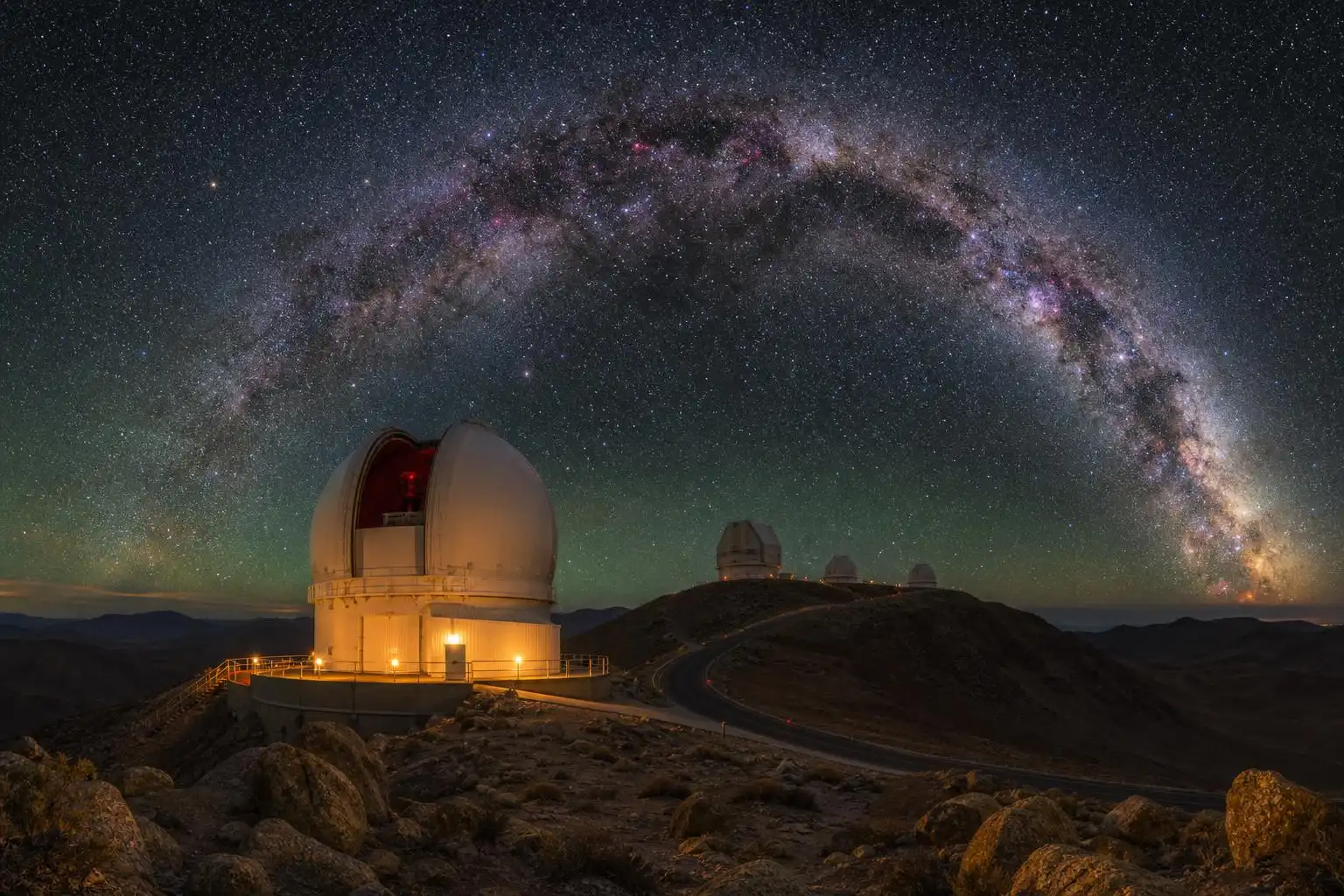

On a ridge in the Chilean Atacama, 2,400 meters above sea level, sits a 3.6-meter telescope that has been quietly revolutionizing our understanding of planetary systems for more than two decades. The telescope itself is unremarkable by modern standards — its mirror is modest compared to the VLT’s 8.2-meter monoliths roughly 600 kilometers to the north at Paranal. What makes La Silla’s 3.6-meter extraordinary is the fiber-fed instrument it serves: HARPS, the High Accuracy Radial velocity Planet Searcher, a fiber-fed échelle spectrograph that has pushed radial velocity precision to below 1 meter per second and in doing so has catalogued hundreds of exoplanets, including some of the most Earth-like worlds yet found.
This is a story about one instrument, one measurement problem, and the engineering obsession required to solve it.
The Measurement Problem: Detecting a Wobble
When a planet orbits a star, both bodies orbit their common center of mass. For a Jupiter-mass planet at 1 AU, the host star wobbles back and forth at roughly 28 m/s — a detectable signal even with 1990s-era spectrographs. But detecting an Earth-mass planet in the habitable zone of a Sun-like star requires measuring a stellar velocity shift of just 9 cm/s. That is not a typo. Nine centimeters per second. The speed of a leisurely crawl.
To convert a velocity into a measurable quantity, you need a spectrograph. Light from the star is dispersed into a spectrum, and the Doppler shift of known absorption lines tells you how fast the star is moving toward or away from you. The physics is clean. The engineering is anything but.
The core challenge is instrumental stability. If the spectrograph itself shifts — thermally, mechanically, or due to pressure fluctuations — the spectral lines move on the detector even when the star is perfectly still. A shift of one pixel on a typical spectrograph detector corresponds to a velocity error of hundreds of meters per second. To reach 1 m/s precision, you need to know where the spectrum falls on the detector to a tiny fraction of a pixel — roughly 1/1000th of a pixel, depending on the dispersion scale. To reach 10 cm/s, you need to go further still.
HARPS was designed from the ground up to solve this problem.
The Instrument: Architecture of Stability
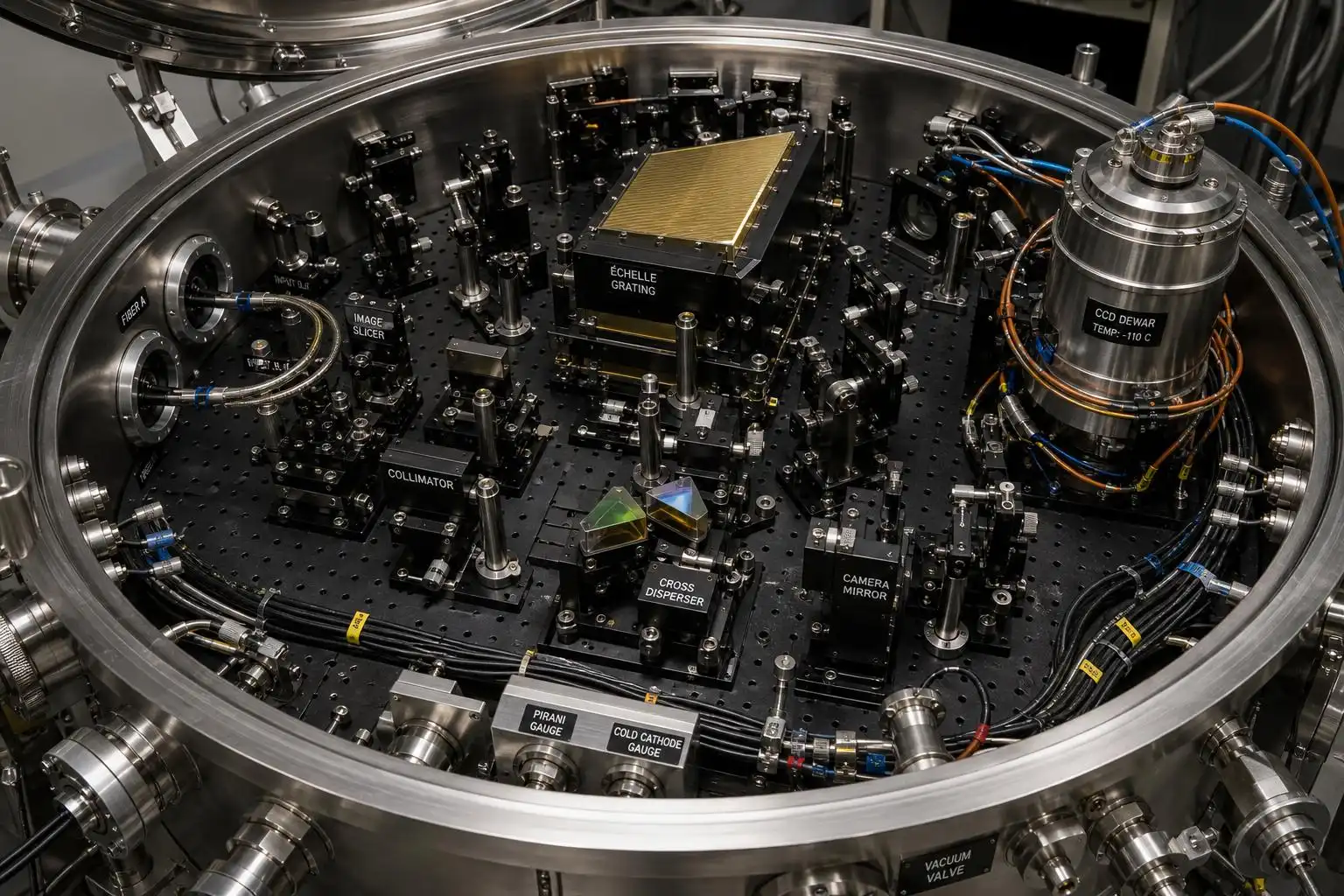
HARPS saw first light in February 2003. It is a cross-dispersed échelle spectrograph, meaning it uses a high-blaze-angle grating (the échelle) to spread light into many overlapping spectral orders, and a second disperser oriented perpendicular to the first to separate those orders on the detector. The result is a two-dimensional pattern of spectral stripes, each covering a narrow wavelength range, stacked neatly across a 4k × 4k CCD mosaic. Together, the orders span 378 to 691 nm, covering most of the optical window in a single exposure.
The échelle grating itself is a masterpiece of precision optics: a 214 × 840 mm ruled grating blazed at 75 degrees, operating in orders 89 through 161. At this blaze angle, the grating is working in very high diffraction orders, which is what delivers the fine dispersion — about 0.6 km/s per pixel in the green — needed to resolve individual stellar absorption lines with enough detail to centroid them accurately.
But the grating is only part of the story. The spectrograph is housed in a vacuum vessel maintained at 0.01 mbar, eliminating the refractive index fluctuations that would accompany any air pressure variation. Temperature inside the vessel is controlled to ±0.01 K using an active thermal regulation system — a double-shell enclosure with resistive heaters and sensors distributed throughout. The entire instrument weighs roughly 1,000 kg and sits on a vibration-isolated bench in a dedicated room at the coudé focus level of the telescope, decoupled from the telescope structure itself so that slewing and tracking don’t mechanically disturb the spectrograph.
Starlight reaches HARPS via a pair of optical fibers. Fiber A carries the stellar light; Fiber B carries the calibration source — either a thorium-argon hollow cathode lamp or, in later upgrades, a laser frequency comb. The two fiber outputs are imaged side by side on the detector, so every science exposure is simultaneously calibrated. Any instrumental drift that shifts the stellar spectrum also shifts the calibration spectrum by the same amount, and the difference gives you the true stellar velocity.
The Calibration Problem: Anchoring the Wavelength Scale
A spectrograph’s wavelength solution — the mapping from pixel position to wavelength — must be known with extraordinary precision. HARPS’s original calibration workhorse was the thorium-argon lamp. ThAr lamps produce hundreds of sharp emission lines across the optical, and their wavelengths are known from atomic physics to better than 1 part in 10⁸. By fitting a polynomial to the positions of these lines on the detector, you build a wavelength solution accurate to a few m/s.
For HARPS’s original design goal of 1 m/s, ThAr calibration is sufficient. But as the community pushed toward 10 cm/s, the limitations of ThAr became apparent. The lamp’s intensity varies line-to-line by orders of magnitude, meaning faint lines are noisy and bright lines can saturate. The line density is uneven — some spectral regions are richly populated, others sparse. And the lamp itself ages, with lines shifting subtly as the discharge conditions change.
Enter the laser frequency comb. A frequency comb generates a spectrum of thousands of equally spaced, equally bright, laser-sharp lines whose frequencies are tied directly to an atomic clock. The spacing between lines is set by the repetition rate of the laser — typically a few GHz — and every line’s absolute frequency is known to better than 1 part in 10¹¹. Frequency combs have been implemented on HARPS-N, the separate northern-hemisphere twin at Telescopio Nazionale Galileo on La Palma, and later in HARPS itself. With a comb, the wavelength solution becomes effectively perfect at the detector level, and the systematic floor drops dramatically.
Fiber Mode Scrambling: Taming the Seeing
A subtler problem lurks in the fiber itself. When starlight enters the fiber, the telescope’s seeing — the blurring caused by atmospheric turbulence — means the illumination pattern at the fiber entrance changes from moment to moment as the seeing cell pattern shifts. If the fiber transmitted this spatial information faithfully to the spectrograph, the illumination of the échelle grating would fluctuate, and the effective center of the instrumental profile would wander. That wander would appear as a spurious velocity signal.
Optical fibers scramble the input illumination to some degree — a property called modal scrambling — but a single circular fiber is imperfect. HARPS uses a double-scrambler: an optical relay that swaps the near-field and far-field of the fiber output, so that spatial structure in the input becomes angular structure in the output and vice versa, and a second fiber segment then scrambles that. The result is a highly uniform, stable illumination of the spectrograph pupil regardless of how the seeing cell happens to be illuminating the fiber entrance at any given moment. This single engineering choice contributes several tens of cm/s of improvement in long-term stability.
What HARPS Has Found
The science return from this engineering investment has been extraordinary. HARPS discovered Gl 581c in 2007, a 5 Earth-mass planet orbiting a red dwarf at the edge of the habitable zone. It found the multi-planet system around HD 40307, including three super-Earths with orbital periods of 4, 10, and 20 days. The HARPS approach also carried over to HARPS-N, which characterized the mass of Kepler planet candidates by following up transit detections with precise radial velocities, anchoring the mass-radius relationship that underpins our understanding of planetary composition.
Most dramatically, HARPS contributed to the detection of Proxima Centauri b — the nearest known exoplanet to Earth, an approximately 1.2 Earth-mass world orbiting in the habitable zone of our nearest stellar neighbor at 1.3 parsecs. The radial velocity semi-amplitude of that signal is 1.4 m/s, right at the edge of what HARPS can reliably detect, and the detection required hundreds of carefully scheduled observations spread over years to separate the planetary signal from stellar activity noise.
That last point matters enormously. At the precision HARPS operates, stellar activity — spots, faculae, convective flows — produces radial velocity signals of comparable amplitude to small planets. A starspot rotating across the disk of a star can mimic a planetary signal at the rotation period of the star. Disentangling astrophysical noise from planetary signal is now the dominant challenge in the field, and it has spawned an entire subfield of Gaussian process modeling and activity indicator analysis. HARPS didn’t just find planets; it defined the frontier where instrumentation meets stellar physics.
The Numbers That Matter
It’s worth pausing on what HARPS actually achieves in practice. The instrument’s long-term radial velocity precision on quiet stars — stars with low chromospheric activity — is approximately 0.5–1.0 m/s over timescales of years. This is not the short-term photon-noise limit, which for a bright star in a 15-minute exposure can be below 20 cm/s; it is the systematic floor imposed by calibration drift, fiber illumination residuals, and the thermal stability of the enclosure over seasons. The engineering goal when HARPS was designed in the late 1990s was 1 m/s. The team hit it.
The detector is a mosaic of two 2k × 4k CCDs with 15-micron pixels, read out at low gain to minimize readout noise. The resolving power R = λ/Δλ is 115,000, meaning two wavelengths separated by 1 part in 115,000 are just resolved. At 550 nm, that corresponds to a wavelength separation of 0.005 nm, or a velocity resolution of about 2.6 km/s per resolution element. Individual stellar lines are typically 5–10 km/s wide due to thermal and rotational broadening, so they are well resolved, and their centroids can be determined to a tiny fraction of a resolution element.
The Legacy and What Comes Next
HARPS is now more than twenty years old, and it remains one of the most productive planet-hunting instruments on Earth. Its successor philosophy — extreme stability through vacuum enclosure, thermal control, and simultaneous calibration — has been adopted by every serious radial velocity spectrograph built since: ESPRESSO at the VLT (which I wrote about earlier in this series), NEID at Kitt Peak, EXPRES at Lowell Observatory, and the forthcoming ANDES for the Extremely Large Telescope.
ESPRESSO, operating on the VLT’s 8.2-meter aperture with improved fiber scrambling and a laser frequency comb from the outset, was designed for 10 cm/s-class precision on quiet stars. ANDES, planned for the ELT’s 39-meter primary, aims to push toward the cm/s regime; an Earth twin around a Sun-like star induces about a 9 cm/s signal, and reaching that goal will require not just better instrumentation but a deeper understanding of stellar surfaces, because at these levels, the convective blueshift of a solar-type star — the net Doppler shift from rising hot granules and sinking cool intergranular lanes — becomes the dominant systematic.
HARPS didn’t solve the planet-detection problem. It defined the next layer of the problem, which is the highest compliment you can pay to a scientific instrument.
Engineering as Science
What I find most striking about HARPS is how much of its success is invisible in the final data product. You see a list of radial velocities with error bars. You don’t see the vacuum vessel humming at 0.01 mbar, or the thermal regulation system making microkelvin corrections through the Chilean night, or the double-scrambler turning a turbulent fiber input into a placid, uniform beam. You don’t see the years of characterization work — mapping the CCD’s charge transfer inefficiency, measuring the fiber’s focal ratio degradation, fitting the wavelength solution order by order and tracking its drift over thousands of nights.
All of that engineering disappears into the error bar. The smaller the error bar, the more engineering had to vanish into it. That is the discipline at the heart of high-precision observational astronomy: building instruments whose imperfections are smaller than the signals you care about, and then spending careers making sure they stay that way.



Leave a Reply