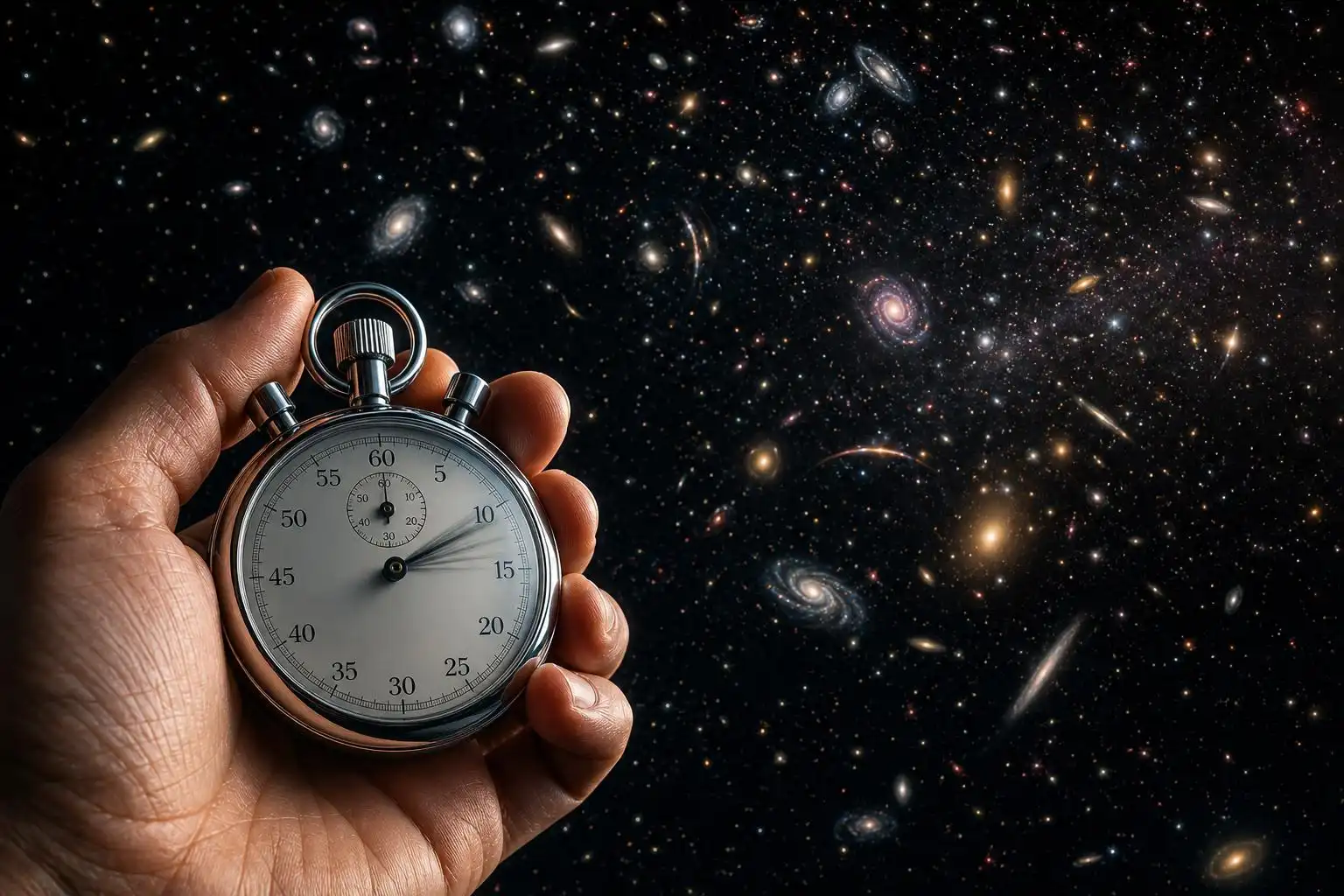

Close your eyes for a moment and count to one. One second. Your heart probably beat once. A hummingbird’s wings flapped about eighty times. Light — the fastest thing in the universe — traveled 186,000 miles, roughly seven and a half laps around the Earth.
That one second is the unit of time you use to measure everything: how long a sneeze lasts, how quickly a sprinter crosses a finish line, how fast your phone unlocks. But the universe uses seconds the way an ocean uses single drops of water. To understand the cosmos on its own terms, you have to stretch your intuition for time until it nearly snaps — and then keep stretching.
Let’s go on that tour. Fasten your sense of wonder.
One Second to One Year: The Human Neighborhood
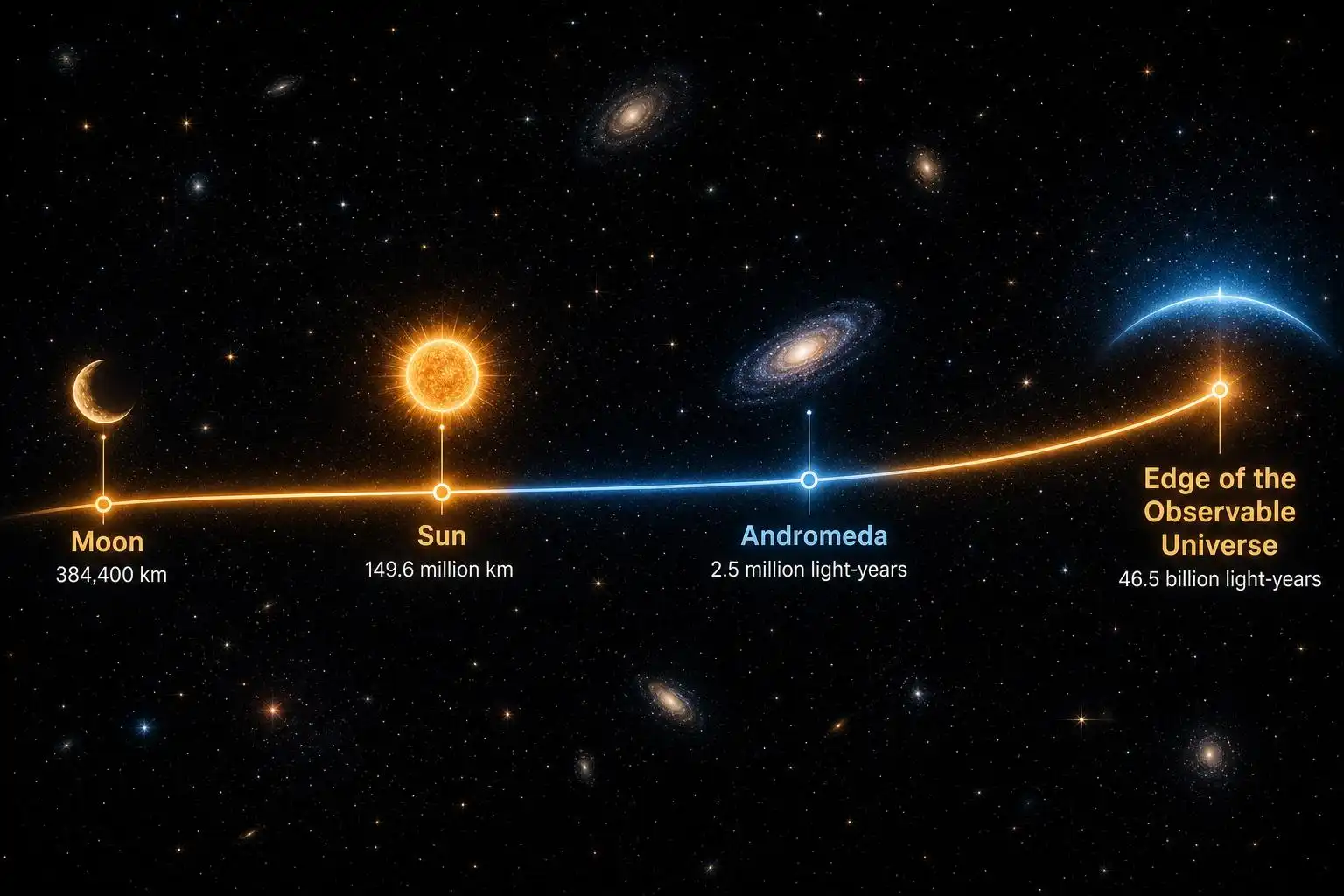
Start small. The Moon is about 1.3 light-seconds away. That means when you look at the Moon tonight, you’re seeing it as it was 1.3 seconds ago. That’s not a big deal, right? You probably don’t worry that the Moon has secretly moved in the last heartbeat. But it’s worth noting: every astronomical observation is a time machine. Every single one.
The Sun is about 8 light-minutes away. When you feel sunlight on your face, you’re absorbing energy that left the Sun eight minutes ago — before your morning coffee was brewed, before you read a single headline. If the Sun quietly switched off right now, you wouldn’t know for eight minutes. You’d still feel warm. You’d still be squinting.
Neptune, the most distant planet in our solar system, sits about 4 light-hours away. A radio signal — traveling at the speed of light — takes over four hours to make the one-way trip. When NASA’s Voyager 2 spacecraft flew past Neptune in 1989, every command sent from Earth had to be aimed at where Neptune would be hours later. Mission controllers weren’t steering a car. They were threading a needle across a continent while blindfolded, four hours ahead of schedule.
One Year to One Thousand Years: Reaching for the Stars
The nearest star system to our own is Alpha Centauri, about 4.2 light-years away. To cross that gap at the speed of our fastest spacecraft — the Parker Solar Probe, which clocks in around 430,000 miles per hour near the Sun — would take roughly 6,000 years. The entire span of recorded human civilization, twice over, just to reach the nearest neighbor.
Proxima Centauri b, the rocky planet orbiting Proxima Centauri (the closest of the three stars in that system), is one of the most tantalizing exoplanet candidates we know of. It sits in the so-called habitable zone, where liquid water might exist on its surface. When astronomers announced its discovery in 2016, the excitement was electric. But if someone there were watching us with an impossibly powerful telescope right now, they’d be seeing Earth as it was in the year 2022. They’d have no idea you were reading this.
Go out to about 640 light-years and you reach Betelgeuse, the red supergiant in Orion’s shoulder that everyone keeps saying is “about to explode.” When you look at Betelgeuse, you’re seeing light that left it around 1385 CE — the year Chaucer was writing The Canterbury Tales. Betelgeuse may have already exploded. We genuinely won’t know until the light from that explosion arrives, possibly centuries from now.
Ten Thousand to One Hundred Thousand Years: The Milky Way’s Breadth
Our galaxy, the Milky Way, is roughly 100,000 light-years across. Wrap your mind around that: a message sent from one edge of our galaxy, traveling at the speed of light, would take 100,000 years to reach the other side. When that hypothetical message was sent, Homo sapiens had barely left Africa. Neanderthals were still alive. Cave paintings hadn’t been invented yet.
The center of the Milky Way is about 26,000 light-years away. The famous 2022 image of Sagittarius A*, our galaxy’s central supermassive black hole — captured by the Event Horizon Telescope collaboration — shows the black hole as it appeared 26,000 years ago. The light that formed that image left its source around the time humans were making Ice Age cave art in Europe. It crossed the galaxy, threaded through interstellar dust clouds, entered our telescopes, and became a picture we posted on the internet.
That image is 26,000 years old. It went viral in a day.
Millions of Years: Galactic Neighborhoods
The Andromeda Galaxy is about 2.537 million light-years away. I wrote an entire piece about what it means to look at Andromeda — how the light reaching your eye left before humans had writing, before Homo sapiens existed in our current form, before we had fire as a deliberate tool. The photons that enter your retina on a dark, clear night have been traveling since the Pleistocene epoch, since our ancestors were making stone tools and mammoths roamed the Northern Hemisphere.
And Andromeda is our nearest large galactic neighbor. The universe contains an estimated two trillion galaxies. Two trillion. If you counted one galaxy per second, it would take over 63,000 years to finish counting.
The Virgo Cluster, a massive congregation of galaxies that our Local Group is gravitationally tugged toward, is about 65 million light-years away. The light we see from its galaxies tonight left around the time a six-mile-wide asteroid struck the Yucatán Peninsula and ended the reign of non-avian dinosaurs. The K-Pg extinction event and the photons now entering your telescope: contemporaries.
Billions of Years: The Deep Lookback
The most distant galaxies ever observed sit near the edge of the observable universe — over 13 billion light-years away. The James Webb Space Telescope has captured light from galaxies that formed when the universe was only a few hundred million years old, a cosmic infant. When we look at those images, we’re not looking at space. We’re looking at time. We’re looking at a universe that no longer exists in that form.
Here’s a way to feel that: the universe is about 13.8 billion years old. If you compressed all of cosmic history into a single calendar year — the classic “cosmic calendar” framing — the Big Bang happens on January 1st, the Milky Way’s oldest components begin taking shape in January, the Sun and Earth form in early September, and all of recorded human history — every empire, every war, every book, every song — fits into the last 10 to 15 seconds of December 31st.
Every second of that cosmic year represents about 438 years of real time.
Why Does Any of This Matter?
Here’s the question I imagine you might be asking. You’re not a cosmologist. You have a dentist appointment on Thursday and a grocery list that includes oat milk and hopefully some good bread. Why should the light-travel time to the Virgo Cluster matter to you?
Because it changes how you see your own life.
When you realize that looking up is looking back — that the night sky is a living museum of time — the universe stops being a backdrop and becomes a story. You are not a small thing watching a big thing. You are a 13.8-billion-year-old process that has become aware of itself, briefly, in the form of a person who needs oat milk.
Every second that ticks by on your watch is a second the universe has been running. You are embedded in that timeline. Your heartbeat — roughly 100,000 beats per day, 2.5 billion over a lifetime — is a tiny drumroll inside a symphony that started before the Earth existed.
One second. A hummingbird’s wings. Light circling the Earth seven times. The Moon as it was a heartbeat ago.
That’s where we live. And once you know it, you can’t quite unsee it.



Leave a Reply