
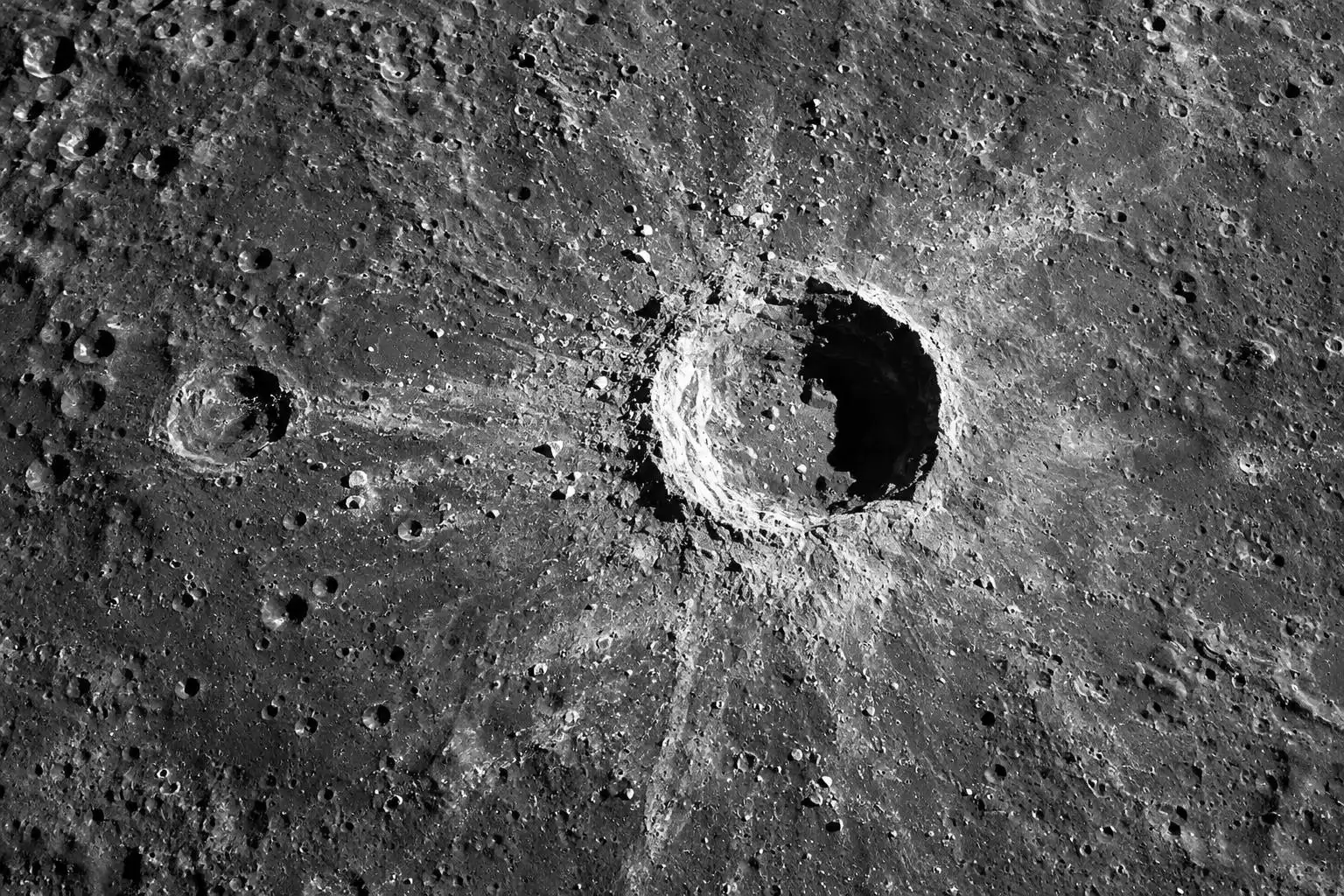

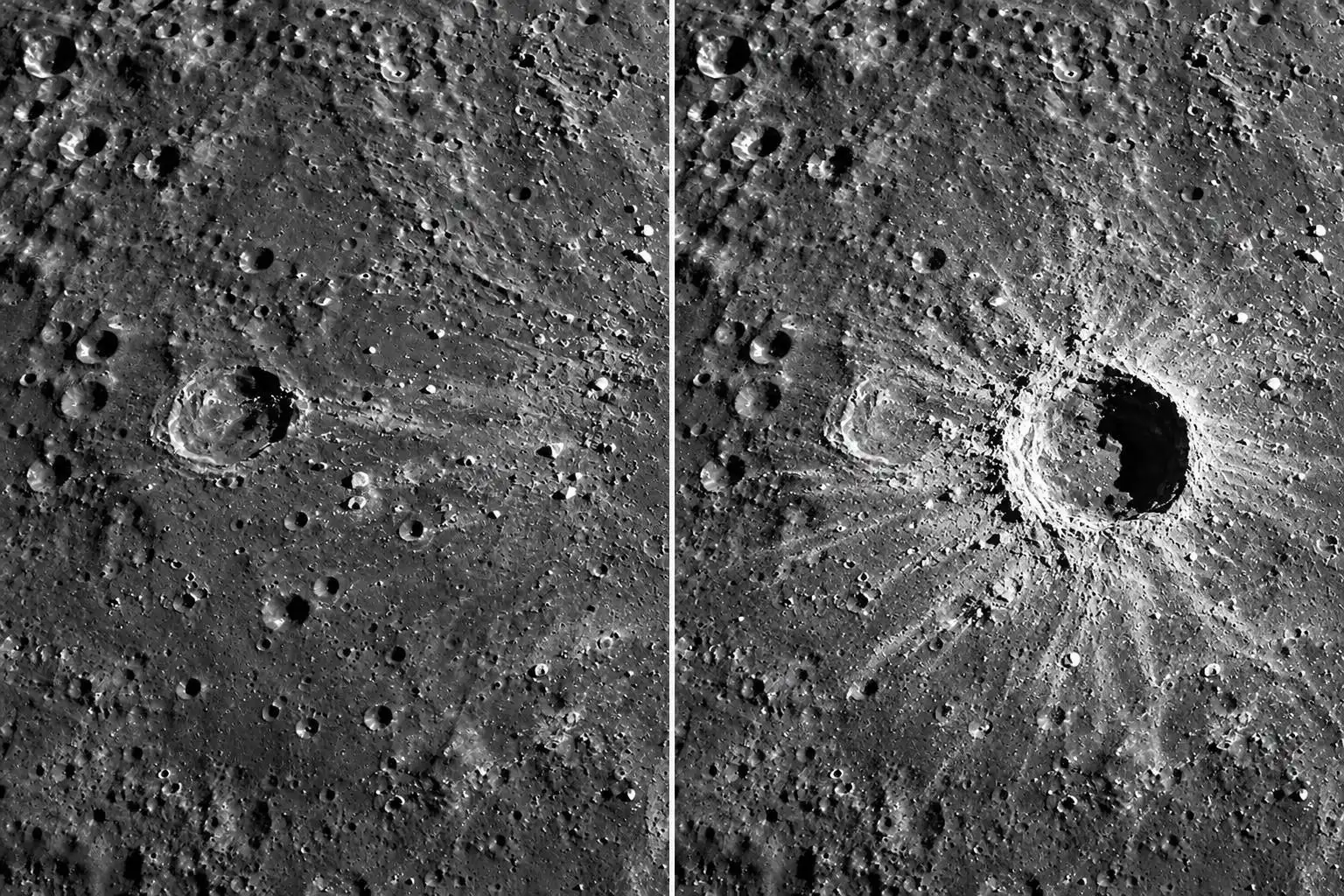
Somewhere on the Moon’s near side, a piece of space rock struck ground that NASA’s Lunar Reconnaissance Orbiter had already photographed. No telescope caught the collision. There was no warning flash to point investigators toward the site. But when researchers compared older orbital images with newer ones, a steep-sided crater had appeared where none existed before. Around it lay evidence that the impact had disturbed a much larger patch of lunar ground.[6]
That pairing—pictures from before and after—is what makes the newly named McGetchin crater extraordinary. Scientists can measure not only the hole but also how its surroundings changed, while the impact’s traces are still relatively fresh. Two studies published in September 2026 use cameras and a heat-sensing instrument aboard the same spacecraft to examine the event at different scales.[8]
The impact nobody saw
McGetchin measures about 222 metres (728 feet) across and reaches roughly 43 metres (141 feet) deep. Its diameter is longer than two football fields laid end to end. That is small beside the Moon’s ancient basins, but enormous for a crater whose formation falls within the lifetime of an orbiting spacecraft. Researchers estimate that the impactor may have been comparable in size to a three- to six-story building, although its exact dimensions depend on properties we cannot directly measure, including its composition and impact speed.[6]
The date is a bracket, not an eyewitness account. Lunar Reconnaissance Orbiter, or LRO, had an image showing the site before the impact on April 11, 2024, and another showing the new crater by May 22. The strike happened somewhere between those observations. Its signature was not picked out of the spacecraft’s accumulated images until August 2025; more detailed imaging followed that autumn, and researchers confirmed the discovery in early 2026.[6]
That delay is understandable. LRO has surveyed the Moon since 2009, producing an immense, continually growing record. Finding a new crater means locating images of the same place from different dates, matching the terrain, and checking whether a bright or dark change is real rather than an effect of sunlight or viewing angle. The reward for doing that patient work is unusually precise: the ground itself supplies the experiment’s baseline.
What the cameras can measure
LRO’s camera system, LROC, gives researchers both a broad view and a close one. Its Wide Angle Camera helps survey large areas and find changes; its Narrow Angle Cameras resolve much finer surface detail. At a typical 50-kilometre orbital altitude, a narrow-angle image can distinguish features on approximately half-metre scales. Think of the wide view as finding a spill on a kitchen floor and the close view as tracing its individual streaks.
At McGetchin, LROC follow-up images reveal the new crater and the material thrown out around it. Comparing those images with pre-impact views lets researchers separate features made by this particular collision from older craters, rocks and patches of soil. The camera study found an extensive ejecta pattern, including evidence that material travelled unexpectedly far and was launched at a higher angle than anticipated.[8][6]
A picture does not directly record the impactor’s speed or replay the explosion. Those quantities must be reconstructed from the crater, the distribution of debris and models of how lunar soil responds to a high-speed strike. That is why the before image matters so much: without it, a bright patch near the crater might be mistaken for newly thrown-out material when it was there all along.
The crater is named for Thomas McGetchin, a former director of the Lunar and Planetary Institute. Its discovery also sets a striking observational record: NASA describes it as the largest known impact crater formed in the solar system in recent times, about three times wider than the previous record-holder identified by LRO. That wording matters. The Moon has vastly larger craters; McGetchin is remarkable because we can establish when it appeared and examine its fresh aftermath.[6]
A heat map beyond the visible debris
The second study asks a different question: how far from the crater did the surface change, including places where an ordinary photograph might not make the alteration obvious? For that, researchers turned to Diviner, LRO’s Lunar Radiometer Experiment. Diviner measures infrared radiation emitted by the Moon. It does not take a photograph of heat in the way LROC photographs reflected sunlight; it measures thermal emission that can be converted into surface-temperature information.[8]
That distinction opens another window on lunar soil. Fine, fluffy regolith and exposed rock warm and cool differently as the Sun moves across the sky. A surface’s thermal behaviour can therefore reveal changes in its texture or rockiness, even where a visual image alone is ambiguous. Diviner detected an altered thermal region extending beyond the ejecta pattern emphasized in the camera study.[8]
The thermal anomaly is not a map of material that remains hot from the 2024 collision. More than two years have passed. Rather, it points to ground whose response to the ordinary lunar day-and-night cycle differs from its earlier state or its surroundings. Nor does every thermally altered spot necessarily lie under a thick blanket of debris. Impact vibrations, scattered fragments and changes to the uppermost soil can all motivate questions for follow-up analysis; interpreting which process dominates requires comparing the infrared measurements with images and models.
LROC and Diviner thus act like two investigators looking at the same scene with different senses. One tracks visible patterns and individual surface features. The other asks whether the physical character of the ground changed across a broader area. Neither instrument, by itself, tells the entire story of the collision. Together with the pre-impact record, they can test how well our descriptions of large lunar impacts match an event that happened on a known patch of ground.
How far can a lunar impact reach?
McGetchin’s effects extend more than 106 kilometres (66 miles) across the lunar surface, according to NASA’s account. That does not mean the impact excavated a 106-kilometre-wide hole. The crater itself is 222 metres across; the larger distance describes how far the disturbance and scattered material reach. The distinction is rather like a stone striking a dry sandpit: the pit and the farthest grains that fly from it have very different dimensions.[6]
The Moon gives flying debris no substantial atmosphere to slow it down. Rock and soil launched above the surface follow ballistic arcs before falling back, potentially far from their starting point. Exactly where they land depends on launch speed and angle, the shape of the target terrain and the mechanics of the initial collision. At McGetchin, the unexpectedly high-angle ejecta reported by researchers makes those mechanics a live question rather than a detail that can simply be assumed from older examples.[6]
There is also a useful difference between a visible extent and a physical extent. The outermost fragment a camera can identify need not mark the outer edge of every disturbance. Diviner’s broader thermal signal suggests the surrounding ground has a more complicated footprint than the bright debris alone. Researchers can now compare that footprint with simulations, adjusting their account of how impacts fracture, scatter or rearrange the Moon’s upper surface.[8]
What a rare crater means for lunar explorers
One estimate puts the formation of a crater this large at roughly once every 132 years. That is a statistical expectation, not a schedule: it neither predicts the next strike nor says that any proposed lunar base has a one-in-132 chance of taking a direct hit. The danger to a particular site depends on its area and on the full range of impactor sizes, including much smaller objects that strike far more often.[6]
The event nevertheless matters for exploration planning because its reach is so much greater than the crater’s width. Engineers need to understand what impacts do to terrain and how far debris can travel. A rare, large event with measured before-and-after conditions offers a valuable check on models used to assess those effects. It is evidence for refining risk estimates, not a reason to treat the entire Moon as if a McGetchin-scale collision were imminent.
There is a limit to what an orbiter can settle. Cameras and thermal measurements view the upper surface from above; they cannot pick up every small fragment or directly feel how loose the soil is. Surface observations at a fresh impact site could connect orbital patterns with the sizes and distribution of individual pieces of ejecta. Researchers involved in the new studies have noted how useful such a comparison would be, though no visit to McGetchin is established by these results.[8]
For now, LRO has delivered something almost as valuable as witnessing the impact: a picture of the ground before it happened, followed by close images and infrared measurements afterward. McGetchin is a new scar on an ancient-looking world. By measuring both the scar and the much wider changes around it, scientists can learn how the Moon is still being remade—one collision at a time.
References
- NASA spacecraft discovers moon crater bigger than Roman Colosseum – CBS News — https://www.cbsnews.com/news/nasa-spacecraft-new-crater-moon
- A NASA spacecraft just found a giant new crater on the moon. Here’s why everyone’s talking about the ‘once-in-a-century’ discovery | Space — https://www.space.com/astronomy/moon/nasa-just-found-a-giant-new-crater-on-the-moon-heres-why-everyones-talking-the-once-in-a-century-discovery



Leave a Reply
You must be logged in to post a comment.