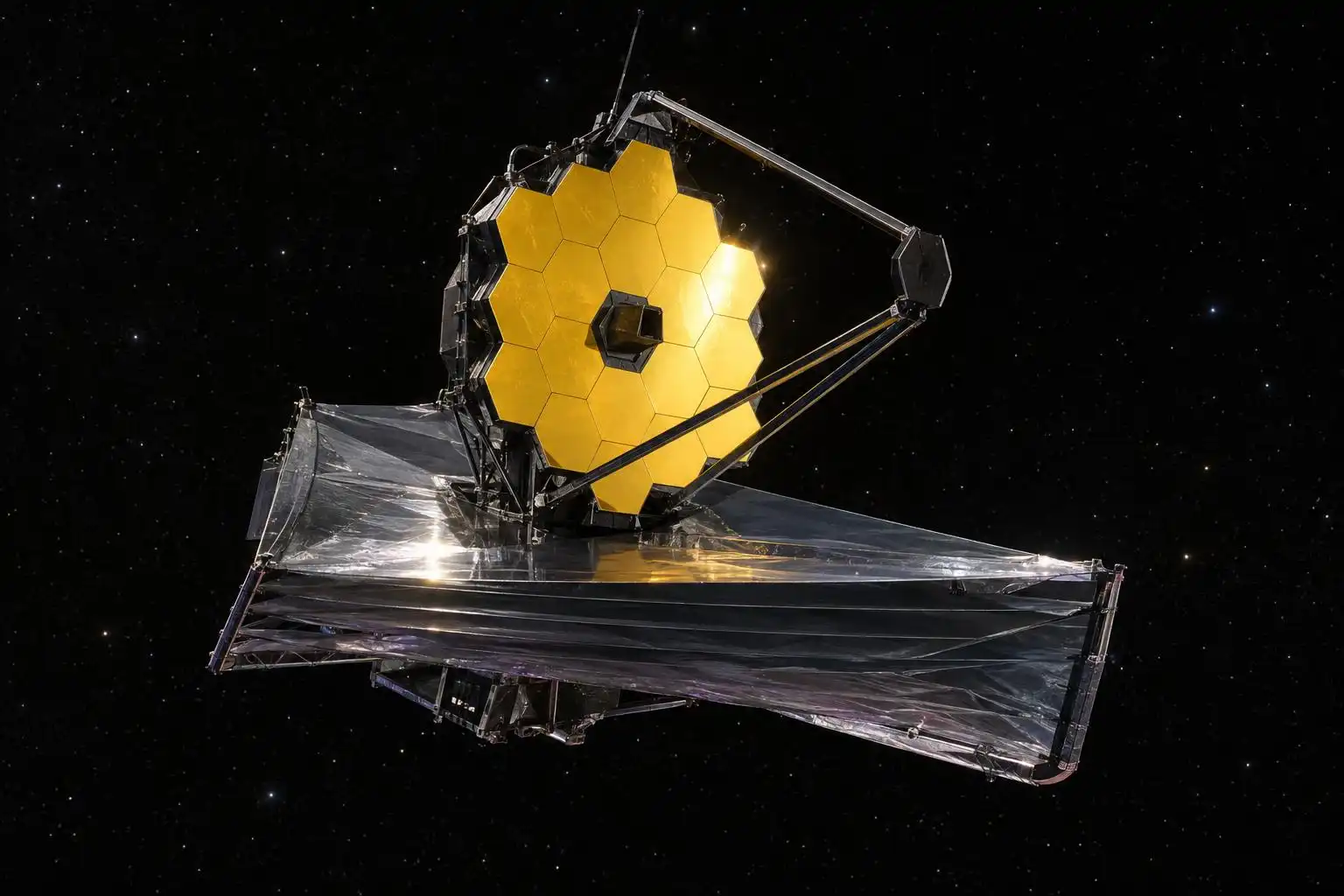

When the James Webb Space Telescope reached its observing position, it did not yet have a working 6.5-meter mirror. It had 18 separate mirrors, each capable of making its own image of a star. The launch had delivered the hardware; weeks of optical alignment still had to turn it into a telescope.
That distinction matters. Webb was built to study faint infrared light, but its enormous mirror had to fold to fit inside an Ariane 5 rocket. Nobody could finish aligning the whole optical system on the ground, then expect it to survive launch and unfold without shifting. Engineers had to plan for adjustment in space, roughly 1.5 million kilometers from Earth, with no prospect of a service visit.
Why the mirror had to travel in pieces
Webb’s primary mirror consists of 18 hexagonal beryllium segments, each about 1.32 meters across. Twelve form its fixed central section; two wings carrying three segments apiece folded inward for launch. Unfolded, they provide about 25 square meters of light-collecting area. Each segment wears a thin gold coating chosen for its infrared reflectivity.
The material underneath the gold is just as important. Beryllium is light and holds its shape well at the telescope’s operating temperature, around 40 kelvin. But a mirror that performs beautifully when cold will not necessarily have exactly the right shape at room temperature. The segments had to be fabricated and tested with their eventual cryogenic behavior in mind.
Even perfect individual mirrors would not make a perfect telescope by themselves. Light reflected from neighboring segments must arrive at the instruments with the right relative timing. If one segment sits slightly too far forward, its part of a star’s wavefront falls out of step with the rest. Webb needed not merely 18 well-aimed reflectors, but one coherent optical surface.
The machinery behind a nanometer-scale adjustment
Each primary-mirror segment has seven actuators on its back. Six adjust its position and orientation; the seventh changes its curvature. The secondary mirror has actuators too. In total, Webb carries 132 mirror actuators, giving its optical team a way to correct the alignment after deployment and as conditions change over the mission.
This is not a mirror that thrashes around to cancel every spacecraft vibration. During an observation, pointing is handled by the spacecraft’s attitude-control system and fine guidance sensor. Mirror alignment is a slower, deliberate process: measure the light, calculate the error, command a small movement, and verify the result. Individual actuator movements can be measured in nanometers.
The distinction between pointing and alignment is easy to miss. A telescope can hold a star steadily in a detector’s field while still producing a blurred image of it. Webb’s optical commissioning had to solve both problems independently: keep the observatory steady, then make its separate mirrors agree about where the star was.
Eighteen images of one star
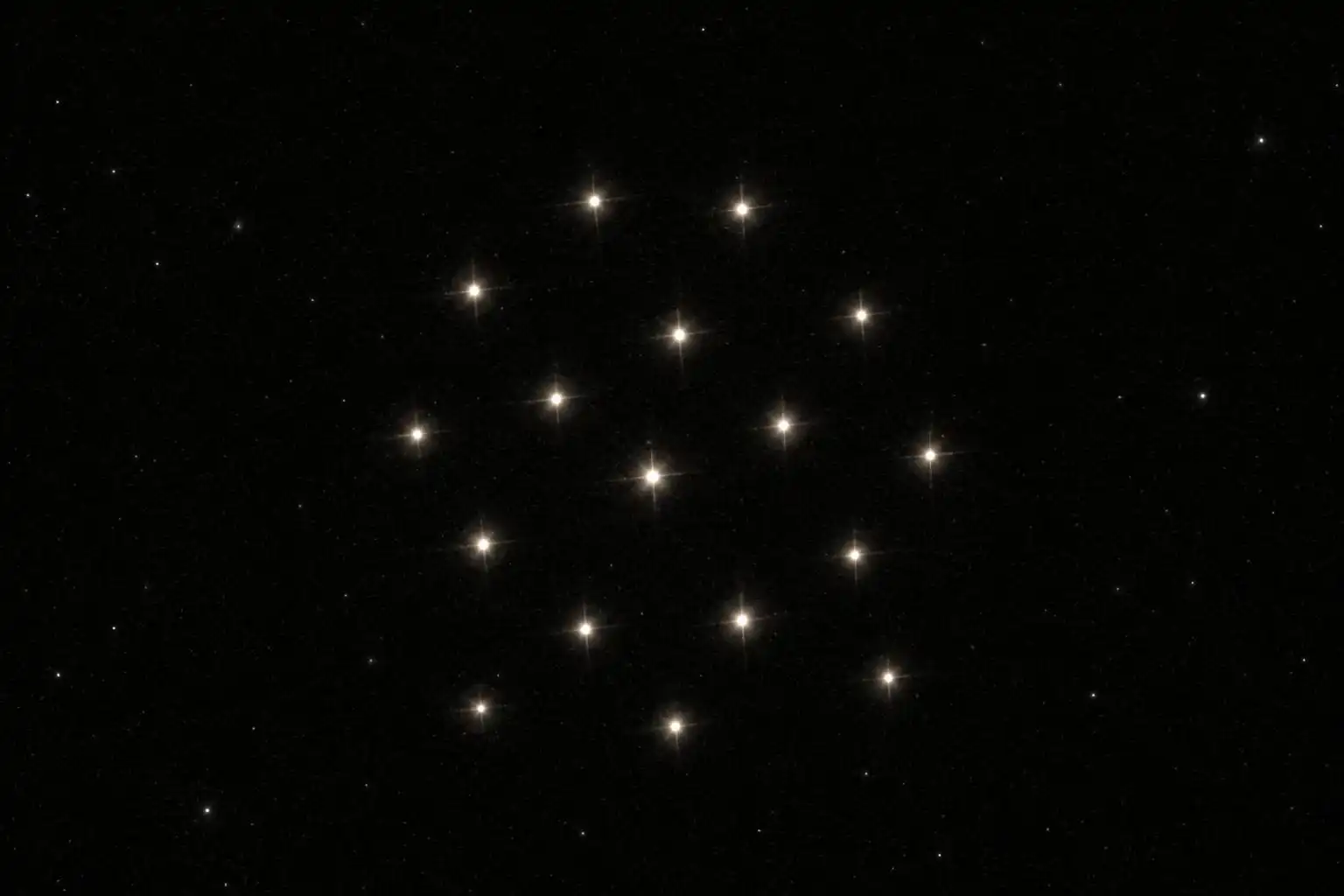
In February 2022, Webb’s Near-Infrared Camera, or NIRCam, began collecting the measurements needed for mirror alignment. Engineers used a bright, isolated star, HD 84406. At first, the telescope recorded 18 distinct images of that single star—one from each primary segment. It was an alarming-looking result only if you expected a finished telescope. For the commissioning team, it was the map they needed.
First they identified which spot belonged to which segment. They then moved the mirrors to bring those spots together and sharpened each segment’s individual image. But stacking 18 bright spots was not enough: their light still had to combine properly. Fine phasing used deliberately defocused images to infer errors in the incoming wavefront, allowing the team to adjust the segments until they acted together.
The work proceeded in stages because changing one part of the optical system could affect the next measurement. After the primary mirror was phased, engineers checked performance across the fields of all four science instruments, not just NIRCam. By late April 2022, NASA reported that Webb’s optical alignment was complete; instrument commissioning continued before the first science images were released in July.
The alignment does not end after commissioning
Space is quieter than a launch vehicle, but it is not a sealed laboratory. Temperature changes, spacecraft maneuvers, and slow mechanical settling can alter optical alignment. Webb’s team therefore monitors its wavefront and makes corrections when needed. The ability to measure and adjust the mirror is part of routine operations, not merely a trick that got the telescope through its first months.
There is also damage an actuator cannot undo. In May 2022, a micrometeoroid struck segment C3, producing a larger change in its shape than earlier impacts had caused. The team could adjust the segment to compensate for some of the effect, but it could not erase the local distortion. Webb continued to exceed its overall optical performance requirements, while operators studied how to reduce future risk—including avoiding certain orientations that expose the mirror more directly to particles along its direction of travel.
That incident draws a useful line between correction and repair. An actuator can reposition a mirror or alter its overall curvature. It cannot replace material knocked out of the optical surface. Every adjustment is made within that physical limit, by a team working with measurements sent home from an observatory far beyond Earth orbit.
A telescope assembled by light
Webb’s first sharp images depended on hardware decisions made years earlier: folding wings to survive launch, beryllium that would retain its intended figure in the cold, actuators behind every segment, and a camera capable of measuring the errors those actuators would correct. Remove any one of those provisions and the 6.5-meter aperture becomes a much less useful collection of polished pieces.
There is a quiet satisfaction in the commissioning record. The telescope did not emerge from its rocket ready to see. Engineers found 18 images of one star, worked out which mirror made each one, and brought their light together. That is what it takes to build a large eye in space: not just an extraordinary mirror, but a way to finish making it after launch.



Leave a Reply