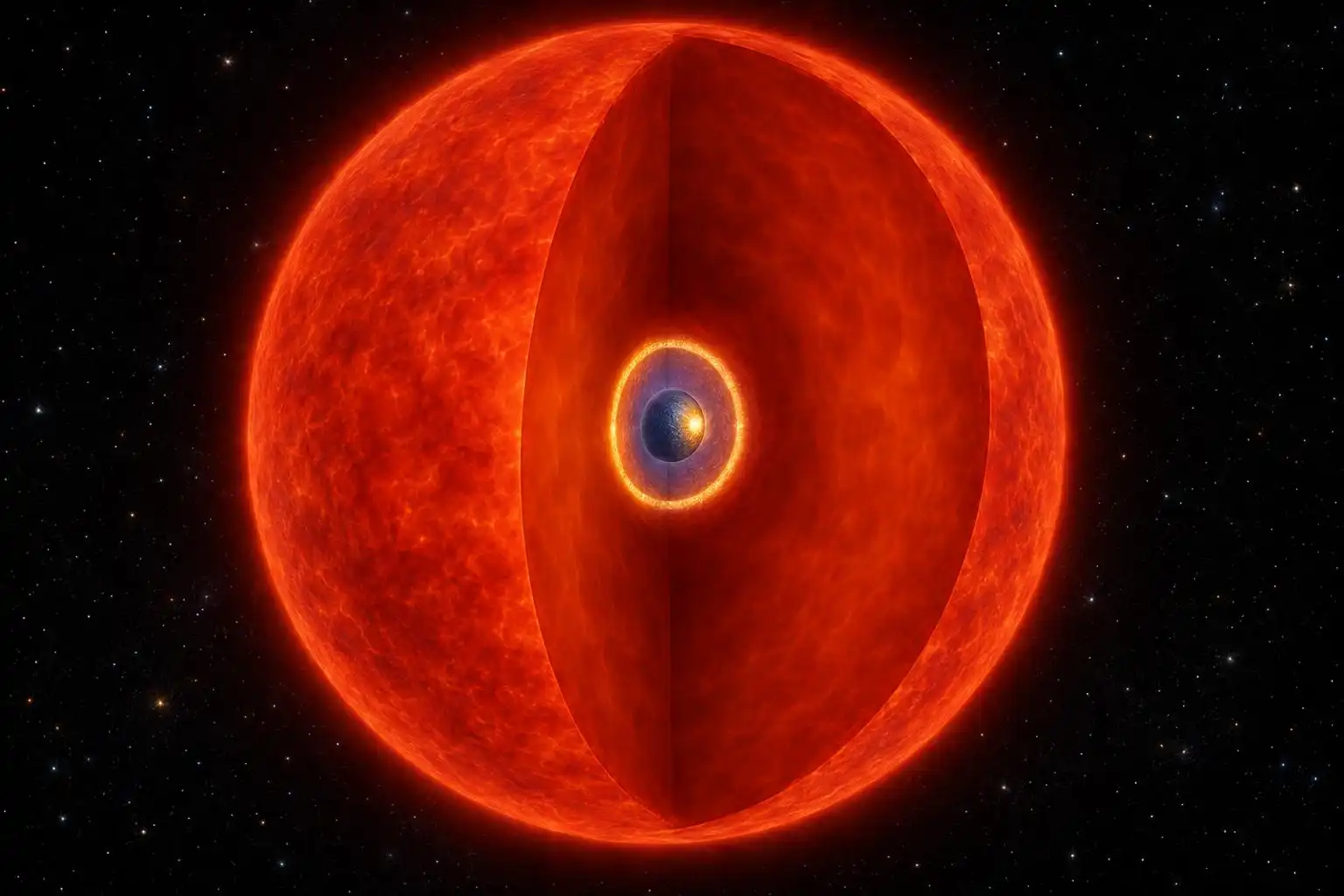

Near the tip of the red giant branch, a star like the Sun is about to ignite helium. For a brief interval, its helium-burning power can climb to billions of times the Sun’s present luminosity. Yet an observer would not see the star flare comparably. The event is buried inside a giant envelope, and most of its energy is spent changing the core itself.
The puzzle is not simply why helium ignites so violently. It is why an enormous burst of nuclear energy fails to become an enormous burst of light.
A Core That Cannot Adjust Its Pressure
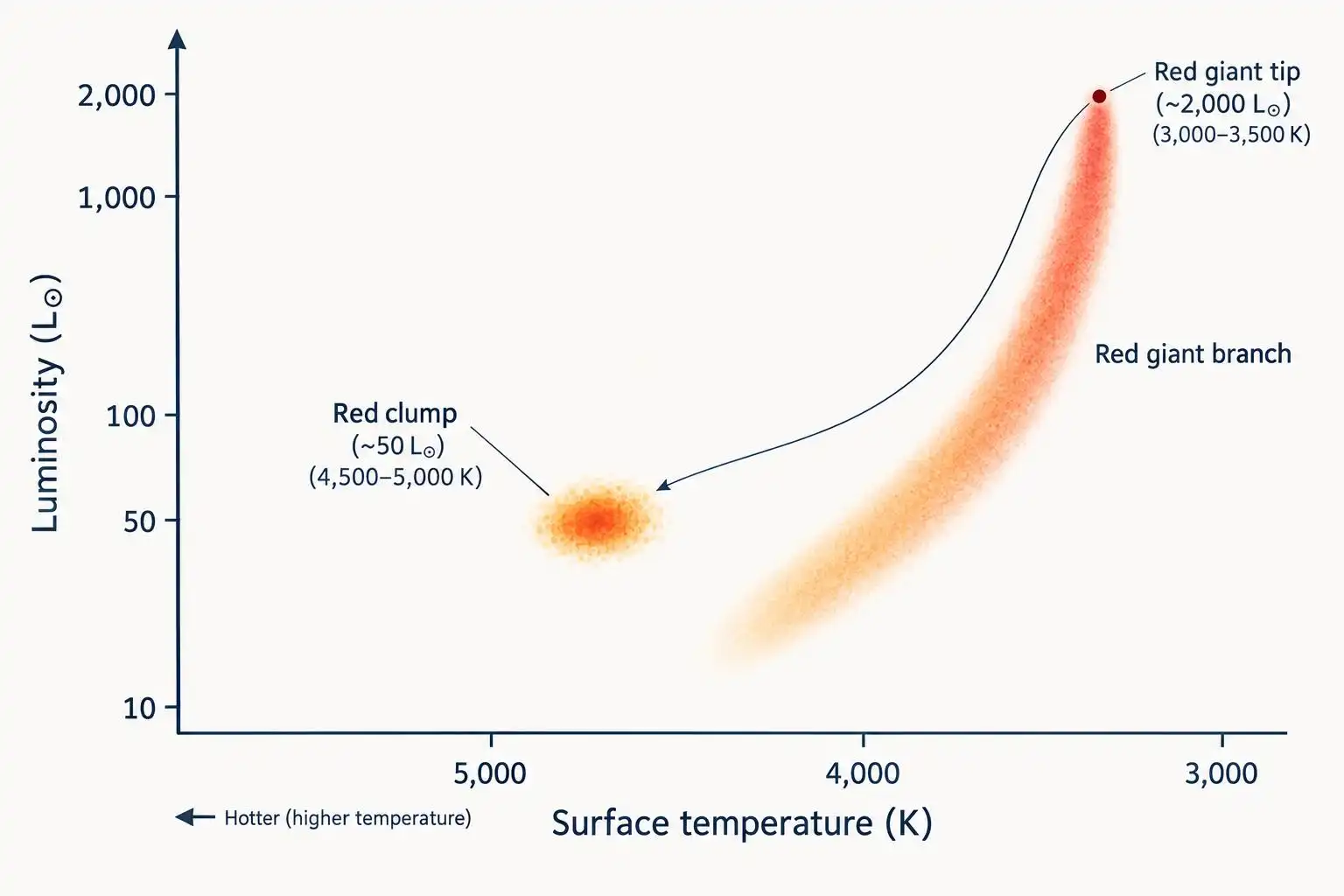
After a low-mass star exhausts hydrogen at its center, it builds a helium core beneath a hydrogen-burning shell. The shell deposits more helium onto that core while the outer layers swell and cool. Near the red giant branch tip, a roughly solar-composition star can shine at around 2,000 solar luminosities while its surface has the cool, reddish appearance of a K- or M-type giant.
The helium core is compact: ignition typically comes when its mass reaches about 0.47 solar masses. Its pressure is supplied largely by degenerate electrons. Unlike the pressure of an ordinary hot gas, electron degeneracy pressure depends primarily on density, not temperature. Heating the core therefore does not immediately make it expand and cool—the response that normally stabilizes stellar burning.
This path is characteristic of stars born with roughly 0.8 to about 2 solar masses, although the upper boundary depends on composition and stellar physics. More massive stars begin helium burning before their cores become strongly degenerate, so they do not undergo the same kind of flash.
Why Ignition Begins Away From the Center
It might seem that the center, where the density is greatest, must ignite first. But the dense core loses energy through neutrinos that escape the star. Electron conduction also redistributes heat efficiently. Together with heating associated with the growing core, these effects produce a temperature maximum somewhat outside the center.
When that region approaches about 100 million kelvin, the triple-alpha reaction begins converting helium into carbon. Around this temperature its rate is extraordinarily sensitive to heat: a small temperature rise can produce a much larger increase in nuclear power. The burning region heats itself faster, but degeneracy initially prevents the pressure-driven expansion that would stop the rise.
The resulting runaway is the helium flash. Models can reach a peak helium-burning power of order 10⁹–10¹⁰ solar luminosities. That number describes energy production deep in the core, not the star’s surface brightness. Convection carries energy through the flash region, but the red giant’s vast envelope does not suddenly become a window onto the burning core.
Where the Energy Goes
An ordinary gas has a built-in thermostat: heat it, and it expands; expansion lowers its temperature and slows its nuclear reactions. During the flash, the helium core must first absorb enough energy for thermal pressure to matter alongside degeneracy pressure. Much of the released energy goes into expanding and restructuring the core rather than promptly emerging as radiation.
Core expansion has an important consequence for the layer just above it. The hydrogen-burning shell is no longer held at quite the same high temperature, so its energy production falls. The star’s dominant pre-flash power source weakens even as helium burning has switched on beneath it.
The first flash is not necessarily the end of the adjustment. Weaker helium-burning episodes can follow as the burning region moves inward and the core settles over roughly a million years. Once the center can sustain stable helium burning, temperature changes again produce enough expansion to regulate the reaction rate. The runaway has built its own off-switch by removing the conditions that permitted it.
The Clue Left on the Hertzsprung–Russell Diagram
The observable transformation is gradual rather than explosive. After the star leaves the red giant branch tip, its envelope contracts and its surface becomes warmer. For a solar-metallicity population, stable core-helium-burning stars gather in the red clump, commonly at luminosities of a few tens of solar luminosities—far below the luminosity of the giant branch tip.
On a Hertzsprung–Russell diagram, the star has moved away from the bright, cool tip toward a fainter, somewhat hotter position. The two locations reveal a change in internal energy sources: before ignition, a hydrogen-burning shell surrounds an inert helium core; afterward, the core burns helium while hydrogen burning continues outside it.
The helium flash is thus fierce precisely because the core initially cannot respond to heat in the usual way. Its aftermath is quiet because the energy changes the star’s internal structure before it can brighten the surface. The red clump is the long-lived evidence of that hidden reset.


Leave a Reply