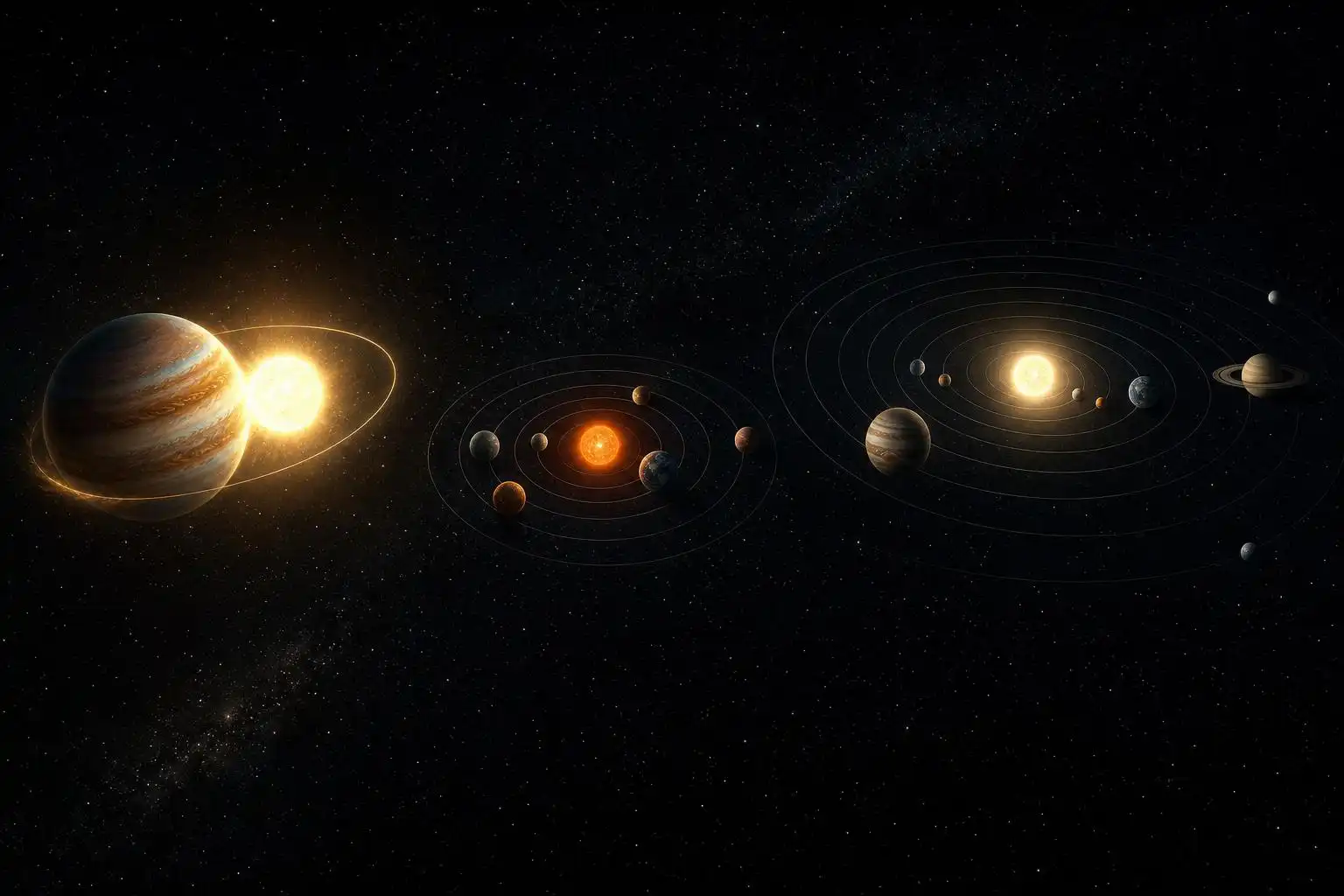

Imagine visiting a new city, seeing one house, and deciding that houses everywhere must have a front porch, two bedrooms, and a yellow door. That is roughly where humanity began its study of planets. For most of our history, the only planetary system we knew was our own. Earth was our example of a habitable world—and our only example.
Now we have discovered thousands of planets around other stars. They have made our cosmic neighborhood feel less like a blueprint and more like one address in a very large, very varied city. But they have not yet answered a surprisingly slippery question: Is Earth ordinary?
Our first example was never a fair sample
The solar system has small rocky planets close to the Sun and giant planets farther out. Before we found exoplanets, it was tempting to picture other systems arranged much the same way. Then came planets that challenged that picture, including giants orbiting astonishingly close to their stars.
One famous example is 51 Pegasi b, announced in 1995: a gas giant that circles a Sun-like star in about four days. Mercury, the Sun’s innermost planet, takes 88 days. Finding such a close-in giant did not mean our solar system was defective. It meant we had mistaken the first system we knew for a general rule.
The easiest planets to find are not the most common
There is a catch to that early surprise. A large planet close to its star is easier to detect than a small one on a long orbit. It can tug its star more strongly, and if it passes in front of the star from our viewpoint, it can block more light. It also completes an orbit quickly, giving astronomers more chances to notice a repeating signal.
Think of counting animals by watching a busy road. You might spot deer more readily than mice, but that would not prove deer outnumber mice. Astronomers have to account for what their searches could have missed before turning discoveries into estimates of what is common. Once they do, close-in giant planets appear to be uncommon, even though they were among the first exoplanets found.
Other systems have their own ideas
We have since found many planets between Earth and Neptune in size—a range absent from our solar system. Some are often called super-Earths, though that name describes size or mass, not a promise of familiar ground underfoot. A planet in that group might have a thick atmosphere, and its size alone cannot tell us whether it has an ocean or a rocky surface.
Then there is TRAPPIST-1, a small star with seven known planets roughly Earth-sized. All seven orbit closer to their star than Mercury does to the Sun. Because TRAPPIST-1 is much cooler and dimmer than the Sun, that tight arrangement does not automatically rule out moderate temperatures on some of its planets. Nor does it guarantee that any of them can support life.
These discoveries tell us that our solar system is not the only workable arrangement. They do not yet tell us how unusual every feature of it is. “Typical” depends on what you choose to compare: a planet’s size, its orbit, its atmosphere, or the company it keeps.
Earth-like is a much bigger claim than Earth-sized
Suppose tomorrow’s announcement describes an Earth-sized planet receiving about as much energy from its star as Earth receives from the Sun. Exciting? Absolutely. A second Earth? Not on that evidence alone.
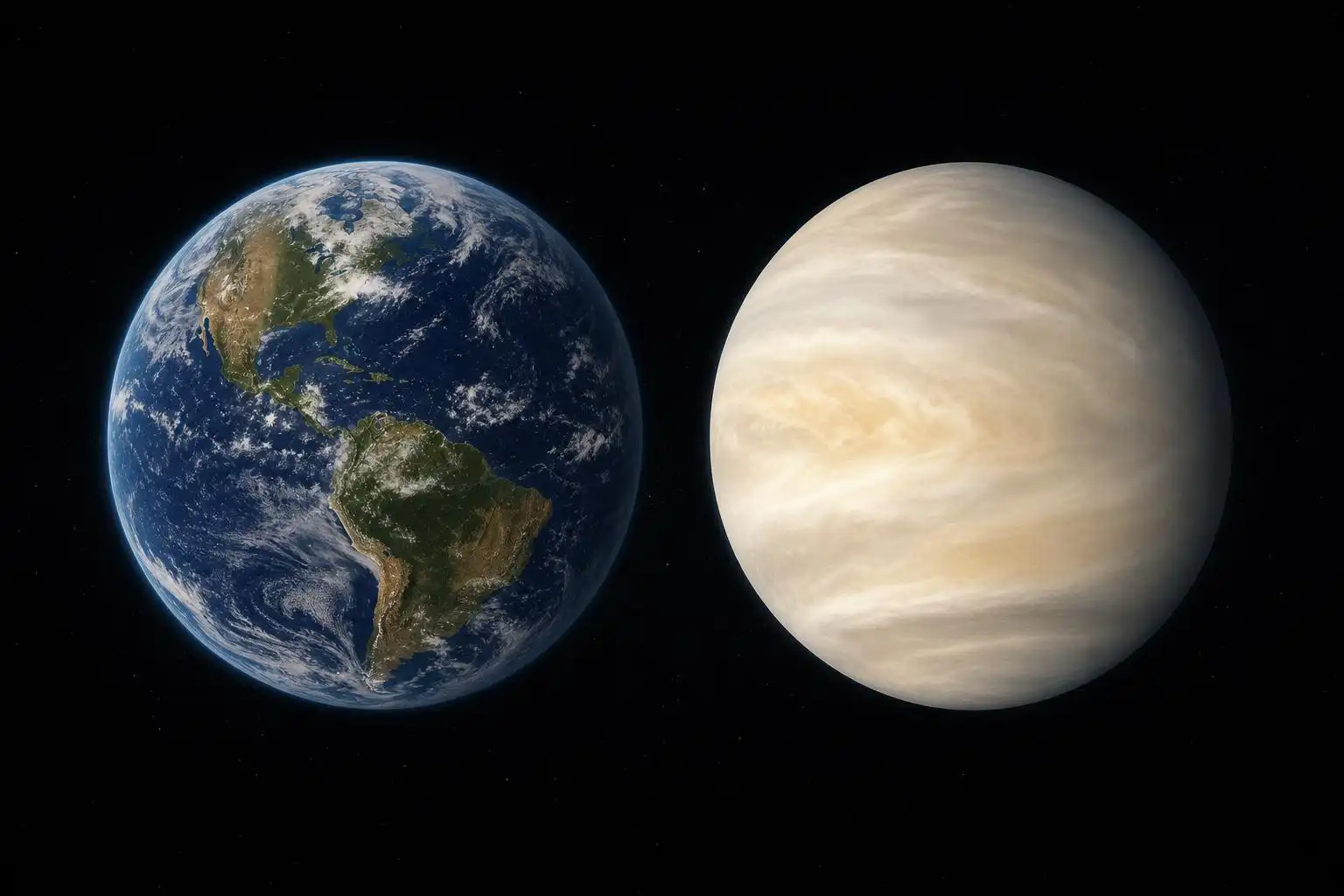
Venus is nearly Earth-sized, yet its surface is fiercely hot beneath a dense atmosphere. Earth’s oceans, atmosphere, geological activity, and long history all matter to the world we know. For distant planets, many of those details are hard to measure. And so far, Earth remains the only planet where we know life exists. We cannot calculate how common living worlds are from one confirmed example.
Being ordinary is not the point
It is natural to hear “Is Earth typical?” as a question about our importance. But frequency and value are different things. A familiar home is not less precious because many homes exist; it is not more precious because no other home looks quite like it.
The answer will become clearer as we discover more planets and learn more about their atmospheres. For now, the honest position is also a wonderful one: we live on one real example of a living world, in a universe that has shown us many other ways to make a planet. Earth is the place that taught us to ask the question. It is too early to let it answer on behalf of everywhere else.


Leave a Reply