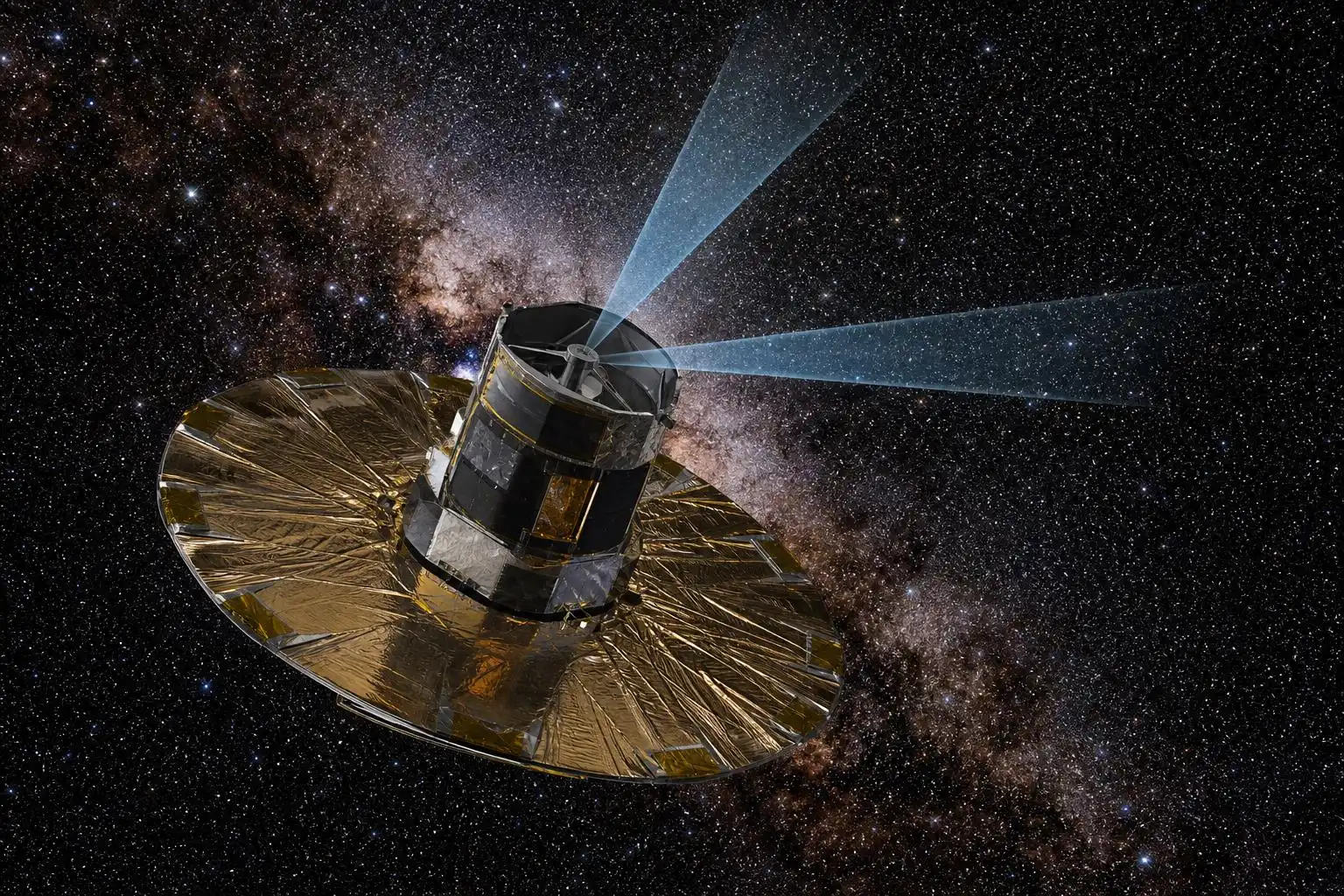

A star’s parallax is a tiny change in its apparent position as Earth travels around the Sun. At a distance of one kiloparsec, that annual shift has an amplitude of just one milliarcsecond: roughly the angle a coin would subtend from thousands of kilometers away. Measuring it means distinguishing a repeating positional wobble from the star’s steady motion across the sky—and from imperfections in the measuring instrument.
Gaia’s solution was not to take a particularly sharp snapshot. The spacecraft repeatedly swept the sky, timing where each star crossed its detectors. Its extraordinary map of stellar distances grew from millions of such measurements, each made under controlled but changing conditions. The craft is in the repetition: the same star must be observed at different times and from different directions before its parallax can be separated from everything else.
A telescope that measures as it spins
Gaia carries two telescopes whose viewing directions are separated by a fixed basic angle of 106.5 degrees. Both feed a shared focal plane. As the spacecraft spins once every six hours, stars from each field of view drift across its detectors. Comparing stars in widely separated patches of sky helps tie their positions into one global reference frame rather than a collection of local maps.
The spin axis does not stay pointed in one direction. Gaia keeps it at a 45-degree angle to the Sun and lets it precess, changing how the two fields sweep across the sky. Over months and years, a star is observed at different scan angles. That matters because a single sweep measures position most precisely in the direction of travel, called the along-scan direction. Crossings at other angles supply the geometry needed to locate the star in two dimensions.
A telescope on the ground might hold a target still on one part of a detector. Gaia does the opposite: it lets a target move across the focal plane at a predictable rate. The detector has to follow that motion electronically, without physically moving.
Keeping pace with a star on the CCD
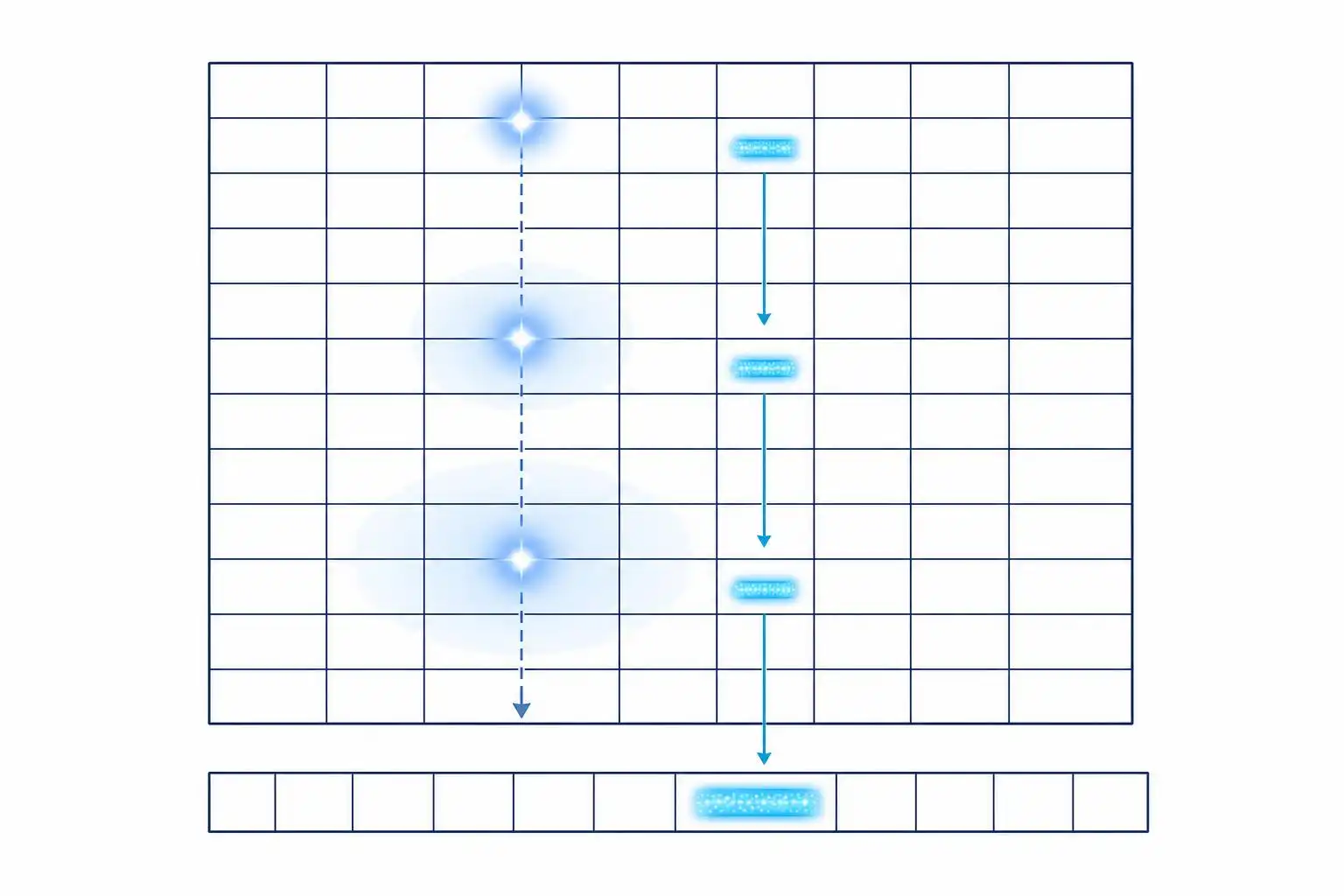
Gaia’s astrometric CCDs operate in time-delay integration, or TDI, mode. Instead of collecting charge in one stationary pixel for the duration of an exposure, the electronics shift that charge from row to row in step with the star’s image. Light arriving at successive rows is added to the same moving packet of charge.
An astrometric CCD has 4,500 rows in the along-scan direction. Charge advances one row about every 0.983 milliseconds, taking roughly 4.4 seconds to cross the device. A star can pass over as many as nine astrometric CCDs during one visit. Each crossing offers another measurement of its along-scan position, rather than a single prolonged exposure that smears the image.
At the focal plane, one pixel corresponds to about 59 milliarcseconds along the scan. That is vastly larger than the parallax precision Gaia can eventually achieve for a favorable bright star. The apparent contradiction is familiar to observational astronomers: a detector does not need pixels a microarcsecond wide to estimate a position to microarcsecond precision. It needs a well-characterized image profile, enough detected photons, and repeated measurements whose errors can be modeled.
The CCDs are not perfect rulers. Their responses and geometry must be calibrated, and a star’s measured centroid can depend on its brightness and color. For bright sources, Gaia can shorten the effective exposure with electronic gates to limit saturation. These details enter the astrometric solution; they cannot simply be averaged away by observing more stars.
Finding the annual wobble in repeated transits
For each star, Gaia fits a model that includes its position, its proper motion—the steady drift across the sky—and its parallax. The parallax signal is not an arbitrary yearly sine wave. Its apparent direction and size depend on where the star lies and where Gaia is in its orbit around the Sun when an observation is made.
That is why the observing dates matter as much as the number of measurements. A sequence taken at nearly identical points in Earth’s orbit would struggle to distinguish annual parallax from other effects. Gaia’s repeated, differently angled scans supply the leverage to fit the wobble alongside proper motion and the instrument’s changing orientation.
The scale of the result depends strongly on brightness. In Gaia Data Release 3, typical parallax uncertainties are around 0.02 milliarcseconds for stars near magnitude G = 15, rising to roughly 0.5 milliarcseconds near G = 20. These are broad guideposts, not promises for any particular source. Crowding, color, unusual motion, and the number and distribution of usable transits can all change an individual star’s result.
A parallax of one milliarcsecond corresponds to a distance of about one kiloparsec. But taking the reciprocal of a measured parallax is not always a sound way to estimate distance: when the uncertainty is a substantial fraction of the measurement, the resulting distance estimate becomes strongly asymmetric. The catalog provides a measurement and its uncertainty; interpreting them is a separate step.
The angle that could imitate parallax
One of Gaia’s hardest problems is built into its two-telescope design. The basic angle must be known exquisitely well. If it changes as the spacecraft spins, stars in the two viewing directions appear to shift relative to one another. Certain repeating changes in that angle can closely imitate a shift in the parallaxes of stars across the whole sky.
Gaia carries a Basic Angle Monitor that uses interference fringes to track changes between the two lines of sight. The basic angle did vary with the spacecraft’s rotation, so the monitor’s measurements and the global astrometric calibration became essential parts of the reduction. The satellite could not rely on its mechanical structure being perfectly rigid.
Even after calibration, Gaia parallaxes have a small zero-point bias. It is not one universal number that can safely be subtracted from every star. In the Gaia EDR3 and DR3 astrometry, its size depends in part on brightness, color, and position on the sky. Studies using objects such as distant quasars—whose true parallaxes are effectively zero—find a bias on the order of tens of microarcseconds, with important variations. At the precision Gaia reaches, that is a measurement issue, not a rounding error.
What the map owes to the measurement
Gaia Data Release 3’s astrometry draws on roughly 34 months of observations. A catalog position or parallax compresses that long sequence of CCD crossings and calibrations into a few reported numbers. Those numbers are powerful precisely because the underlying scan pattern, detector behavior, and spacecraft geometry have been treated as parts of the same measurement problem.
It is tempting to picture a three-dimensional Milky Way map as a finished view. Gaia’s achievement is more exacting: charge packets kept pace with moving stars, repeated crossings revealed tiny changes in position, and an angle between two telescopes was watched closely enough to keep the instrument from mistaking its own motion for stellar distance. The beautiful map begins with that engineering discipline.


Leave a Reply