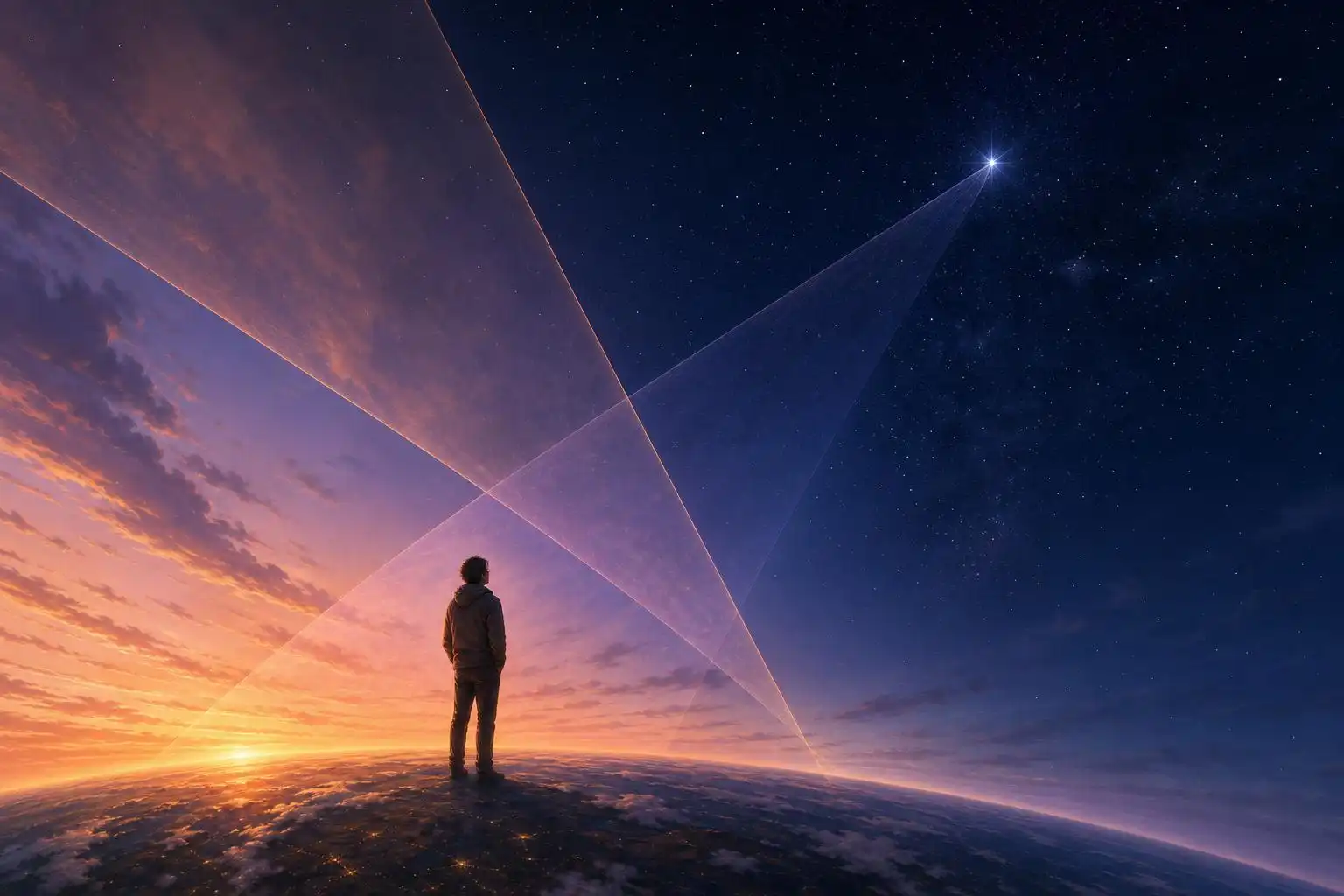

Imagine a friend on a planet orbiting Proxima Centauri, the nearest star to the Sun. You look at your watch and wonder: What is my friend doing right now? It sounds like a question with an answer you simply cannot get yet. Their news would take more than four years to reach you. But relativity reveals a stranger difficulty: for events that far apart, different observers can disagree about which moment on that planet counts as “right now.”
How do you agree that two things happened at once?
Suppose lightning strikes both ends of a moving train. An observer standing beside the tracks, halfway between the strike locations, sees the flashes arrive together. After accounting for the light’s travel time, they conclude that the strikes happened simultaneously.
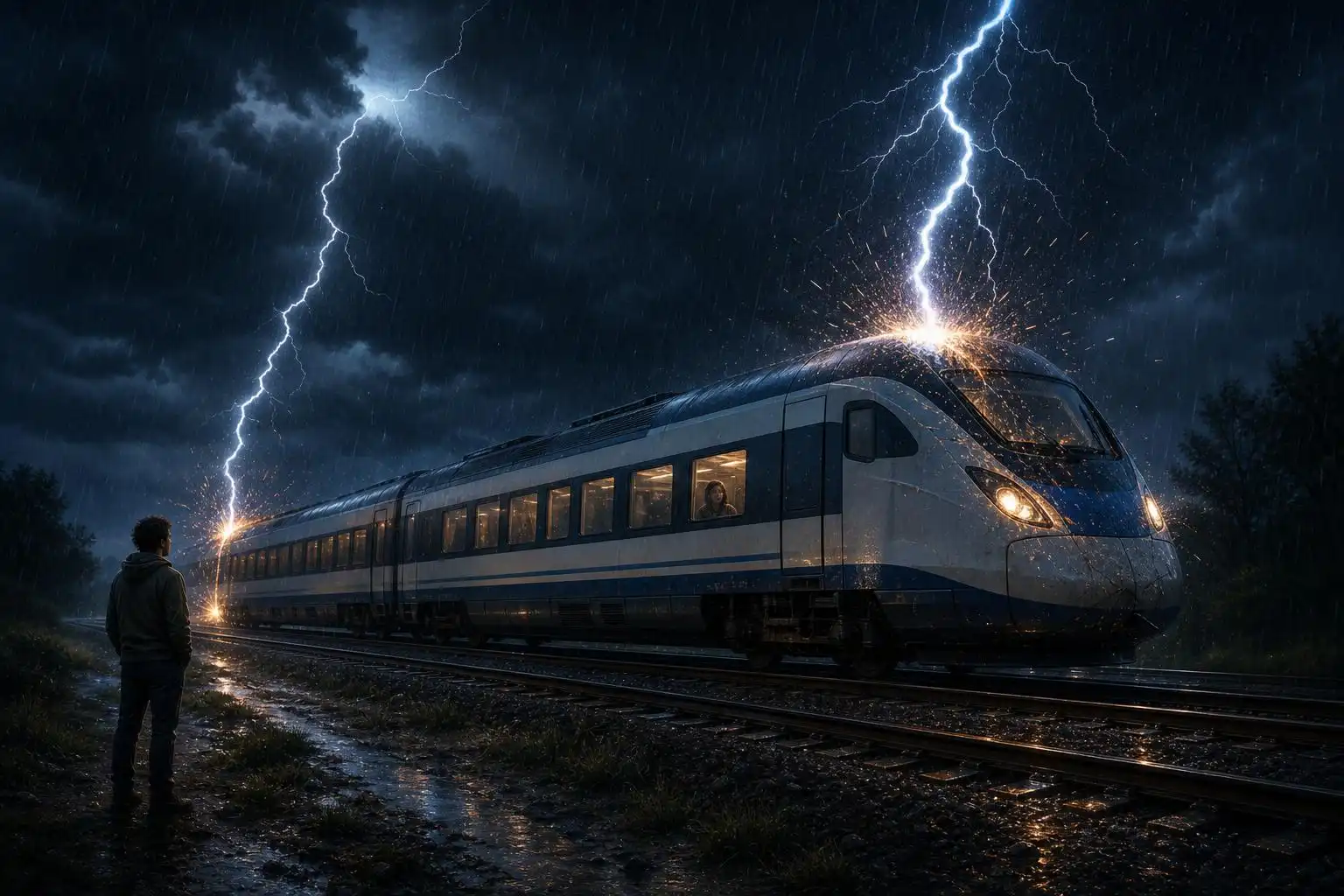
A passenger sitting halfway along the train sees the flash from the front arrive first. The passenger is moving toward that flash and away from the one at the rear. So far, this might sound like a trick of perspective, like hearing one firework before another because you stood closer to it.
Here is the twist Einstein brought to light in 1905: both observers measure light traveling at the same speed. When the passenger uses clocks and distances at rest on the train to work out when the strikes occurred, they conclude that the front strike happened first. Neither observer made a mistake. “At the same time” depends on the observer’s state of motion.
The difference grows with distance
On a train, the disagreement is far too small to notice without precise equipment. Stretch the distance, though, and a tiny difference in motion becomes consequential. Two observers passing each other at a walking speed of about one meter per second can assign moments at Proxima Centauri that differ by roughly four-tenths of a second, if their motion is along the direction to the star.
That is not because one person’s watch runs noticeably faster during their walk. The surprising part is how each observer extends their definition of “now” across the roughly 4.2 light-years between here and Proxima. Change the observer’s motion, and that distant slice of time tilts a little.
No one can watch this disagreement play out live. A signal from Proxima still takes more than four years to reach Earth. Relativity changes how we label distant events, not the speed at which we can learn about them.
What everyone can agree on
Relativity does not make time a free-for-all. If you send your friend a message and they reply, everyone agrees that your message was sent before their reply. Information cannot outrun light, so events linked by a possible signal have an order that all observers share.
The uncertainty belongs to events too far apart for light to travel between them in the time separating them. Neither event could have caused the other. One observer may place those events in one order, another may reverse them, and both descriptions can fit the same physical reality.
Think of a photograph taken at a family reunion. Everyone in the room can point to the same scene. A photograph labeled “the whole universe at this instant” is harder to define. There is no single cosmic camera whose shutter setting every observer must use.
Then why do we say the universe is 13.8 billion years old?
Astronomers do use a shared cosmic clock when describing the universe on its largest scales. They can choose a frame of reference in which the universe’s large-scale matter is, on average, at rest. In that useful framework, the time since the hot early universe is about 13.8 billion years.
That does not overturn the train lesson. The cosmic clock is a sensible way to describe a particular universe, not proof that nature requires every moving observer to agree on one universal present. A map can have a north arrow without north being the only direction anyone is allowed to face.
Why this matters on an ordinary Tuesday
If there is no universal “now,” does that make your own present less real? Not at all. The conversation you are having, the hand you are holding, the sunlight warming your face: these are events you can meet and respond to. Relativity does not take that immediacy away. It tells us to be careful when we try to stretch it across the stars.
Your friend near Proxima has a perfectly real day, too. You just cannot wrap their day and yours in one definition of “at this very moment” that every observer will share. The universe is not one enormous room with a clock on the wall. It is a place where connection takes time—and where the moments we can share are made possible by light crossing the distance between us.



Leave a Reply