

A bright streak across a long Hubble exposure might be a distant galaxy—or a cosmic ray that struck the detector halfway through. In an ordinary photograph, those two events can be difficult to separate. Hubble’s Wide Field Camera 3 infrared channel has a useful advantage: it can check the accumulating signal repeatedly before the exposure ends. The resulting sequence of readings tells astronomers not just how much light arrived, but when it arrived.
An infrared detector that remembers its exposure
Installed on Hubble in 2009, WFC3’s infrared channel observes roughly 0.8 to 1.7 micrometers. Its detector is a 1024 × 1024-pixel mercury-cadmium-telluride array, with a science area of about 1014 × 1014 pixels. Each pixel collects electrical charge when infrared photons arrive. A silicon readout circuit, connected beneath the light-sensitive material, measures that charge.
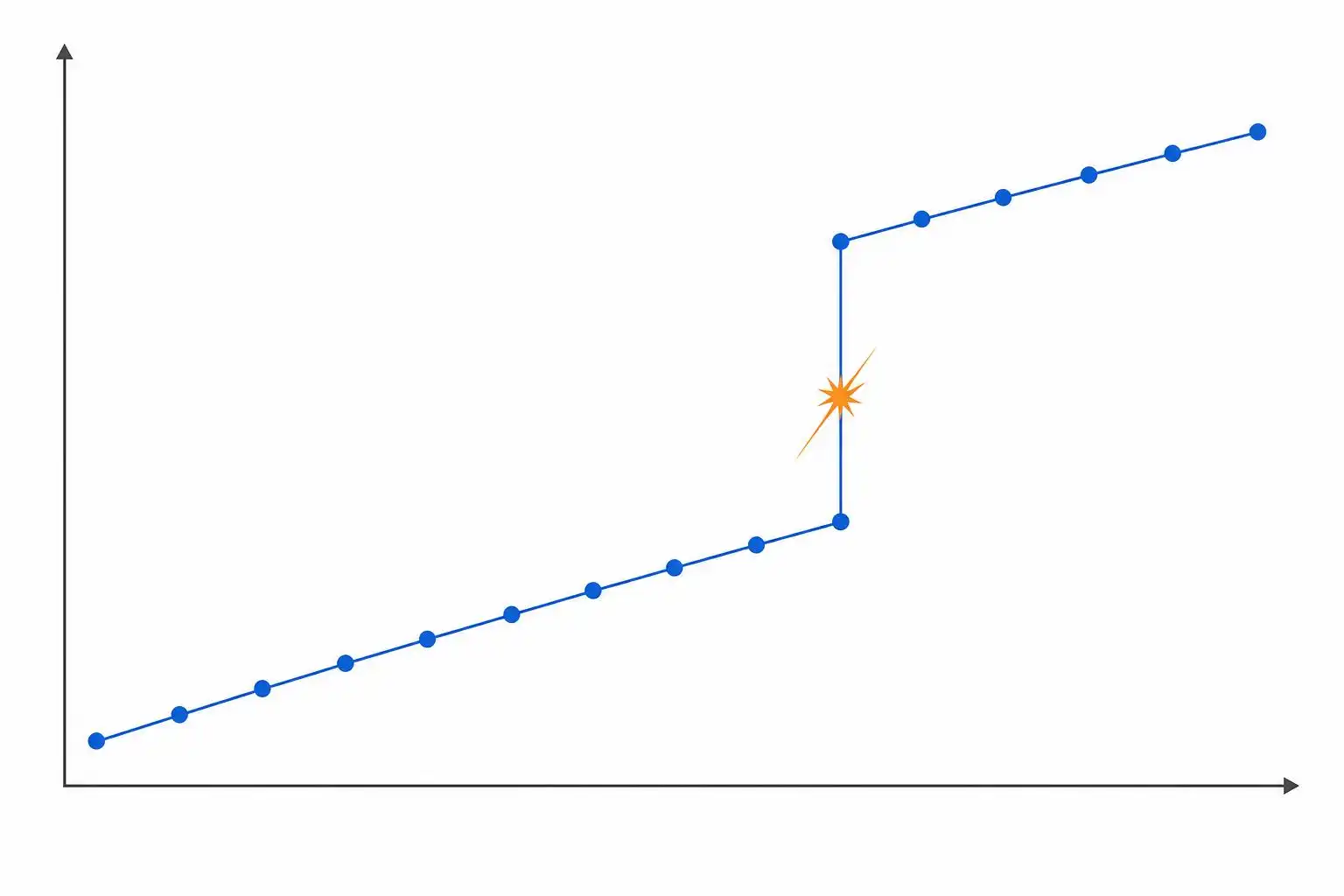
Unlike a conventional exposure that is read only at the end, WFC3/IR can measure its pixels repeatedly without clearing them between measurements. This is called nondestructive readout. A pixel viewing a steady source should climb steadily in signal as the exposure proceeds. Plot its readings against time and the result is a ramp; the ramp’s slope is the source’s count rate.
That slope matters more than any single reading. One noisy measurement can be weighed against the others, while a sudden change can be identified by when it happened. The camera offers different sampling sequences so observers can choose how often to read during an exposure. The WFC3 Instrument Handbook describes those choices in detail.
What a cosmic ray looks like in time
Imagine a pixel whose charge rises at a nearly constant rate for several reads. Then an energetic particle hits it, depositing a burst of charge. The next reading jumps upward, but later readings resume a roughly steady climb. A distant galaxy does not normally switch on in one pixel for an instant; a cosmic-ray hit does.
Processing software looks for those jumps and fits the uncontaminated parts of the ramp. If enough valid readings remain, the pixel can still contribute a useful estimate of the astronomical signal. In a single-read image, the same hit would be harder to distinguish from genuine light without comparing separate exposures.
Repeated reads also help with read noise: the uncertainty introduced each time the electronics measure a pixel. Fitting several measurements can reduce its effect on the estimated count rate. It cannot erase photon noise, however. When the source or background delivers only a small number of photons, their random arrival remains an unavoidable limit.
The signal does not always rise neatly
A ramp is a measurement model, not a promise that every pixel will behave perfectly. Detector response becomes less linear as a pixel fills, so calibration must account for the changing relationship between collected charge and reported signal. Once a pixel saturates, its later readings cannot recover the lost information. Earlier, unsaturated readings may still be useful, but they represent a shorter effective exposure.
There is another complication: persistence. After a bright source has illuminated the array, some charge can remain trapped in the detector material and leak out during a later exposure. It may leave a faint afterimage where the earlier source appeared. Unlike a cosmic-ray jump, persistence can add signal throughout a new ramp. More frequent reads alone cannot establish that the light belongs to the new target; observers and calibration software must consider what the detector saw before.
Background light matters, too. Hubble avoids the absorption and glow of Earth’s atmosphere as seen from the ground, but its infrared images still contain sky background, and some exposures are affected by variable emission associated with Earth’s upper atmosphere. When that background changes during an exposure, a single straight-line fit may not describe every ramp adequately.
A sharp image needs more than a clean ramp
WFC3/IR pixels subtend about 0.13 arcseconds on the sky. At a wavelength of 1.4 micrometers, the radius from the center of an ideal Hubble diffraction pattern to its first dark ring is about 0.15 arcseconds—barely more than one infrared pixel. The detector therefore samples fine image detail coarsely in a single exposure.
Observers address that problem by dithering: taking exposures with small offsets so the same object lands at different positions within the pixels. Combining those exposures can recover spatial detail and help identify bad pixels. Ramp fitting and dithering solve different problems. The ramp asks whether a pixel’s signal is trustworthy over time; the offsets provide additional information about where the light fell on the sky.
This is why a finished Hubble infrared image is not simply a long shutter opening followed by a color adjustment. Its cleanest features depend on calibrated ramps, checks for cosmic rays and persistence, and carefully registered exposures. The beauty of the final image owes a great deal to the discipline of measuring each pixel more than once—and knowing when not to trust it.



Leave a Reply