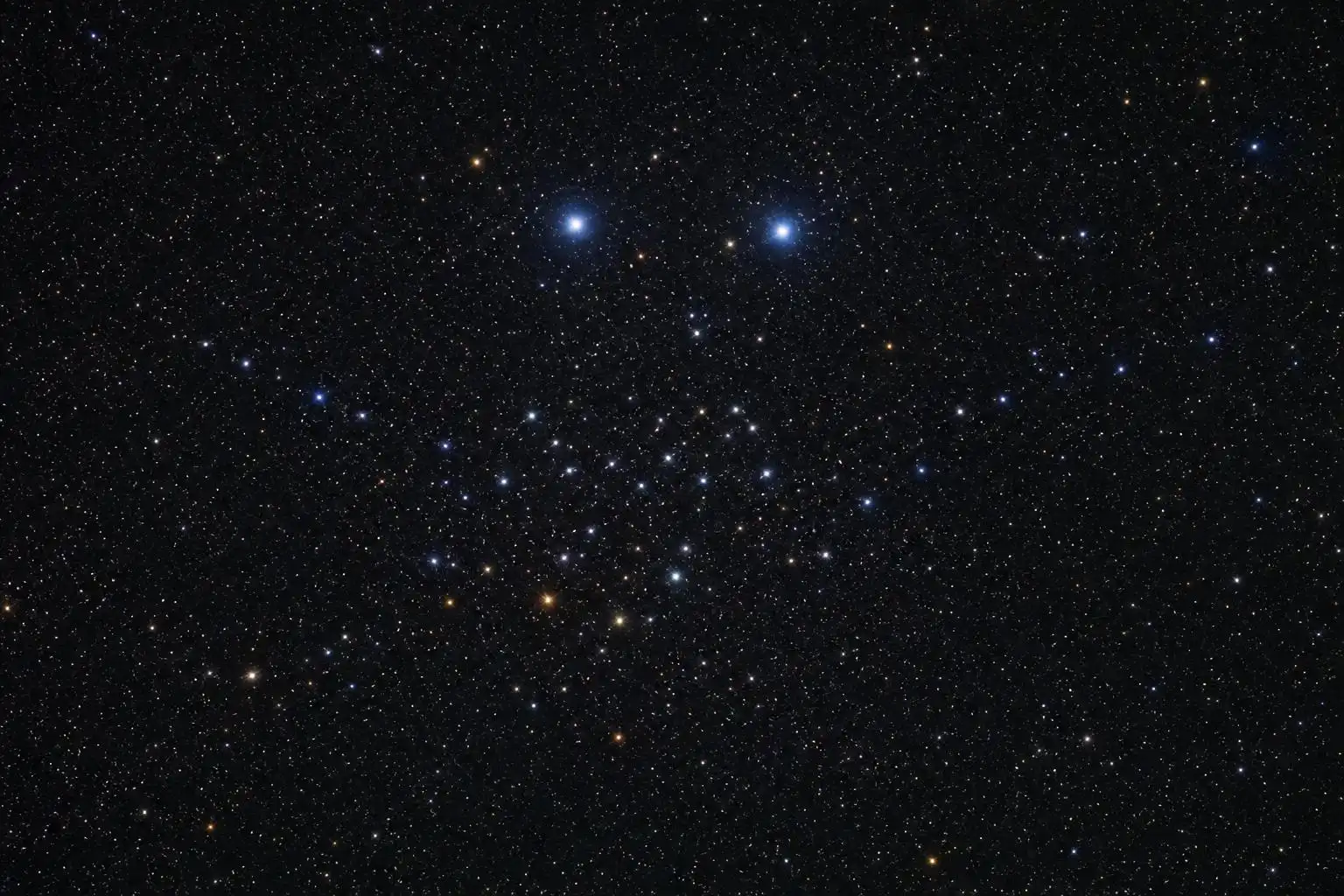

The first time I found NGC 457, I was looking for a tidy little star cluster. Instead, a figure seemed to stare back at me: two bright eyes, a scattering of fainter stars between them, and long, uneven wings. I have called it the Owl Cluster ever since. Other observers see a flying alien or a stick figure. Once you find it, you can decide for yourself.
NGC 457 is an excellent autumn target because it rewards almost any telescope. A small refractor shows its shape; a larger scope fills in the fainter stars. You can enjoy it under suburban skies, then return from a darker site and discover how much more there is around the edges. This season also offers a timely reason to stay out late: the Orionid meteors are expected to peak around October 21–22, 2026.[3] The cluster is your evening appointment; the meteors are an optional predawn encore.
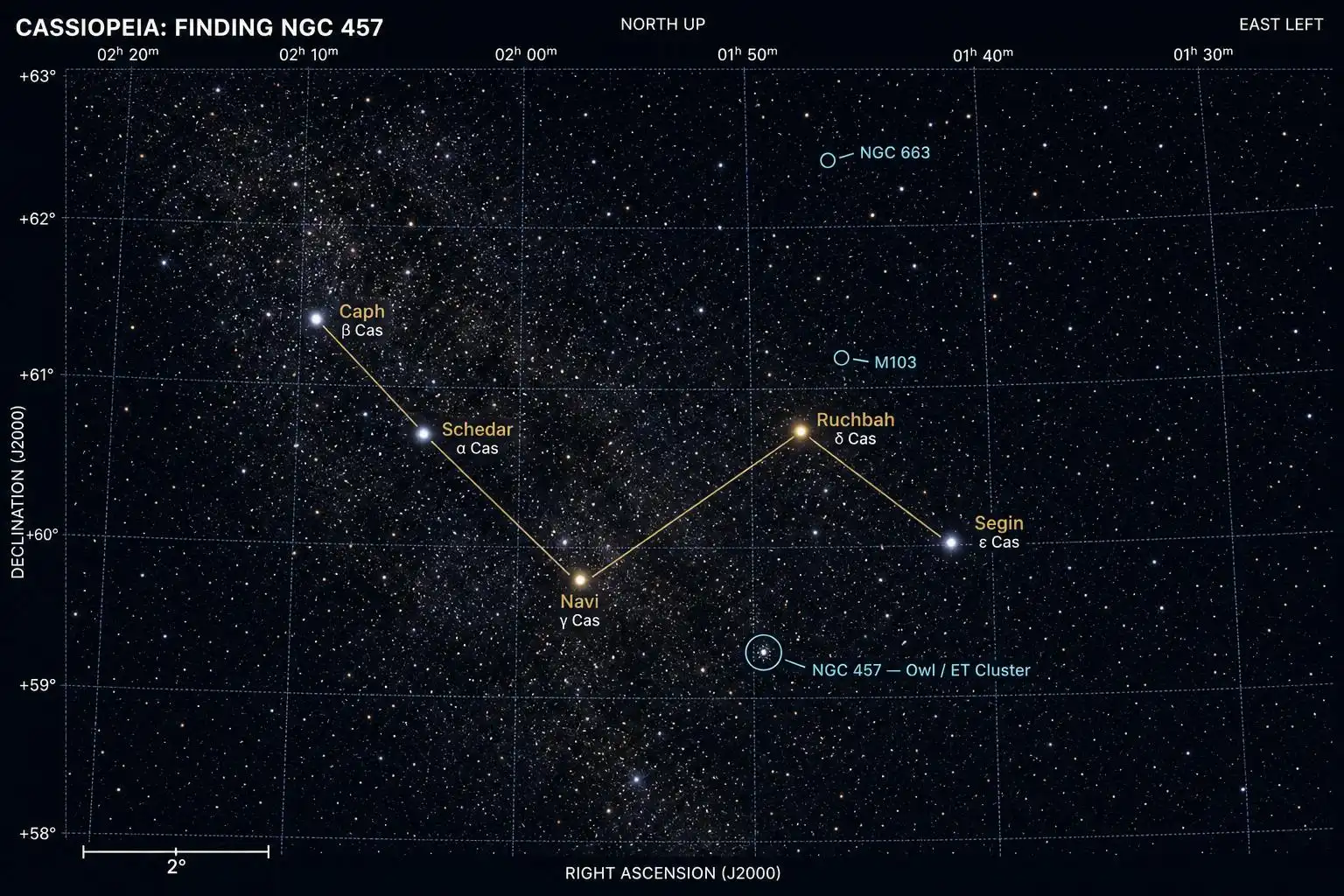
Find the owl beneath Cassiopeia’s W
Start with Cassiopeia’s familiar W, high in the northern sky on autumn evenings for mid-northern observers. Find Ruchbah, also called Delta Cassiopeiae, near the W’s eastern end. NGC 457 lies about two degrees south and a little west of that star. Its coordinates are approximately right ascension 01h 19m, declination +58° 17′.
I put Ruchbah at the edge of a low-power eyepiece and sweep slowly south-southwest. If your telescope has a straight-through finder, the view may be inverted; let the star pattern, rather than an assumed direction in the eyepiece, guide the last part of the hop. In an 8×50 finder under a reasonably dark sky, you may pick up the cluster as a small, grainy patch with a conspicuous star beside it.
That conspicuous star is Phi Cassiopeiae, one of the owl’s apparent eyes. At about magnitude 4.6, it can be seen without optical aid under good conditions, but I would not count on it from a brightly lit backyard. Use Ruchbah for the initial hop, then switch to the eyepiece and look for a bright point with a spray of dimmer stars extending away from it.
Give the shape room to appear
My favorite first view is through a 6-inch f/8 Dobsonian with a 25 mm Plössl. Its 1,200 mm focal length gives 48× and roughly a one-degree field—plenty of space around a cluster about 20 arcminutes across. I can take in the bright eyes and the fainter outstretched members without feeling that I have pinned the owl against the field stop.
An 80 mm f/5 refractor works beautifully, too. A 20 mm eyepiece gives 20×, though the cluster may look small at first. Try a 10 mm eyepiece for 40×, let your eye settle, and resist the temptation to chase the faintest star immediately. The outline often arrives before the details do.
In my 8-inch f/6 reflector, I begin with a 32 mm Plössl at about 38×. From a Bortle 4 site on a transparent night, the surrounding field is rich enough to make the cluster seem embedded in a much larger Milky Way gathering. At 100×, more faint points separate, but the complete figure loses some of its charm. I usually go back down in power before moving on.
This is a cluster for transparency more than exquisite seeing. Steady air makes the bright stars prettier, but haze or a high, thin cloud deck erases the faint members that give the owl its wings. If you can see the prominent eyes but little else, wait for a clearer night before deciding you have seen all NGC 457 can offer.
Look past the face
The two bright eyes make a handy landmark, not a definitive membership test. A star can sit in front of a cluster or far behind it and still appear to belong to the same drawing from Earth. Phi Cassiopeiae’s relationship to NGC 457 has been debated; through the eyepiece, apparent position alone cannot settle it.
That uncertainty is part of what keeps me looking. NGC 457 is generally placed roughly 8,000 light-years away. At that distance, its apparent span of about 20 arcminutes corresponds to something on the order of 45 light-years across. The little creature in the eyepiece is a vast arrangement of stars, compressed by perspective into a shape our minds recognize at once.
Try studying it without naming the shape. Are the stars evenly distributed, or do they gather in knots? Which apparent wing looks richer? Can you hold the dimmest stars with direct vision, or do they appear only when you look slightly aside? I jot down a quick sketch at the telescope, then compare it with my first impression. The owl often changes as my eyes adapt.
Open clusters are useful classrooms for distance, too. Nearby stars are not necessarily close to one another in space, and stars of equal apparent brightness need not have equal luminosity. Astronomers use measurements such as parallax, stellar color and motion to investigate which stars travel together. At the eyepiece, we see the starting evidence: points of light sharing one small patch of sky.
Take the short Cassiopeia tour
Once NGC 457 has had its time, return to Ruchbah and try M103, roughly a degree northeast of it. This compact open cluster has a very different feel: less sprawling, easier to overlook at low power, and worth a modest increase in magnification. The comparison is instructive. Two clusters in the same general part of the sky can ask for quite different eyepieces.
For a longer hop, look for NGC 663 about three degrees northeast of Ruchbah. It is broader and busy with faint stars, especially satisfying from a dark site in a 6-inch or larger telescope. I like to revisit NGC 457 afterward. Its bold outline seems even more peculiar once my eyes have adjusted to clusters that refuse to draw a recognizable picture.
You need not make a checklist of the three. If the Moon is bright or your time is short, spend twenty minutes on the owl alone. Change magnification once, sketch what you actually see, and note the sky conditions. A careful look through one telescope teaches more than a hurried sweep past several objects.
If you stay for the Orionids
Around the October 21–22 peak, the Orionids offer a separate observing session for anyone willing to return outside before dawn. The shower comes from debris associated with Halley’s Comet; one current forecast suggests roughly 10–20 meteors per hour under dark skies.[3] Treat that as a favorable-sky expectation, not a promise for a suburban driveway.
Leave the telescope packed for meteors. Find a safe, dark place with a broad view of the sky, dress more warmly than seems necessary, and give your eyes time away from bright screens. You do not need to stare directly at Orion: shower meteors can cross other parts of the sky, though their paths trace back toward its radiant.
NGC 457 asks you to narrow your attention to a single field. A meteor watch asks you to widen it until the whole sky becomes the field. I enjoy that contrast. On my next clear autumn evening, I will find Ruchbah, slide down to the owl, and start with low power. Whether or not I make it back outside before dawn, that is already a night well spent.
References
- 6 Major Space Events to Watch This Fall and Winter – Facebook — https://www.facebook.com/groups/1530461628066045/posts/1758089561969916


Leave a Reply