
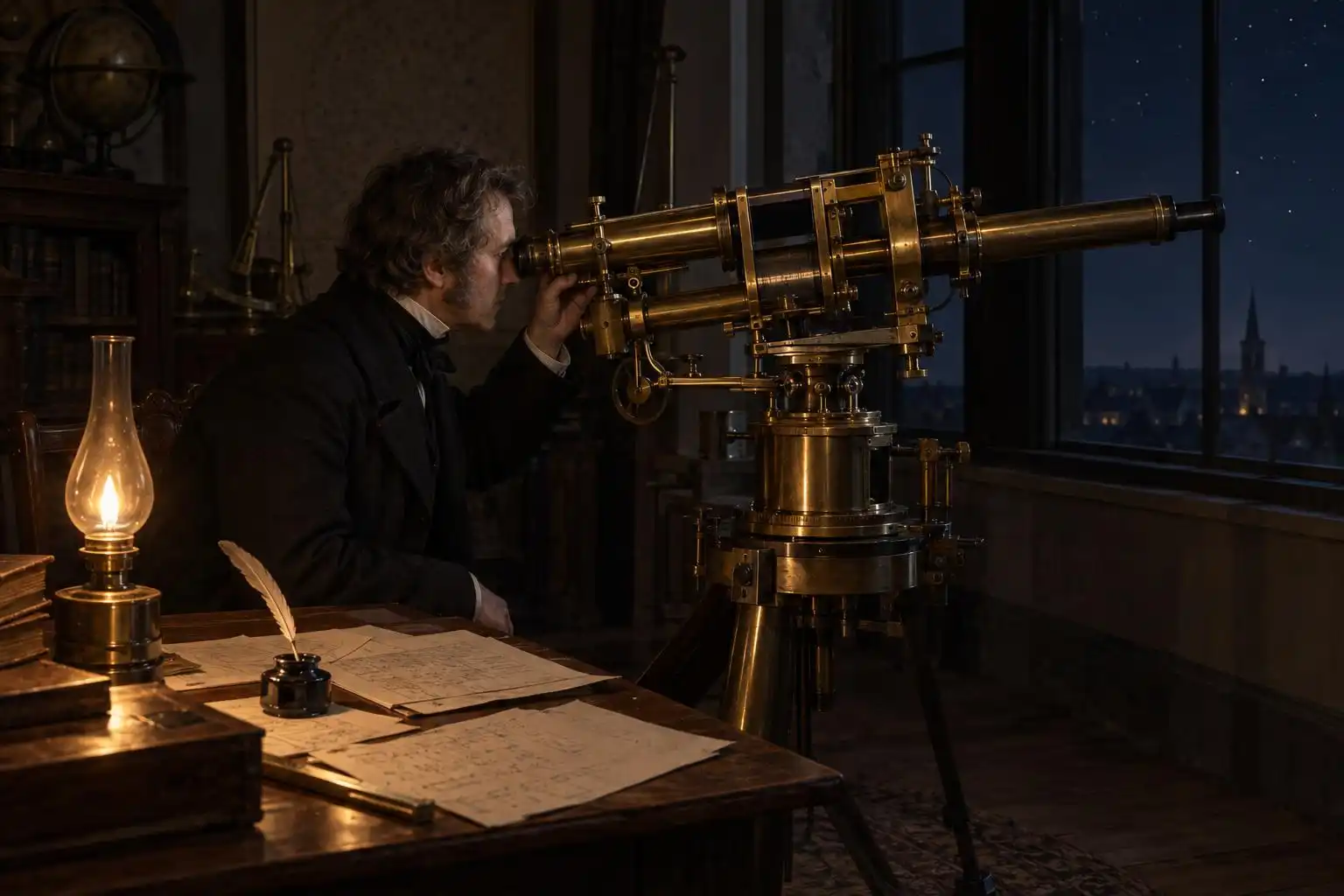

In August 1837, Friedrich Wilhelm Bessel stood at the heliometer of the Königsberg Observatory, turning a fine screw that made one star appear to slide toward another. The instrument’s brass fittings held the day’s warmth, but his work depended on movements too small for a hand to feel. In the eyepiece, 61 Cygni was a modest pair of stars in a crowded stretch of the Milky Way. Bessel was looking for something smaller still: a change in its position caused by Earth’s journey around the Sun.
A successful measurement would give him a distance to a star. Astronomers had wanted such a number for centuries. Many had announced signs of stellar parallax before; none had produced a result that survived scrutiny. Bessel knew that a screw reading on one clear night would prove almost nothing. He would need months of observations, comparison stars, and an account of every other reason the image might move.
The missing motion that troubled Copernicus
When Nicolaus Copernicus placed Earth in orbit around the Sun in De revolutionibus in 1543, he offered a new way to arrange the heavens. The arrangement carried a test. If Earth changed position over the year, a nearby star ought to appear to shift against more distant stars, much as a raised finger appears to move against a wall when viewed first with one eye and then the other.
No one could see the shift. For Tycho Brahe, observing before the telescope, this was a serious objection to a moving Earth, not a failure of imagination. Perhaps the stars were so distant that the displacement was invisible. But telescopes did not yet exist, and the visible disks of stars seemed to imply that, at such distances, those stars would be enormously large. Tycho’s Earth-centered system, with the planets circling the Sun and the Sun circling Earth, avoided the difficulty while preserving much of the new planetary order.
The apparent disks were misleading effects of observation rather than dependable measures of stellar size. Tycho could not have known that. His objection shows how an argument can be soundly made from the evidence available and still lose its force when instruments improve. Even then, improvement did not bring a quick answer. The predicted parallax was smaller than astronomers had supposed.
False starts under a moving sky
In 1674, Robert Hooke published An Attempt to Prove the Motion of the Earth from Observations. He had watched Gamma Draconis near the zenith, where atmospheric refraction should interfere less, and claimed to detect the change he sought. The observation was not persuasive to other astronomers. A star’s recorded position could change with the instrument, the air, or the observer as well as with Earth’s orbit. Separating those causes became the central problem.
James Bradley later pursued Gamma Draconis with a zenith sector built for Samuel Molyneux. He found an annual motion, but its direction and timing did not match parallax. In 1728 he explained it as aberration of starlight: the apparent displacement produced by Earth’s motion combined with the finite speed of light. Bradley had discovered evidence connected to Earth’s movement without measuring the distance to a star.
That result made the challenge sharper. An astronomer searching for parallax could not simply point to a yearly change. Aberration also repeated each year, and by an angle much larger than the parallax Bessel hoped to find. If the measurements were not precise enough to distinguish the patterns, the sky might appear to give an answer while withholding the one that mattered.
Why Bessel chose the flying star
Bessel had learned astronomy outside the usual academic route. As a young merchant’s apprentice in Bremen, he worked through mathematics that helped him calculate a comet’s orbit. His calculations brought him to the attention of the physician and astronomer Heinrich Wilhelm Olbers. By 1810, Bessel had been appointed director of the new observatory at Königsberg, where patient work on stellar positions became his profession.
He understood how much labor lay behind a trustworthy coordinate. His Tabulae Regiomontanae, published in 1830, reduced earlier observations into a more dependable framework for locating stars. Parallax demanded an even stricter kind of bookkeeping: not just where a star appeared, but how its place changed by a fraction of an arcsecond while the telescope, atmosphere, and star itself all complicated the reading.
The star called 61 Cygni offered a promising target. Giuseppe Piazzi had drawn attention to its rapid proper motion across the sky, earning it the nickname the “flying star.” Proper motion is not parallax; it is a star’s own gradual movement relative to others as seen from Earth. But an unusually swift apparent motion suggested that 61 Cygni might be comparatively nearby, making its parallax easier to detect.
There was no guarantee. A distant star moving rapidly through space could also cross the sky quickly. Bessel chose 61 Cygni as a good bet, then treated its steady drift as another signal to disentangle from the yearly displacement. He measured its position relative to two fainter comparison stars close enough in the sky that much of the atmosphere’s disturbance would affect all three similarly.
A divided lens, and a year of doubt
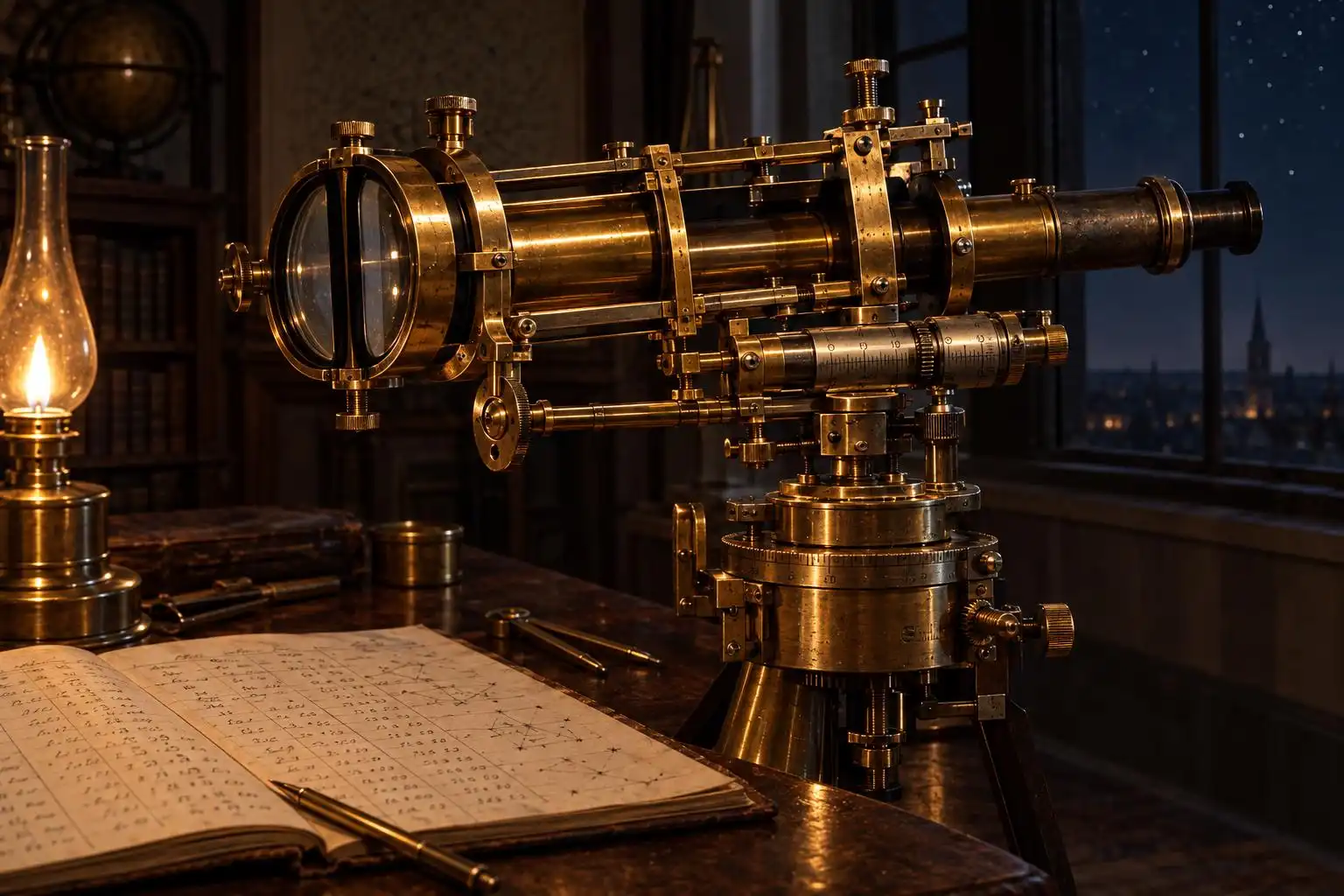
Bessel’s heliometer had an objective lens cut into two halves. One half could slide past the other, producing two images whose relative positions he adjusted with a measuring screw. By bringing the image of 61 Cygni into alignment with that of a comparison star, he could measure their separation more finely than he could judge positions by eye alone. The instrument came from the optical workshop associated with Joseph von Fraunhofer, whose reputation rested on such precision.
The design did not make the readings automatic. Bessel had to repeat measurements, attend to the scale of the screw, and account for changes that might belong to the apparatus rather than the stars. He followed both comparison stars because agreement between independent sets of separations would be harder to dismiss as an accident. Nor could he rely on a few favorable evenings: the claim concerned a cycle, and a cycle takes time to reveal itself.
From August 1837 into 1838, the observations accumulated. Against the steady sweep of 61 Cygni’s proper motion, Bessel looked for a small variation that rose and fell with Earth’s changing position. The expected displacement was tiny—roughly three-tenths of an arcsecond. An arcsecond is one 3,600th of a degree. At that scale, a plausible-looking curve could be made by an unnoticed error as readily as by a nearby star.
His result held together when he treated the two comparison stars separately. In 1838 he published “Bestimmung der Entfernung des 61sten Sterns des Schwans”—a determination of the distance of the sixty-first star of Cygnus—in Astronomische Nachrichten. The calculated parallax was about 0.314 arcsecond. That corresponded to a distance of roughly 10 light-years, though the uncertainty in the measurement mattered more than the tidy round number.
For the first time, an astronomer could offer a measured distance to a star beyond the Sun that other astronomers had good reason to trust. Modern measurements place 61 Cygni at about 11.4 light-years. The difference is not an embarrassment hidden by the later result. Bessel had detected the right small effect with the means available to him, and had made his method and uncertainty visible enough for others to test.
Other claimants to the distance scale
Bessel was not alone in approaching the problem. Friedrich Georg Wilhelm Struve, working at Dorpat Observatory, pursued parallax with its powerful refracting telescope and reported results for Vega. His measurements were part of the same breakthrough era, although their interpretation changed as the observations were reconsidered. The race was not a simple contest between one careful observer and careless rivals. Each faced the same difficulty: a desired signal smaller than many ordinary errors.
Thomas Henderson had an even more awkward claim to priority. While serving at the Cape of Good Hope Observatory in 1832 and 1833, he observed Alpha Centauri, the bright southern star that could not be studied from Königsberg. After returning to Britain, he worked through measurements that indicated a substantial parallax. His observations predated Bessel’s, but he published his result in 1839, after Bessel’s announcement.
Henderson’s caution was understandable. Earlier claims had failed, and a southern star’s position had to be compared across observations made with different instruments and at different times. To announce a stellar distance was to invite questions about every correction. His result was broadly right: Alpha Centauri is the nearest star system to the Sun. But Bessel’s published case, assembled from a sustained program with two nearby comparison stars, arrived first and was especially convincing.
Priority therefore depends on what one means by “first.” Henderson made the earlier relevant observations. Struve was gathering important evidence of his own. Bessel published the first widely accepted stellar parallax. Giving each astronomer his part makes the achievement more interesting, not less: three observers were pushing different instruments toward a limit that had defeated their predecessors.
A distance, and the work behind it
Parallax did not shrink the heavens to a comfortable size. It put a number on their vastness. Light from 61 Cygni had spent more than a decade traveling before it entered Bessel’s telescope. For earlier generations, the absence of a visible shift had been an argument about whether Earth moved. By 1838, the question had become how to measure a shift that was there but almost impossibly small.
The heliometer did not settle that question by itself. Bessel needed Piazzi’s notice of a fast-moving star, generations of positional astronomy, optical craftsmanship, and comparison observations that could expose a faulty result. Henderson’s delay and Bradley’s unexpected discovery belonged to the same history. Astronomers learned as much from motions that did not mean parallax as from the one that finally did.
Bessel’s small annual curve is a reminder that science rarely advances when a single new sight sweeps old objections away. Tycho’s missing parallax had been a real observational problem. Hooke’s claimed detection had not solved it. Bradley found something else. The distance to 61 Cygni emerged only when an observer could tell those stories apart—and show, measurement by measurement, why his own was different.



Leave a Reply
You must be logged in to post a comment.