
A bathroom mirror shows you where light has been. A small device left on the Moon by Apollo astronauts does something more useful: it sends light back toward its source. By timing the return of a laser pulse, scientists can measure the Earth–Moon distance and track a change too slow to notice in any single night. The Moon is moving away from us at an average rate of about 3.8 centimeters a year.
The equipment Apollo left behind
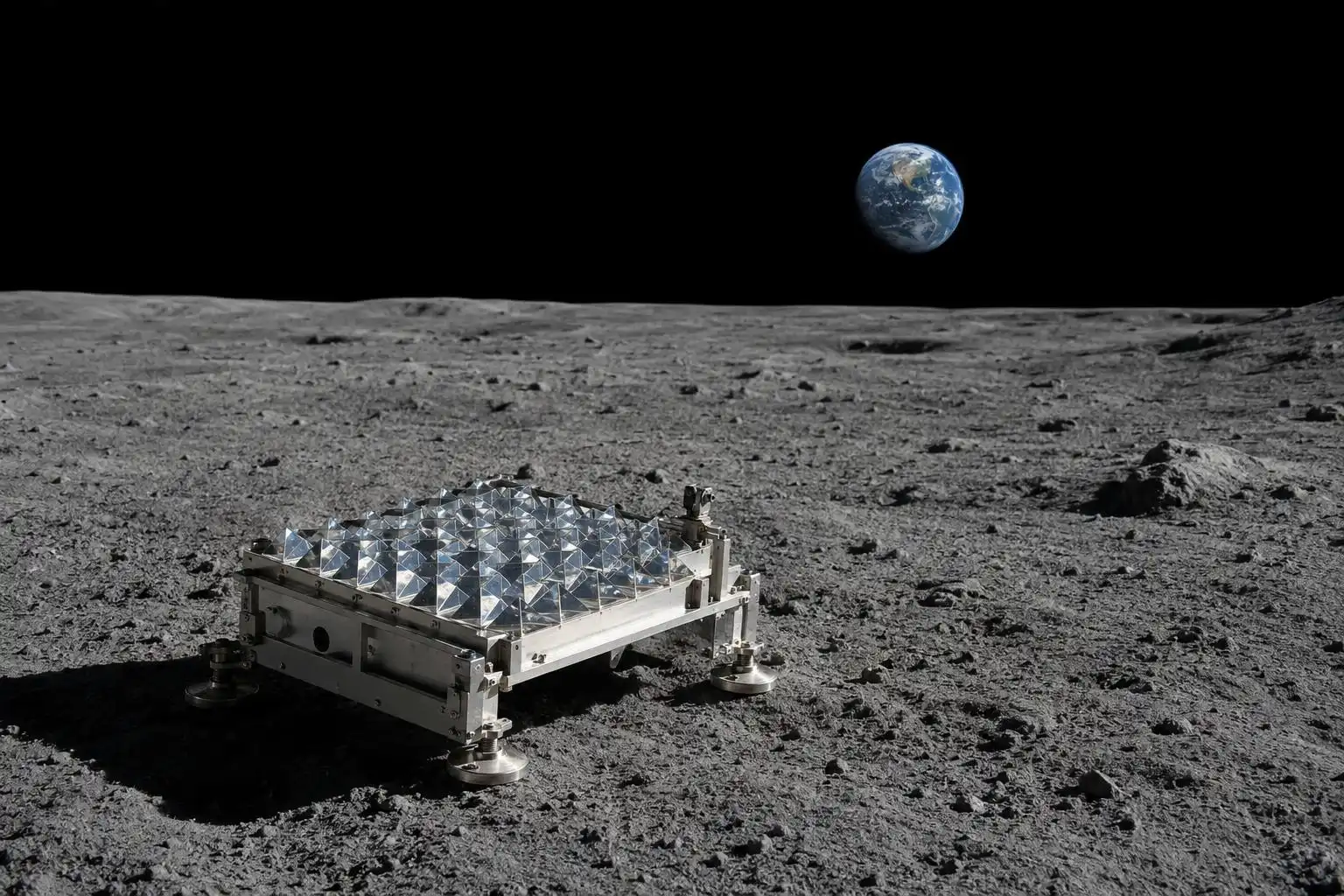
Apollo 11, 14, and 15 each placed a panel of retroreflectors on the lunar surface. Soviet Lunokhod rovers carried reflectors there too. Each panel contains arrays of corner-cube reflectors: three reflective surfaces arranged so that incoming light returns in roughly the direction it came from. Unlike a bathroom mirror, the panel does not need to be aimed precisely at an observatory on Earth.
These are passive instruments. They have no batteries to exhaust and no radio transmitter to fail. More than five decades after Apollo 11, observatories can still fire laser pulses at lunar reflectors and detect a tiny fraction of the returning light.
Two and a half seconds for a round trip
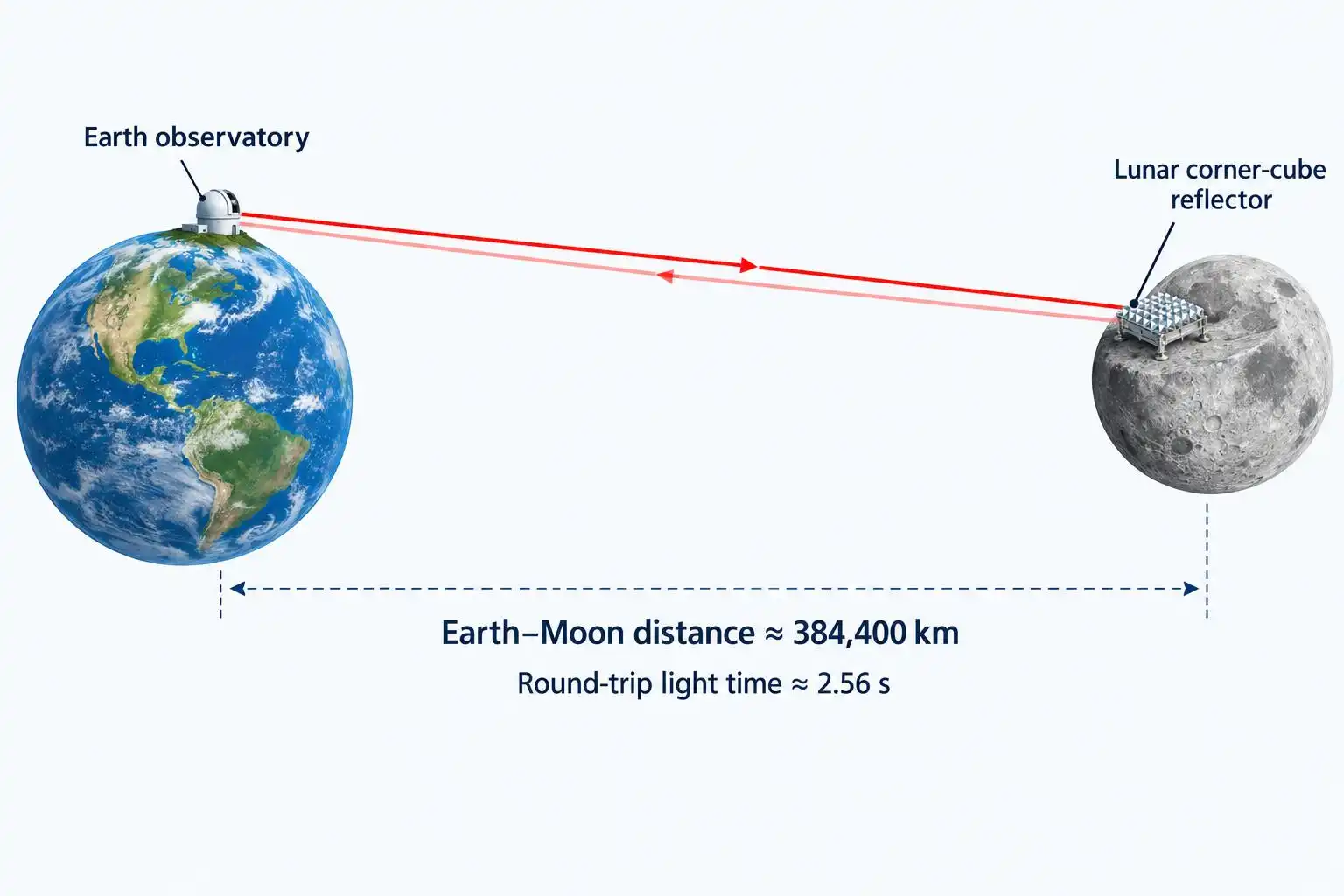
The measurement starts with a clock. An observatory records when it sends a short laser pulse and when returning photons reach its detector. Light travels at about 300,000 kilometers per second, so a round trip to the Moon takes roughly 2.5 seconds. Divide that elapsed time by two, multiply by the speed of light, and you have a distance to the reflector.
In practice, the calculation is more involved. The Moon moves while the pulse is in flight. The observatory moves as Earth rotates. Light passes through the atmosphere, which slightly delays it. Researchers account for those effects and combine many measurements rather than trusting one returning photon.
The reflected signal is extraordinarily faint. Even a well-aimed beam spreads on its way to the Moon, and only a small portion strikes a reflector. On the return trip it spreads again. Detecting photons from that round trip is a measurement of a known target, not an image of a bright lunar beacon.
Why the distance is changing
The Moon does not move away by 3.8 centimeters every year like a bead sliding along a ruler. Its orbit is elliptical, so its distance from Earth changes by tens of thousands of kilometers over a month. The measured recession rate describes a gradual increase in the orbit’s average size, extracted from observations spanning decades.
Earth’s tides provide the main explanation. The Moon’s gravity raises tidal bulges in Earth’s oceans. Because Earth rotates faster than the Moon orbits, those bulges are carried slightly ahead of the line connecting the two bodies. Their gravity pulls the Moon forward, transferring some of Earth’s rotational angular momentum into the lunar orbit.
As the Moon gains orbital angular momentum, its orbit grows. Earth’s rotation, meanwhile, gradually slows. Real tides are complicated by coastlines, seafloor shapes, and changing oceans, so today’s recession rate should not be projected unchanged billions of years into the past or future.
A distance measurement that tests gravity
The reflectors do more than document a departing Moon. Decades of laser-ranging data let researchers compare detailed predictions of how the Moon should move with what it actually does. Those comparisons test aspects of gravitational theory and help constrain the Moon’s interior, including the behavior of its core.
That scientific range comes from repeated, precise measurements, not from a single spectacular return signal. The Apollo panels were installed to provide fixed lunar targets; their value grew as observatories kept measuring the same orbit over years and then decades.
The next time the Moon looks perfectly fixed in the sky, remember what those returning photons say: its orbit is slowly growing, and we know because we left something there that answers when we call with light.



Leave a Reply
You must be logged in to post a comment.