
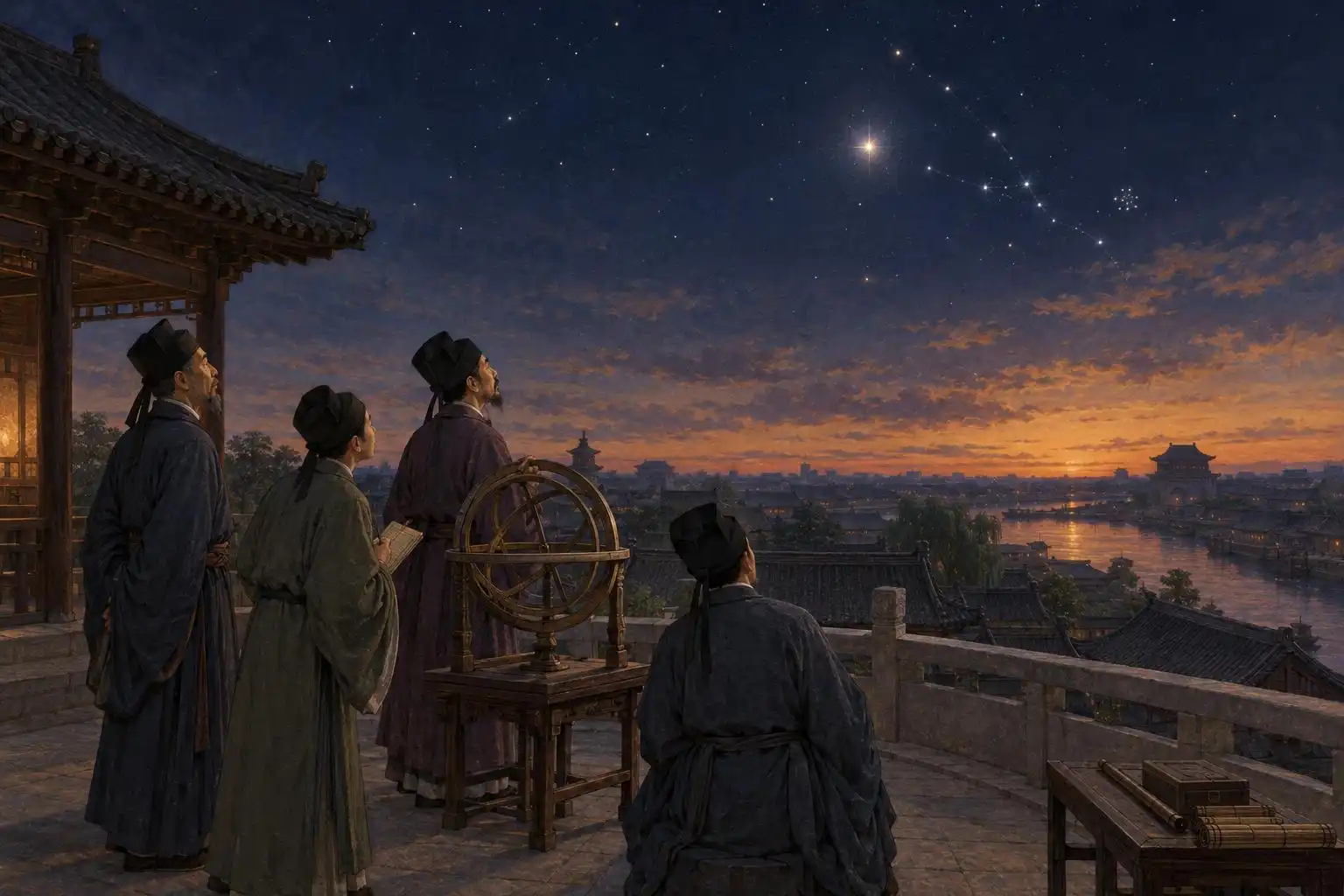

In the summer of 1054, a new point of light appeared near a familiar star in Taurus. It was bright enough to be seen in daylight. To astronomers of China’s Song dynasty, it was a guest star: an unexpected visitor to a sky whose patterns they knew well. Nearly a thousand years later, we can look at the place they recorded and see the Crab Nebula, the expanding remains of a stellar explosion.
The connection is a scientific achievement spanning centuries. The Song observers could not see a neutron star or identify nuclear collapse. Modern astronomers could not travel back to watch the explosion. A written observation and a remnant in the sky supplied what each, alone, lacked.
A visitor beside Tianguan
The guest star appeared close to Tianguan, an asterism associated with the star we now call Zeta Tauri. This was not a vague report of something bright somewhere overhead. Locating the visitor beside a named feature gave later readers a position they could compare with the sky.
Accounts preserved in the Song Huiyao Jigao and the Song Shi describe its exceptional brightness. The latter reports that it could be seen by day for 23 days. Records of its eventual disappearance indicate that it remained observable at night for many months more. The date commonly given for its first recorded appearance is July 4, 1054, though converting historical calendars and interpreting the surviving texts require care. That is a date of observation, not a precise timestamp for the explosion itself.
Why the record survived
Astronomy was part of Song statecraft. At the imperial capital of Kaifeng, court specialists tracked the heavens and reported unusual events because changes in the sky could carry political meaning. The astronomer Yang Weide is named in connection with a report on the guest star. Its courtly interpretation belongs to the history of the observation, even if modern readers do not share that interpretation.
Those circumstances shaped both what was noticed and what was written down. A guest star was worth reporting precisely because it disrupted an expected pattern. The terms and comparisons in the record were those of Song astronomy, not an early version of a modern supernova catalogue.
Nor are the surviving works simple eyewitness notebooks. The Song Shi was compiled after the Song dynasty, while the Song Huiyao Jigao survives through later editorial reconstruction. Historians have to weigh transmission as well as observation. The position near Tianguan, the descriptions of brightness, and the duration together make the account unusually valuable despite those limits.
Finding the visitor’s remains
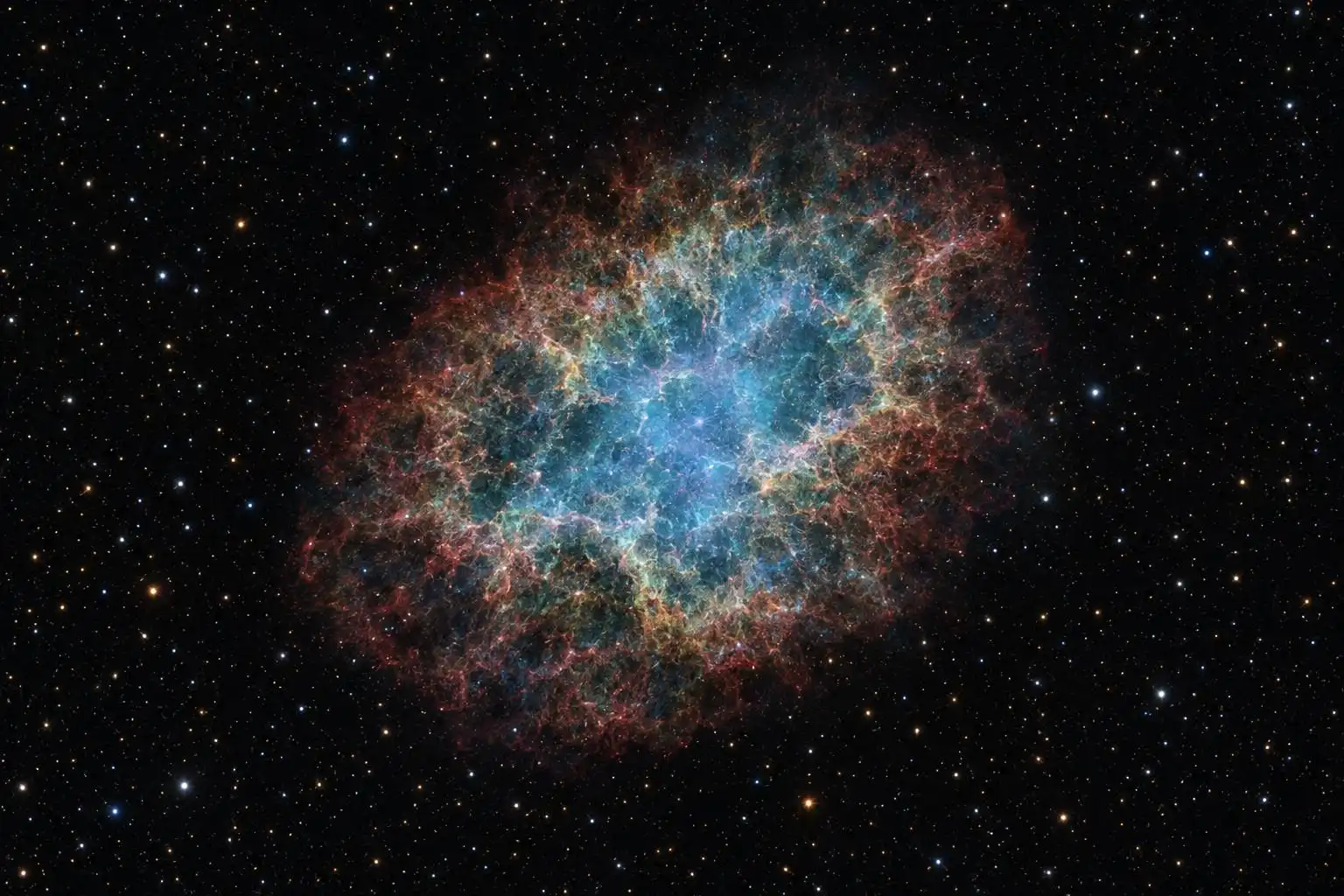
In the same region of Taurus lies the Crab Nebula, catalogued as Messier 1. Telescopes reveal filaments of gas moving outward from an explosion that occurred roughly 6,500 light-years away. At its center is a pulsar: a rapidly spinning neutron star left by the collapse of a massive star’s core. It turns about 30 times each second.
The nebula’s location near Zeta Tauri provides the first clue linking it to the guest star. Its expanding debris provides another: it is young enough to belong to an event observed about a millennium ago. Astronomers must account for changes in the gas’s speed rather than simply run a present-day expansion rate backward as an exact clock. Still, the historical position and the physical evidence form a compelling match.
What the Song observers saw was the sudden light from the catastrophe, not the faint nebula we photograph today. Light from that distant explosion reached Earth in the eleventh century; its debris has continued to spread and change ever since.
A chronology written by two kinds of evidence
The Crab Nebula is often introduced through its modern image: colored filaments surrounding an energetic central remnant. But an image cannot, on its own, tell us what a person saw in the sky in 1054. The Song accounts provide a dated human encounter with the event, including how conspicuous it was to the unaided eye.
The comparison also shows why historical astronomy needs more than a search for old observations that happen to agree with present-day science. Yang Weide and his fellow court astronomers were working within their own system of celestial positions, reporting, and interpretation. That system made their observations legible and preserved them long enough to become evidence for a very different question.
What the guest star changes
To understand the Crab Nebula fully, we need both the physics of a dying star and the history of people who watched its light arrive. Song astronomy does not merely add a colorful preface to a modern discovery. Its careful record anchors the remnant to a witnessed event and reminds us that the night sky has a human chronology as well as a physical one.


Leave a Reply
You must be logged in to post a comment.