
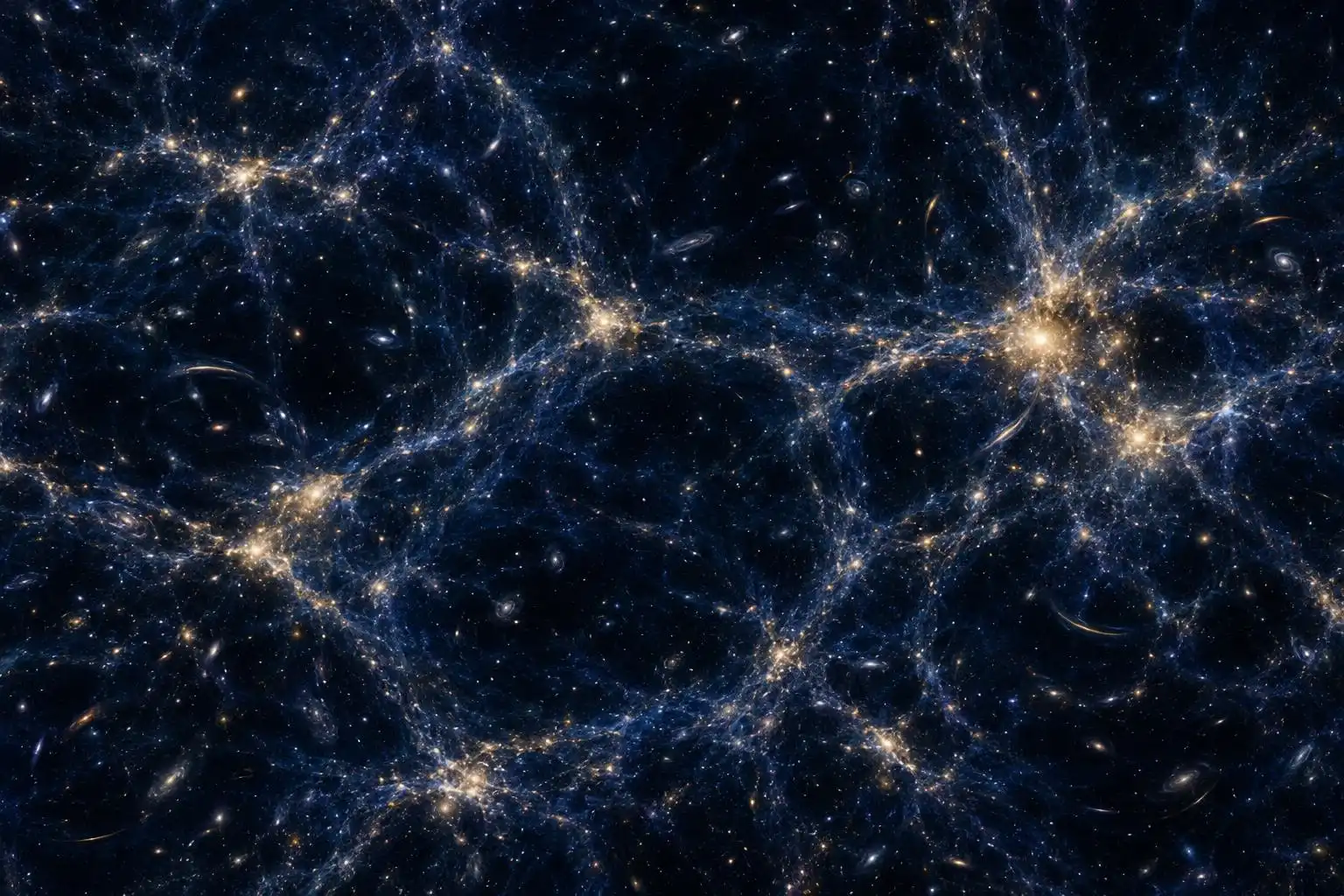

The early universe was remarkably smooth, but not perfectly so. Tiny differences in density, visible in the cosmic microwave background, became the seeds of galaxies and clusters. Gravity has been amplifying those differences for billions of years. If our standard cosmological model is right, measurements of the early universe should let us predict how clumpy the universe is today.
That comparison produces a persistent puzzle. Some surveys of the nearby universe find less clustering than the prediction inferred from the early universe. The disagreement is called the S8 tension. It is not yet strong enough to overturn the standard model, but it asks a wonderfully direct question: has cosmic structure grown exactly as we think it has?
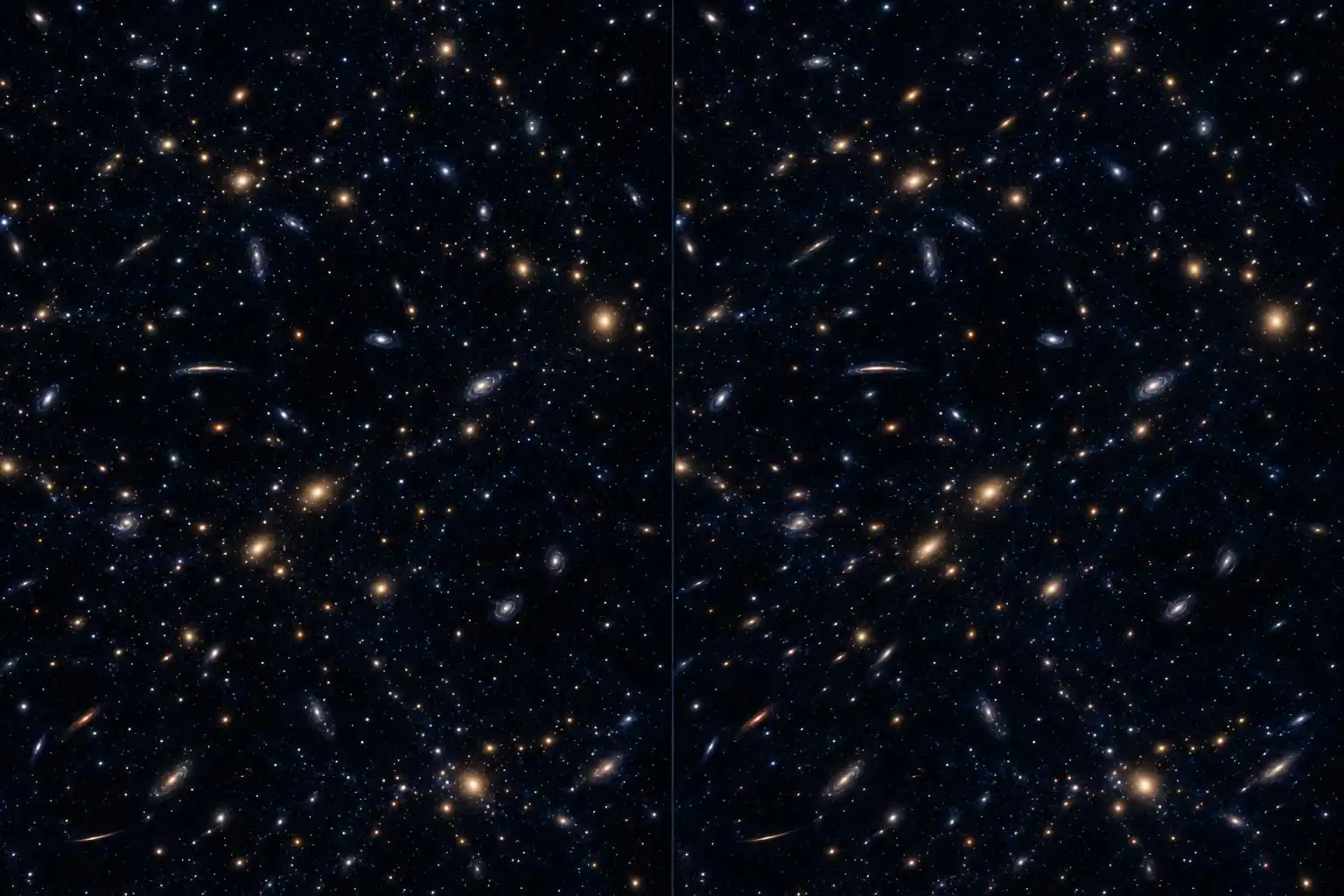
A number for cosmic clumpiness
Cosmologists use S8 to describe the amplitude of matter clustering, accounting for the fact that a survey’s answer depends partly on how much matter it assumes the universe contains. Its ingredients are σ8, a measure of density fluctuations on a particular large scale, and Ωm, the fraction of the universe’s present-day energy density in matter. A higher S8 generally means stronger clustering.
The Planck mission’s analysis of the cosmic microwave background gives S8 of about 0.834 ± 0.016, assuming the standard ΛCDM cosmological model. Planck did not measure today’s clumpiness directly. It measured conditions when the universe was roughly 380,000 years old; the present-day value follows from running that model forward through cosmic history.
That distinction matters. A disagreement could mean something unexpected happened as structure grew. It could also mean that one of the measurements, or an assumption used to interpret it, needs work.
Weighing matter by its bending of light
To map relatively recent structure, astronomers often use weak gravitational lensing. Matter bends the paths of light from distant galaxies. Across millions of galaxies, this produces a faint statistical pattern of aligned distortions in their apparent shapes. The pattern reveals the distribution of matter along the light’s journey, including matter that emits no light.
The Dark Energy Survey’s Year 3 analysis, combining galaxy shapes with measurements of galaxy positions and their correlations, reported S8 = 0.776 ± 0.017 in ΛCDM. The result is lower than Planck’s prediction. The surveys are not simply looking at the same cosmic volume with different cameras: they draw on different epochs, observables and modelling choices.
KiDS-1000, another weak-lensing survey, also reported a comparatively low value: approximately 0.76, with an uncertainty of a few hundredths, for its cosmic-shear analysis. Agreement between low values is intriguing, but it does not make their possible errors independent. Weak-lensing studies face some of the same difficulties, including measuring the true shapes and distances of extremely faint galaxies.
How convincing is the disagreement?
A difference between two central values is not, by itself, a discovery. For Planck and the DES Year 3 combined result, the offset is at roughly the 2–3σ level, depending on how the comparison is made. That is worth investigating, not grounds for declaring new physics.
The measurements are also harder than the phrase “galaxy shapes” suggests. A galaxy’s apparent shape reflects both lensing and its own structure. Nearby galaxies can be intrinsically aligned with the same cosmic environment. Blurred images, uncertain galaxy distances and selection effects can alter the inferred lensing signal. On small scales, gas expelled by energetic galaxies can redistribute ordinary matter and change how it clusters with dark matter.
Researchers test and model these effects rather than ignoring them. They can restrict analyses to scales where the modelling is more secure, compare independent observing bands, and check results against galaxy clustering and lensing of the microwave background. Each safeguard has a cost: discarding difficult data usually enlarges the uncertainty. A robust tension must survive those choices.
What might slower growth mean?
If the lower S8 values persist, the universe may have built structure more slowly than baseline ΛCDM predicts. Several kinds of physics could affect that growth:
- Massive neutrinos can suppress clustering because they travel freely across regions where colder matter collects.
- Dark energy that changes with time could alter the expansion history and, with it, the opportunity for gravity to assemble structure.
- Modified gravity could change the relationship between matter and the forces that shape the cosmic web.
None is an automatic solution. Neutrinos, for example, have mass, but the amount required to resolve a particular S8 discrepancy must still satisfy other cosmological and laboratory constraints. A proposed change to dark energy or gravity must also fit distances, galaxy clustering and the microwave background. Explaining one number while spoiling the rest would not be progress.
Nor do all measurements of later structure give an identical answer. Different surveys probe different redshifts and physical scales, and their constraints depend on the data combined and the model fitted. That complexity is frustrating if we want a verdict, but useful if we want a diagnosis. A genuine change in cosmic growth should leave a pattern across time and scale, not merely a lower value in one analysis.
The next test is a pattern, not a headline
Euclid and the Vera C. Rubin Observatory’s Legacy Survey of Space and Time are designed to map enormous numbers of galaxies. Their reach should improve weak-lensing measurements and help trace how clustering changes across cosmic history. Larger samples alone will not settle S8; controlling image distortions, galaxy distances and the behaviour of ordinary matter will be just as important.
The most revealing outcome may not be that every survey converges on one number. It may be a measurable difference in when or where the predicted growth goes astray—or evidence that the discrepancy fades as the measurements improve. Either result would teach us something. We have a remarkably successful account of how small primordial ripples became a cosmic web. Whether we have followed every step of that transformation correctly remains open.



Leave a Reply
You must be logged in to post a comment.