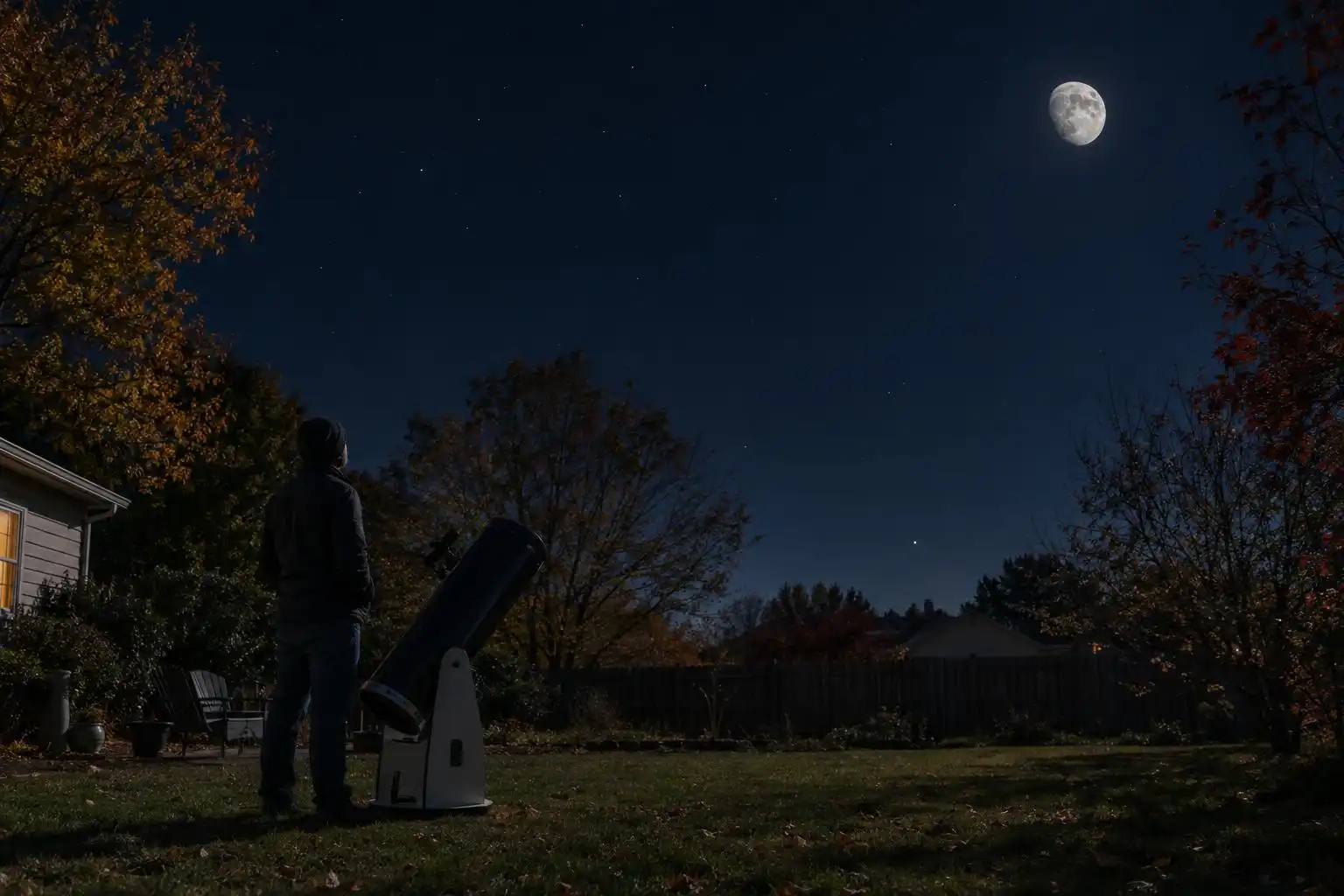

The Orionids have passed their peak, but I would not put the telescope away. The last week of October offers a good lesson in choosing targets to suit the sky you actually have: Saturn and the Moon can reward you under bright conditions, while a fine galaxy in Pegasus asks for patience and a darker night.
Halley’s Comet left the dust that produces the annual Orionid meteor shower. Its 2026 peak fell around October 21, so an observer going out now should expect fewer meteors than at the peak, not a guaranteed display. The Moon is also growing bright. Still, a quick Orionid can be a lovely bonus while you wait for your optics to cool.[1]
Give the Meteors a Modest Chance
If you want to look for a late Orionid, leave the telescope capped. Settle into a reclining chair where buildings or trees block any direct moonlight, and watch as much open sky as you can. The hours before dawn generally put the shower’s radiant higher for Northern Hemisphere observers, though moonlight will wash out many faint streaks this week. Give your eyes time to adapt, dress more warmly than seems necessary, and count even one fast meteor as a success.
The radiant lies in Orion, but a meteor can appear well away from that constellation. You do not need to stare at a single star. Nor should you expect Halley’s Comet itself: the comet is far from our evening sky, while its old debris is what flashes through Earth’s atmosphere. That distinction makes the shower no less satisfying to me. It means a brief line of light has a much longer story behind it.
Start with Saturn While the Moon Is Bright
The Moon passed near Saturn on October 24, and the pair made a useful signpost in the evening sky. By tonight, October 25, their spacing has changed: the Moon moves east against the stars from night to night. Find Saturn as a steady, pale point in the southern evening sky rather than relying on yesterday’s diagram. Its position above your horizon will vary with your location and observing time.[1]
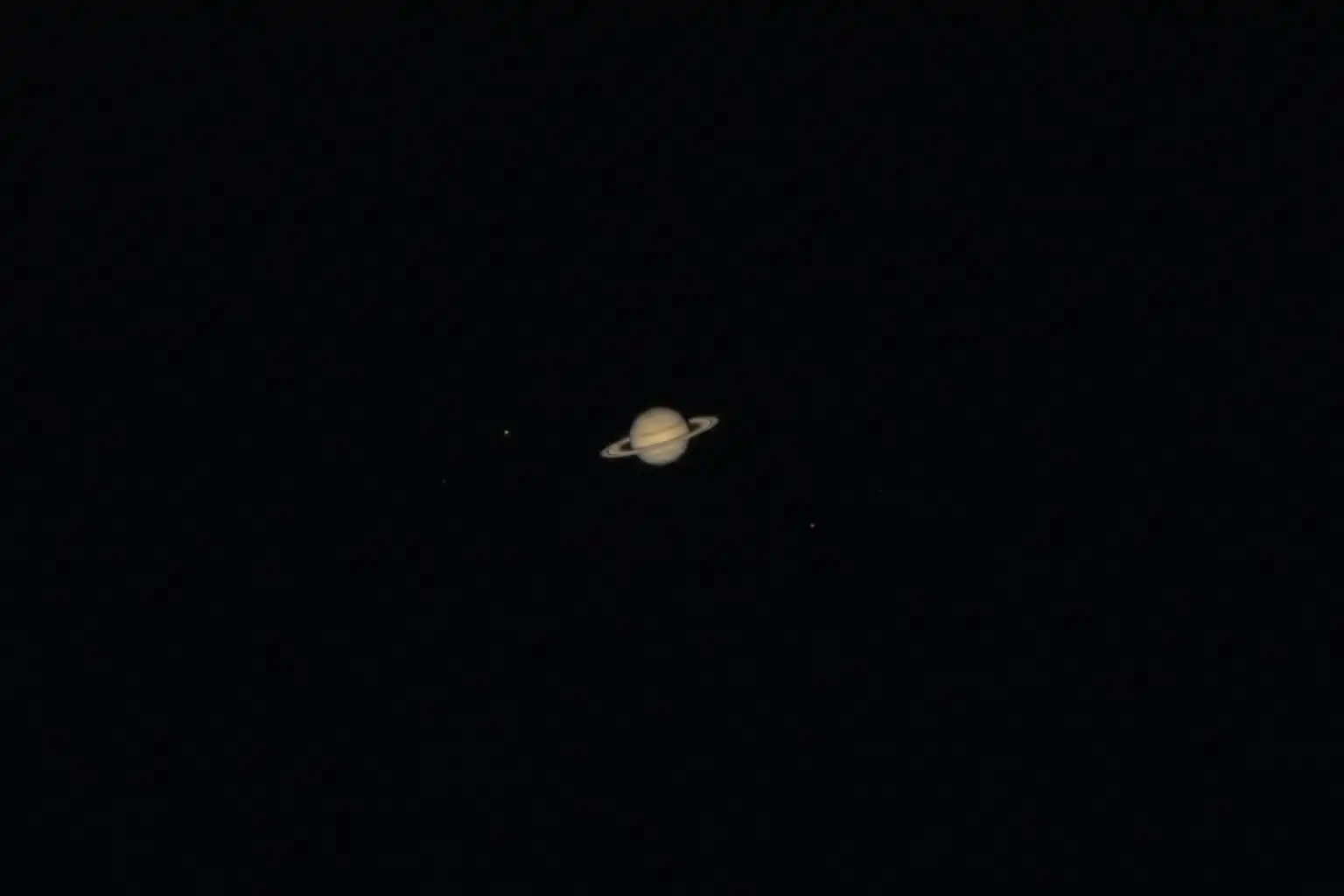
In my 8-inch f/6 Dobsonian, I begin with a 25 mm Plössl at about 48×. Saturn is plainly not a star even there. A 10 mm eyepiece gives 120× and a more satisfying view of the planet and rings; if the air is steady, a 6 mm eyepiece raises that to 200×. Do not force the highest power every night. When the planet shimmers or refuses to hold a crisp edge, I step back to 120× and usually see more.
The rings are presented at a relatively narrow angle compared with their broad, familiar appearance in many photographs. Look first for the overall shape, then for the dark space on either side of the planet where the ring system extends beyond the globe. A four- or six-inch scope can deliver a memorable view. An eight-inch adds brightness and helps with the subtler distinctions, but no backyard aperture can make poor seeing disappear.
Saturn’s moons are the other reason I linger. Titan is the easiest to pick out, though its position changes over successive nights. Several smaller moons may appear as tiny points if the sky is steady and your telescope has enough aperture. Make a sketch of every point near Saturn, noting the time and which side of the planet it lies on. Check a current moon chart afterward. That order lets you discover a moving moon rather than merely confirm a predicted dot.
Iapetus is a more demanding project. An observing report for October 22 noted that this two-toned Saturnian moon was passing south of the planet, making it easier than usual to locate then.[4] Do not carry its October 22 position over to tonight: use a chart calculated for your observing hour. Iapetus changes brightness conspicuously around its orbit because one hemisphere is much darker than the other. Finding it with a modest telescope takes a chart, a careful eye, and often more than one attempt.
Let the Moon Be the Target, Not the Nuisance
The approaching Full Hunter’s Moon makes faint-object hunting increasingly difficult in late October.[3] It does not spoil a lunar session. Set up near dusk while there is still light to see your equipment, then aim at the boundary between lunar day and night—the terminator. Shadows there reveal relief far better than the nearly shadowless center of a full Moon.
A small telescope at 50× will show major ray systems and dark maria; at 100× to 150×, steady air can bring crater rims and rough highland terrain into view. Scan the terminator slowly rather than racing between named formations. One evening’s favorite may be less dramatic the next because the Sun has risen higher over it. The Moon rewards return visits on a timescale of days, not years.
If the glare bothers you, raise the magnification enough to dim the view and inspect a smaller area, or use a neutral-density or variable polarizing filter for comfort. A lunar filter does not reveal hidden detail by itself; its job is to make looking pleasant. I also keep my observing eye covered until I reach the eyepiece so nearby lights do not repeatedly spoil the adjustment.
Neptune Is a Chart-and-Patience Challenge
Neptune had a close apparent encounter with the Moon on October 23, but it was not a naked-eye companion: binoculars or a telescope were needed.[2] By October 25, the Moon is no longer a reliable finder marker, and its growing brightness makes Neptune harder to distinguish from field stars. I would save this search for a more transparent night and bring a planetarium chart set to the right date and hour.
At around magnitude 7.8, Neptune looks star-like in binoculars. In a telescope, moderately high power may show a minute blue-gray disk rather than a sharp stellar point, but this is subtle work. Compare the field with your chart and return another night if you are unsure. There is no shame in leaving a difficult identification open; I have learned far more from a second look than from a confident guess made beside a bright Moon.
Put NGC 7331 on the Dark-Sky List
For a moonless evening later in the season, mark NGC 7331 in Pegasus. This spiral galaxy sits at roughly right ascension 22h 37m, declination +34° 25′. A practical starting point is Matar, Eta Pegasi: move about 4½ degrees north-northwest. A finder chart showing stars down to at least magnitude 9 helps more than a heroic sweep, because the galaxy is small and easy to pass over.
My first convincing view came in an eight-inch scope under a Bortle 4 sky, after I had mistaken a faint patch for an unresolved group of stars. At about 50×, NGC 7331 was an elongated glow with a brighter middle. Around 120×, the core became clearer, but the outer light still needed averted vision. Under suburban Bortle 7 skies, I would expect the core to be much harder and might postpone the attempt altogether while the Moon is up.
This is one of those objects that teaches restraint. Photographs show a splendid tilted spiral, but an eyepiece usually gives you a slender, subdued presence, not bright arms. Once I knew exactly where to look, that modest streak became more affecting: its light had traveled across intergalactic space to arrive in a patch of sky I could cover with my thumbnail.
One Clear-Night Plan
If you have only an hour this week, take the easy rewards first. Watch the sky without optics for a few minutes in case a late Orionid appears. Then give Saturn half an hour, changing magnification only when the image supports it, and finish by following the lunar terminator. Keep Neptune and NGC 7331 on separate lists for nights with better conditions. That way a bright Moon is not a failed galaxy session; it is the reason you noticed a crater or a Saturnian moon you might otherwise have rushed past.
References
- Fragments of Halley’s Comet, which comes after every 76 years, to light up the night sky this week: All you need to know – The Times of India — https://timesofindia.indiatimes.com/technology/tech-news/fragments-of-halleys-comet-which-comes-after-every-76-years-to-light-up-the-night-sky-this-week-all-you-need-to-know/articleshow/135055055.cms
- The Sky Today on Friday, October 23: Nab Neptune near the Moon — https://www.astronomy.com/observing/the-sky-today-friday-october-23-2026
- 2026 Full Moon calendar: When to see the Full Moon and phases — https://www.astronomy.com/observing/full-moon-calendar-dates-times-types
- The Sky Today on Thursday, October 22: Iapetus at superior conjunction — https://www.astronomy.com/observing/the-sky-today-thursday-october-22-2026



Leave a Reply
You must be logged in to post a comment.