
The Martian needs a storm powerful enough to threaten the crew’s departure vehicle and strand Mark Watney. It is a terrific opening. It is also where the movie asks Mars’s atmosphere to do something it probably cannot.
The planet really does have enormous dust storms. Some spread across most of Mars and last for weeks. But a sky full of dust is not the same thing as a wind with enough force to knock over a spacecraft. The distinction matters because the quieter version of the danger has already ended real missions.
Why a fast Martian wind pushes so gently
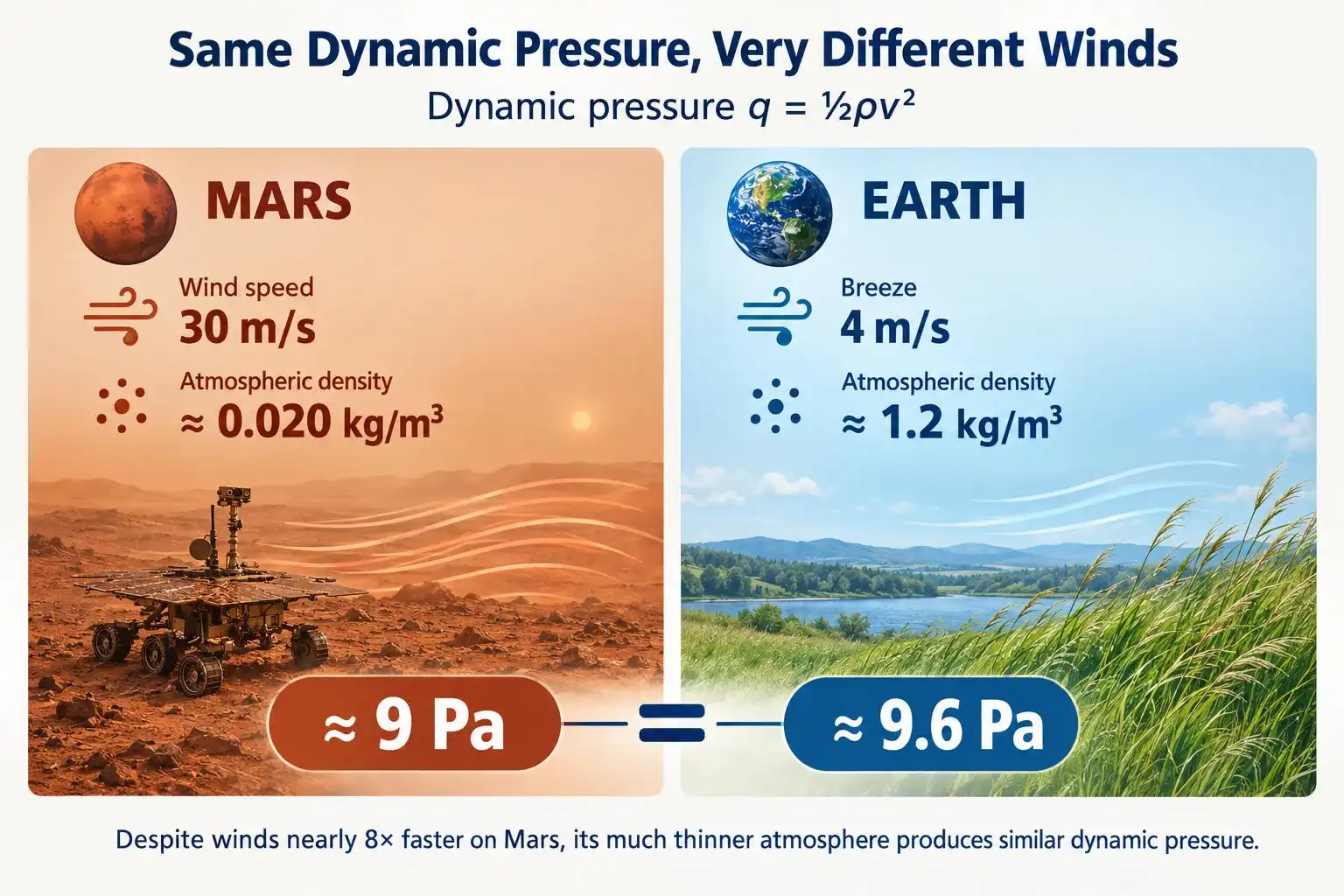
At the Martian surface, atmospheric pressure averages roughly 0.6 percent of Earth’s sea-level pressure. Mars’s carbon-dioxide-rich air is correspondingly thin, though its density varies with location and season. Wind speed alone therefore tells you surprisingly little about what that wind can move.
The useful quantity here is dynamic pressure: approximately half the air’s density multiplied by the square of its speed. For a rough comparison, take Martian air at 0.02 kilograms per cubic meter. A 30-meter-per-second wind—about 108 kilometers per hour—produces a dynamic pressure of around 9 pascals. On Earth, a breeze of about 4 meters per second produces a similar value.
That does not mean you should ignore a Martian forecast. A particularly large, lightweight structure could still be vulnerable, and engineers must account for the loads a vehicle might face. But the movie’s towering departure vehicle is threatened by wind as though it were standing in Earth’s much denser air. Mars cannot supply the same shove at the same wind speed.
Thin air can still make a planet disappear
If Martian winds are relatively weak, how do they raise so much dust? The answer is that moving dust and pushing a spacecraft are different problems. Mars has abundant fine material at its surface. Winds can set grains in motion, and bouncing grains can disturb more particles. Once fine dust enters the atmosphere, it can remain suspended and travel far from where it started.
Dust also changes the weather that carries it. Airborne particles absorb sunlight and warm the atmosphere, affecting circulation and potentially helping storms grow. A local disturbance can become regional; in some years, dust spreads around nearly the entire planet. From orbit, familiar surface features can fade beneath a hazy veil.
So The Martian is right to treat a dust-filled sky as serious. Its mistake is giving that sky the mechanical force of an Earth storm. The dangerous question for many Mars missions is not “Will the wind topple us?” but “How much sunlight can get through?”
The storm that silenced Opportunity
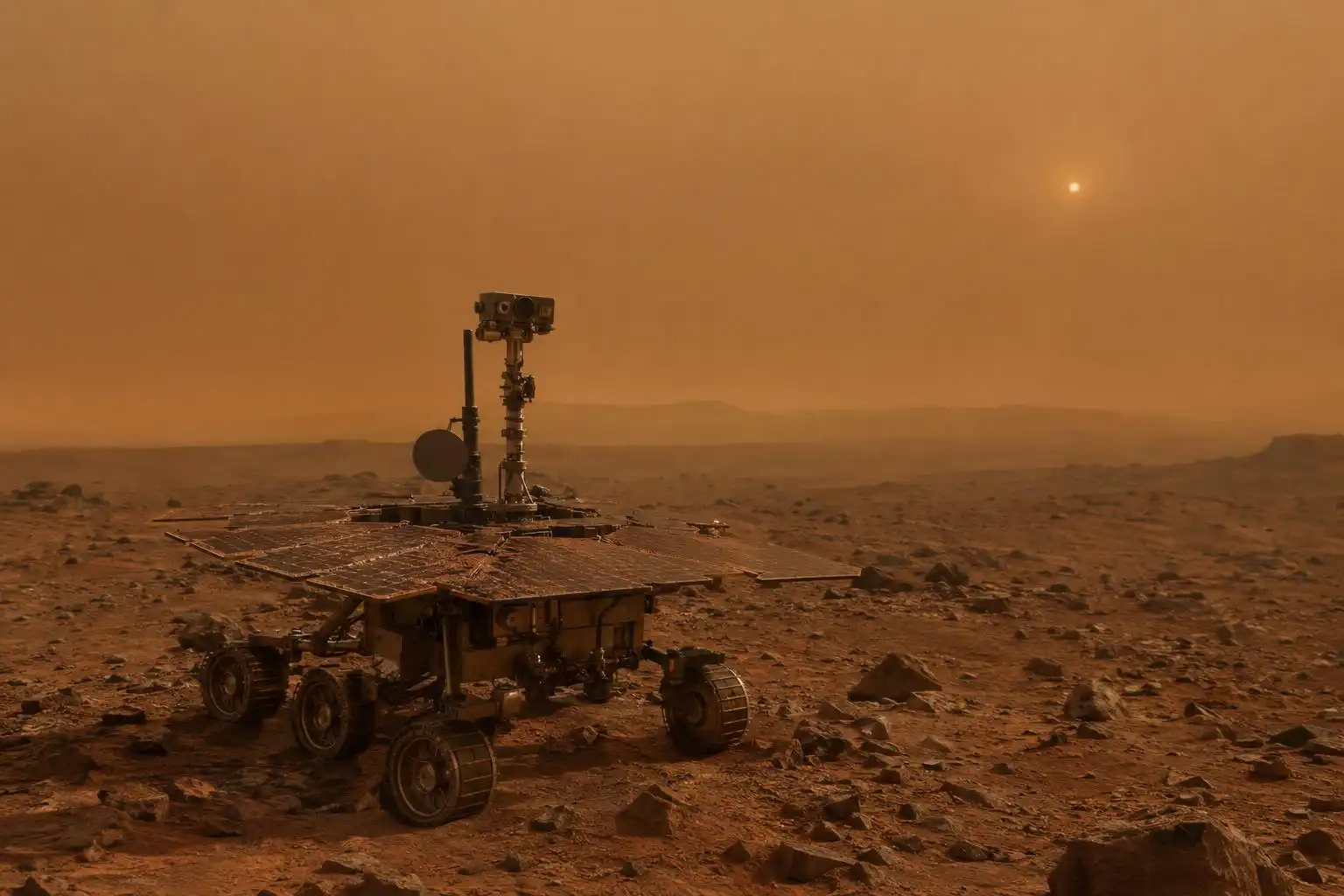
NASA’s Opportunity rover offers the clearest real-world contrast to Watney’s fictional crisis. In 2018, a planet-encircling dust storm sharply reduced the sunlight reaching its solar panels. Opportunity sent its last signal on June 10. NASA spent months trying to restore contact before declaring the mission over in February 2019.
We cannot say from the final silence exactly what failed. The point is narrower and more important: dust in the atmosphere can deprive a solar-powered machine of the energy it needs to operate and stay warm. Nothing has to be blown apart. Darkness can be enough.
Dust settling on equipment presents a second problem after the sky clears. NASA’s InSight lander, also powered by solar arrays, accumulated enough dust on them to contribute to its declining energy supply. Its mission ended in 2022. InSight did not need The Martian’s violent opening scene to face a formidable Martian dust problem.
What the movie should make us worry about
Imagine a different opening for The Martian. The crew stays put through the wind, but sunlight dims for days. Solar power falls. Fine dust works its way into places designers hoped to keep clean. The emergency becomes a contest between the duration of the storm and the reserves built into the mission.
That version might be a slower movie, but it captures a central engineering challenge. Solar panels, batteries, seals and operating plans all have to cope with an environment that can be dusty for far longer than a dramatic gust lasts. A crewed mission would have more options than an isolated rover, but it would also have people relying on those systems.
Mars does not need Earth-style hurricane force to be hostile. It can leave a spacecraft standing perfectly upright, then take away the sunlight that keeps it alive. That is the dust-storm detail from The Martian worth telling someone about.



Leave a Reply
You must be logged in to post a comment.