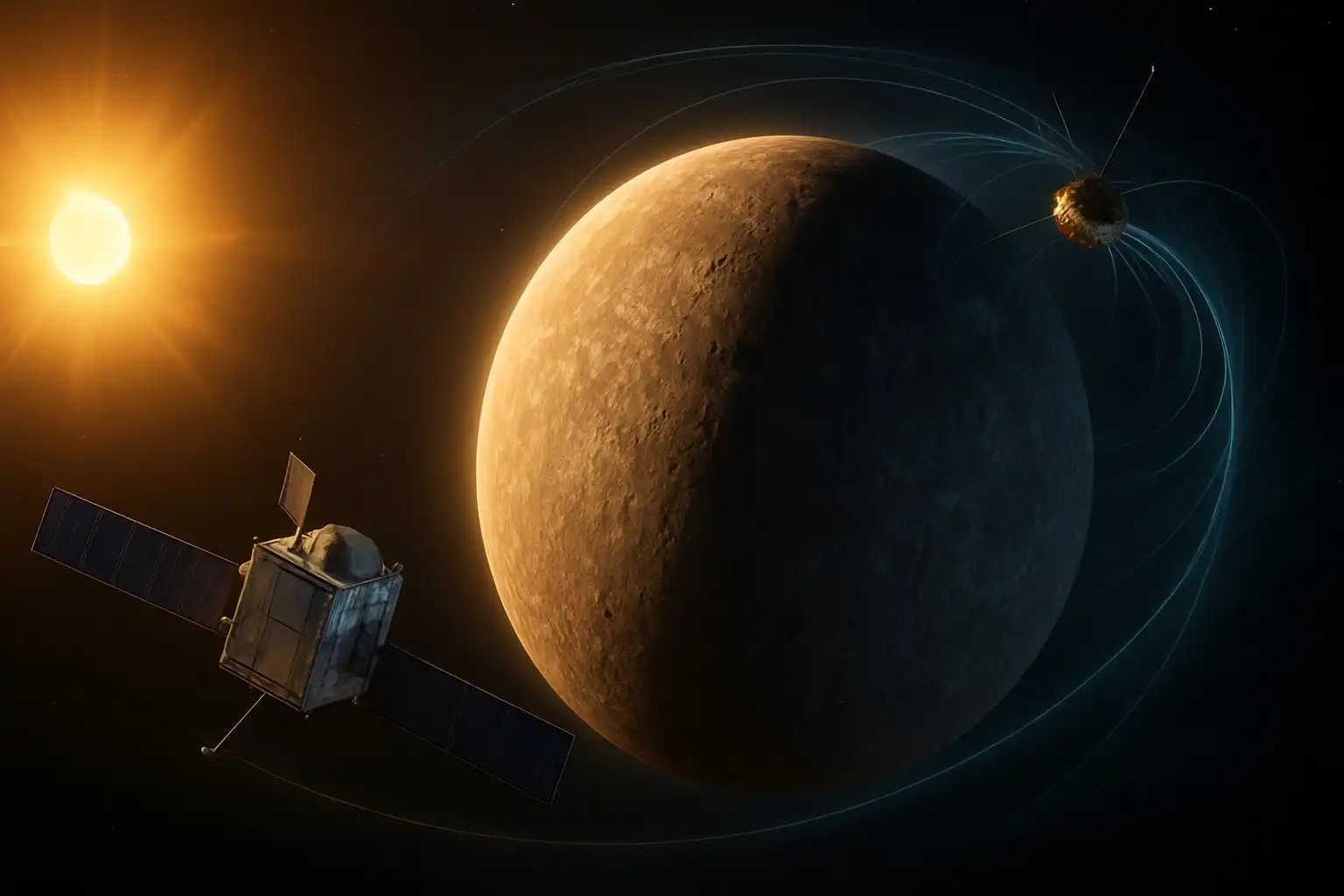

In late 2026, after an eight-year cruise through the inner solar system, the BepiColombo mission will finally brake into orbit around Mercury—and begin deploying two separate spacecraft. One will settle into a low, fast orbit to map the surface. The other will swing high above the planet’s poles to measure the invisible architecture of Mercury’s magnetic field and watch how the solar wind tears at the smallest, innermost, and least-understood terrestrial world[1].
BepiColombo is a joint mission of the European Space Agency (ESA) and the Japan Aerospace Exploration Agency (JAXA), and its dual-orbiter design reflects a fundamental truth about Mercury: you cannot understand this planet from one vantage point. The European Mercury Planetary Orbiter (MPO) will circle as low as 480 kilometers above the surface, while JAXA’s Mercury Magnetospheric Orbiter (MMO, also called Mio) will trace a highly elliptical path that takes it from 590 kilometers at closest approach out to 11,640 kilometers at apoapsis. Together they will attack a question that has puzzled planetary scientists since Mariner 10’s first flyby in 1974: how does a planet barely larger than our Moon sustain a global magnetic field, and why is that field lopsided?
The Mariner 10 surprise
When Mariner 10 swept past Mercury in March 1974, its magnetometer detected something no one expected—a planetary magnetic field strong enough to carve out a magnetosphere in the solar wind. At the time, dynamo theory suggested that only large, rapidly rotating planets with molten metallic cores could generate such fields. Mercury rotates once every 58.6 Earth days, creeps around the Sun in just 88 days, and has a diameter of only 4,880 kilometers. By rights it should have been magnetically dead, like the Moon or Mars.
But the field was there: weak—about one percent the strength of Earth’s—but unmistakable. Mariner 10 made two more flybys in September 1974 and March 1975, confirming the discovery but leaving the mechanism unexplained. For three decades, Mercury’s dynamo remained a theoretical puzzle, debated in conference rooms but inaccessible to new instruments.
NASA’s MESSENGER mission, which orbited Mercury from 2011 to 2015, finally returned high-resolution magnetic field data and revealed an even stranger detail: the field is offset northward by about 20 percent of the planet’s radius. Imagine Earth’s magnetic poles shifted a fifth of the way toward the Arctic. MESSENGER’s magnetometer, a triaxial fluxgate sensor mounted on a 3.6-meter boom to isolate it from the spacecraft’s own electronics, mapped this asymmetry in exquisite detail. The offset means that Mercury’s southern hemisphere is more exposed to the solar wind, which compresses the magnetosphere on the dayside to an altitude of just 1,000 kilometers—closer than any other planet.
MESSENGER also measured the field’s strength at the surface, finding values between 200 and 400 nanoteslas at the equator, and discovered that the field is almost perfectly aligned with Mercury’s rotation axis, unlike Earth’s 11-degree tilt. But MESSENGER’s single-spacecraft, highly elliptical orbit limited its ability to provide simultaneous, two-point coverage across Mercury’s magnetosphere and to separate spatial structure from time-varying solar-wind effects. That is where BepiColombo’s MMO comes in.
Two orbiters, two measurement regimes
MMO carries five instruments dedicated to Mercury’s space environment, including a fluxgate magnetometer (MGF), the Mercury Plasma Particle Experiment (MPPE), the Plasma Wave Investigation (PWI), the Mercury Sodium Atmosphere Spectral Imager (MSASI), and the Mercury Dust Monitor (MDM). MPPE includes sensors such as an ion mass spectrometer, electron analyzers, and energetic-particle detectors. The spacecraft itself is a spinning cylinder—one rotation every four seconds—which allows the magnetometer to sweep through a full circle of orientations and separate the ambient field from any spacecraft-generated interference. MGF will measure the field with a resolution of 0.1 nanoteslas, more than enough to detect the fine structure of current sheets and magnetic reconnection events where the solar wind couples into Mercury’s magnetosphere.
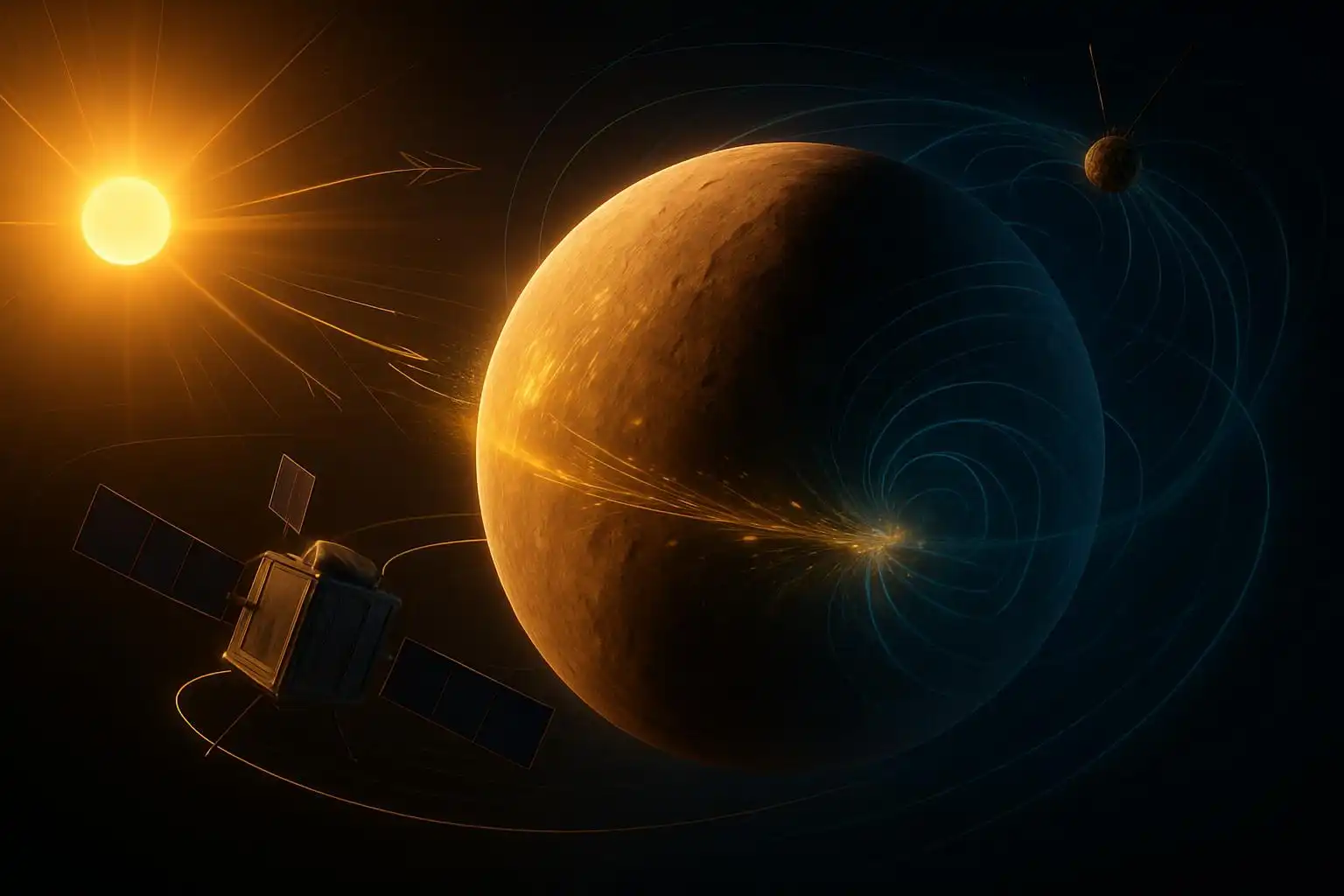
MMO’s orbit was chosen to sample the entire magnetosphere, from the dayside magnetopause—where the solar wind rams into Mercury’s field—out to the nightside magnetotail, where the field lines stretch away from the Sun like a comet’s tail. The solar wind at Mercury’s orbit travels at 400 kilometers per second and carries a magnetic field of its own, the interplanetary magnetic field (IMF), which can reinforce or oppose Mercury’s field depending on its orientation. When the IMF points southward, reconnection at the dayside magnetopause allows solar wind plasma to penetrate deep into the magnetosphere, sometimes reaching the surface. MMO will measure how often this happens, how much energy is deposited, and whether the offset field makes the southern hemisphere more vulnerable.
Meanwhile, the European MPO will work the surface. Its suite includes the BepiColombo Laser Altimeter (BELA), which will fire 10-nanosecond infrared pulses at the surface up to 10 times per second and measure the round-trip time to build a topographic map with vertical precision of one meter. BELA’s data will tie directly into the magnetic field measurements: if Mercury’s dynamo is powered by convection in a liquid outer core surrounding a solid inner core—the leading model—then the planet’s internal structure, revealed by gravity and topography, will constrain the size and composition of that core.
MPO also carries the Mercury Radiometer and Thermal Infrared Spectrometer (MERTIS), an infrared spectrometer that will map surface mineralogy by measuring thermal emission in the 7-to-14-micrometer range, and the Spectrometers and Imagers for MPO BepiColombo Integrated Observatory System (SIMBIO-SYS), a three-channel imaging suite that includes a high-resolution camera capable of 5-meter-per-pixel images. SIMBIO-SYS will photograph the magnetic “weak spots” near the poles where solar wind particles funnel down field lines and sputter atoms off the surface, feeding Mercury’s tenuous exosphere.
The offset mystery and the dynamo inside
Why is Mercury’s field offset? The most compelling explanation involves the planet’s thermal history. Mercury’s core is enormous—it makes up 85 percent of the planet’s radius, compared to 55 percent for Earth. Models suggest that the outer core is still molten iron alloyed with a lighter element, probably sulfur or silicon, while the inner core has solidified. As the inner core grows, it releases latent heat and expels the light element upward, driving convection in the outer core. But if the mantle above the core is not uniform—if it is thicker or cooler on one side—then heat escapes more efficiently from one hemisphere, and convection becomes asymmetric. The dynamo, which depends on the flow of conducting fluid, follows the convection, and the magnetic field becomes lopsided.
MESSENGER found evidence for this asymmetry in the planet’s gravity field and in the distribution of volcanic plains, which are concentrated in the northern hemisphere. BepiColombo’s MPO will measure the gravity field with an accuracy ten times better than MESSENGER by tracking tiny Doppler shifts in its radio signal as it orbits. Those shifts, measured to a fraction of a millimeter per second, reveal how mass is distributed inside the planet. Combined with BELA’s topography and MERTIS’s surface composition maps, the gravity data will tell us whether the mantle is indeed thicker in the south, and whether that asymmetry extends down to the core-mantle boundary 400 kilometers below the surface.
MMO’s magnetometer will test a different prediction: if the field is generated by asymmetric convection, then it should vary on timescales of decades to centuries as the convection pattern shifts. MESSENGER’s four-year mission was too short to detect such changes, but BepiColombo’s planned one-year nominal mission (with possible extensions) will overlap with future Mercury observations and provide a baseline for long-term monitoring. MMO will also measure how the field responds to the solar wind on much shorter timescales—minutes to hours—by watching magnetic storms triggered by changes in the IMF orientation.
The solar wind laboratory
Mercury is a natural laboratory for studying how magnetic fields protect—or fail to protect—planetary surfaces. The solar wind at 0.3 astronomical units is eleven times more intense than at Earth, and Mercury’s weak field cannot fully shield the surface. Solar wind protons and heavier ions, especially during coronal mass ejections, strike the surface directly in the southern hemisphere and sputter sodium, potassium, calcium, and magnesium atoms into the exosphere. MESSENGER’s Ultraviolet and Visible Spectrometer (UVVS) detected these atoms as a glowing tail stretching millions of kilometers downwind, and found that the exosphere’s density varies by a factor of ten depending on Mercury’s position in its elliptical orbit and the state of the solar wind.
MMO’s MSASI instrument will photograph the exosphere in the sodium D-line at 589 nanometers, the same wavelength that gives street lamps their orange glow. By correlating exosphere brightness with solar wind conditions measured by the magnetometer and plasma instruments, the mission will quantify how much material Mercury loses to space and whether the offset field creates a hemispheric asymmetry in sputtering rates.
This matters beyond Mercury. Thousands of known exoplanets orbit closer to their stars than Mercury does to the Sun, and many are thought to have lost their atmospheres to stellar wind erosion. By studying how the solar wind interacts with Mercury’s surface and magnetosphere, BepiColombo will provide a template for understanding how magnetic fields—or their absence—shape the evolution of close-in rocky worlds[1].
Arrival and the road ahead
BepiColombo launched in October 2018 and has since completed flybys of Earth, Venus twice, and Mercury six times, using gravity assists to shed orbital energy. The final Mercury flyby, in January 2025, set up the orbit insertion in late 2026, when the spacecraft’s propulsion system will slow the stack enough for Mercury’s gravity to capture it. The two orbiters, which have traveled together for eight years as a single composite spacecraft, will separate during the commissioning and orbit-lowering sequence after arrival: Mio/MMO will be released into its science orbit before MPO is maneuvered down to its own low-altitude science orbit.
The mission’s nominal science phase will last one Earth year, equivalent to just over four Mercury years. During that time, MPO will complete thousands of orbits and BELA will fire more than 100 million laser pulses. MMO will trace its elliptical path hundreds of times, sampling the magnetosphere in all local times and under a wide range of solar wind conditions. If the spacecraft remain healthy—and both were designed to withstand dayside surface temperatures exceeding 430°C and the intense radiation environment—the mission could be extended for another year.
Why it matters
Mercury is the last of the classical terrestrial planets to receive a dedicated orbiter mission, and it remains the least understood. We know the bulk composition from MESSENGER’s X-Ray Spectrometer (XRS) and Gamma-Ray Spectrometer (GRS), which measured surface abundances of magnesium, aluminum, silicon, sulfur, calcium, titanium, and iron by detecting the characteristic X-rays and gamma rays emitted when cosmic rays and solar particles strike the surface. We know the planet has a liquid outer core from MESSENGER’s measurements of the amplitude of Mercury’s libration—a slight rocking motion caused by the Sun’s tidal pull on the planet’s eccentric orbit. We even know that water ice, shielded from the Sun in permanently shadowed craters at the poles, has persisted for millions of years.
But we do not yet know how Mercury’s dynamo works, why the field is offset, how fast the planet is losing mass to space, or how its surface has evolved over the past four billion years. BepiColombo, with its two orbiters and its seventeen instruments, will answer those questions not with a single measurement but with a coordinated campaign that ties magnetic field structure to internal dynamics, surface composition to exosphere sources, and thermal history to present-day activity.
When MMO’s magnetometer begins its first full sweep of Mercury’s magnetosphere after arrival, it will be measuring a magnetic field generated by a dynamo smaller than any other in the solar system—and trying to understand how a planet that should be dead is still, against all expectations, alive.


Leave a Reply