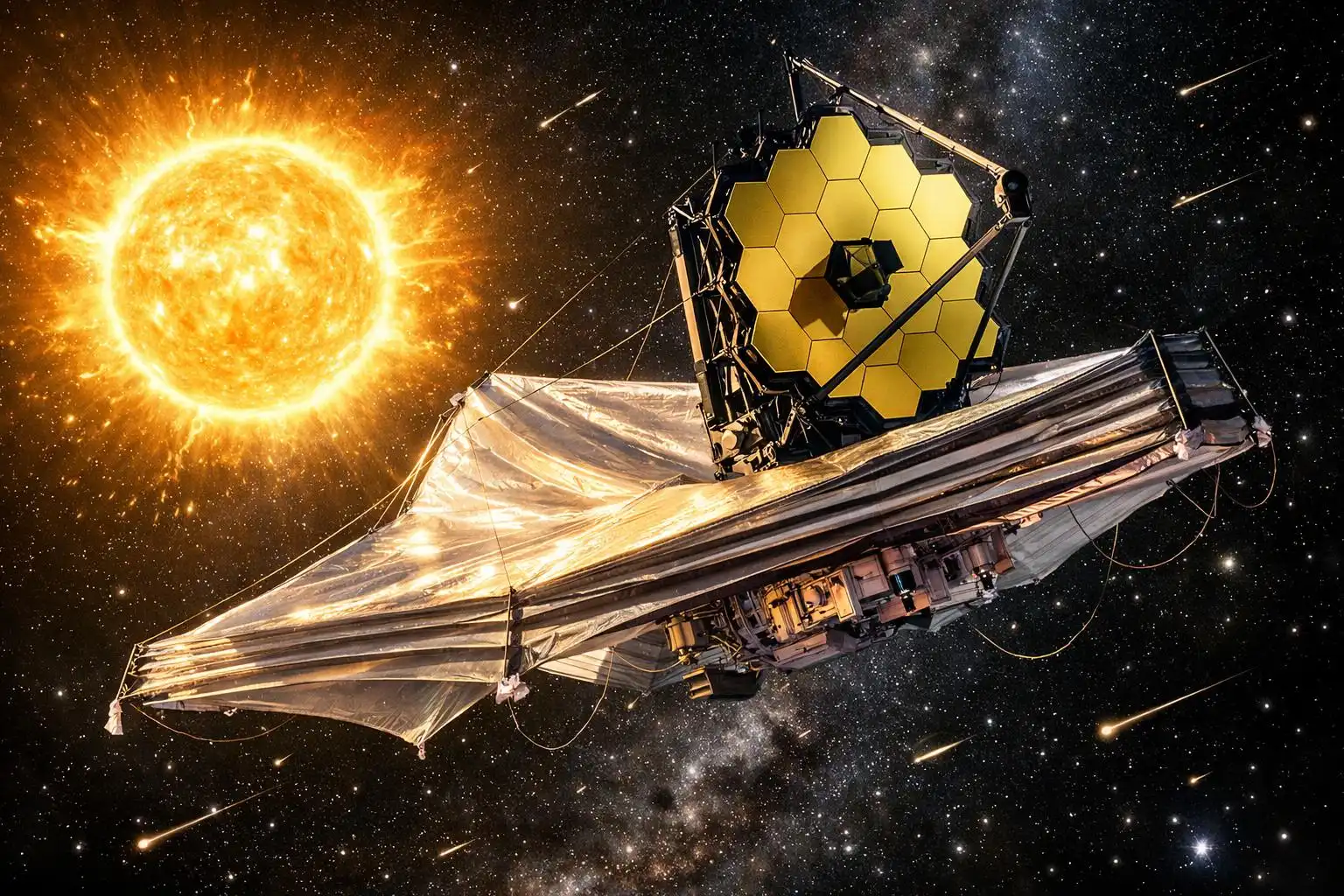

When the James Webb Space Telescope unfolded en route to L2 in early January 2022, the world watched a tennis-court-sized sunshield bloom in the vacuum like some origami miracle. What they didn’t see was the decade of engineering arguments, the materials science gambles, and the cold realization that we were betting $10 billion on five sheets of Kapton surviving a journey no one could fully rehearse.
I want you to understand what that sunshield actually does, and why it scared us.
The Thermal Problem
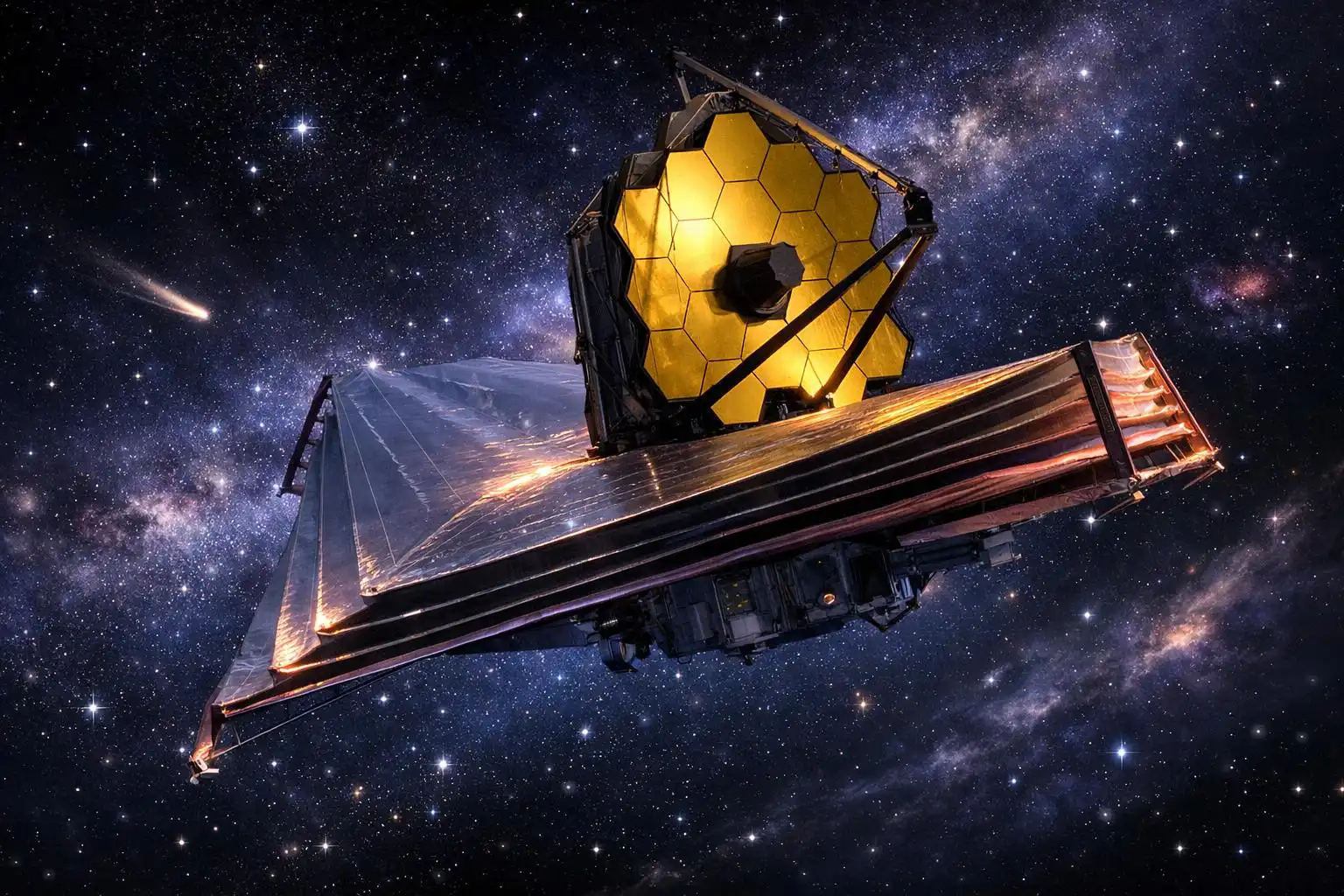
Webb observes in the infrared—0.6 to 28.5 microns, spanning near-IR through mid-IR. Its 6.5-meter segmented primary mirror, coated in gold for IR reflectivity, needs to operate at approximately 50 Kelvin (-223°C). The Mid-Infrared Instrument (MIRI) goes colder still: 7 K, maintained by a dedicated cryocooler. At these temperatures, thermal photons from the telescope itself don’t swamp the faint infrared whispers from distant galaxies.
But Webb orbits the Sun at L2, roughly 1.5 million kilometers from Earth. The Sun pours 1,368 watts per square meter onto anything facing it. Without protection, Webb’s mirror would cook to several hundred Kelvin—useless for infrared work. You can’t refrigerate a 6.5-meter mirror in space. The only option is passive cooling: block the heat before it arrives.
That’s the sunshield’s job. Five layers of membrane, each thinner than a human hair, stacked with gaps in between. The Sun-facing layer hits about 383 K (110°C). The coldest layer, facing the mirror, reaches around 36 K. Temperature drop: 347 degrees across 40 centimeters of mostly vacuum.
Why Five Layers?
Each layer reflects some solar radiation and radiates absorbed heat into space. The vacuum gaps between layers prevent conduction; heat transfer happens only via radiation, which scales with the fourth power of temperature (Stefan-Boltzmann). Stack enough layers with enough spacing, and you build a thermal gradient steep enough to keep the telescope cold.
Early designs considered three layers. Thermal models said insufficient. Six layers added mass and complexity. Five was the Goldilocks answer—barely sufficient, maximally risky. Each layer is Kapton E film, aluminized on both sides for reflectivity. The two Sun-facing layers also carry a doped-silicon coating to radiate heat efficiently in the infrared.
Layer dimensions: roughly 21.2 by 14.2 meters when deployed. Total area: about 300 square meters. Mass: approximately 40 kilograms for all five layers combined—astonishingly light for something so critical. The membranes are 25 to 50 microns thick, depending on the layer.
The Deployment Nightmare
The sunshield couldn’t deploy on Earth. No way to test it under flight conditions—zero gravity, vacuum, thermal extremes. We rehearsed it in cleanrooms, under gravity offload, in pieces. But the full stack, unfolding in space, pulling taut on 90 tensioning cables across 107 sunshield release mechanisms? That was a trust fall into the void.
The deployment sequence began on December 28, 2021, three days after launch. First, the forward and aft pallets extended like drawbridges, pulling the folded membranes outward. Then the mid-booms—telescoping composite structures—pushed the layers sideways to full width. Finally, the tensioning system pulled each layer taut, starting with the large Sun-facing layer and working downward.
It took eight days. Every step was irreversible. If a cable snagged, if a membrane tore, if a motor jammed—mission over. No servicing at L2. No second chances.
The mid-boom deployment stands out in my memory. Each boom consisted of five telescoping segments, deploying like a carpenter’s rule. They had to extend symmetrically, smoothly, without jerking the fragile membranes. The team added a “low tension” mode after ground tests showed the membranes could snag on deployment hardware. They slowed the process, added pauses, monitored temperatures. It worked. Barely felt like luck; mostly felt like competence rewarded.
What Keeps Me Up: Micrometeoroids
On May 23, 2022, a micrometeoroid struck primary mirror segment C3. The impact was larger than pre-launch modeling predicted—not catastrophic, but enough to degrade the segment’s optical performance measurably. Engineers adjusted the segment’s position to partially compensate. Webb continues to exceed its performance requirements, but the strike was a reminder that pre-launch models did not perfectly capture every impact event: space is full of things moving at 10 kilometers per second.
The sunshield is a much bigger target than the mirror—300 square meters versus 25. And it’s far more fragile. A Kapton membrane can’t be realigned like a mirror segment. Puncture a layer, and you lose some of its thermal protection. Puncture several, and the thermal gradient collapses.
Pre-launch models estimated a small probability of mission-ending damage over Webb’s nominal 5-year mission (now extended to 10+ years thanks to fuel efficiency). The sunshield has likely been hit. We don’t have sensors on every square centimeter, so we infer its health from thermal telemetry. So far, temperatures remain stable. The mirror sits at 50 K. MIRI at 7 K. The sunshield is doing its job.
But I think about it. Five layers. No redundancy you can activate. Just membrane and vacuum and the hope that Kapton’s toughness—tested in the lab, modeled in simulation—holds up in the real flux of deep space.
The Data Rates and Operations Reality
Webb downlinks science data at 28 megabits per second via Ka-band to the Deep Space Network. It observes continuously; the sunshield always faces the Sun, the mirror always faces cold space. Fine pointing stability: better than 7 milliarcseconds over 24 hours. That stability depends on the sunshield holding its shape, not flexing or rippling as Webb slews.
Each observation is planned months in advance. The scheduling software accounts for the sunshield’s orientation constraint: Webb must keep the Sun between roughly 85 and 135 degrees from its pointing direction, so the sunshield can protect the mirror. That limits the “field of regard” at any given time—about 39% of the sky is observable at any moment, but the full sky becomes accessible over six months as Earth orbits.
The mission cost: approximately $10 billion, including development, launch (Ariane 5), and five years of operations. It’s the most expensive science mission NASA has ever flown. Every photon Webb collects has to justify that price.
Why It Matters
Hubble sees in visible and near-UV, wavelengths where the universe is bright and nearby. Webb sees in the infrared, where the most distant galaxies—redshifted by cosmic expansion—finally become visible. The first stars, the first galaxies, the assembly of structure in the early universe: all of it glows in the infrared by the time the light reaches us.
But infrared astronomy demands cold detectors and cold optics. Ground-based IR telescopes fight atmospheric water vapor and thermal emission from the telescope itself. Space telescopes escape the atmosphere but face the Sun’s glare. The sunshield is what makes Webb possible. Without it, the telescope is just an expensive, gold-plated mirror baking in sunlight.
The Quiet Satisfaction
Two and a half years into operations, Webb has imaged galaxies at redshift z > 13, less than 300 million years after the Big Bang. It’s characterized exoplanet atmospheres, revealing water vapor, carbon dioxide, sulfur compounds. It’s dissected star-forming regions in the Milky Way, showing protostars embedded in their natal clouds. Every image, every spectrum, depends on the sunshield keeping the mirror cold.
The engineering team doesn’t get a lot of headlines now. The sunshield deployed, the telescope focused, the science started. But I think about those eight days in early January 2022, watching telemetry as cables pulled and booms extended and membranes unfurled. I think about the material scientists who tested Kapton samples to failure, the thermal engineers who ran Monte Carlo simulations of micrometeoroid impacts, the mission planners who choreographed 300 single-point failures into a ballet that somehow worked.
Webb is working. The sunshield is holding. Fifty Kelvin, steady as a metronome, while the Sun blazes three hundred degrees hotter just 40 centimeters away.
That’s what it takes to build eyes that work in space. Not just ambition or budget, but five layers of Kapton and the people who trusted them enough to fly.


Leave a Reply