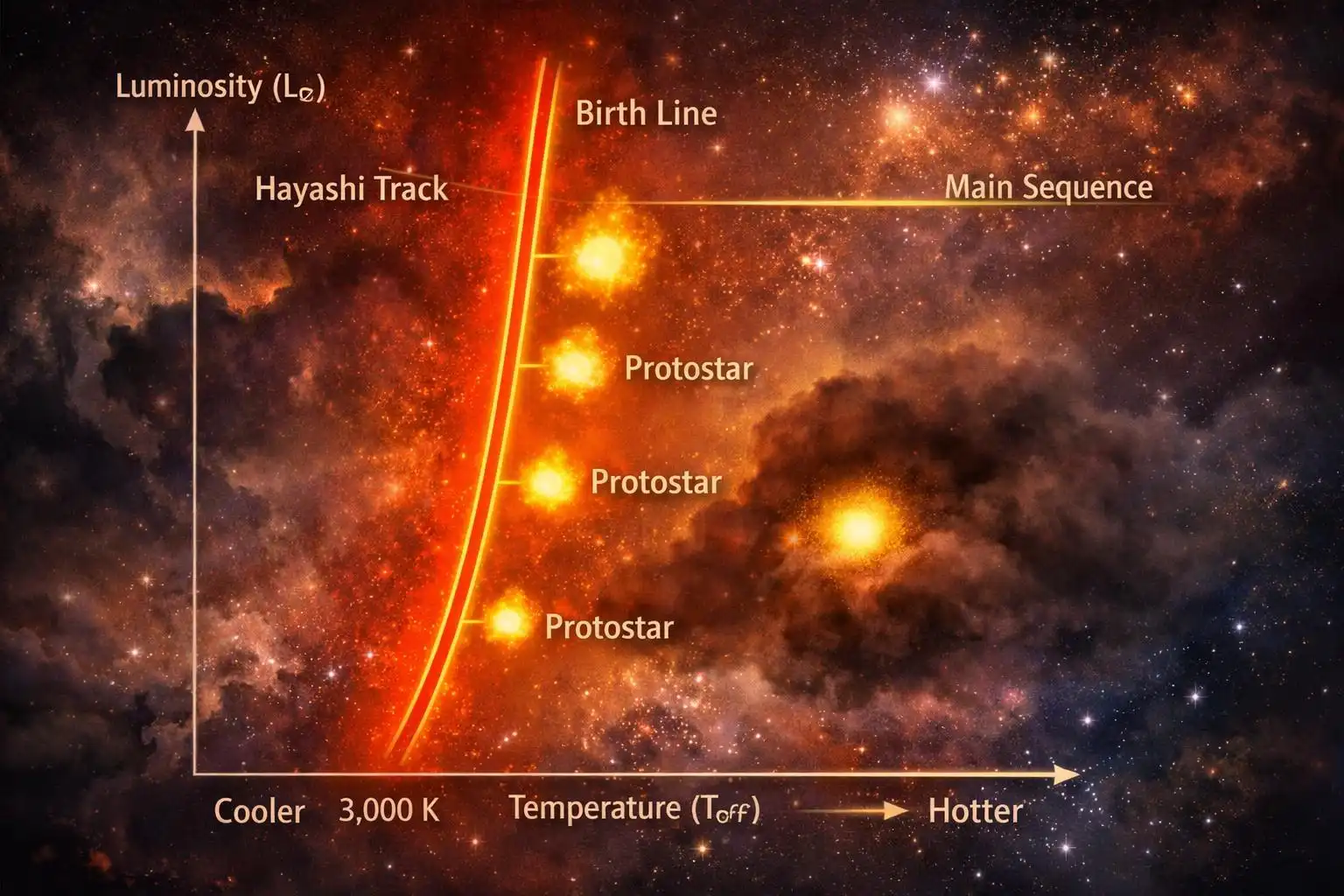

When does a collapsing cloud of gas become a star? The question sounds philosophical, but it has a sharp, quantitative answer rooted in the physics of opacity, convection, and hydrostatic equilibrium. The boundary is the Hayashi limit, traced by Hayashi tracks—the nearly vertical cool edge on the Hertzsprung-Russell diagram that marks the coolest effective temperature a fully convective object in hydrostatic equilibrium can sustain at a given luminosity. Approach this limit during early contraction, and you are following a protostar or pre-main-sequence star as it emerges from its dusty cocoon; descend the track from above, and you trace the early contraction of a pre-main-sequence star toward hydrogen ignition. This article focuses on one precise puzzle: why the Hayashi track exists at all, and what the “birth line” tells us about when protostars first become optically visible.
The Opacity Barrier and the Hayashi Forbidden Zone
The Hayashi track is a consequence of convective energy transport in cool, dense stellar envelopes. When a star’s photosphere cools below roughly 4,000 K (the exact value depends on metallicity and surface gravity), hydrogen begins to recombine and H⁻ ions form. These ions are extraordinarily efficient at absorbing radiation, driving the opacity κ sharply upward. Radiative transport becomes inefficient—the radiative temperature gradient ∇_rad exceeds the adiabatic gradient ∇_ad—and convection takes over.
A fully convective star in hydrostatic equilibrium obeys a tight relationship between luminosity L, radius R, and effective temperature T_eff. The structure is set by the adiabatic gradient and the equation of state; there is only a narrow allowed range of T_eff for each L. Try to make the star cooler at fixed luminosity, and the opacity rises so steeply that the photosphere cannot maintain the assumed equilibrium solution—the star readjusts toward hotter effective temperatures. The result is a nearly vertical boundary on the HR diagram, the Hayashi limit, to the right of which no stable, fully convective stars can exist.
For a solar-mass protostar, the Hayashi track runs near T_eff ≈ 3,800 K. More massive objects have slightly hotter tracks (T_eff ∼ 4,500 K for 3 M☉); lower-mass ones cooler (T_eff ∼ 3,000 K for 0.3 M☉). The Hayashi limit is a boundary condition for pre-main-sequence evolution, while the Hayashi track is the evolutionary path followed by many fully convective pre-main-sequence stars as they contract and heat their cores.
Protostellar Accretion and the Birth Line
Before a protostar reaches the visible pre-main-sequence phase, it is deeply embedded in its natal envelope, accreting material from an infalling disk and envelope. The birth line is a model-dependent locus on the HR diagram where protostars are expected to first become optically visible, as accretion slows and the envelope disperses enough for photospheric light to escape. It is not a universal curve that is simply to the right of, and parallel to, the Hayashi track; its position and shape depend on mass, accretion history, and the criterion used for visibility.
The birth line’s position depends on the accretion rate Ṁ. During the main accretion phase (Class 0 and early Class I), Ṁ ∼ 10⁻⁵ M☉ yr⁻¹ for solar-mass protostars. Accretion luminosity L_acc = GMṀ/R often dominates over the protostar’s intrinsic Kelvin-Helmholtz luminosity L_KH. The infalling material shocks at or near the stellar surface, releasing energy and affecting the protostar’s radius, luminosity, and entropy in ways that depend on the accretion geometry. During the most embedded stages, the object is hidden by dust extinction A_V ∼ 10–100 mag and may not be represented by a simple photospheric point on an optical HR diagram.
As the envelope depletes and Ṁ drops below ∼ 10⁻⁶ M☉ yr⁻¹, L_acc fades, the radius contracts, and T_eff evolves toward the visible pre-main-sequence locus. The protostar crosses the birth line when A_V falls to a few magnitudes and the photosphere becomes visible in optical and near-infrared bands. For a 1 M☉ star, this can occur at L ∼ 1–3 L☉, T_eff ∼ 3,500–4,000 K—near the Hayashi track. The object is then observed as a young T Tauri star, still often accreting from a disk but no longer completely enshrouded.
Observational Signatures: The Orion Nebula Cluster
The Orion Nebula Cluster (ONC) provides important empirical constraints on young pre-main-sequence populations, including the upper envelope of optically and near-infrared visible low-mass stars. Near-infrared surveys (2MASS, VISTA) and optical/infrared spectroscopy have placed thousands of pre-main-sequence stars on the HR diagram, corrected for extinction using multi-band photometry and spectroscopy. The distribution is broadly consistent with Hayashi-track predictions for cool, low-mass stars, but it does not provide a perfectly sharp, selection-free map of a single birth line.
The observed HR diagram shows relatively few low-mass stars at very high luminosities and T_eff < 4,000 K, consistent with the idea that embedded protostars become visible only after accretion has dropped and envelopes have partly cleared. Interpreting that upper envelope, however, requires accounting for extinction, variability, unresolved binaries, accretion luminosity, and sample-selection effects. Higher-mass protostars (M > 2 M☉) can emerge at higher L because their Kelvin-Helmholtz contraction is faster and their accretion luminosities were higher to begin with.
The ONC data also reveal a spread around the Hayashi track among the youngest stars. This spread reflects a mixture of physical and observational effects—variations in Ṁ, disk mass, envelope clearing timescales, ages, extinction corrections, variability, and unresolved multiplicity. Stars that accreted rapidly and cleared their envelopes early may arrive on the Hayashi track at higher L; slower accretors may arrive lower. Once on the track, they contract downward at a rate set by Kelvin-Helmholtz timescale τ_KH ≈ GM²/(RL), which for 1 M☉ and R ∼ 3 R☉ is ∼ 10⁷ yr.
Why the Hayashi Track Matters for Stellar Evolution
The Hayashi track is not just a curiosity of early evolution—it is a diagnostic of internal structure. Stars on the Hayashi track are largely or fully convective, meaning their interiors are efficiently mixed: lithium and deuterium can be carried into hotter layers where nuclear reactions destroy them once the relevant temperatures are reached. This helps explain why T Tauri stars show lithium depletion patterns that depend on mass and age.
For M < 0.35 M☉, stars remain fully convective throughout their main-sequence lives, but they do not remain on the pre-main-sequence Hayashi track; they contract along it and eventually settle onto the hydrogen-burning main sequence. For M > 0.35 M☉, a radiative core develops as the protostar contracts, central temperature rises, and radiative energy transport becomes efficient in the interior. The star then moves leftward off the Hayashi track onto the radiative Henyey track, where T_eff increases at roughly constant L. Deuterium burning (²H + p → ³He + γ) switches on at T_c ∼ 10⁶ K and can provide a temporary brake on contraction, but it is not the cause of the Hayashi-to-Henyey transition.
The deuterium-burning phase lasts of order 10⁵–10⁶ yr and can slow, rather than completely halt, the descent along the Hayashi track. The star’s position on the HR diagram during this phase depends sensitively on initial deuterium abundance [D/H] ∼ 2 × 10⁻⁵ and on accretion history. Observations of pre-main-sequence stars in young clusters like NGC 2264 and λ Orionis are broadly consistent with evolutionary tracks that include deuterium burning, but they are not a unique, direct observational confirmation of that process through a single HR-diagram clump.
Open Questions: The Birth Line at High and Low Mass
The birth line is well-defined for 0.5 M☉ < M < 2 M☉, but its behavior at the extremes remains uncertain. For very low-mass stars and brown dwarfs (M < 0.1 M☉), accretion rates are lower (Ṁ ∼ 10⁻⁷ M☉ yr⁻¹) and Kelvin-Helmholtz timescales longer (τ_KH ∼ 10⁸ yr). The birth line should lie at much lower L, but observational samples are incomplete below L ∼ 0.01 L☉. The Taurus star-forming region, with its low stellar density and minimal extinction, offers the best prospects for mapping the substellar birth line with JWST.
For massive protostars (M > 8 M☉), the situation is more complex. Accretion rates can reach Ṁ ∼ 10⁻³ M☉ yr⁻¹, and the accretion luminosity exceeds 10⁴ L☉. Radiation pressure on dust should halt infall, yet massive stars clearly form. The leading model invokes anisotropic accretion through a disk, with radiation escaping along the polar axis. The birth line for massive stars may not be a single locus but a broad region, depending on viewing angle and disk geometry. Observations of massive young stellar objects (MYSOs) with ALMA and VLT/GRAVITY are beginning to resolve these structures at scales of a few AU, but the connection to the HR diagram remains murky.
Physical Intuition: What the Hayashi Track Teaches
The Hayashi track embodies a fundamental principle: stellar structure is not arbitrary. A star’s radius, luminosity, and temperature are linked by the laws of hydrostatic equilibrium, energy transport, and opacity. The Hayashi track is the coolest possible solution for a convective star—a hard boundary set by atomic physics (H⁻ opacity) and thermodynamics (the adiabatic gradient).
When you see a pre-main-sequence star on an HR diagram, its position tells you its interior: to the right of the Hayashi limit, impossible in equilibrium; on the track, fully convective or largely convective and descending; to the left, developing a radiative core. The birth line adds a historical dimension: where the star first emerged from its envelope, with part of its accretion history encoded in its starting point.
The next time you look at an HR diagram of a young cluster, don’t just see a scatter plot. See the Hayashi track as a coastline, the birth line as a harbor entrance, and each star as a ship that launched from that harbor at a different time, now sailing downward toward the main sequence. The physics of opacity and convection drew the coastline; the physics of accretion and envelope clearing set the harbor’s depth. Together, they turn a cloud of gas into a visible, contracting protostar—the first step toward a star.



Leave a Reply